The Same $100M Ceiling, Three Quantum Manufacturing Challenges
Compare three CHIPS research awards through their payment terms and the hardware each project must scale, then identify the measurements that would show progress toward repeatable production.

Compare three CHIPS research awards through their payment terms and the hardware each project must scale, then identify the measurements that would show progress toward repeatable production.
The U.S. Department of Commerce signed quantum research agreements with three companies, each with a funding ceiling of $100 million. Atom Computing will work on controlling large neutral atom arrays, Quantinuum on optics for trapped ions, and Rigetti on readout and cryogenics for superconducting circuits. The manufacturing question is whether the equipment can deliver the specified performance under the same test conditions as systems get larger and more units are built.
This article draws solely on public information available on November 15, 2026. It distinguishes award terms, reported measurements, and the tests I would look for next.
In the earlier article on lunar transport, I kept the contract ceiling in a separate column from the amount ordered. For these quantum awards, I would give a second column to the equipment that needs to work before the next payment.
When does the funding become available?
Commerce announced the final Atom Computing award on November 13. It announced the final Quantinuum and Rigetti awards on September 8. The two public companies' quarterly filings date their research agreements to September 4, four days before that announcement. The distinction matters if you are mapping the dates onto financial statements. Commerce on Atom Computing, Quantinuum 10-Q, Rigetti 10-Q note
| Commerce announcement | Company | Award ceiling | Available to draw on or around the award date | Subsequent conditional amounts |
|---|---|---|---|---|
| November 13, 2026 | Atom Computing | $100 million | Undisclosed in the Commerce release | Undisclosed in the Commerce release |
| September 8, 2026 | Quantinuum | $100 million | $56.0 million | $32.0 million and $12.0 million |
| September 8, 2026 | Rigetti | $100 million | $43.9 million | $29.9 million and $26.2 million |
The amount available to draw is a provision of the agreement. As of September 30, Quantinuum reported drawing none of the funds, and Rigetti reported receiving none. Both disclose milestones for the later payments and the related issuance of shares to Commerce. The tranche amounts give no basis for reconstructing the technical acceptance criteria. Commerce's Atom release publishes the ceiling and scope, leaving the payment schedule unreported in that document. Quantinuum 10-Q, U.S. Government Transaction, Rigetti 10-Q, Department of Commerce CHIPS Act Award
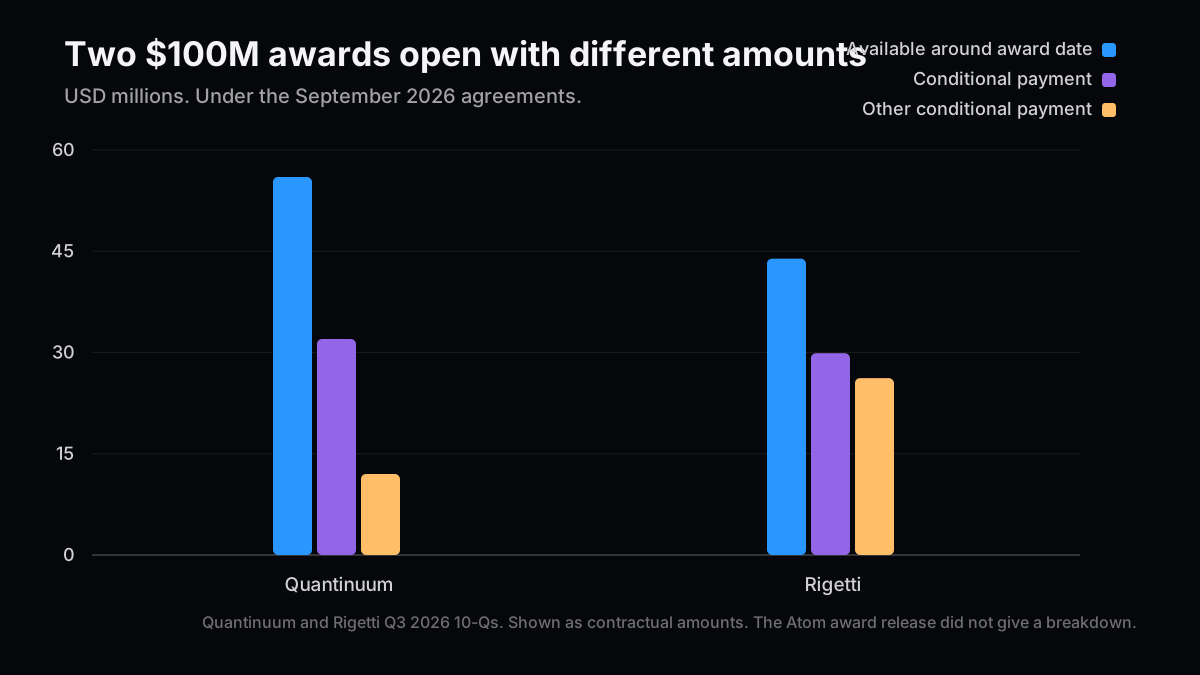
Once the early and conditional amounts have their own columns, it is easier to see when a technical setback might matter to the funding plan. A team could finish a design and still spend longer than expected testing the reliability of a component. I'd update the equipment milestones and the payment milestones separately at the next reporting date.
What becomes harder as the machine gets bigger?
Commerce's summaries point to different manufacturing problems under the same label of quantum computing. My background in automotive EEPROM process development makes me want to keep the process conditions beside every device measurement. What starts to drift when you increase the number of parts or sites?
Neutral atoms need control across the array
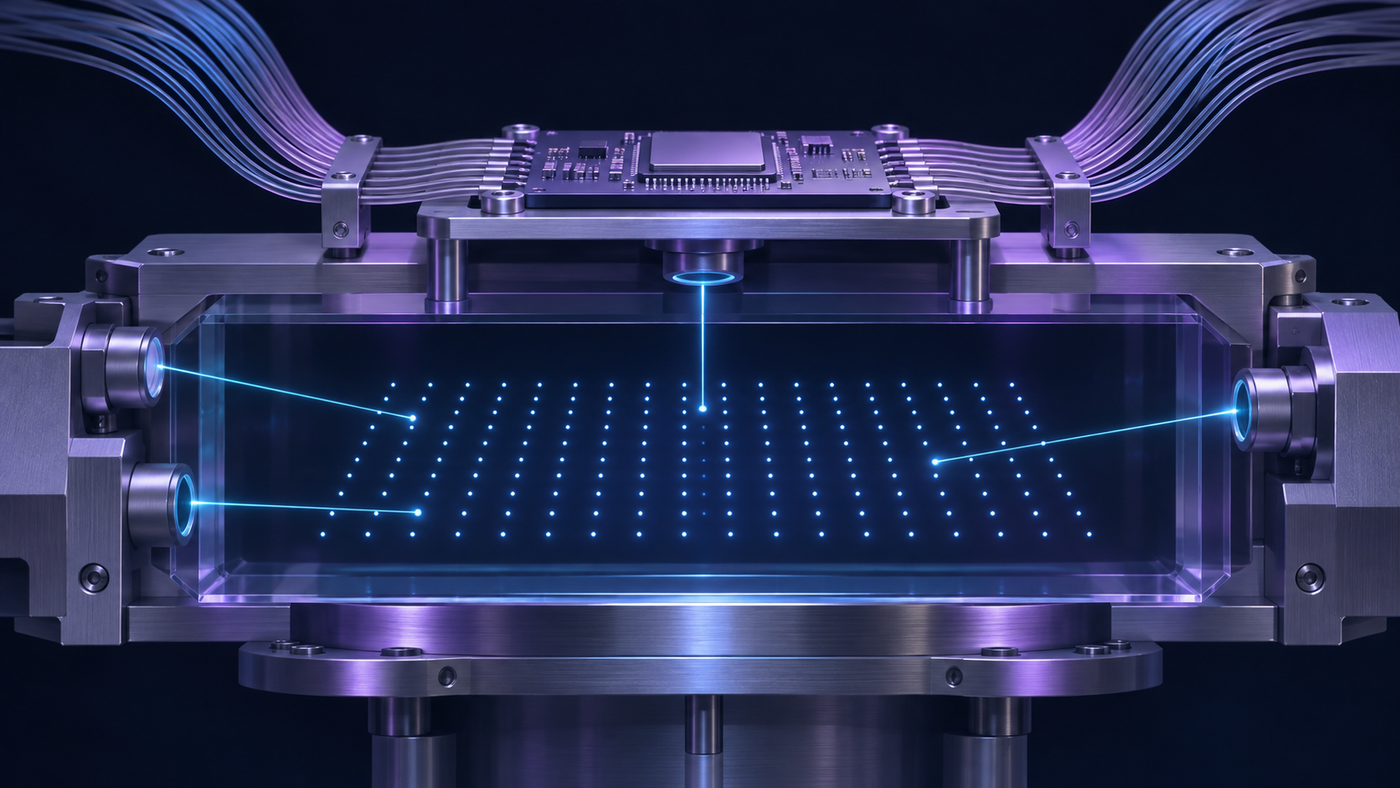
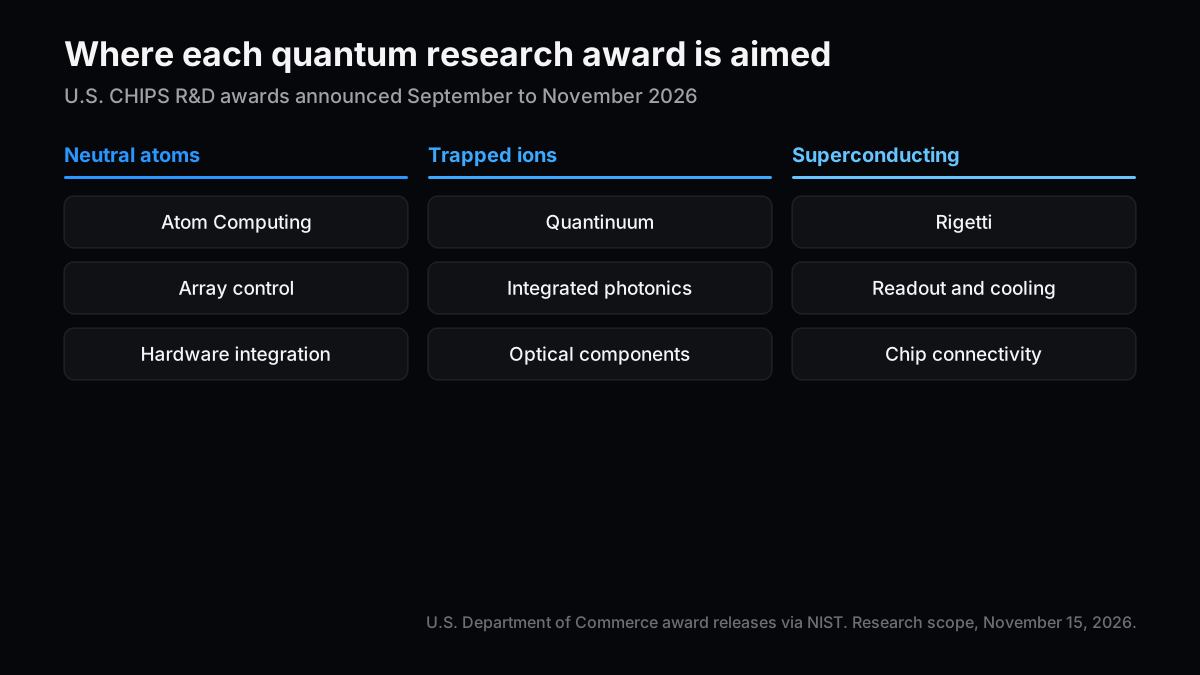
The Atom Computing award supports hardware and systems integration for addressing, manipulating, and controlling tens of thousands of qubits, followed by performance validation. Commerce describes the scale of the proposed work. I would record the number under the scope of research and leave the measured system performance in its own field. Commerce on Atom Computing
The next time a company shows a photograph of a larger array, I would look for the test conditions below it. How many of the sites did the test actually use? How do the success rate and elapsed time change when the machine operates on several sites at once? If calibration or an adjustment interrupts the session, the elapsed time should tell us whether that step is included. Knowing the share of sites measured and the number of repeated runs would help connect a demonstration on individual sites to operation across the machine.
Trapped ions need optics that survive integration
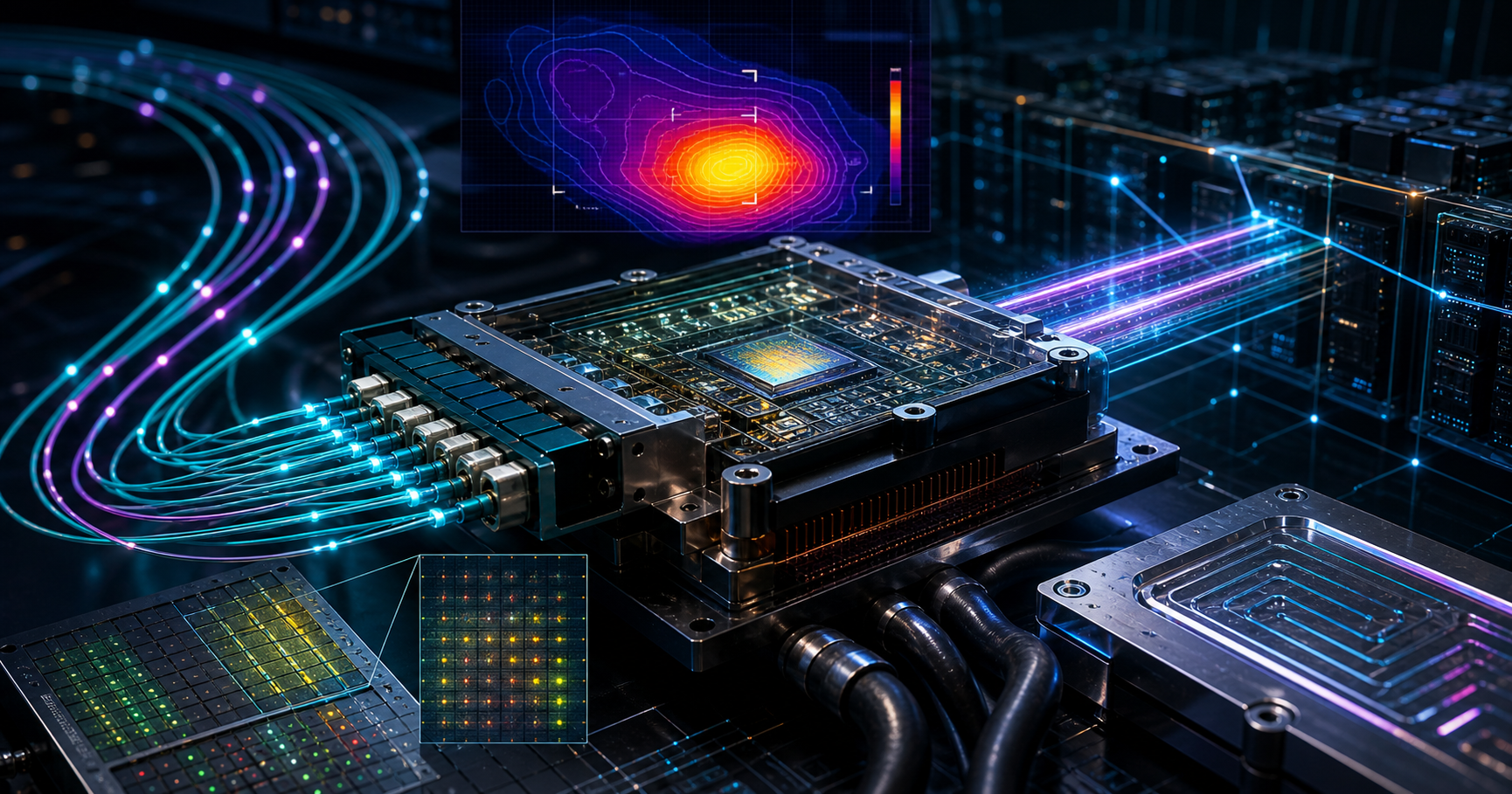
For Quantinuum, Commerce names integrated photonics with low optical loss, specialized semiconductors for use at low temperature, and optical components that remain reliable at wavelengths relevant to the ions. A prototype photonic chip can guide light under one set of conditions. For manufacturing, a separate test asks how much light reaches the point of use after integration and how consistently units from the same process do so. Commerce on Quantinuum
I would look for a distribution and a description of the population tested. A result for optical loss on a stand alone component belongs in one cell. Measurements on several packaged units belong in another. Installation and alignment can change the work the customer has to do. The bare component result leaves those steps unmeasured.
Superconducting circuits need room for readout inside the cryostat
The Rigetti award covers readout electronics, cryostat design, and the capability to fabricate chips with more extensive connectivity. As the chip grows, the extra readout must fit within the cooling system and the new connections must perform reliably. Drawing the measurement boundary at the edge of the chip leaves the behavior of the installed hardware outside the comparison. Commerce on Rigetti
On November 10, Rigetti reported measurements for its current machine and published targets for its next system by mid-2028. Rigetti technology update, Technology Performance and Roadmap
| Metric | Published result for the current system | Company target by mid-2028 |
|---|---|---|
| Physical qubit count | 108 | More than 300 |
| Median two-qubit gate fidelity | 99.5% | About 99.7% |
| Gate time | — | Below 60 nanoseconds |
The current system connects twelve nine-qubit chiplets. Rigetti expects faster readout and more cryogenic capacity on the next machine. For that step, I would look for the overall median and the distribution within and across chiplets. A better median would leave open the possibility that failures are concentrated at particular connections.
Which results can be compared?
A physical qubit count describes the scale of the hardware. Gate fidelity describes how accurately a specified operation was performed. When a test uses error correction, it also matters how well a logical qubit encoded across physical qubits holds up over repeated correction cycles. An award objective, a physical operation, and an error corrected logical operation each come with their own conditions.
| Modality | Published figure | What it describes | Conditions needed for interpretation |
|---|---|---|---|
| Neutral atoms | Tens of thousands of qubits | Scope of the Atom research award | Sites addressed, degree of parallel operation, share of sites measured |
| Trapped ions | 99.921% | Mean two-qubit gate fidelity reported by Quantinuum for Helios as of December 31, 2025 | Optical integration conditions, sample population and spread |
| Superconducting | 108 qubits, 99.5% | Rigetti's machine size and median fidelity reported on November 10 | Coverage and distribution within and across chiplets |
The 99.921% for Helios is a mean as of year end 2025. The 99.5% figure is a median for another machine. Ranking machines on a workload would require a common workload and test protocol. The figure for Atom describes the intended scale of research in qubits. Quantinuum 10-Q, Overview, Rigetti technology update, Commerce on Atom Computing
I would leave gaps visible when estimating the time to a commercial system. Suppose the next announcement reports a substantially lower logical error rate. To evaluate the capacity the customer receives, it would still need to specify the machine configuration and how long that same circuit takes to complete. I would also track prototype installation, customer acceptance, and replication on subsequent units as separate events. An operating test that reports successful circuit runs and time spent on adjustments would help estimate how much work a delivered system can finish in a day.
What would change the manufacturing outlook?
Start with the component, look at it after integration, then ask for a repeat on another unit. The award releases show where the research money is aimed. Procurement and customer acceptance records will be needed to assess how many machines have been delivered and under what conditions.
| Case | What to look for in a disclosure | Implication |
|---|---|---|
| Baseline | Test conditions and distribution for one integrated prototype | A design path has evidence. Repeatability across units remains open. |
| Progress | Tests across units or lots with stated conditions and service intervals | Equipment integration has stronger support. Track delivery and operating records next. |
| Progress unverified | Higher scale targets with sparse updates on conditional payments or integration tests | Hold the manufacturing assessment and look for the reason in the next update. |
What would change my assessment as an investor?
I would judge the design closer to production once a customer has accepted an installed system and measurements across several units show they meet the same performance requirements under the same test conditions. The acceptance record tells me what the customer required. The measurements show how much performance varies from unit to unit.
I currently expect the three modalities to face different manufacturing constraints. Evidence that would change my comparison would be a common logical circuit and success condition, with elapsed time and logical error reported across machines and repeated runs. Once those conditions match, I would put more weight on how often an installed machine finishes the same job.
Related Posts
- Reading NASA's lunar transport awards — Align a funding ceiling, individual orders, and reporting dates.
- Manufacturing and servicing robot hands — Connect the design of a component to equipment downtime.
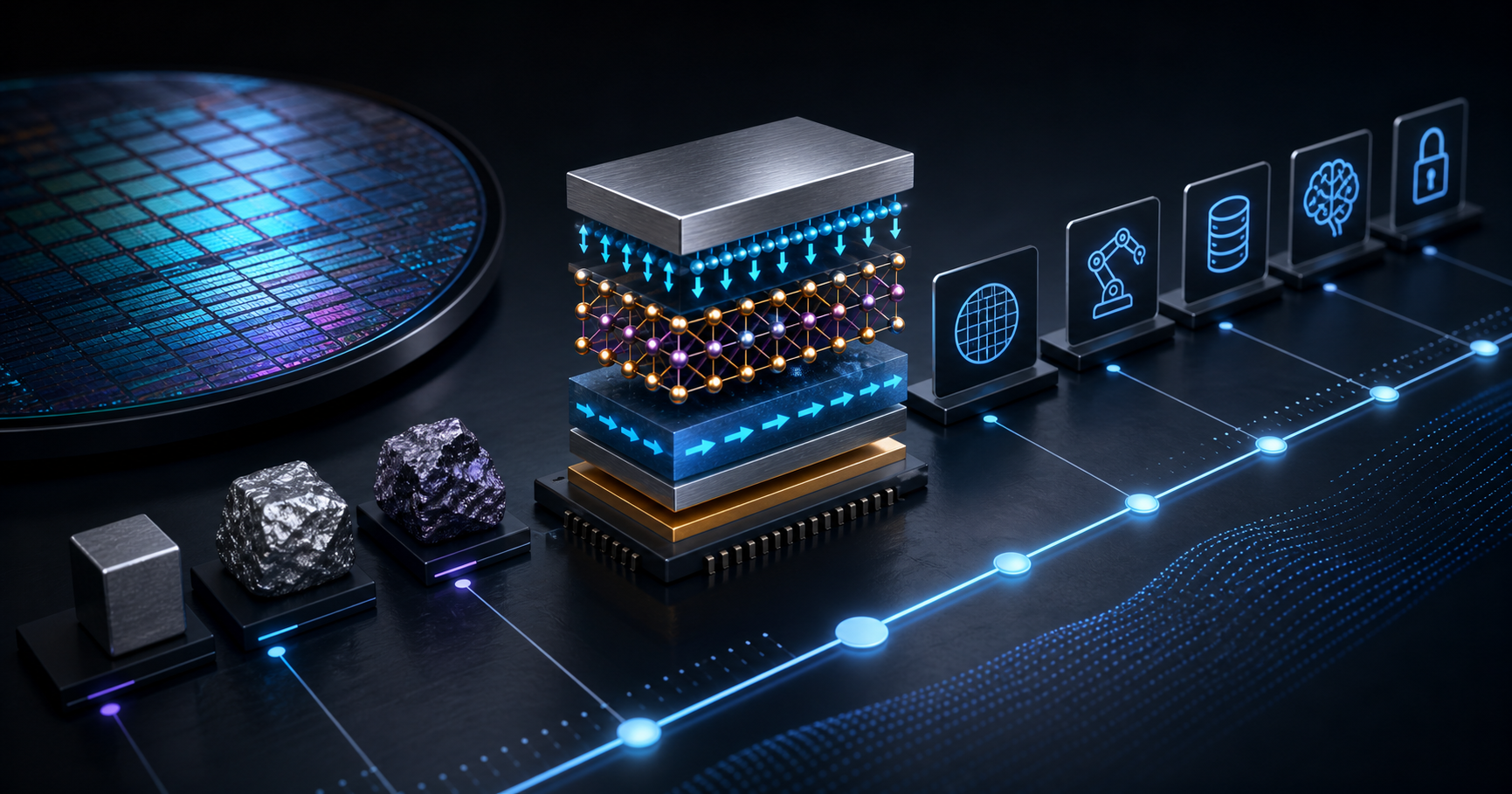
- A nonvolatile quantum switching element and the path to a product — A separate case of moving from device prototype to validation.
References
- U.S. Department of Commerce and NIST, November 13, 2026, Atom Computing final research award
- U.S. Department of Commerce and NIST, September 8, 2026, Quantinuum final research award
- U.S. Department of Commerce and NIST, September 8, 2026, Rigetti final research award
- Quantinuum, filed November 10, 2026, Form 10-Q
- Rigetti, third quarter 2026, Form 10-Q award note and November 10 technology update
Next Issue Ideas
- What a quantum system has to show at acceptance — Trace tests between installation and customer handover and see which ones are comparable in public contracts.
- Where integrated photonics yield is measured — Follow optical coupling, packaging, and test data to identify which parts of production have evidence.
- How to read elapsed time in a logical qubit announcement — Compare repeated error correction and full circuit completion under the specified test conditions.
This article is for informational purposes and does not constitute investment advice. The author may hold positions in some securities mentioned. Generative AI assisted in its preparation. See the disclaimer for details.