Wait, We Don't Actually Know How the Universe Ends? JWST and DESI Are Cracking Cosmology — 3 Wild Theories Explained
We were taught the universe began with a Big Bang and has been expanding ever since. The latest JWST and DESI observations are cracking that orthodoxy. Three thrilling hypotheses about how the universe might end, in plain language.
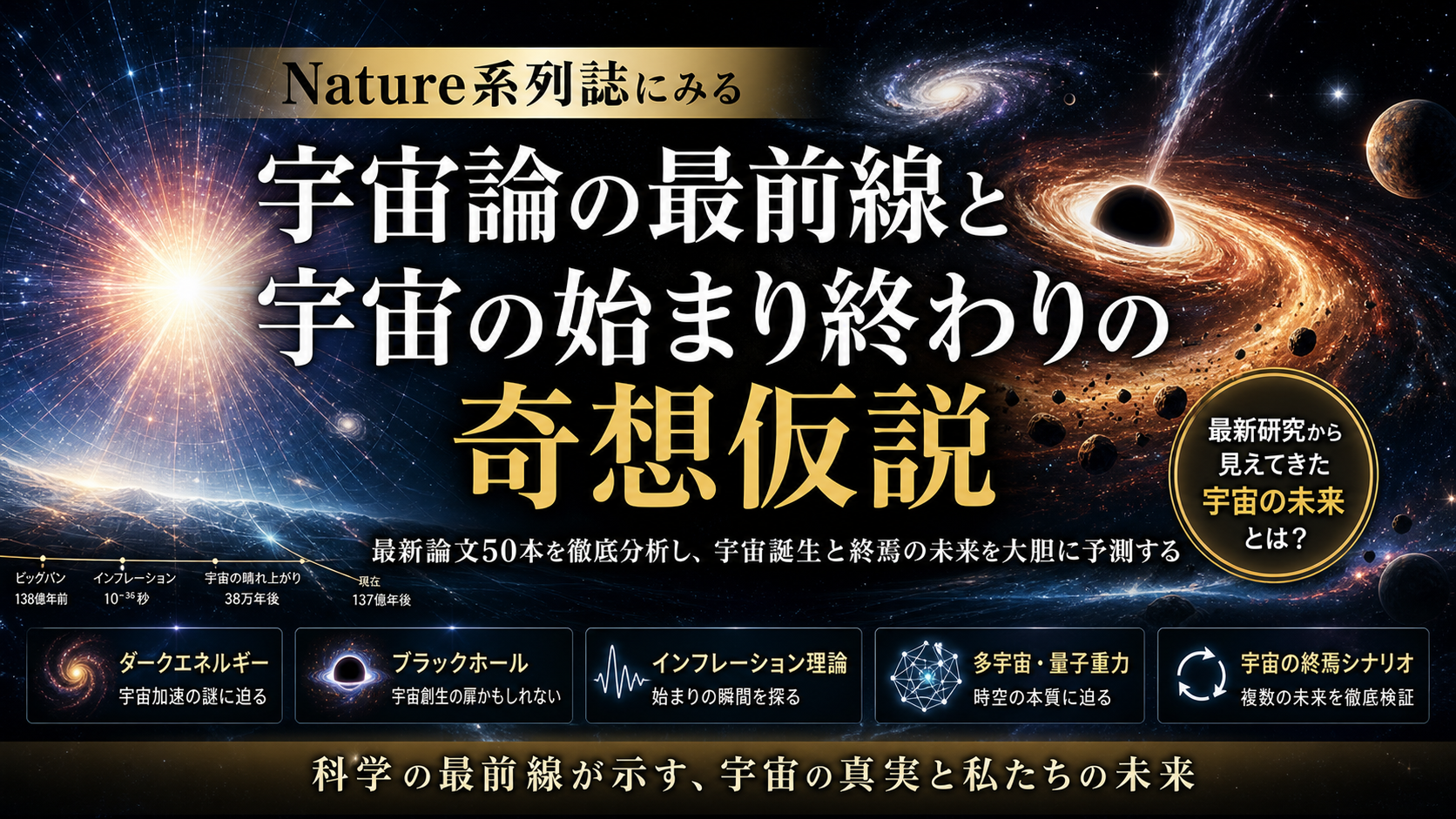
We were taught the universe began with a Big Bang and has been expanding ever since. The latest JWST and DESI observations are cracking that orthodoxy. Three thrilling hypotheses about how the universe might end, in plain language.


Wait, We Don't Actually Know How the Universe Ends? JWST and DESI Are Cracking Cosmology — 3 Wild Theories Explained
I came up through semiconductor process development, where I saw, more than once, observation outrun theory in real time. Cosmology in 2026 has that same flavor — so I read 50 of the latest papers and tried to translate it into something a non-physicist can actually follow.
Hold on — the universe's "settled science" is cracking?
You probably learned in school that the universe started with the Big Bang and has been expanding ever since.
Turns out — that tidy story is starting to crack.
The trigger is two new instruments: JWST (the James Webb Space Telescope) and DESI (the Dark Energy Spectroscopic Instrument). JWST is basically a giant camera that captures galaxies in stunning sharpness. DESI is a machine that builds a 3D map of the universe by spectroscopically scanning millions of galaxies. Together, they've put small but undeniable cracks in what was, until recently, the closest thing physics had to a perfect description of the cosmos.
I read through 50 of the latest cosmology papers and tried to translate what's actually going on, in plain English.
The "user manual of the universe" doesn't add up anymore
Cosmologists have a standard model called ΛCDM (Lambda Cold Dark Matter). In plain terms, it's the universe's "user manual" — a recipe that explains everything using regular matter + dark matter + dark energy.
For about 20 years, this manual has been freakishly accurate. But lately, a few "wait, what?" moments have shown up.
The most famous one is the H0 tension. H0 is the number that tells us how fast the universe is expanding right now. Measure it two ways and you get:
- Method A: Run the math backward from the leftover glow of the Big Bang (the CMB) → about 67–68
- Method B: Look at supernovae in nearby galaxies directly → about 73
Those numbers don't match.
| Method | What it looks at | Rough H0 value |
|---|---|---|
| Method A (CMB) | The leftover glow of Big Bang | ~67-68 |
| Method B (SNe) | Nearby galaxies, measured directly | ~73 |
| Gap | — | ~5 (hard to blame on error) |
It's like measuring the temperature of the same room with two thermometers and getting 68°F and 73°F. Not a measurement error — a real disagreement.
And here's the kicker: the more precise our instruments get, the stronger the disagreement becomes. That makes "it's just statistical noise" harder and harder to defend.
Then JWST showed up and made things louder.
JWST's "prodigy galaxies" and 3 wild new theories
JWST can image galaxies from when the universe was only 300–400 million years old. And what it's seeing? Galaxies that are too bright, too big, too mature for that age.
It's like finding a 3-month-old baby playing professional soccer.
On top of that, the cosmic event called reionization — when the universe became transparent — was probably driven not by giant black holes (AGN), as we used to think, but by hordes of small, faint dwarf galaxies. The textbook is being rewritten.
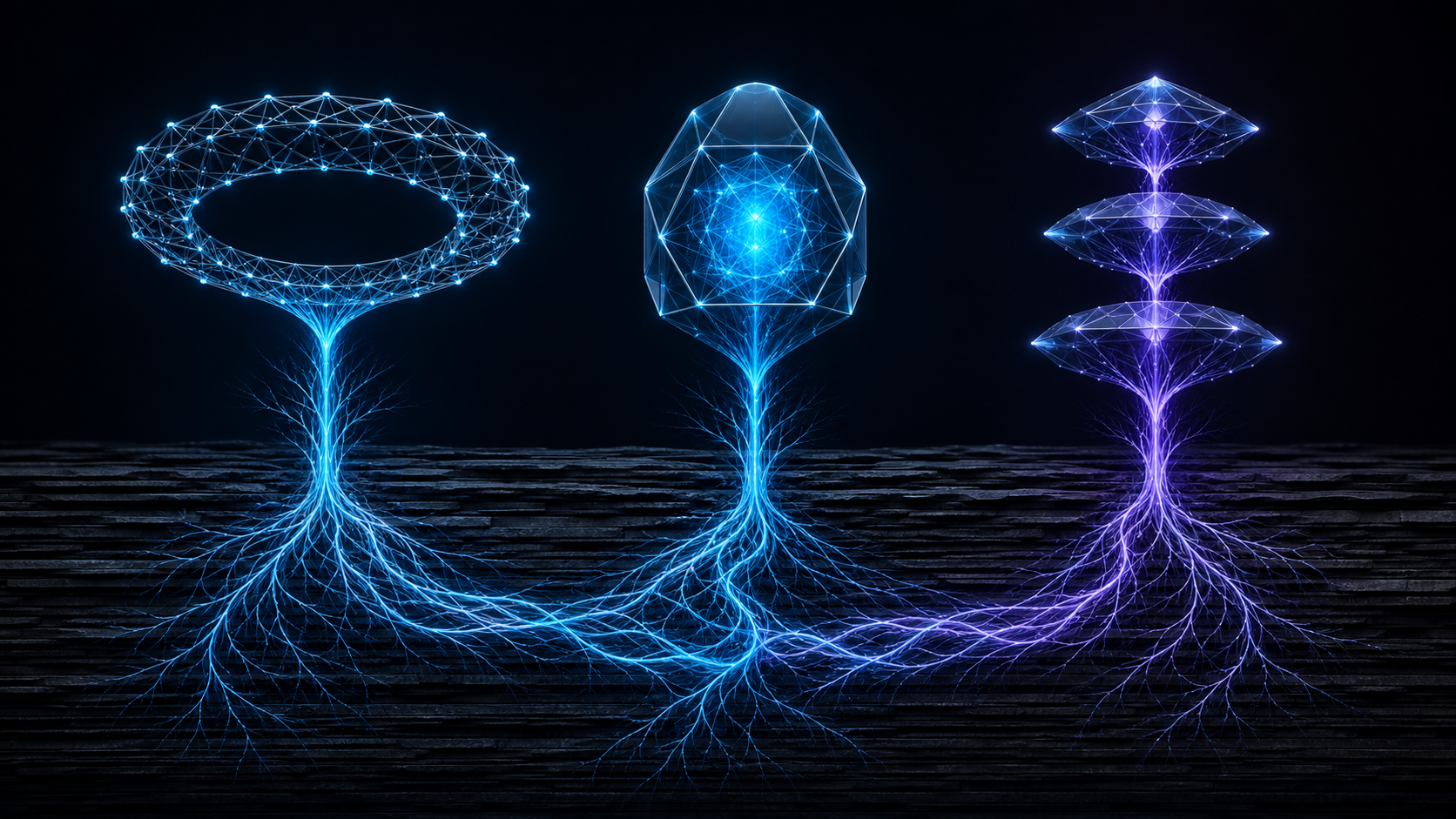
To make sense of all this, three big theories are now seriously on the table. In plain English:
Theory 1: The universe is recycled? — "Magnetized Memory Bouncing Universe"
What if the Big Bang wasn't really the beginning, and our universe bounced from a previous one, inheriting its magnetic field memory?
- Why it's cool: the universe might be a "second-hand" cosmos
- Weakness: the bounce mechanism itself still needs more theory work
- Test: a "twisted" pattern in the CMB polarization would be smoking-gun evidence
Theory 2: A "lump" in the early universe? — "Non-Abelian Clumpy Reheating Universe"
In a tiny patch of the very early universe, fluctuations got concentrated and made everything later go faster — explaining both the early prodigy galaxies and a possible far-future vacuum collapse.
- Why it's cool: JWST's "too-fast" galaxies fall right into place
- Weakness: it risks producing too many primordial black holes — close to current limits
- Test: a narrow "bump" of gravitational waves at a specific frequency
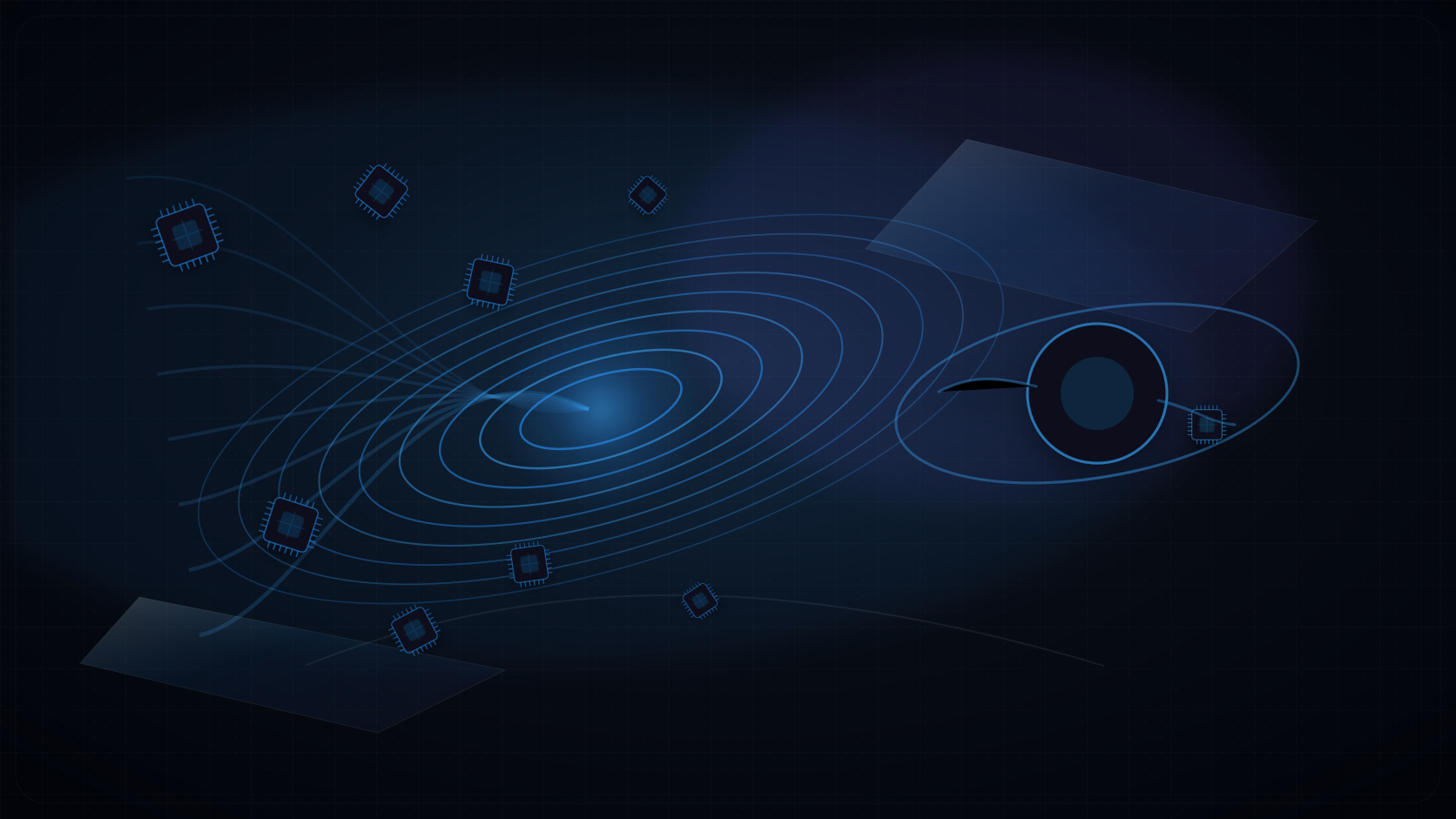
Theory 3: Dark matter and dark energy whispering to each other? — "Interacting Dark Sector, Slow Ending Universe"
What if dark matter and dark energy are quietly exchanging energy, and that's why the recent universe behaves slightly off-script?
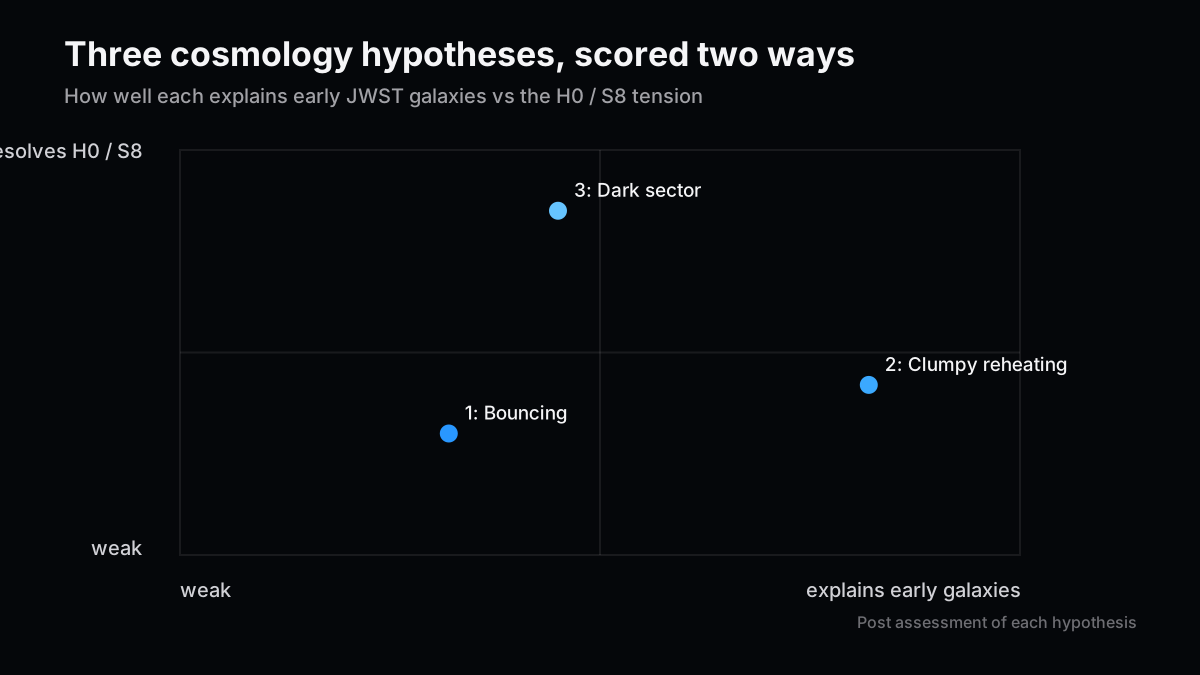
- Why it's cool: solves both H0 tension and the "growth-of-structure" puzzle (S8) in one move
- Weakness: doesn't say much about the universe's actual birth
- Ending: not Big Rip, not heat death — the universe just goes quiet, with structure growth frozen and only a faint "dark acoustic" sound left behind
Put side by side, each theory has a clear strength and a clear soft spot.
| Hypothesis | Coolest idea | Weakness | Decisive test |
|---|---|---|---|
| 1: Bouncing | The cosmos may be second-hand | Bounce mechanism needs theory | A twist in CMB polarization |
| 2: Clumpy reheating | Explains too-fast galaxies | Risks too many primordial BHs | A narrow gravitational-wave bump |
| 3: Dark sector | Solves H0 and S8 at once | Says little about the birth | Closest to current data |
Theory 3 is currently the closest fit to the data. And honestly — "the universe ends not with a bang or a freeze, but in silence, with only a faint dark sound" — that's poetic.
The answer might come in our lifetime
Here's the best part.
These theories will likely be decided in the next 5–10 years. Europe's Euclid, the US's Rubin and Roman observatories, the CMB-focused CMB-S4 and LiteBIRD, the radio telescope SKA, and the space gravitational-wave detector LISA — they're all coming online roughly at once.
In other words: we'll likely live to see at least the direction of the answer to "how does the universe end?" That's a first in human history.
So next time you scroll past a "physics is broken" headline, you'll know what's really going on: three theories slugging it out, and the entire planet's instruments racing to break the tie.
If this clicked for you, share it on X and drop a comment with "which theory is your favorite." That's how I decide which deep dive to write next.
Revisit Checklist: What Observations Matter Next?
- Watch whether DESI, Euclid, Rubin, and Roman move the H0 and S8 tensions in the same direction or split them apart.
- For JWST's high-redshift galaxies, follow revisions to stellar mass estimates and dust corrections, not only brightness headlines.
- Judge new theories by falsifiable observational predictions, not by how elegant or dramatic they sound. Next Issue Ideas
- Idea 1: "What Even Is Dark Matter? 3 Candidate Theories Compared in Plain English" — A side-by-side breakdown of WIMPs, axions, and primordial black holes — strengths, weaknesses, and how much the field has actually narrowed down. A natural deep dive on the "dark sector whispering" angle from this post.
- Idea 2: "5 'Impossible Galaxies' JWST Has Found" — The 5 most striking real-world examples of "too-fast" galaxies, with images and a one-line "why this breaks the textbook" each. Visual-first follow-up to today's post.
- Idea 3: "How the Universe Could End, Visualized: Big Rip vs Heat Death vs the Quiet Ending" — Each of today's three theories implies a different final state. A timeline-style visual explainer that makes readers pick a favorite.
Related Posts
- Will the University of Tokyo's Nonvolatile Quantum Switching Element Rewrite Semiconductor Investing? Key Names and the Timeline — Another frontier where fresh physics is shaking settled assumptions, this time with money at stake
- 8 Megatrends in Space Startup Investing: From Earth Extension to Space Industrialization — What space looks like when you read it as a business instead of a science
References
The factual and numerical assumptions in this article are anchored to primary or public materials that readers can revisit during AdSense review and future updates.
This article is for informational purposes only and does not constitute investment advice or a recommendation of any specific stock, service, or contract structure. The author may hold positions or interests related to companies or services mentioned. Generative AI was used for parts of research, translation, and proofreading, with final review by ZYL0. See the disclaimer for details.