Physical AI Startup Map ①: Robot Training Data, Simulation and Fleet Ops (XDOF, Applied Intuition, Foxglove)
The robot-data shortage, the sim-to-real gap and fleet-ops pain, and how XDOF, Applied Intuition, Foxglove, Formant, Viam and others are building the data, simulation and operations stack around them. Starts from Sapphire Ventures' physical AI map. Part 1 of the series.
The robot-data shortage, the sim-to-real gap and fleet-ops pain, and how XDOF, Applied Intuition, Foxglove, Formant, Viam and others are building the data, simulation and operations stack around them. Starts from Sapphire Ventures' physical AI map. Part 1 of the series.


Physical AI Series ①: The Startups Building the Data, Simulation and Ops Stack
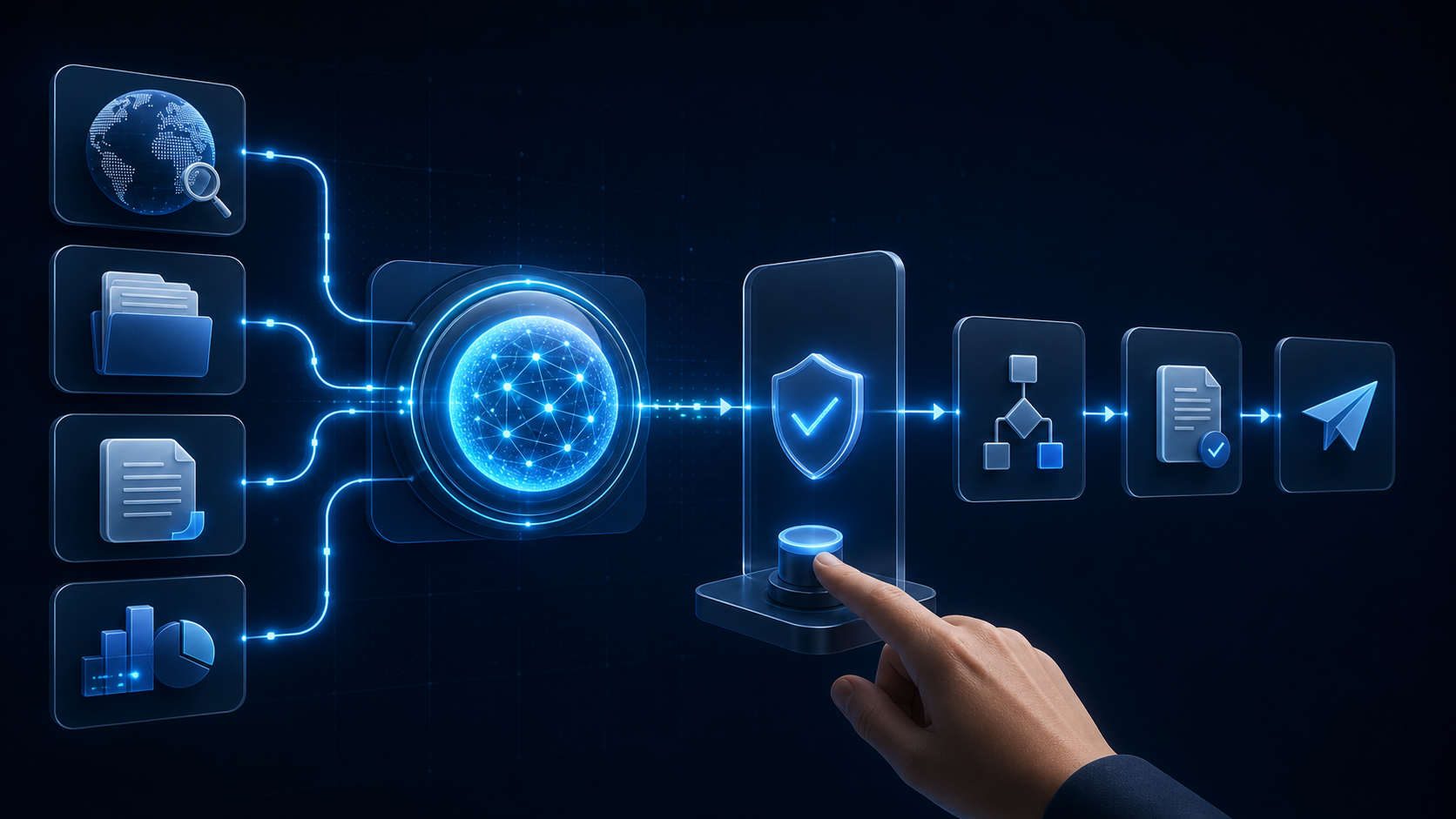
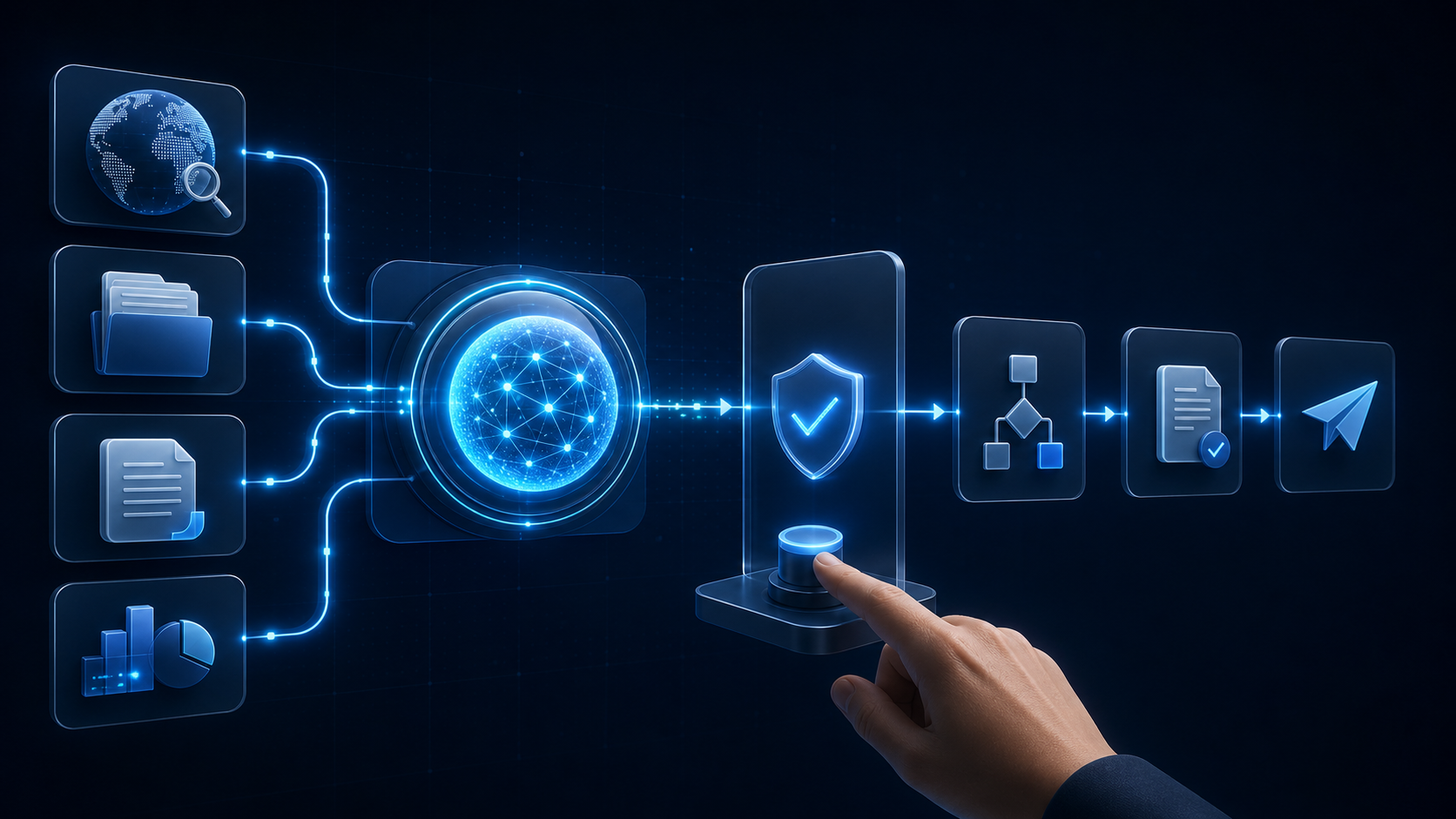
Whenever I write about physical AI, reader questions converge on one thing: which robot company wins. But ever since my March piece on physical AI as an investment theme, what has nagged at me is the plumbing that sits in front of the robot brain — the layer that collects data, tests policies in simulation, and keeps fleets running once they ship.
As of October 3, 2026. Round sizes and valuations come from company announcements and press reports; anything reported but not confirmed is flagged. Totals and ratios are my own calculations.
Why Look at the Plumbing Before the Brain
My short answer: this layer is unglamorous, but it is where cash changes hands first.
In March I wrote that I wanted core exposure to foundation models and platforms now, and would pick up robot hardware on a dip in 2027. Six months later, Physical Intelligence's valuation has roughly doubled, from about $5.6 billion to about $11.7 billion. Capital is concentrating in foundation models just as expected. Meanwhile the companies that feed those models data, and keep the robots alive after deployment, barely get mentioned.
The map for this series is Sapphire Ventures' Physical AI Market Map, published on August 27, 2026. Sapphire splits physical AI into six layers: hardware, embodiment and form factor, applications, Development, Infrastructure & Enablement, and Intelligence & Models. This series reads the back half of that stack in three parts.
| Part | Layer | Core question |
|---|---|---|
| ① (this post) | Development / Infrastructure & Enablement | Where are data, simulation and operations getting stuck? |
| ② | Intelligence & Models | Who is building the robot brain, and how? |
| ③ | Hardware | What is the real bottleneck in actuators, hands and sensors? |
The money backdrop matters. Using PitchBook data, Sapphire shows venture investment in physical AI rising from $12.7 billion in 2024 to $21.8 billion in 2025 — roughly 1.7x. Carta's Q1 2026 report found that of the $30.4 billion raised by companies on its platform, more than 60% went to AI. The median Series A valuation for AI foundation model companies was $300 million, against $55 million for non-AI companies. The same report calls hardware "the quiet winner."

Mapping the Bottlenecks: Data, Simulation and Operations
What surprised me when I laid this out is that most of the friction comes from differences in kind, not shortages of quantity.
Language models had the internet as a textbook. Robots have nothing equivalent. Video is plentiful, but very little of it carries action labels — which joint moved, with how much force. Sapphire puts the teleoperation problem bluntly: every hour of teleop data costs an extra hour of human labor. Offshoring does not make it cheap, and it never reaches internet scale.
Here are the choke points I ended up with. There turned out to be six.
| Bottleneck | What it is | What limits it | Companies in this post |
|---|---|---|---|
| Missing action labels | Video exists, but without joint angles or force | Labor cost of collection | XDOF, Mecka, Human Archive, Scale |
| Embodiment gap | Human video shows what happened, not how the body did it | Translating between bodies | Human Archive, Mecka |
| Sim-to-real gap | Physics, touch and sensor noise are imperfectly modeled | Calibration against real data | Applied Intuition, ReSim, Zeromatter, world-model labs |
| Telemetry volume | Sapphire notes a single autonomous vehicle can produce terabytes a day | Storage, search, debugging | Foxglove, Rerun, Nominal, Sift, Roboto |
| Connectivity and remote rescue | Warehouses, construction sites and offshore sites have patchy links | Low-latency video and control | LiveKit, Reactor |
| Mixed-fleet operations | Every robot model has its own software and update process | A shared operations layer | Formant, Viam, OpenMind |
One caution on numbers. The "hours of data" that companies advertise do not measure the same thing. In my post restating Big Tech capex on one definition, I normalized four disclosures before comparing them. Here is the same exercise for training data.
| Data source | Scale | Type of data | Source and date |
|---|---|---|---|
| DROID + Open X-Embodiment (public) | ~5,000 hours | Robot interaction | Scale (Sep 2025) |
| Scale AI's own lab | 100,000+ hours | Production hours on real robots | Scale (Sep 2025) |
| Generalist GEN-1 pretraining | 500,000+ hours | Low-cost wearables on humans | Generalist (Apr 2026) |
| DYNA-2 pretraining | 1,000,000+ hours | Human first-person video | DYNA (Aug 2026) |
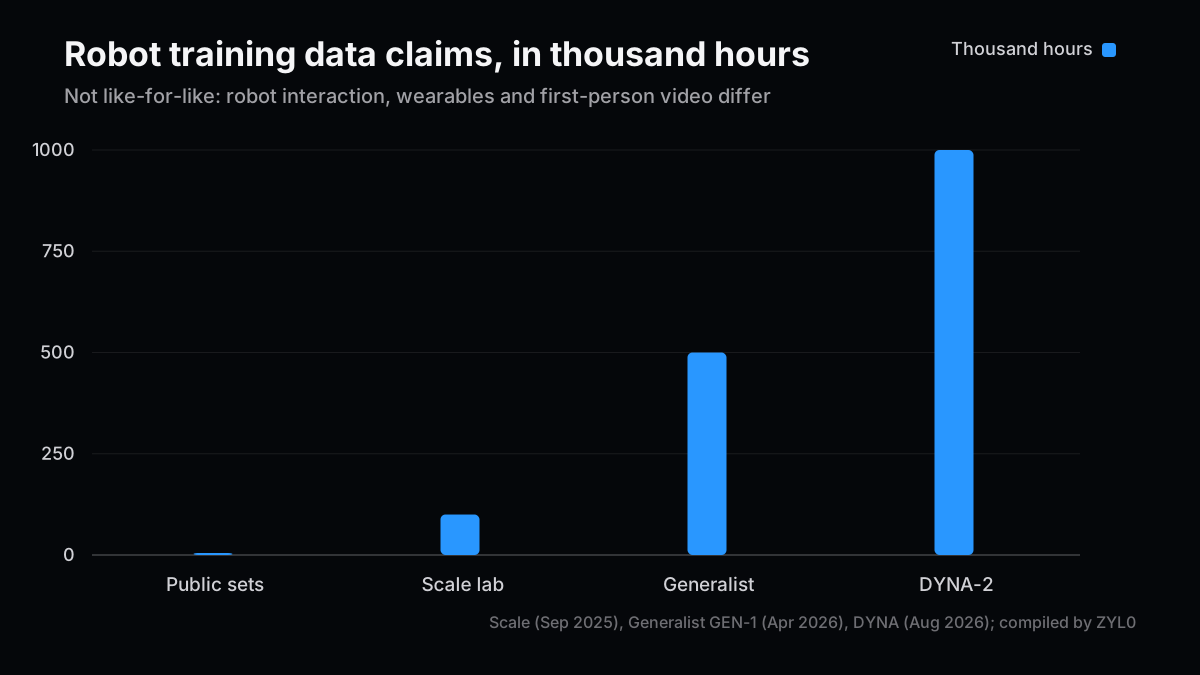
The public datasets' ~5,000 hours barely register on the chart. The gap is 200x. But reading that as "DYNA's data is worth ten times Scale's" would be a mistake. First-person video has no action labels; real-robot data carries the body's constraints directly. The unit is the same, but the information that actually trains a policy is not.
Development: The Companies Collecting and Generating Data
The strongest impression this layer left on me is that "companies that collect data" and "companies that generate data" are splitting into two businesses.
Collecting: XDOF, Mecka, Human Archive, Scale
XDOF was founded in October 2024 by Philipp Wu, who ran into the data wall as a PhD student at UC Berkeley, and his co-founders. It came out of stealth on June 17, 2026 with $70 million from Thrive Capital, Spark Capital, a16z, Lux and WndrCo. Its technical approach is a three-tier pyramid: teleoperation on deployed robots at the top, data from GELLO — a low-cost teleop rig — in the middle, and first-person data from wearable sensors at the base. The "ABC" dataset it released with UC Berkeley contains 130,000 manipulation trajectories. It has about 20 customers, including several frontier AI labs. In September, reports said it was negotiating a Series B at roughly a $1.2 billion valuation; nothing had been confirmed as of writing.
Mecka takes the opposite route and skips robots altogether. It records human gestures and gaits with custom body sensors and iPhones, then sells the data to robotics companies. It has raised $60 million in rounds led by Framework Ventures and says signed contracts point to a $100 million annual run rate. A Sequoia-led round at around a $500 million valuation has also been reported. Human Archive is even more stripped down: it has handed more than 1,000 camera headsets to gig workers in India and captures synchronized RGB-D, motion, tactile and force data. It has raised $8.2 million.
Scale AI extended its language-era labeling business into the physical world. In September 2025 it said its San Francisco prototyping lab had logged more than 100,000 production hours, and named Physical Intelligence and Generalist as customers. Encord sits on the management side rather than collection. It raised a $60 million Series C led by Wellington Management in February 2026 and says the data it manages grew from about 1 PB to more than 5 PB in a year.
Generating: Applied Intuition, ReSim and the world-model labs
Let me bring in some personal experience here. When I worked on automotive EEPROM process development, I traced a yield problem that had been written off as "an equipment issue" to its real root cause using TCAD process simulation. What made the difference was not how sophisticated the model was. It was recalibrating it against measured data, again and again. An uncalibrated simulation, however pretty, was useless for decisions on the line.
That is why I judge simulation companies by one question: how tight is their loop for calibrating against real-world data?
On that measure Applied Intuition is the deepest. It started in automotive simulation and counts 18 of the top 20 automakers as customers. It raised a $600 million Series F at a $15 billion valuation in June 2025, and is pushing into trucking, defense, mining, construction equipment and general robotics. ReSim, a Pittsburgh company that raised a $10.3 million seed in September 2024, builds cloud infrastructure for running virtual tests in parallel on top of existing simulators and log-replay tools. Zeromatter specializes in sensor simulation and environment generation, and sells multi-cloud support across AWS, Google Cloud and Azure.
On Sapphire's map, world models also sit in this Development layer. I read them here as data engines; the policy models themselves are for Part 2.
| Company | Latest round (announced or reported) | Product / technical approach |
|---|---|---|
| World Labs | $1B at a $5B valuation (Feb 2026) | "Marble," for generating and editing 3D worlds; Autodesk invested $200M |
| Decart | $300M at ~$4B (May 2026, led by Radical Ventures) | Real-time generated video worlds; has shown driving simulation |
| General Intuition | $220M at $6.2B (Sep 2026) | Action models and an API trained on gameplay video; also raised $320M in January |
| AMI (Advanced Machine Intelligence) | $1.03B seed (2026) | Yann LeCun's lab; action-conditioned world models |
General Intuition's pitch is clever. People play games and operate robots the same way — vision in, controller input out — so gameplay footage is effectively action-labeled video. Is that really true? Game physics is an approximation produced by a game engine; friction and deformation are not the real thing. To me, the calibration problem I described above is still sitting right there.
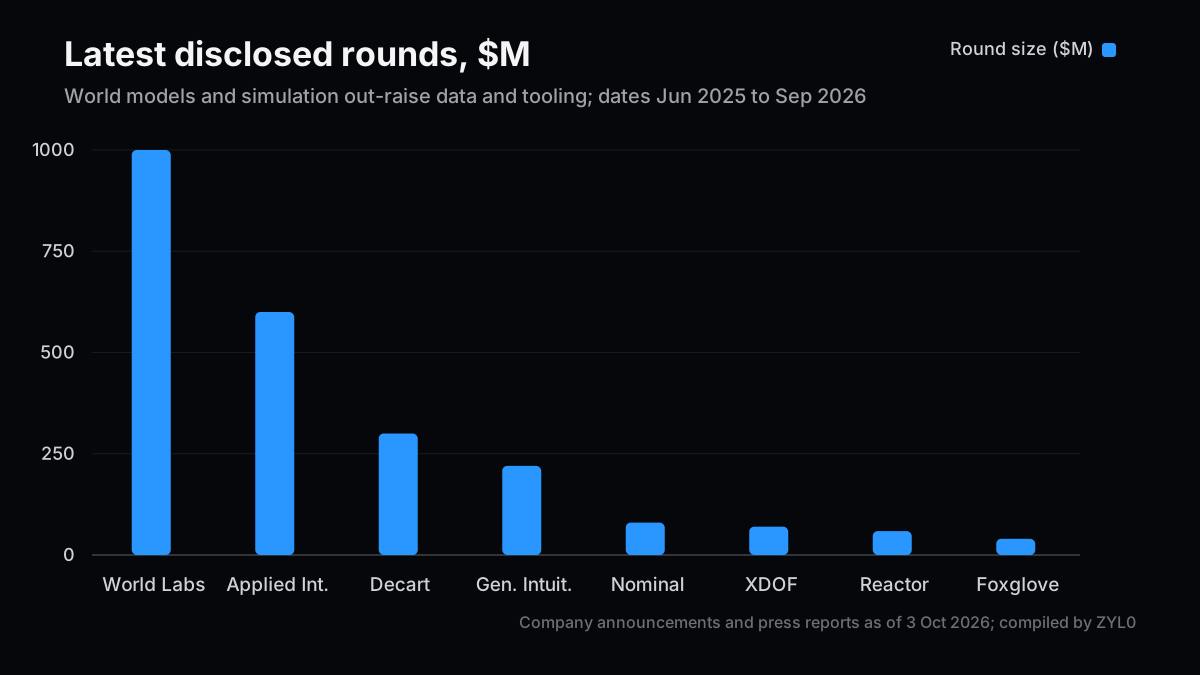
The tilt in funding is plain in the chart. Since the start of 2026, the three world-model companies (World Labs, Decart, General Intuition) have announced roughly $1.84 billion in rounds. Over the same period, five tooling companies across observability, test data, connectivity and perception (Nominal, Sift, Reactor, LiveKit, Luxonis) announced about $295 million — roughly a 6x gap. Those are my sums of announced amounts; undisclosed rounds would change them.
Infrastructure: Making Robots Operable
Honestly, this layer overlaps with one of my own painful lessons.
After moving into business development, I taught myself enough AWS to build and run a river flood-detection system on IoT Core, Lambda and DynamoDB. The hard part was not the sensors. It was designing for connections that drop, and handling the endless stream of "nothing is happening" data in normal conditions. The anomalies that mattered showed up in a tiny fraction of the data. If I could not find those few minutes after the fact, I could not improve the system.
Robot fleets have the same problem at a vastly larger scale.
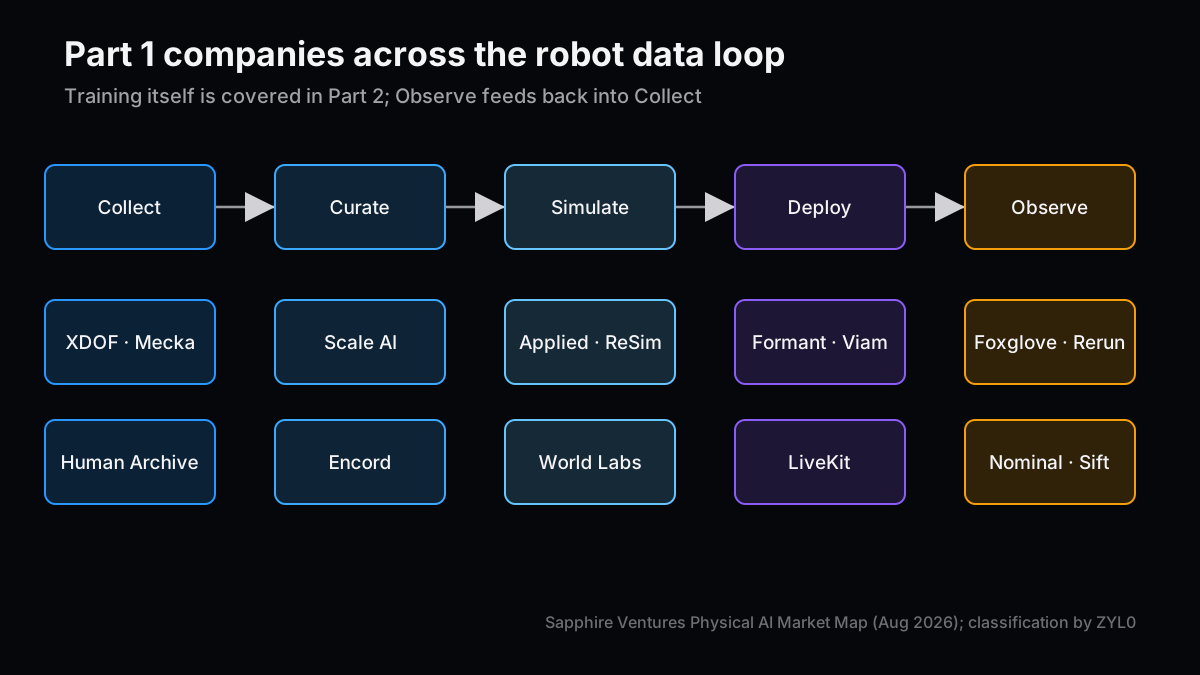
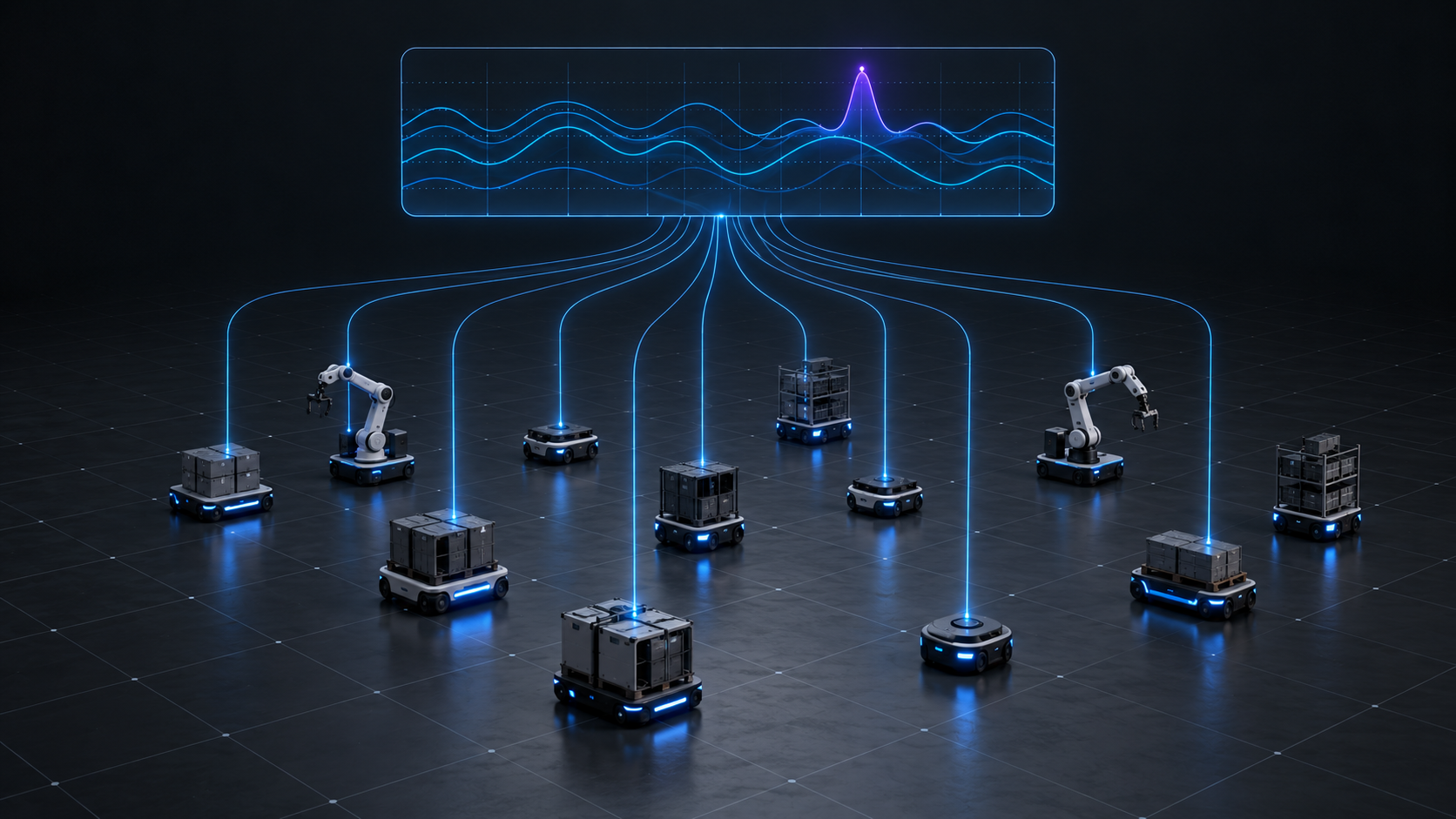
Observing: Foxglove, Rerun, Nominal, Sift, Roboto
Foxglove builds visualization and data-management tools for robot logs, and created MCAP, the log format now widely used with ROS. It raised a $40 million Series B led by Bessemer in November 2025 and launched a unified data platform in April 2026. Rerun began with open-source logging and visualization and is expanding into a database for multimodal data; it raised a $17 million seed led by Point Nine in March 2025.
Nominal and Sift come out of aerospace and defense hardware testing. Nominal raised $80 million in March 2026, led by Founders Fund with Sequoia, Lux, General Catalyst and Lightspeed, reaching a $1 billion valuation. It raised $155 million in ten months and says revenue grew sevenfold in a year. Sift was founded in 2022 by former SpaceX engineers and raised a $42 million Series B led by StepStone in March 2026. Roboto, built by alumni of Amazon's drone-delivery program, focuses on searching sensor logs.
Connecting: LiveKit, Reactor
LiveKit is real-time communications infrastructure built on WebRTC. It raised $100 million at a $1 billion valuation in January 2026, led by Index Ventures. Voice AI is its core customer base, but it positions itself as infrastructure for voice, video and physical AI agents. When a remote operator has to rescue a stuck robot, latency under 100 milliseconds matters. Reactor emerged from stealth in May 2026 with $59 million, with Lightspeed leading the Series A. It builds infrastructure for serving world models in production and says it delivers frames to devices in under 50 milliseconds, against an industry average of about 400. That is the company's claim, not an independent measurement.
Orchestrating: Formant, Viam, OpenMind, Luxonis
Formant offers cloud software for fleet management, teleoperation and incident handling; it raised $21 million led by BMW i Ventures in October 2023. Viam is led by MongoDB co-founder Eliot Horowitz. It raised a $30 million Series C led by Union Square Ventures in March 2025 and announced a partnership with Tech Mahindra in June 2026. OpenMind builds OM1, a hardware-agnostic robot operating system, and FABRIC, a protocol that lets robots verify identity and share context with each other. It raised $20 million led by Pantera Capital in August 2025.
In perception, Luxonis stands out. Its OAK cameras and DepthAI software give robots depth perception, and it ran for more than seven years without outside institutional capital before raising a $14 million Series A in July 2026.
| Company | Category | Latest round | Product |
|---|---|---|---|
| Foxglove | Observability | $40M (Nov 2025, led by Bessemer) | Log visualization and data management; MCAP |
| Rerun | Observability | $17M (Mar 2025, led by Point Nine) | Open-source logging/visualization, multimodal DB |
| Nominal | Test data | $80M at $1B (Mar 2026) | Running, monitoring and analyzing hardware tests |
| Sift | Telemetry | $42M (Mar 2026, led by StepStone) | Ingesting and analyzing machine sensor data |
| LiveKit | Connectivity | $100M at $1B (Jan 2026) | WebRTC infrastructure, sub-100ms latency |
| Reactor | Inference | $59M total (May 2026, Lightspeed-led A) | Production inference for world models |
| Viam | Integration | $30M (Mar 2025, led by USV) | Open-source layer linking devices, data and AI |
| OpenMind | Robot OS | $20M (Aug 2025, led by Pantera) | OM1 and FABRIC |
In my MangoBoost DPU post, I translated marketing claims back into data paths before judging them. This layer needs the same discipline. Numbers like "50 ms latency" or "5 PB of data" should not drive an investment decision until you know under what conditions, and measuring what.
The Investment Call and Scenarios
My conclusion is to hold this layer as three separate positions.
First, data collection: short-term long, medium-term neutral. The revenue growth at XDOF and Mecka looks real. But teleoperation data cannot escape the "one hour of data, one hour of labor" structure, so margins tend to look more like services than software.
Second, observability and test data: medium-term long. Once a log format or a test workflow is embedded, switching costs pile up. These companies are badly out-raised by the world-model labs, but this looks to me like the place where switching costs bite hardest.
Third, world models: valuations are running ahead. General Intuition reached a $6.2 billion valuation in under a year. Until robot companies actually wire these models into their evaluation pipelines, I stay short-term neutral.
Public-market exposure is thin. NVIDIA (Isaac and Cosmos), Autodesk (which put $200 million into World Labs), and Alphabet (whose GV backs Sift) offer only indirect exposure. For now, most of this layer's value will be set in private markets.
| Scenario | Condition | Evidence to watch | Implication |
|---|---|---|---|
| Base | Data-collection revenue grows, but margins stay service-like | XDOF's Series B terms; Mecka's contracts turning into revenue | Collection is a volume game; valuations capped by revenue multiples |
| Main | World models become a standard step for evaluation and synthetic data | Robot companies building Decart, World Labs or General Intuition APIs into testing | Demand concentrates in simulation and observability |
| Tail | Foundation-model companies bring collection and ops in-house, squeezing independents | Physical Intelligence or Skild running their own data factories; NVIDIA tools going free | Independent tooling vendors lose pricing power |
What would change my mind: if a model trained only on human first-person video matches a teleop-trained model's success rate in an independent evaluation, my view of teleop-data companies goes down. DYNA-2 claims progress in that direction, but for now it is the company's own announcement.
Watch Points
- Whether XDOF's Series B closes at the reported valuation
- Whether Nominal's acquisitions reach into robotics
- How far NVIDIA's open tools displace paid products from independents
- Whether world-model APIs start showing up on robot companies' test and evaluation invoices
Next time I turn to the receiving end of all this data: the companies building the robot brain.
Related Posts
- Physical AI Series ②: The Race to Build the Robot Brain — The companies that consume this data, and their valuations
- Physical AI Series ③: Hardware Is the Last Bottleneck — Actuators, hands, sensors and the startups attacking them
- Physical AI: The Next Investment Frontier — My March investment call and the starting point for this series
- What Does MangoBoost's DPU Offload? — A method for turning product claims into measurable data paths
References
- Sapphire Ventures: Physical AI: The Countdown to Robotics' ChatGPT Moment (Aug 27, 2026)
- Carta: State of Private Markets: Q1 2026
- TechCrunch: XDOF's robot-data business and $70M raise (Jun 17, 2026)
- Lightspeed Venture Partners: Our Series A in Reactor
- Nominal: $80M funding announcement
- Scale AI: Expanding Our Data Engine for Physical AI (Sep 2025)
Next Issue Ideas
- Idea 1: Stress-testing robot foundation model valuations — Put Skild AI's $14 billion and Physical Intelligence's ~$11.7 billion next to revenue, data volume and deployed units in Part 2.
- Idea 2: What one hour of teleop data really costs — Separate labor, rigs and QA to back out how far data-collection margins can climb, using only public information.
- Idea 3: World-model API pricing versus inference cost — Compare Reactor's latency claims with Decart and World Labs API terms to find the break-even for joining robot test pipelines.
This article is for informational purposes only and is not investment advice or a recommendation to buy or sell any security. The author may hold securities of companies mentioned. Generative AI was used in parts of the research, writing and translation. Some round sizes and valuations are reported but unconfirmed; totals and ratios are the author's calculations using the methods described. See the disclaimer for details.