Nine NPU and AI-Accelerator Makers Compared: Groq, Tenstorrent, Hailo, EdgeCortix and the Edge-Inference Map
Groq, Tenstorrent, Hailo, Axelera AI, EdgeCortix and four more NPU and AI-accelerator makers compared on funding, architecture, commercial stage and chip specs — plus the inference market after NVIDIA's roughly $20B Groq licensing deal and the listed proxies, from public information as of June 2026.
Groq, Tenstorrent, Hailo, Axelera AI, EdgeCortix and four more NPU and AI-accelerator makers compared on funding, architecture, commercial stage and chip specs — plus the inference market after NVIDIA's roughly $20B Groq licensing deal and the listed proxies, from public information as of June 2026.


Reading the 9 NPU / AI-Accelerator Developers From the Outside: An Edge-Inference Investment Map and Its Public Proxies
NPUs — dedicated AI-inference processors — entered a new phase in the past six months: the question shifted from "who wins" to "who absorbs whom." At the end of 2025, NVIDIA licensed Groq's LPU technology non-exclusively for roughly $20 billion and pulled founder Jonathan Ross and his team into NVIDIA. The sharpest independent in inference was, in effect, absorbed by the GPU king — and that single headline changed how I read my list of NPU companies.
I came up through semiconductor process engineering. I worked on automotive EEPROM volume production, and I once used TCAD simulation to pin the true root cause of a yield failure that had been blamed on "the equipment." So when I look at a chip, I distrust the peak-TOPS spec sheet first and ask whether it actually closes at volume — through yield and software maturity. After moving into CVC, I trained myself to convert that suspicion into investment decisions.
This piece re-racks the nine companies at the edge-to-inference frontier — Kneron, Hailo, Axelera AI, EdgeCortix, NVIDIA (Jetson), Google (TPU), Preferred Networks (MN-Core), Tenstorrent, and Groq — not as a technology tour but through the lens of reading them from the outside as investment targets. What I want is not "an impressive architecture" but "where the moat forms, where the money comes from, and which stock lets me, as an individual investor, get exposure." This is a June 2026 snapshot; valuations and partnerships will be rewritten within six months. Groq and Hailo alone prove it — the landscape flipped for both in just a few months.
Note: this piece is an outside-in read based solely on public information — company releases, product pages, papers, and press coverage.
The Next Battlefield After the GPU: From Training to Inference, and the Memory Wall
My first observation: the essential change in NPUs is not "a chip faster than a GPU," but the rise of chips specialized for the work GPUs don't do.
With LLMs and multimodal models everywhere, the center of gravity of compute shifted from "training" in the cloud to "inference" at the edge and on-prem. A few hyperscalers keep training on GPUs, but inference ships in volume, is brutally power- and latency-sensitive, and grows more valuable the closer it sits to the field. That is where NPUs and domain-specific accelerators (DSAs), optimized for particular operations, find their home.
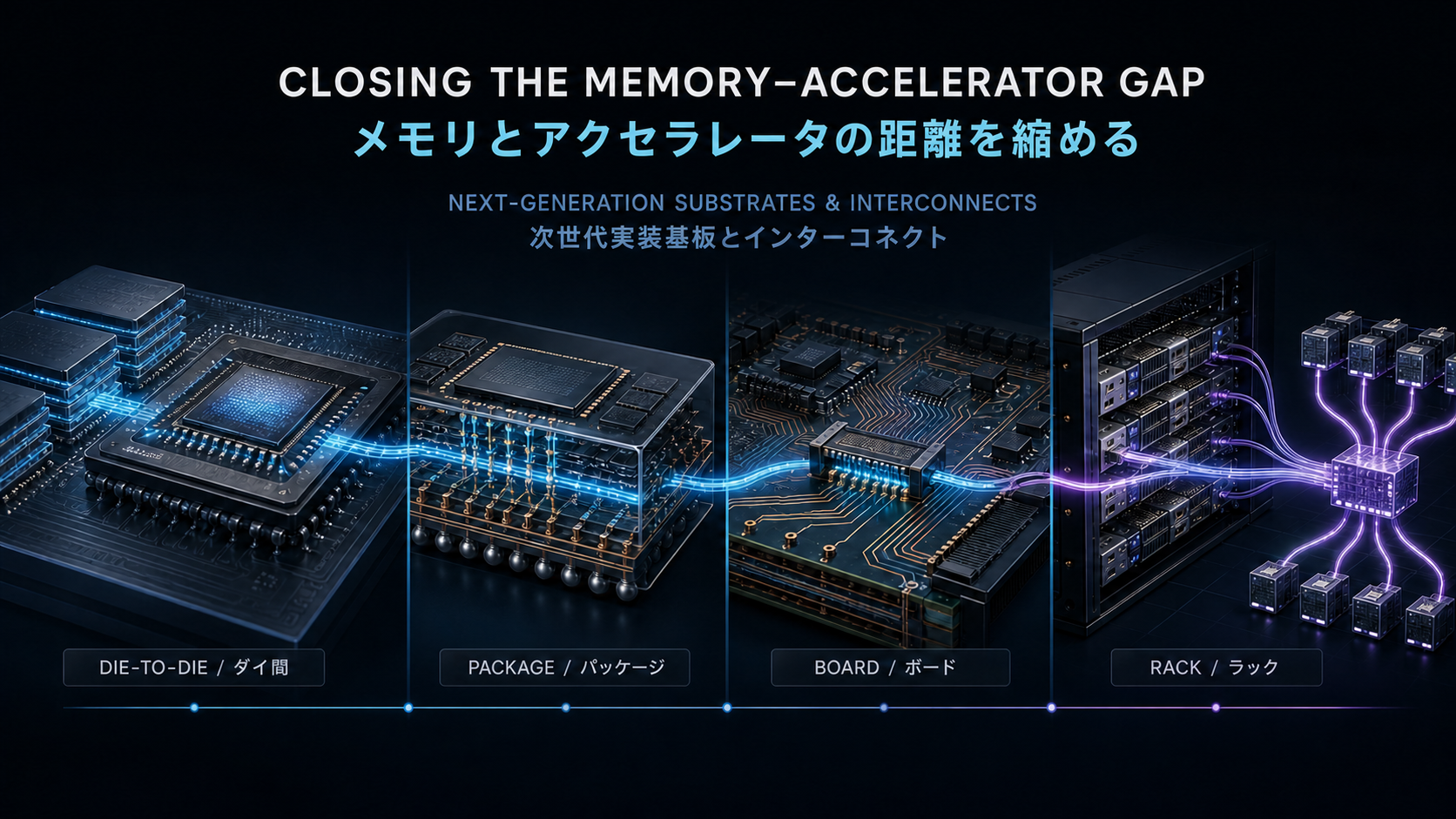
The technical fight collapses to one point: not the arithmetic units, but the data movement between memory and compute — the "memory wall." The nine approaches split right here. Groq throws out external HBM and packs huge SRAM onto the die; Axelera embeds compute inside the SRAM cells (in-memory); PFN stacks memory and logic vertically in 3D; EdgeCortix wrings out cheap external DRAM with a dedicated block. How each climbs the wall is its personality — and where it places its moat.
That is the technology trend. As an investor, the line I draw is: whose wallet does this reach, and how does it extract money? And there the landscape splits cleanly.
The First Line an Investor Draws: Four Architectures × Business Models
A second observation. Line up the nine, and before any debate about technical merit, the monetization model splits four ways. This is where I sort first.
| Model | Companies | Source of value | Monetization speed | The CVC question |
|---|---|---|---|---|
| ① Hyperscaler in-house | Google (TPU) | Own cloud consumption / platform | Indirect (Gemini, cloud rental) | Parent too large for direct upside |
| ② Ecosystem lock-in | NVIDIA (Jetson) | CUDA/Isaac + integrated SoC | Fast (direct + lock-in) | Strongest moat, but expensive |
| ③ Edge NPU IP/SoC | Kneron, Hailo, Axelera, EdgeCortix | Chips / IP licenses | Tied to adoption cycle | Volume-design wins vs. valuation |
| ④ Deterministic / new-memory upstarts | Groq, PFN, Tenstorrent | Inference service / design IP | Capital-intensive, partner-dependent | Big capital and a large patron — or not |
What bites here is the capital intensity and long adoption cycle endemic to semiconductors and hardware. For ③, even great tech takes years to clear automotive/industrial qualification. For ④, whether it's Groq packing SRAM or PFN stacking 3D, volume production demands enormous capital and a manufacturing partner. "A good architecture" and "a good investment" are different things, and neither closes on its own.
That structure showed most dramatically in ④'s Groq. An independent that achieved ultra-low latency through deterministic execution ended up under NVIDIA's roughly $20 billion roof. I read this not as defeat but as proof of structure: inference-only silicon ultimately converges into a battle of capital and ecosystem. With that lens, here are the nine in detail.
Mapping the Nine Companies
A third observation. The nine share the "NPU / AI accelerator" banner, but their funding stages, power ranges, and target markets are all over the map; one ruler will not measure them. I scan on finance, technology, commercialization, and the hardware profile of the flagship chip. Figures are as of June 2026, prioritizing what I could re-confirm against primary sources and official announcements.
Finance and Corporate
| Company | HQ | Founded | Total raised / valuation | Lead backers | Key people |
|---|---|---|---|---|---|
| Kneron | San Diego / Taiwan | 2015 | ~$190M (+$49M in May 2026) | Qualcomm, Sequoia, Foxconn, Himax, Winbond, Alibaba | Albert Liu (CEO) |
| Hailo | Israel | 2017 | ~$340M / valuation $1.2B → halved to under $500M | OurCrowd, ABB, Delek-linked | Orr Danon (CEO) |
| Axelera AI | Eindhoven, NL | 2021 | $250M+ (largest in EU) | imec, Samsung Catalyst, EuroHPC (public) | F. Del Maffeo (CEO) |
| EdgeCortix | Tokyo | 2019 | $110M+ (oversubscribed Series B) | TDK Ventures, SBI, NTT Finance, NEDO | S. Dasgupta (CEO) |
| NVIDIA | Santa Clara | 1993 | Self-funded (operating cash flow) | — (listed) | Jensen Huang (CEO) |
| Google (TPU) | Mountain View | — | Internal (Alphabet budget) | Alphabet | Cloud / DeepMind |
| Preferred Networks | Tokyo | 2014 | Domestic VC / corporates (undisclosed) | Toyota, NTT, ENEOS, MHI | T. Nishikawa (CEO) |
| Tenstorrent | US / Canada | 2016 | $693M (Series D, $2B valuation) | Samsung, Hyundai, LG, Fidelity, Bezos | Jim Keller (CEO) |
| Groq | Mountain View | 2016 | ~$3B / $6.9B valuation + $20B NVIDIA deal | Saudi ($1.5B), Samsung (mfg), various VCs | Simon Edwards (CEO) |
Finance alone reveals the past six months' tectonic shift. Groq raised $750M at a $6.9B valuation in September 2025, then in December signed a ~$20B non-exclusive license plus talent transfer with NVIDIA. Founder Jonathan Ross is now on NVIDIA's side; Groq runs independently under new CEO Simon Edwards. Hailo, by contrast, saw its peak $1.2B valuation halve to under $500M and is pursuing a de facto rushed IPO via SPAC (a non-binding MOU in March 2026). Within the same edge-NPU bucket, the volume-production honor student Hailo sank into a down-round while Europe's Axelera rode the largest AI-semiconductor raise in the EU — you cannot start the investment-merit debate without that contrast in view.
Technology and Core Architecture
| Company | Architecture | Core technology | Representative spec | Main target |
|---|---|---|---|---|
| Kneron | Dynamically reconfigurable NPU | INT4/Transformer support + data compression | KL830 = 10 eTOPS @2W | Edge GPT, AI PC, surveillance |
| Hailo | Structure-defined dataflow | Distributed memory + Dataflow Compiler | Hailo-8 = 26 TOPS @2.5W | Automotive/industrial vision, edge LLM |
| Axelera AI | Digital in-memory (D-IMC) | MAC inside SRAM + RISC-V | Europa = 629 TOPS @45W | Heavy edge, multi-camera, GenAI |
| EdgeCortix | Reconfigurable (DNA) + MERA | Efficient external-DRAM use (Reshaper) | SAKURA-II = 60 TOPS @10W | Batch-1 low-latency GenAI, defense/space |
| NVIDIA | Integrated SoC (Blackwell + Arm) | CUDA / Tensor Core / Isaac | Jetson Thor = 2,070 TFLOPS FP4 | Humanoids, autonomous machines, heavy edge |
| Google (TPU) | Systolic-array ASIC | Ironwood (v7) inference-first | 192GB HBM3e / 7.4 TB/s | Cloud-scale training & inference |
| Preferred Networks | SIMD deterministic (MN-Core) | No instruction decoder + 3D-stacked DRAM | MN-Core 2 = 393 TFLOPS @TF16 | Training & GenAI inference (in-house) |
| Tenstorrent | RISC-V Tensix mesh | Open IP + TT-Metalium | Blackhole = up to ~300W class | Scale-out inference, IP licensing |
| Groq | Deterministic LPU | Large on-die SRAM (no HBM) | Ultra-low latency, high throughput | Real-time LLM inference (cloud) |
On technology, the axis I find most decisive is software- and compiler-maturity. Deterministic execution — Groq and PFN even discard branch prediction and hand the entire timeline to the compiler — erases latency jitter, but a weak compiler turns the silicon into a paperweight. Kneron, Hailo, and EdgeCortix instead compete on developer experience: how easily a standard framework (PyTorch, etc.) compiles down. More than headline TOPS, I treat "does it really run in software" as the proxy variable for whether it closes at volume.
Commercialization Stage
| Company | Stage | Key validation / adoption | Flagship products |
|---|---|---|---|
| Kneron | Volume | AI PC, surveillance, automotive / COMPUTEX 2026 | KL520–KL830 |
| Hailo | Volume but financially strained | 300+ customers, Raspberry Pi AI HAT+ / SPAC IPO | Hailo-8 / 10 / 15 |
| Axelera AI | Entering volume | Metis shipping (2025), Europa ships H1 2026 | Metis / Europa |
| EdgeCortix | Shipping in real use | Defense, space, industrial; NEDO-backed | SAKURA-II / X |
| NVIDIA | De facto standard | Jetson Thor GA Nov 2025 ($3,499) | Jetson Orin / Thor |
| Google (TPU) | Fully cloud-integrated | Gemini, large external (Anthropic, etc.) | Cloud TPU (Ironwood) |
| Preferred Networks | In-house focused | MN-3 #1 on Green500, MHI alliance | MN-Core L1000 (2027) |
| Tenstorrent | Products + IP supply | IP to automotive OEMs / server builders | Wormhole / Blackhole |
| Groq | Service surge → reorg | GroqCloud (OpenAI-compatible API) / under NVIDIA | Groq 3 LPU (revealed GTC 2026) |
This third table is the most eloquent for an investor. NVIDIA is the de facto standard at the heavy edge (robots, autonomous machines) and Google is fully integrated in the cloud — the two listed names already "sell." The private cohort, by contrast, varies wildly in commercialization. Hailo is in volume at 300+ customers yet financially strained; PFN's real bet, L1000, is a step further out in 2027; Groq was so good it got absorbed by NVIDIA. Technical maturity and "does it pay off as an investment" don't line up here either.
Hardware Profile of the Flagship Chips
| Chip (company) | Compute | TDP | Memory | Max model (rough) | Main use |
|---|---|---|---|---|---|
| KL830 (Kneron) | 10 eTOPS @INT8 | 2W | Tiny on-die SRAM | <1B (lightweight GPT) | Edge AI PC, USB dongle |
| Hailo-10 (Hailo) | 40 TOPS @INT8 | 2.5–5W | Shared host LPDDR | ~7B (compressed Llama class) | Mobile/automotive local inference |
| Europa (Axelera) | 629 TOPS @INT8 | 45W | 128MB L2 + up to 64GB LPDDR5 (200GB/s) | ~32B single | Heavy edge, multi-camera, GenAI |
| SAKURA-II (EdgeCortix) | 60 TOPS @INT8 / 30 TFLOPS @BF16 | 10W | 20MB + up to 32GB LPDDR4x (68GB/s) | 7–13B (batch 1) | Low-latency GenAI, defense/space |
| Jetson AGX Thor (NVIDIA) | 2,070 TFLOPS @FP4 | 40–130W | 128GB LPDDR5X (276GB/s) | 30–70B | Humanoids, autonomous mobile robots |
| Ironwood / TPU v7 (Google) | Inference-first (per-chip undisclosed) | Liquid-cooled | 192GB HBM3e (7.4 TB/s) | Ultra-large (incl. MoE) | Cloud inference, agents |
| MN-Core L1000 (PFN) | Up to ~10× GPU (company claim) | Undisclosed | 3D-stacked DRAM (wide band) | Large-scale GenAI | Cloud inference (2027) |
| Groq 3 LPU (Groq/NVIDIA) | Very high throughput | Air-cooled rack | Large on-die SRAM (no HBM) | Large via rack-scale | Real-time LLM decode |
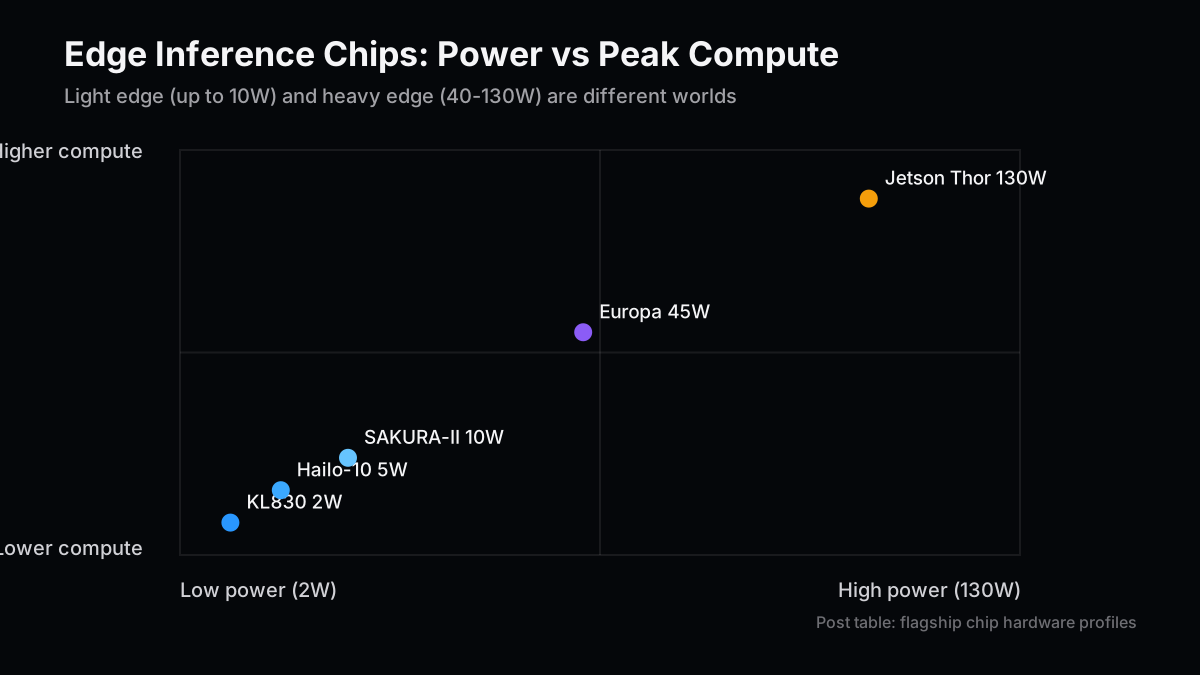
Read the power column vertically and the battlefield splits cleanly into "light edge (≤10W)" and "heavy edge (40–130W)." The 2W Kneron and the 130W Jetson Thor are residents of different planets despite both saying "edge." The investment implication is simple: light edge is a low-ASP, win-on-volume world (components, IP); heavy edge is a world of integrated SoCs and ecosystem lock-in (NVIDIA's garden). Evaluate them together and you'll misjudge.
How to Read This From the Outside — Focus Points and Red Flags
A fourth observation. Reading an NPU company is startlingly similar to the semiconductor-startup investment work I used to do: the question is not "does it work" but "does it close at volume" — meaning commercial adoption. Here is the one-pager I use.
| Evaluation axis | What to look at | Good sign | Red flag |
|---|---|---|---|
| Software / compiler | Ease of lowering from standard FW | Volume deploys straight from PyTorch | Only runs demo models |
| Power / thermal envelope | Light vs. heavy edge | Cooling/chassis matched to TDP | Great spec sheet, blank thermal design |
| Capital resilience of memory strategy | Volume cost of climbing the wall | Secured fab partner (e.g., Samsung) | No capital to sustain SRAM/3D at volume |
| Customer / geopolitical concentration | Revenue and supply-chain skew | Diversified region/use | China or single-OEM dependence (e.g., Kneron) |
| IP / moat ownership | Who holds the design IP | Owns the architecture IP | IP flows to customer; degrades to contract work |
| Capital & ecosystem | Can it fight alone | A large patron / link to a standard | Tech only; thin capital and channels |
And the red flag I am watching most closely is valuation — not as theory. I have sat in an investment committee, recognized that a follow-on round's valuation was excessive, opposed it with data, and led the renegotiation. NPUs are precisely the setup that falls into this pattern.
| Red flag | Why it's dangerous | Question to ask |
|---|---|---|
| Valuation collapses despite volume | Component-cost / gross-margin structure (Hailo type) | What's the path to profit and the gross margin? |
| Peak-TOPS-only benchmarks | Lab conditions vs. real effective Goodput | Effective utilization on real models? |
| Press-release partnerships | No money is moving | The real NRE / PO / license terms? |
| Roster of giant sponsor names | Names used to inflate valuation | Each investor's actual check size and terms? |
| "Independent winner" narrative | Eventually swallowed by capital/standards | The capital to run to volume alone? |
By name, today's Hailo is a live textbook. First-rate tech, designed into the Raspberry Pi AI HAT+, in volume at 300+ customers — and yet rising component costs and the margin wall halved its valuation and forced it toward a rushed SPAC IPO. A good company and a good investment are not always the same. I've re-engraved that with two live examples: Groq's "absorption" and Hailo's "down-round."
Public Proxies and the Private Watchlist
A fifth observation. Fine — the NPU appeal is clear, so what can I actually buy? As an individual investor, of the nine, the only listed names within reach are NVIDIA and Alphabet (Google); the other seven are private. So instead of "buying NPU directly," I hunt for the adjacent listed companies that profit the more NPUs ramp.
| Public proxy | Ticker | NPU linkage | My read |
|---|---|---|---|
| NVIDIA | NVDA | Jetson + $20B Groq license corner inference too | Biggest beneficiary of heavy edge → inference; primary |
| Alphabet | GOOGL | TPU Ironwood optimizes its own inference | Cloud-inference efficiency; large parent, gradual |
| Samsung Electronics | 005930.KS | Builds Groq 3 LPU on 4nm + Tenstorrent backer | "Make × back," low-leak exposure |
| TSMC | TSM | Common foundry for the edge-NPU cohort | Pick-and-shovel for the whole theme |
| Arm Holdings | ARM | Host-CPU IP in Jetson and others | Hidden toll booth in heavy-edge SoCs |
| Hon Hai (Foxconn) | 2317.TW | Kneron investor and volume manufacturer | Two-sided: assembly + equity |
| Himax / Qualcomm | HIMX / QCOM | Strategic investors in Kneron | Small but high-purity edge-vision exposure |
| TDK | 6762.T | TDK Ventures backs EdgeCortix | One of few windows into a Japan-born edge NPU |
The most coherent exposure, ironically, is not an edge-NPU upstart — it is NVIDIA. It de facto dominates the heavy edge with Jetson and just folded in the sharpest inference tech via the Groq license. The pick-and-shovel seller carries low-leak exposure to both edge and inference. Next is Samsung, working both as "maker" (the Groq 3 LPU on 4nm) and "backer" (Tenstorrent). GOOGL optimizes its own inference with Ironwood, but the parent is large and the needle moves slowly, so I hold it as option value.
On the private side, I split the watchlist by character. Axelera (largest-in-EU raise, Europa entering volume) and EdgeCortix (Japan-born, defense/space, TDK/NEDO) are "primary targets if a secondary or IPO appears"; Tenstorrent (Jim Keller, Samsung/Hyundai) and PFN (L1000 in 2027, MHI alliance) are "names to watch with thick patron roofs"; Kneron (COMPUTEX 2026, Foxconn-linked) is "real in volume but watch the geopolitics"; and Hailo is "caution on valuation even if it lists."
Scenarios and the Investment Call
Finally, here is a scenario frame for how the edge-to-inference accelerator theme pays off over 2026–2028 — and I tie the four models I sorted earlier to the scenario where each wins.
| Scenario | Subjective probability | Story | Beneficiary model / names |
|---|---|---|---|
| Base | 50% | Inference demand grows steadily; heavy edge and cloud lead | ② NVIDIA, ① Google, makers Samsung/TSM |
| Bull | 20% | Humanoids / physical AI lift off early | ② NVIDIA (Jetson), Arm, ③ Axelera/EdgeCortix |
| Bear | 20% | Edge adoption lags; inference concentrates in cloud | ① Google, ② NVIDIA (cloud side) only hold up |
| Tail | 10% | Down-rounds / funding strain cascade among privates | Listed proxies (NVDA/GOOGL/Samsung) relatively safe |
What works across every scenario is the infrastructure side that owns inference demand and manufacturing. So my investment call is explicit: near-term, I get exposure through public proxies — anchored on NVDA and Samsung (make × back), with GOOGL and TSM in support. I do not buy NPUs themselves; I ride the structure where the more edge and inference ramp, the more GPUs, fabrication, and cloud sell.
Medium-term, I see appeal in model ③, the edge-NPU IP/SoC names. Axelera's Europa entering volume and EdgeCortix's defense/space adoption are designs that stab directly into real light/heavy-edge demand, and a thin listed window (TDK, etc.) exists. But because they take on volume, margin, and geopolitical risk, I keep ongoing checks on execution as a condition here.
For the private pure-NPU plays, my current conclusion is caution on valuation. Groq's "absorption" and Hailo's "halving" showed that inference-only silicon ultimately converges into a battle of capital and ecosystem. Even with first-rate technology, riding a name at a high price where the gap between commercialization and valuation has widened is the failure I most want to avoid as an investor. This is my view as of June 2026, and I will mark it to market in six months.
Next Issue Ideas
- Idea 1: The Power BOM of Data-Center Inference — Decomposing TPU Ironwood and Liquid Cooling, Component by Component — Map the power-and-cooling investment landscape of cloud inference, starting from Ironwood's 192GB HBM3e and drilling to components. A sequel to this post's "cloud inference" thread.
- Idea 2: What Did NVIDIA × Groq ($20B) Change? — Inference Consolidation vs. the Antitrust Tug-of-War — Drill into the "absorption" of inference-only silicon across regulation, standards, and supply chain, and hunt contrarian-style for the next name likely to be swallowed.
- Idea 3: A Sensitivity Analysis of Edge-NPU Public Proxies — Do Himax, TDK, and Hon Hai Actually Move at the Parent Level? — Quantify, by revenue contribution, whether high-purity small proxies really move the earnings needle on the NPU theme.
Related Posts
- What Did NVIDIA × Groq ($20B) Change? Inference Consolidation, the Antitrust Tug-of-War, and Reading the Next Targets Through MangoBoost — The NVIDIA-Groq $20B deal analyzed across regulation and supply chain — contrarian screen for next acquisition targets…
- Reading the 8 AI Materials-Discovery Companies From the Outside: An MI Investment Map and Its Public Proxies — An outside-in read of eight AI materials-informatics companies — mapping the IP vs.
- Semiconductor VC Series①: Converging on AI Bottlenecks — Where are Tier-1 VCs placing bets in the expanding $975B semiconductor market? Strategies of Sequoia, a16z, Kleiner Pe…
- The Investment Map of AI Infrastructure's "Silicon Periphery": Power, Cooling, Optics, and Site Plays Hiding in Plain Sight — Watching only NVIDIA and AMD misses the point.
References
The factual and numerical assumptions in this article are anchored to primary or public sources that readers can revisit during review and future updates (as of June 2026).
- TheStreet: NVIDIA's ~$20B Groq play and 2026 inference consolidation
- Google Blog: Ironwood, the first TPU for the age of inference
- NVIDIA Newsroom: Blackwell-powered Jetson Thor now available
- Axelera AI: Europa AIPU (629 TOPS @45W) announced
- EdgeCortix: oversubscribed Series B brings total funding over $110M
- Calcalist: Hailo's valuation halved to under $500M ahead of urgent IPO
This article is for informational purposes only and does not constitute investment advice or a recommendation of any specific stock, service, or contract structure. The author may hold positions or interests related to companies or services mentioned. Generative AI was used for parts of research, translation, and proofreading, with final review by ZYL0. See the disclaimer for details.