Tightening by Pressure: Bessent, a Firmer Yen, and the Choice Facing Japanese Equities
A Bessent remark on Abenomics lifted the yen from the upper-159s to the mid-156s against the dollar, and the BOJ heads into its Sept 17-18 meeting leaning toward a hike, splitting Japanese equities into winners and losers along a line most coverage misses.

A Bessent remark on Abenomics lifted the yen from the upper-159s to the mid-156s against the dollar, and the BOJ heads into its Sept 17-18 meeting leaning toward a hike, splitting Japanese equities into winners and losers along a line most coverage misses.


Tightening by Pressure: Bessent, a Firmer Yen, and the Choice Facing Japanese Equities
Part 1 started from Fed Chair Warsh's Jackson Hole speech and traced what it did to rates and dollar-yen. The piece right before this one traced how a blowout jobs print pushed US equities down through the discount rate. Both pieces were written from the US side of the table. Then, late in the same week, the rate story crossed the Pacific and came back from the other direction. A single remark from US Treasury Secretary Scott Bessent about Japanese monetary policy moved dollar-yen by more than three yen in under a week and pushed the Bank of Japan's September meeting into "a hike is nearly certain" territory. That felt like it belonged alongside Part 1. And the more I dug into it, the clearer it became that this tightening pressure is not coming from strong domestic demand in Japan — it is coming almost entirely from outside. If Part 1 was the US-side rate shock, this is its mirror image on the Japanese side.
Taking Apart the Bessent Remarks
My honest first reaction to reading these comments was: he really said the quiet part out loud.
Speaking around a G20-related gathering in North Carolina, Bessent made a string of pointed comments about Japan's monetary and fiscal policy. On Sunday, August 30, he reportedly met with BOJ Governor Kazuo Ueda directly and pressed the case for a rate hike — a US Treasury official told Japanese public broadcaster NHK as much. He then called Abenomics "a tremendous success" while adding that Japan should "let that run and stop the reflation," saying Japan can "sit back and enjoy the benefits." Given that Prime Minister Sanae Takaichi has built her platform on expansionary fiscal policy, this reads as a pointed jab at her own agenda.
Laid out chronologically, the sequence of remarks shows a deliberate design.
| Date | Remark | Implication |
|---|---|---|
| Aug 30 (Sun) | Met Ueda directly, pressed the case for a hike | Direct political pressure on the BOJ |
| Aug 31 - Sep 1 | "A tremendous success in Abenomics," Japan should "let that run and stop the reflation" | A jab at PM Takaichi's expansionary fiscal stance |
| Sep 1 | Japan should "do the right thing" on policy, end "outdated ideas about big stimulus" | A push on both fiscal and monetary fronts |
| Sep 2 | Recent yen moves were "not disorderly" | Not opposition to intervention, but tacit approval of yen strength |
Pressuring fiscal and monetary policy in the same breath is not a common move. Bessent went further still, voicing "strong support for Japan's decisive market and monetary steps to address the substantial undervaluation of the yen." Support the intervention, stop the reflation, hike rates — all three demands point the same direction. I am comfortable calling that external pressure and not much else.
The Yen Got Stronger, Not Weaker
This is the point most likely to get garbled, and it matters for the title of this piece, so let me nail it down first.
I have seen some coverage and social posts frame this as yen weakness. It is the opposite: dollar-yen went down, meaning the yen got stronger. When I wrote Part 1 on August 28, dollar-yen sat around 159.4. From there, Bessent's comments and hawkish remarks from BOJ board member Hajime Takata combined to pull it down to 156.71 by September 3. Nearly three yen of movement in under a week is a large move by any FX standard.
Tracing the path from the intervention through this latest leg makes the sequence clear.
| Point in time | USD/JPY | Context |
|---|---|---|
| Jul 30 (pre-intervention) | 163.99 | A genuine 40-year low for the yen |
| Jul 31 (joint intervention) | 157.40 | First US-Japan joint intervention in 28 years |
| Aug 28 (Part 1 baseline) | ~159.4 | A partial rebound off the intervention low |
| Sep 3 (after Bessent's remarks) | 156.71 | Compounded by Takata's own hawkish comments |
| Sep 4 (after the jobs print) | 156.23 | Barely dented despite a print that ran roughly 3x consensus |
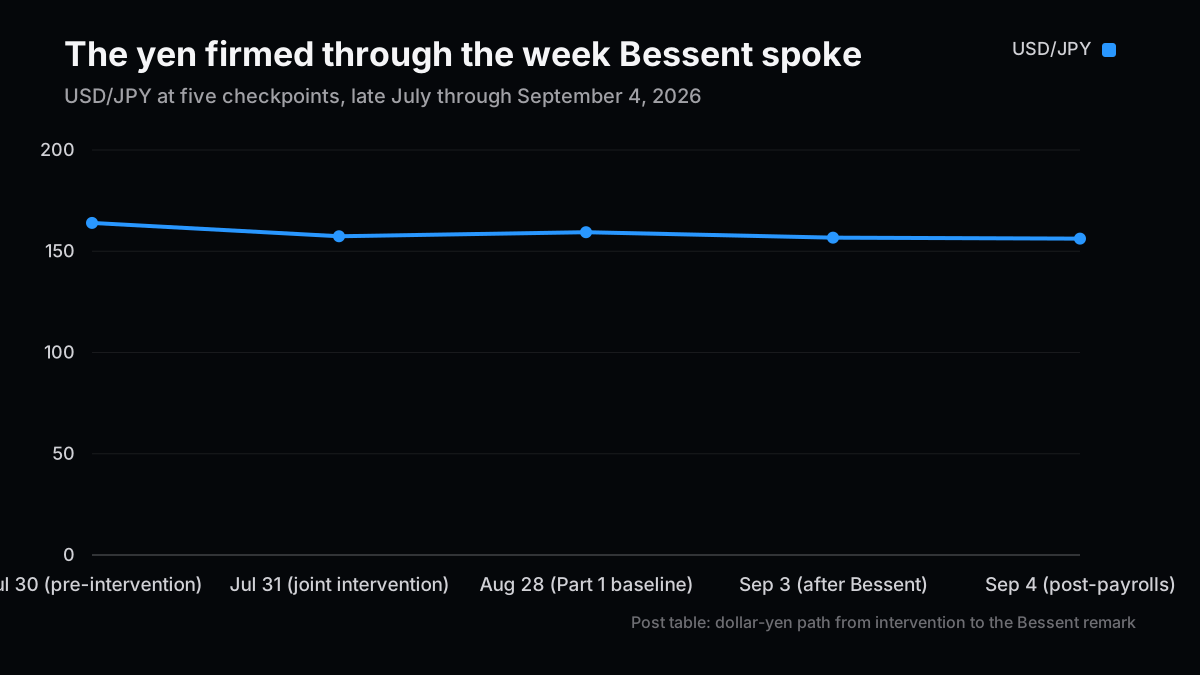
What I find most telling is September 4. As I laid out in the prior piece, that day's US jobs report landed at roughly three times consensus, and the dollar rallied broadly on the back of it. Yet dollar-yen barely moved off 156.23. If the dollar is strong across the board and dollar-yen still does not budge, that tells you the yen-side story — BOJ hike expectations — is outmuscling the dollar-side story on this particular pair right now. It is a small but useful litmus test for which side of the Pacific currently carries more gravitational pull.
The backdrop is worth spelling out too. Between July 31 and August 26, Japan spent a record ¥15.4 trillion (roughly $96 billion) defending the yen — the largest monthly intervention on record. The pre-intervention slide to 163.99 reflected not just the rate differential but also investor unease over PM Takaichi's fiscal expansion plans. President Trump characterized the coordinated action as "a signal of friendship," though in practice it also served US interests: narrowing the trade deficit and underwriting Japan's pledged $550 billion in US investment. Intervention, diplomacy, and monetary policy are unusually tangled together in this episode.
The Reality of the September 17-18 BOJ Meeting
The closer the meeting gets, the more the real question shifts from whether the BOJ hikes to how large the move turns out to be — that is my honest read at this point.
The BOJ's policy rate currently sits at 1.00%. The July 31 meeting held there on an 8-1 vote, with board member Hajime Takata dissenting in favor of 1.25% (as I noted in Part 1). The next meeting is September 17-18. Governor Ueda has said underlying inflation is "quite close" to the 2% target and stated plainly that the board will "fully discuss" a hike "at every policy meeting, including the next one." When asked directly whether he objected to markets nearly fully pricing a September hike, he declined to comment — which I read as closer to tacit agreement than genuine ambiguity.
As with the jobs-report piece, the reported hike probabilities disagree across sources — the same pattern shows up again here.
| Source | As of | Implied hike probability |
|---|---|---|
| Verified primary reading (Sep 4 AM) | Sep 4 | ~98% |
| Press reading A | Sep 2 | ~92% |
| Press reading B | Early Sep | ~84% |
| Tightening priced through year-end | Sep 3 | ~49bp (up from ~22bp at end of July) |
What strikes me more than the headline probability is that 49bp figure priced through year-end. Pricing more than a single 25bp move implies the market is no longer just betting on September in isolation — it is starting to price a September-and-December combination. Takata has kept leaning hawkish since, and there is now real chatter that the BOJ could deliver a 50bp "jumbo" hike at the September meeting rather than the standard 25bp.
One aside worth flagging: Ueda's studied refusal to comment on market pricing echoes, almost eerily, Warsh's line from Part 1 about being "committed to a discipline, not to a decision." Both chairs are deliberately withholding forward guidance. Whether that is coincidence or a shared house style among 2026's central bankers, I honestly cannot say yet.
The Paradox of Tightening Into Weak Domestic Demand
This is the section I most wanted to write.
When Japan's statistics bureau released July household spending data on September 4, I had to read it twice. Real spending by households of two or more people fell 3.6% year over year — the eighth straight month of decline, and the sharpest drop since January 2024's 6.3% fall. Consensus had expected a 1.6% decline, so this was a substantial miss. Nominal spending fell 1.5%. A ministry official attributed it to households "spending selectively while restraining outlays overall."
Breaking it down by category, the categories closest to daily necessities show the steepest declines.
| Category | Jul 2026 YoY (real) | Note |
|---|---|---|
| Total household spending | -3.6% | 8th straight decline; sharpest since Jan 2024 |
| Housing | -16.4% | The single steepest drop |
| Utilities | -9.2% | Worse than June's -7.1% |
| Transport & communication | -8.5% | Worse than June's -5.7% |
| Food | -1.3% | An improvement from June's -2.5% |
| Furniture & household goods | +0.7% | One of the few categories in the green |
Masato Koike, an economist at Daiwa Institute of Research, noted that even with wages rising, "downward pressure on consumption is expected to intensify as higher prices become more pronounced going forward." Fresh food prices rose 7% year over year in July, so even as real wages turn positive on paper, the felt sense of belt-tightening has not gone away.
Now recall the shape of the prior piece. In the US, a strong jobs print confirmed economic strength, and that strength reinforced hike odds — numerator and denominator moved the same direction. Japan's case is twisted the other way. Consumption data has been negative for eight straight months. And yet BOJ hike expectations strengthened over the same week regardless. The reason is not overheating domestic demand — it is a remark from across the Pacific. When policy direction and the underlying economic reality point opposite ways, I think "tightening by pressure" is the honest name for it.
I spent a stretch of my career managing cross-border projects between Japan and the US in English, and I learned something that keeps resurfacing here. Project assumptions and deadlines get fixed by whichever side holds the leverage, regardless of how ready the other side actually is. No matter how loudly the local team argues that the data is not there yet or that more time is needed, once the party with leverage locks in a timeline, everyone else shifts into reconciliation mode. Watching the exchange between the BOJ and the US Treasury this week, that same feeling came right back. Ueda's carefully repeated line — "we discuss it at every meeting" — was, ironically, only sustainable until an explicit external push arrived.
Winners and Losers Created by a Firmer Yen
Even a single trading day, September 3, made this asymmetry unusually visible.
Start with exporter sensitivity. Toyota discloses in its own investor materials that every ¥1 of yen strength against the dollar cuts annual operating profit by roughly ¥50 billion (and ¥10 billion per euro). The company typically budgets around ¥150 to the dollar, so a move into the mid-156 range eats directly into the FX gains that had been accumulating on the books.
On that same September 3, the Nikkei 225 fell 111 points to close at 64,214.48 — a fourth straight decline and its lowest close in roughly a month — while the TOPIX held up, adding 0.5% to 4,102.04. That divergence between the two indexes is itself a clue about where the winners and losers sit.
| Name / sector | Change on Sep 3 | Nature of FX exposure |
|---|---|---|
| Energy explorers | -3.26% | Dollar-denominated revenue erodes on yen strength |
| Advantest (semiconductor equipment) | -0.8% | Export-heavy, margins compress as the yen strengthens |
| TOPIX (broad market) | +0.5% | Diversified, so the impact is diluted |
| Nitori Holdings (import retail) | +8.41% | Import costs fall, lifting margins |
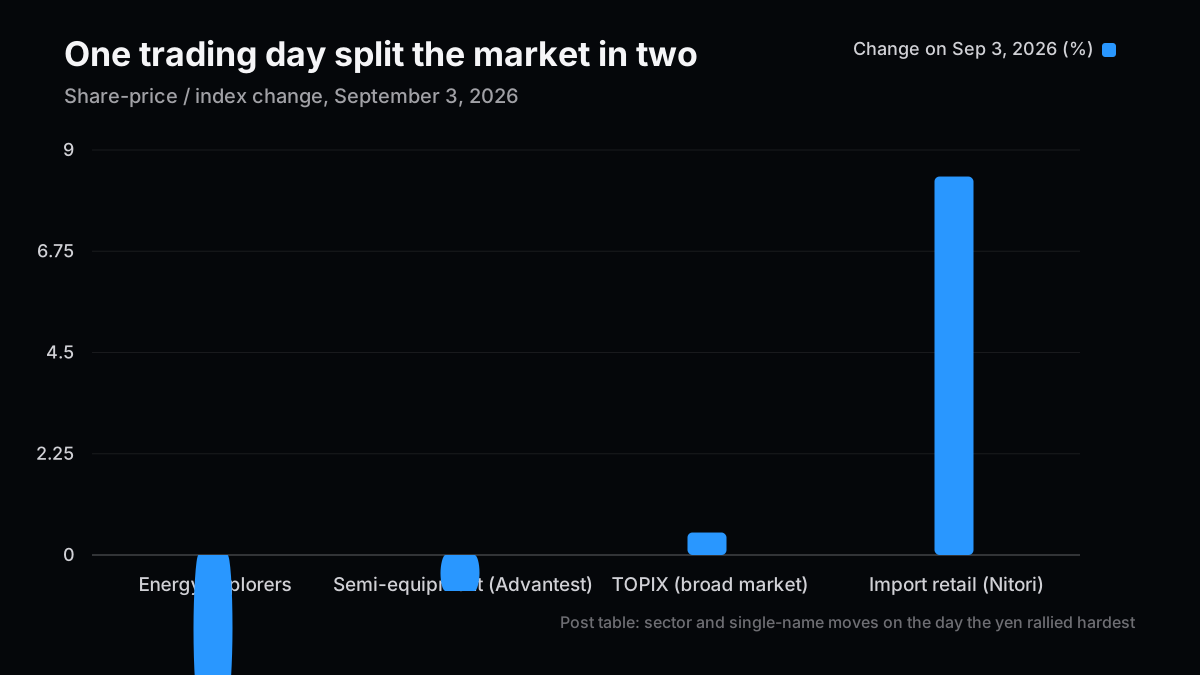
Nitori's 8.41% gain feels like the cleanest illustration in the whole data set. The company sources much of its furniture and household goods from overseas, so a firmer yen flows straight through to lower input costs. On the same day, the big trading houses — Mitsubishi Corp, Itochu, Mitsui & Co — also rallied. Trading houses hold resource interests and dollar-denominated assets, but also run import and trading operations, so their FX exposure does not collapse into a simple "yen strength is bad" story. That diversification is likely exactly why they outperformed the broad market that day. Dollar-revenue names — resource explorers, export-heavy semiconductor equipment makers — sold off clearly on the same tape. A firmer yen does not push Japanese equities down uniformly; the winners and losers only separate once you draw the line through each company's actual revenue structure. Most theme-level "Japan equities" coverage skips straight past that line.
Scenarios and How I Would Position
My conclusion up front: short-term volatility, medium-term selection — that is where I currently stand.
Of the three scenarios laid out in Part 1, the "main case" that pointed to a re-widening toward 160-165 has effectively been rewritten by Bessent's remarks. The variable is no longer primarily the rate-gap direction; it is the size of the BOJ's own hike. Here is the updated framework.
| Scenario | Sep 17-18 meeting | USD/JPY | Implication for Japanese equities |
|---|---|---|---|
| Base: 25bp hike, as priced | 1.00% -> 1.25% | Stable 153-157 range | Exporters take a temporary hit; domestic-demand and import names hold up |
| Main: 25bp hike + hawkish guidance | 1.00% -> 1.25%, signals more to come | Another leg down to 148-153 | Selection intensifies; exporters keep sliding |
| Tail: 50bp jumbo hike | 1.00% -> 1.50% (extension of Takata's proposal) | 145-150, squeeze-like action | A sharp hit to exporters; accelerated rotation into domestic-demand and small caps |
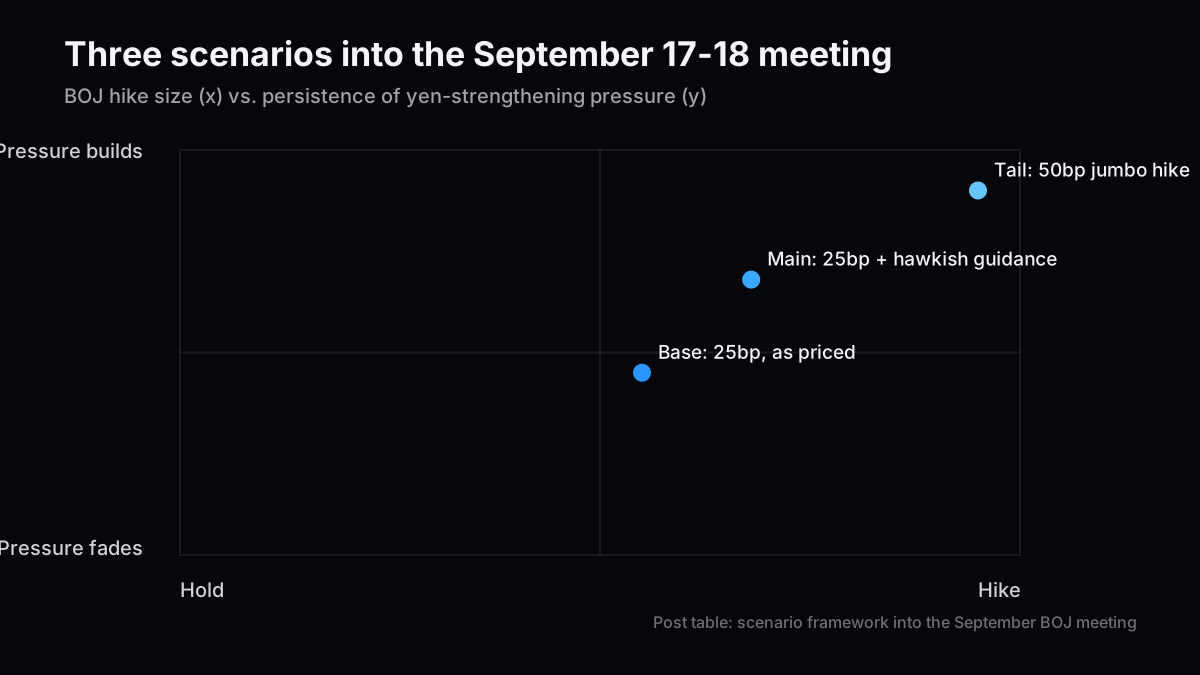
In the prior piece, I landed on "neutral on the short term, selectively long on the medium term" for AI-capex names. The shape of the call here is strikingly similar. The phase where you simply buy or sell "Japan equities" as a theme is over; this is a phase for re-sorting names along a single axis — FX sensitivity. Concretely, I am trimming exposure to dollar-revenue exporters and resource names, and building relative weight in import-heavy domestic-demand and retail names, along with the diversified trading houses that straddle both resource and import exposure. On valuation room, the Buffett Indicator piece I wrote earlier suggested Japanese equities still carry more cushion than US equities — but how much of that cushion this rate-hike cycle eats into is something I cannot see clearly before September 17-18.
Let me also state what would change my mind here. If the BOJ holds at its September 17-18 meeting and Governor Ueda explicitly cites the weakness in July's real consumption spending as the reason, then this round of hike expectations would turn out to have been driven by the underlying data after all, not external pressure — and the entire "tightening by pressure" framing of this piece falls apart. In that case, I would become a buyer of the exporter names on the bounce.
Monetary policy being pushed from outside, against a consumption picture that is weakening from within — the September 17-18 BOJ meeting is the first place that tension gets scored.
Next Issue Ideas
- Idea 1: Grading the September BOJ meeting — Score the actual hike size (25bp, 50bp, or a hold) and the dollar-yen and equity reaction against this piece's base/main/tail scenarios.
- Idea 2: Stress-testing trading-house FX resilience with real numbers — Take this piece's "diversified structure holds up better" hypothesis down to segment-level revenue and dollar-asset exposure at Mitsubishi Corp, Itochu, and Mitsui & Co.
- Idea 3: Comparing the "discipline" playbook at the Fed and the BOJ — Read Warsh's and Ueda's shared instinct to withhold forward guidance as part of a broader 2026 pattern in central-bank communication.
Related Posts
- The Warsh Shock — Part 1: How Jackson Hole Rewired the Rate and Dollar-Yen Outlook — The source of the 159.4 baseline and rate-gap scenarios this piece updates.
- Why a Blowout Jobs Print Sinks Stocks: Rereading a 3x Beat Through the Discount Rate — The US-side "strong economy equals hike odds" story; this piece is its mirror image on the Japanese side.
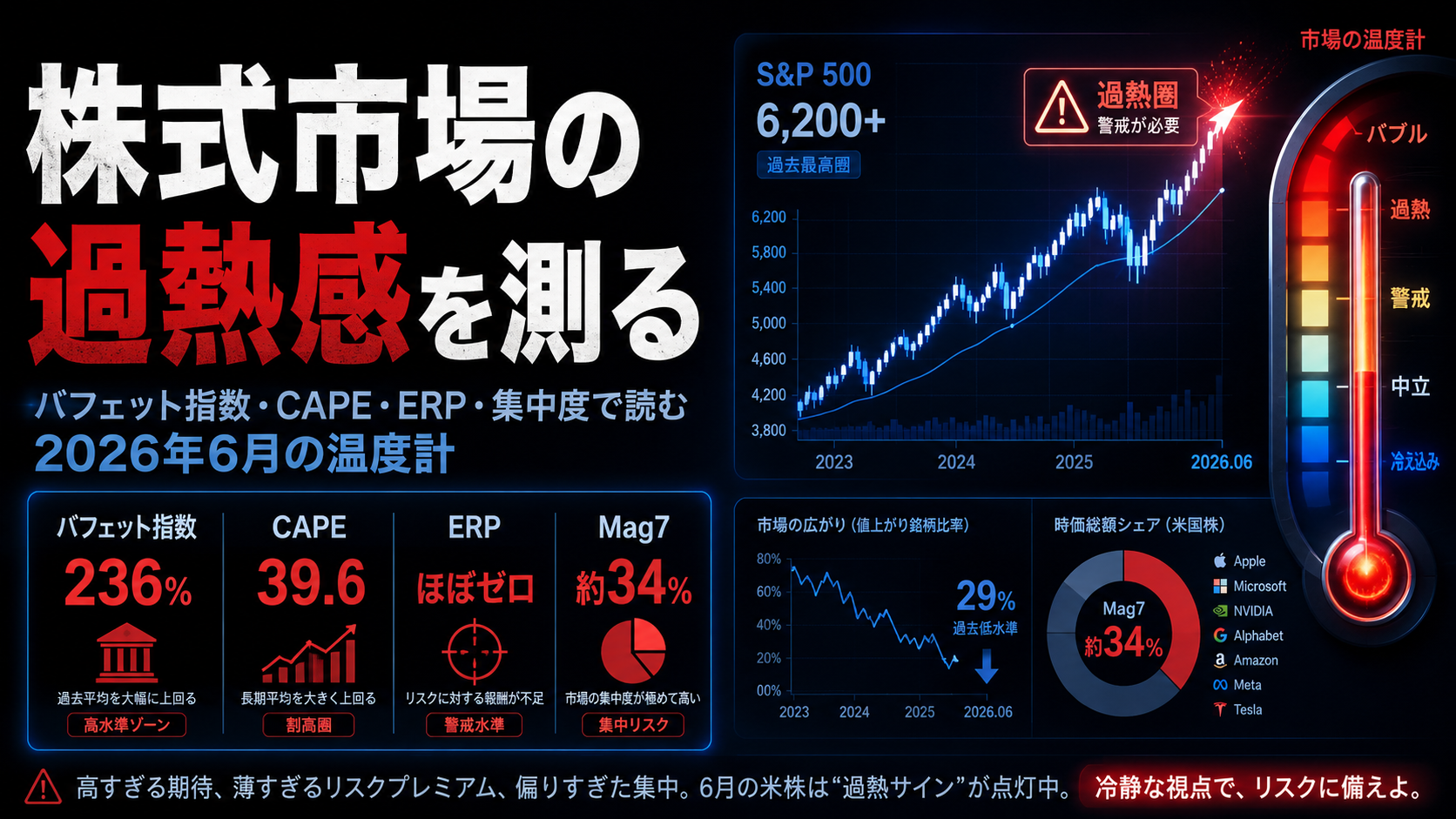
- Measuring Market Overheating: Buffett Indicator, CAPE, ERP and Concentration in June 2026 — A reference point for how much valuation cushion Japanese equities are carrying into this cycle.
References
Facts and figures in this piece prioritize primary and official sources readers can verify themselves.
- Bessent calls Abenomics "a tremendous success," backs intervention, pushes for a reflation reversal (Jiji Press)
- Analysis: Japan faces day of policy reckoning as Bessent calls time on big stimulus (Japan Today / Reuters)
- Japan spent record $96 bn in yen interventions: ministry (France24)
- Japan year-on-year household spending drops for 8 straight months (Investing.com / Reuters)
- BOJ to Discuss Rate Hike at Every Meeting: Governor Ueda (Nippon.com)
- Japan 30 Year Bond Yield (Trading Economics)
This article is for informational purposes only and does not constitute investment advice or a recommendation of any specific security, currency pair, or trade structure. The author may hold positions or interests related to the asset classes discussed. Generative AI was used for parts of research, translation, and proofreading, with final review by ZYL0. See the disclaimer for details.