The Warsh Shock — Part 2: How Far Rate Risk Reaches Into Tech Capex
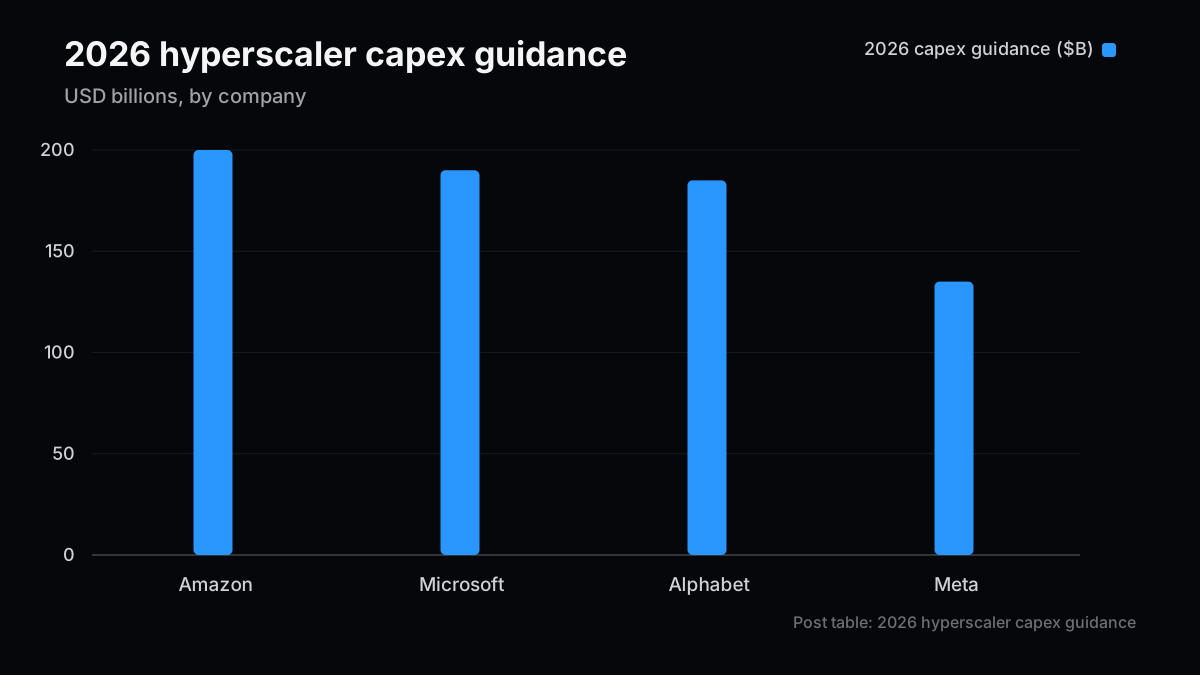
The four hyperscalers combined 2026 capex near 725 billion dollars, up 77% year over year, funded increasingly by debt and equity rather than cash flow. Part 2 examines how far rising rates threaten that buildout.
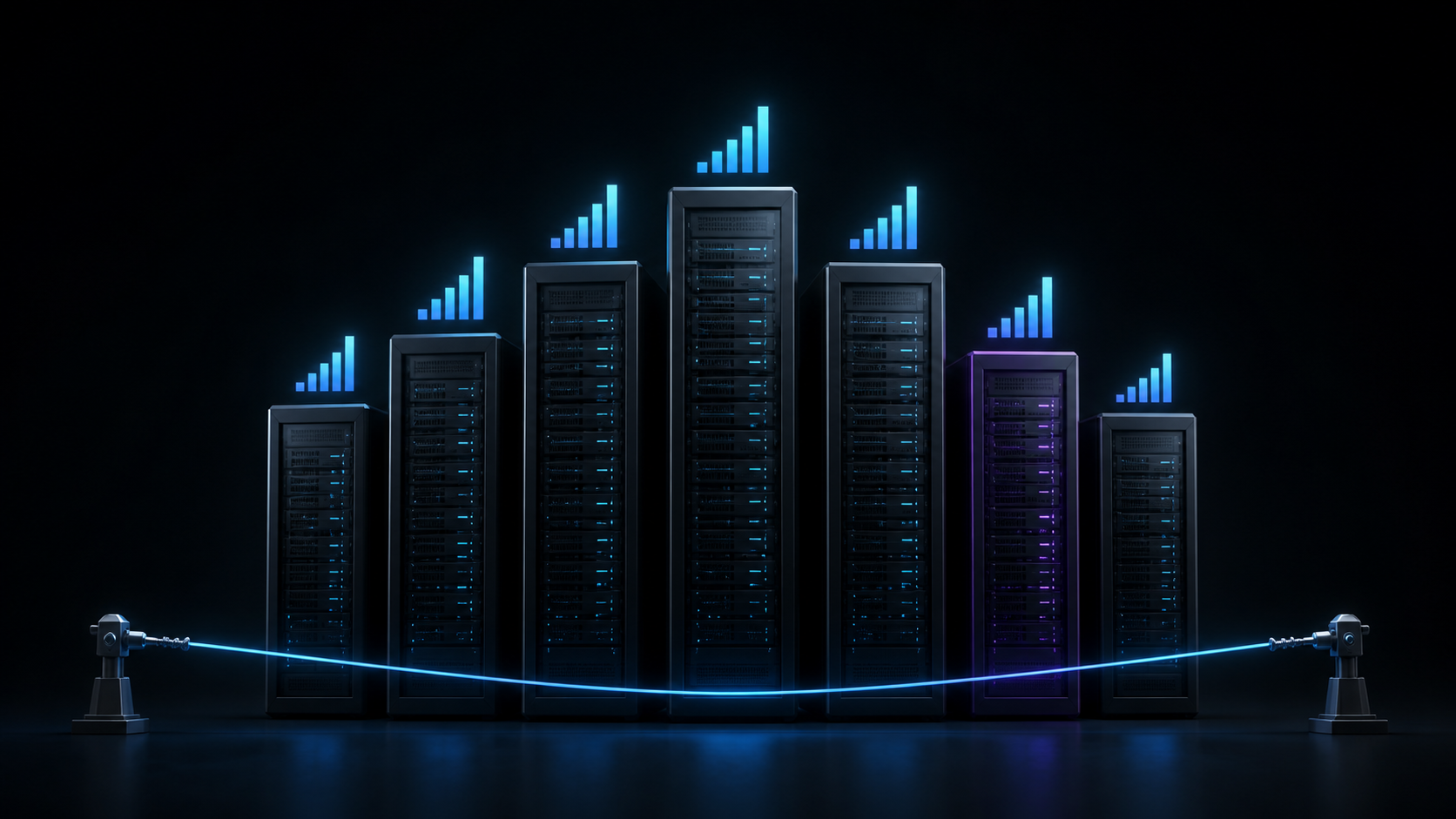
The four hyperscalers combined 2026 capex near 725 billion dollars, up 77% year over year, funded increasingly by debt and equity rather than cash flow. Part 2 examines how far rising rates threaten that buildout.


The Warsh Shock — Part 2: How Far Rate Risk Reaches Into Tech Capex
Part 1 used Kevin Warsh's Jackson Hole speech as the starting point for a rate outlook heading into the September FOMC meeting, plus a read on dollar-yen positioning risk. One question kept nagging at me while writing it: if rates really do rise, where does that burden actually land? This piece looks for the answer in the roughly $725 billion the four hyperscalers now plan to spend on capex in 2026.
From "Year One of AI Investment" to $725 Billion in a Single Year
Lining up Amazon, Microsoft, Alphabet, and Meta's 2026 capex guidance is worth pausing on before doing anything else with the numbers.
| Company | 2026 capex guidance | Revision history |
|---|---|---|
| Amazon | ~$200B | — |
| Microsoft | ~$190B | — |
| Alphabet | $180-190B | Raised from $175-185B at Q1 earnings; flagged a further 2027 increase |
| Meta | $125-145B | Raised from $115-135B |
| Combined | ~$725B | Up 77% from ~$410B in 2025 |
Some analysts already project the combined figure clearing $1 trillion in 2027. What surprised me wasn't the sheer size of these numbers — it was that all four companies raised guidance at their Q1 earnings, in a period when rates were already climbing. Seeing upward revisions rather than downward ones, in that setting, says something about how much conviction is still behind this capex cycle.
Conviction and sustainable financing are two different things, though. The next section looks at where this money is actually coming from.
From Self-Funded to Debt-and-Equity: A Shift in Financing Structure
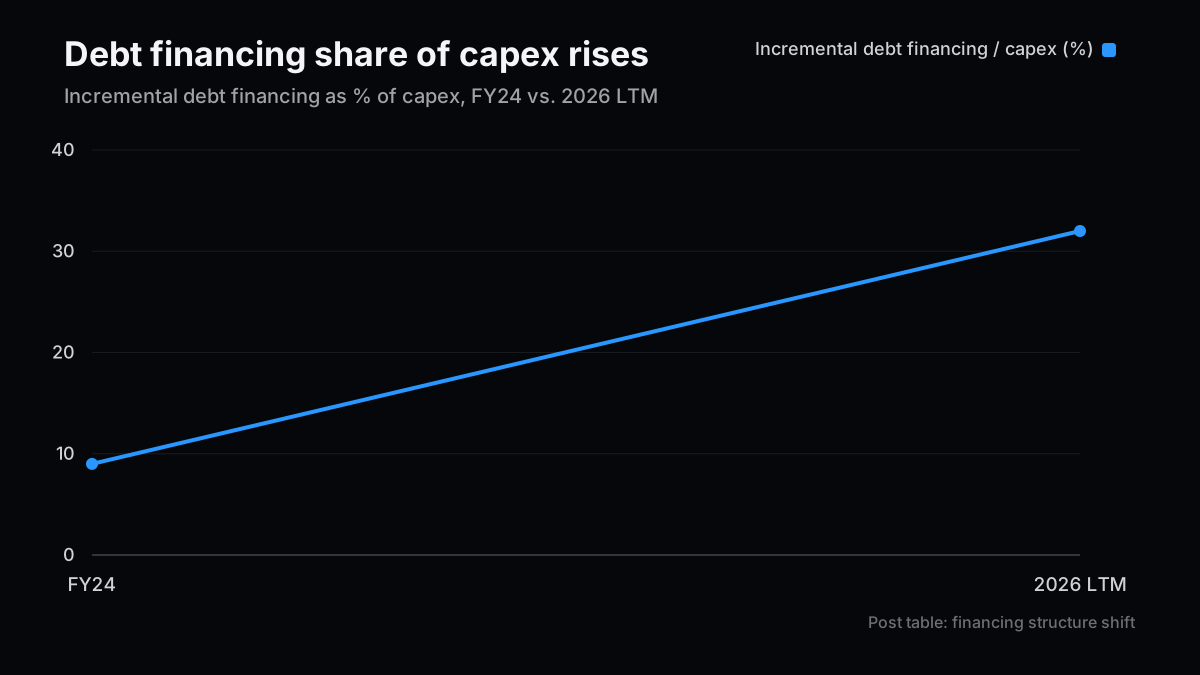
Until recently, the working assumption was that hyperscaler capex was largely self-funded out of abundant free cash flow. That assumption is the single biggest thing that's changed over the past year.
| Metric | FY24 | 2026 LTM (trailing twelve months) |
|---|---|---|
| Incremental debt financing / capex ratio | ~9% | ~32% |
| Alphabet debt balance | ~$16B (a year ago) | ~$100B |
| Alphabet equity raise | — | $84.75B (priced June 2026) |
| Oracle FY27 financing plan | — | $40B combined debt and equity |
Going from a 9% debt-financing ratio in FY24 to roughly 32% on an LTM basis by 2026 is, honestly, a fast pace of change for a single year. Alphabet's debt balance ballooning from roughly $16 billion to about $100 billion, on top of an $84.75 billion equity raise, tells me that "AI capex is fully covered by cash flow" no longer holds for all four names the way it did a year ago.
I once helped take a proof-of-concept proposal through internal sign-off for a project worth several hundred million yen, and what stuck with me is how much a few points on the internal hurdle rate can change whether an otherwise sound project actually gets approved. Hyperscaler capex operates at a very different scale, but the same mechanism should still apply: rising financing costs feed directly into how these decisions get made.
Part 1 of this series, the most recent post at the time I wrote its companion piece on Iran tanker stocks, framed SPR refill purchasing as a form of government demand floor. Hyperscaler capex has a similar structure — except this time the floor is investor-supplied debt and equity, not government purchasing. Government demand is close to price-inelastic; investor-supplied capital reacts directly to rates and credit spreads. That distinction feeds straight into the rate-sensitivity question in the next section.
Who Actually Gets Hurt by Higher Rates: Mapping Cash Flow Cushion Against Rate Sensitivity
Lumping all four names together under "tech capex is rate-sensitive" is, frankly, a bit sloppy. The picture splits more than that.
| Company | Cash flow position | Rate sensitivity |
|---|---|---|
| Microsoft | Ample FCF covers most of its own spend | Low |
| Alphabet | Tapping equity markets too; accepting some FCF pressure | Moderate |
| Amazon | Accepting FCF pressure while continuing to spend | Moderate to high |
| Meta | Accepting FCF pressure and still raising guidance | High |
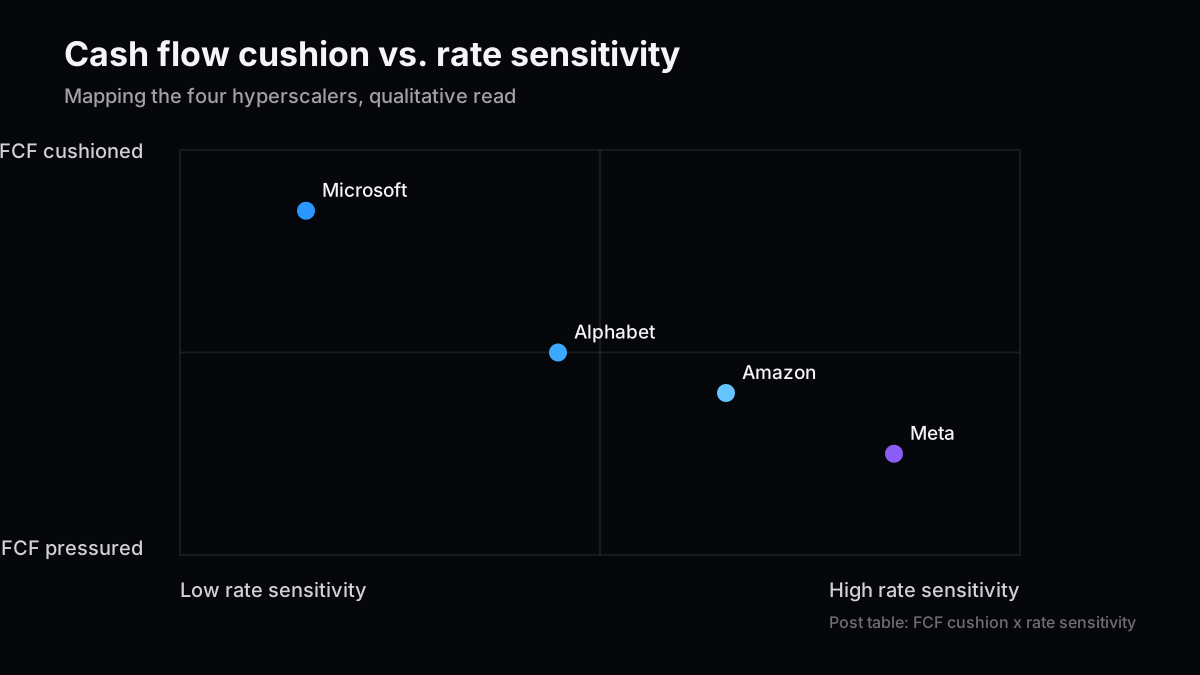
Microsoft is relatively insulated from rate risk simply because its own cash flow covers most of the spend. Alphabet, Amazon, and Meta, to varying degrees, have all chosen to keep spending even while accepting real pressure on free cash flow. For those three, rising rates hit them directly, as financing cost.
Worth touching on the semiconductor supply chain here too. A capex slowdown at the hyperscaler level would first hit NVIDIA and the broader GPU/accelerator supply chain, then ripple out to memory, power delivery, and cooling. Right now, though, the fact that all four companies raised guidance in the same period carries more weight than any early sign of a slowdown. My own read is that financing-structure fragility, not a slowdown signal, is the variable actually worth watching today.
Having worked as a device engineer running TCAD-based process simulations for automotive semiconductor lines, I've seen firsthand how long the lag runs between a shift in demand signals and an actual change in fab output plans — wafer starts, yield ramp, and qualification cycles routinely stretch that lag to several quarters. Even if hyperscaler guidance holds flat, that signal typically doesn't reach NVIDIA's or a memory maker's order book until at least the following quarter. So if this scenario set does shift from main toward tail, I'd expect the real semiconductor supply-chain fallout to show up in the numbers roughly two quarters behind the rate move itself, not immediately.
Scenarios and the Investment Call: Where Does Capex Actually Stop?
Building on Part 1's rate scenarios, here's how I'd frame the capex cycle across a base/main/tail structure.
| Scenario | Description | 2027 capex | Semiconductor supply chain implication |
|---|---|---|---|
| Base: spending continues | Companies accept higher financing costs and execute as planned | Combined total holds above $1T | Orders to NVIDIA and peers stay firm |
| Main: partial deferral | The more rate-sensitive names hold guidance flat or trim slightly | Growth slows to $900B-$1T | Selection tightens toward higher-value products |
| Tail: sharp slowdown | Financing costs spike; multiple companies cut guidance | Flat to down year over year | Broad-based order cuts to equipment and parts |
Given how firmly Alphabet, Amazon, and Meta have all signaled they'll accept FCF pressure rather than pull back, I weight the main scenario most heavily. Here's the condition that would change my mind: if the Fed holds at the September FOMC and pivots to a dovish tone, financing-cost concerns would recede fast, and the base scenario would gain real credibility. Conversely, if Part 1's main scenario — a September hike — actually plays out, the tail-risk case here deserves more weight, not less.
A single variable, rates, reaches all the way from dollar-yen positioning to capex plans worth hundreds of billions of dollars. Writing these two pieces back to back, what stands out to me is that a macro story can have one entry point and several exits. The September FOMC outcome will grade both articles' scenarios at once.
One more thing worth stating plainly: the four companies here aren't a single trade. Microsoft's low rate sensitivity means it can plausibly keep raising guidance even in a hiking cycle, while Meta's high sensitivity means the same hiking cycle could force a guidance cut within a couple of quarters, not a couple of years. Treating "hyperscaler capex" as one undifferentiated basket risks missing that the four names sit at meaningfully different points on the same rate-sensitivity curve — and that curve, not the headline capex total, is what I'll be tracking most closely into year-end.
Next Issue Ideas
- Idea 1: Grading rates and capex after the September FOMC — Score both this series' scenarios against the actual FOMC outcome and hyperscaler earnings commentary.
- Idea 2: Tracing the semiconductor supply chain spillover — A ticker-level look at NVIDIA, memory, and power-delivery names if a capex slowdown scenario starts to materialize.
- Idea 3: Tracking hyperscaler bond issuance terms — Using Alphabet's and Meta's credit spreads as a running gauge of actual financing costs.
Related Posts
- The Warsh Shock — Part 1: How Jackson Hole Rewired the Rate and Dollar-Yen Outlook — Part 1, the rate-scenario foundation this piece builds on.
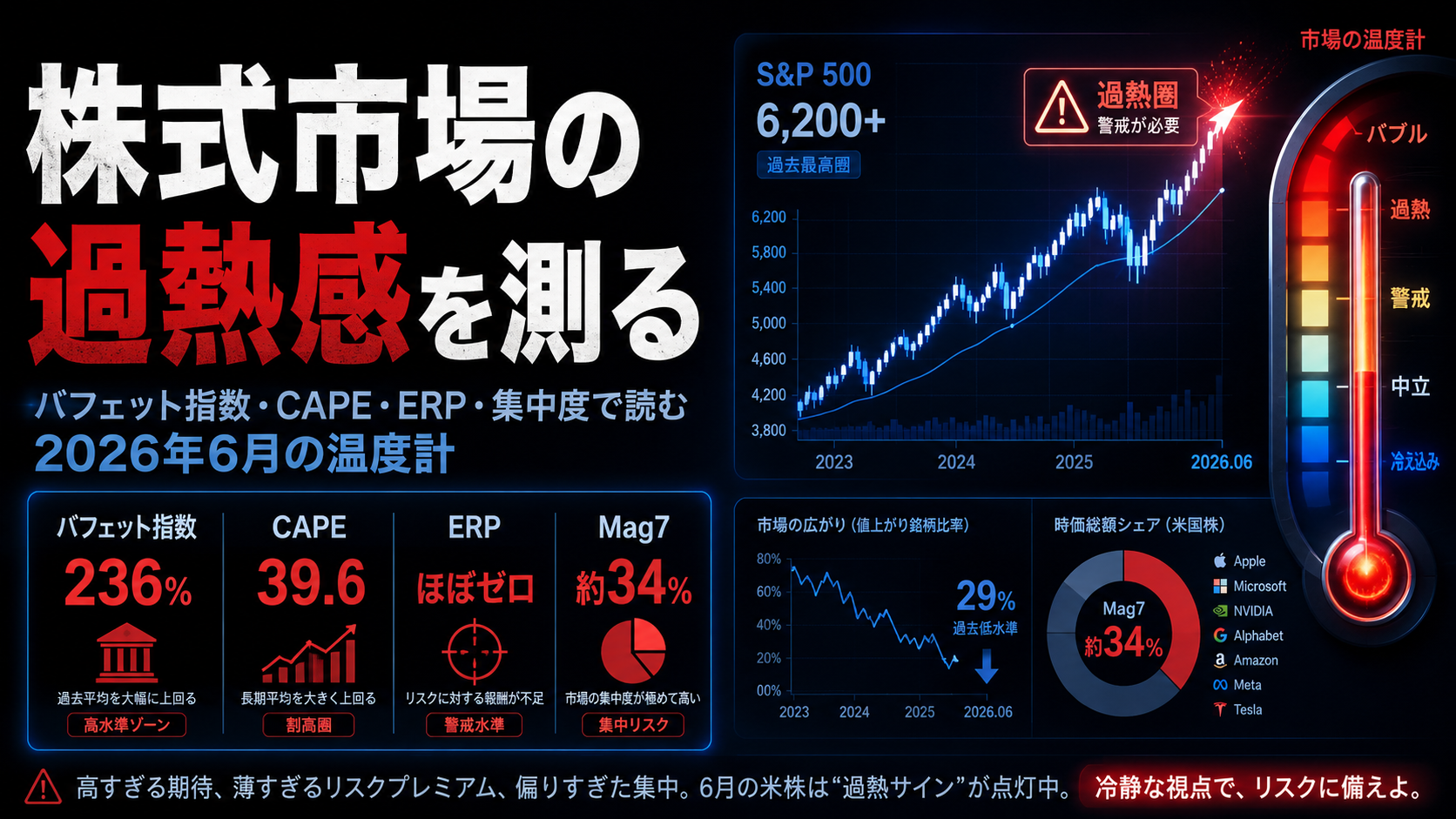
- Measuring Stock-Market Froth: Reading June 2026 Through the Buffett Indicator, CAPE, ERP, and Concentration — Useful context on how much valuation room the broader US market has left.
- Oil's New Map, Six Months Into the Iran War — Part 2: The Investment Playbook in Tankers, War-Risk Insurance, and SPR Refill — The source of the "government demand floor" framing referenced here.
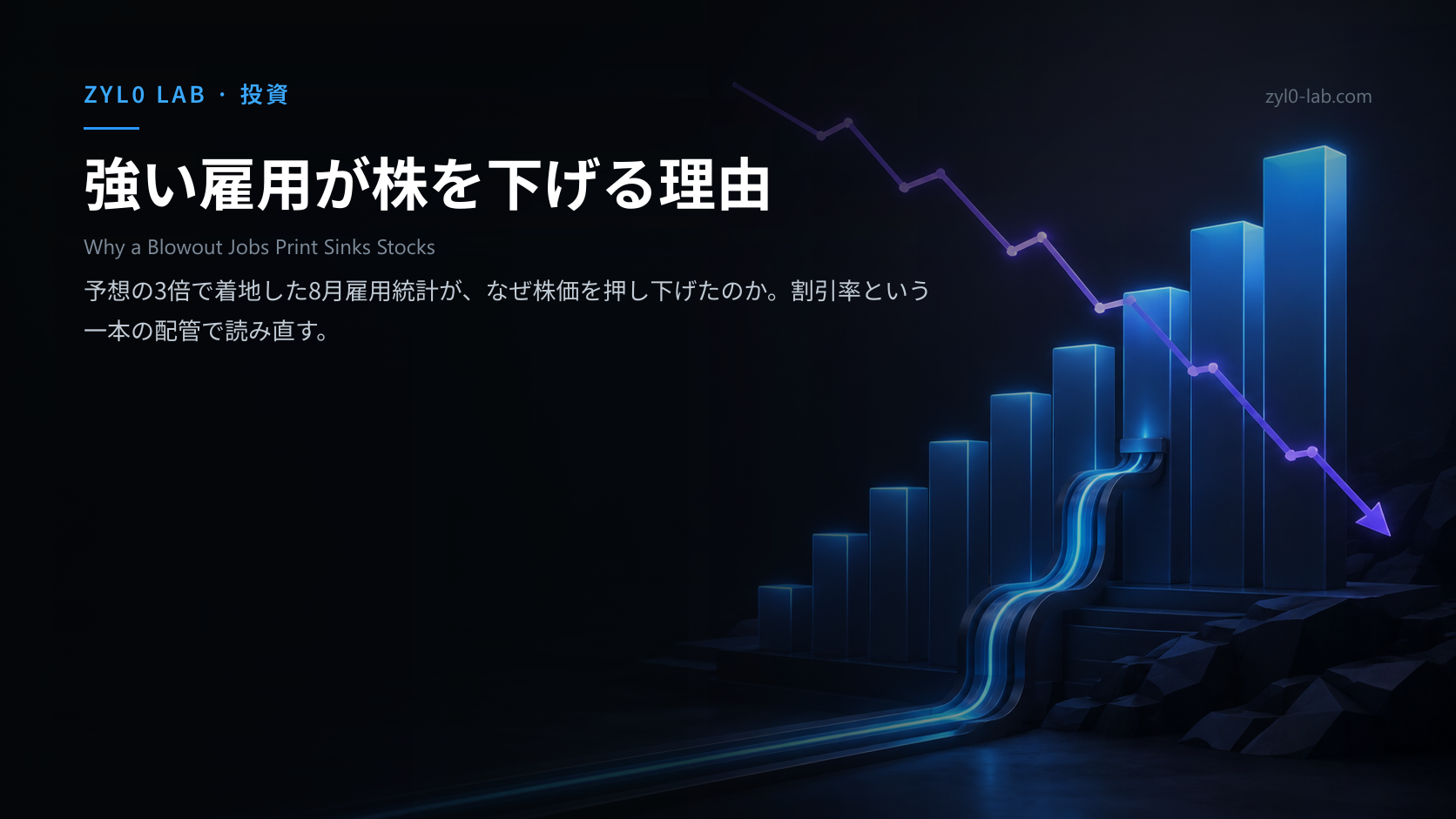
- Why a Blowout Jobs Print Sinks Stocks: Rereading a 3x Beat Through the Discount Rate — The follow-up that tests this piece's hypothesis against the August payrolls data.
- Did the AI Bond Rush Push Up Long-Term US Yields? — The sequel that checks, after the September hike, whether the weight of the borrowing landed on Treasuries or on neocloud bonds.
References
The factual and numerical assumptions in this article are anchored to primary or public materials readers can verify.
- Hyperscalers Tap External Financing as AI Capex Outruns Cash Flow (FactSet Insight)
- Tech AI spending approaches $700 billion in 2026, cash taking big hit (CNBC)
- 2026 hyperscaler capex tops US$700bn – analysis (TMT Finance)
- Keynote remarks by Chairman Warsh at the 2026 Jackson Hole Economic Policy Symposium (Federal Reserve Board, official)
This article is for informational purposes only and does not constitute investment advice or a recommendation of any specific security, service, or contract structure. The author may hold positions or interests related to companies discussed. Generative AI was used for parts of research, translation, and proofreading, with final review by ZYL0. See the disclaimer for details.