Oil's New Map, Six Months Into the Iran War — Part 2: The Investment Playbook in Tankers, War-Risk Insurance, and SPR Refill
Tanker operators, marine war-risk insurers, SPR-refill beneficiaries, and LNG alternative supply — a scenario-based investment playbook built on six months of structural change since the Hormuz blockade.

Tanker operators, marine war-risk insurers, SPR-refill beneficiaries, and LNG alternative supply — a scenario-based investment playbook built on six months of structural change since the Hormuz blockade.


Oil's New Map, Six Months Into the Iran War — Part 2: The Investment Playbook in Tankers, War-Risk Insurance, and SPR Refill
Part 1 took inventory of six months of primary data — Hormuz transit volumes, the pace of stockpile releases, and a scorecard on the Brent-BDTI leading indicator. What follows is what to build on top of that data. One thing that got drilled into me on an investment committee: there's a gap between good data analysis and a good investment decision, and it doesn't close itself. This piece tries to close it with specific names and scenarios.
Crude Normalized, the Chain Didn't
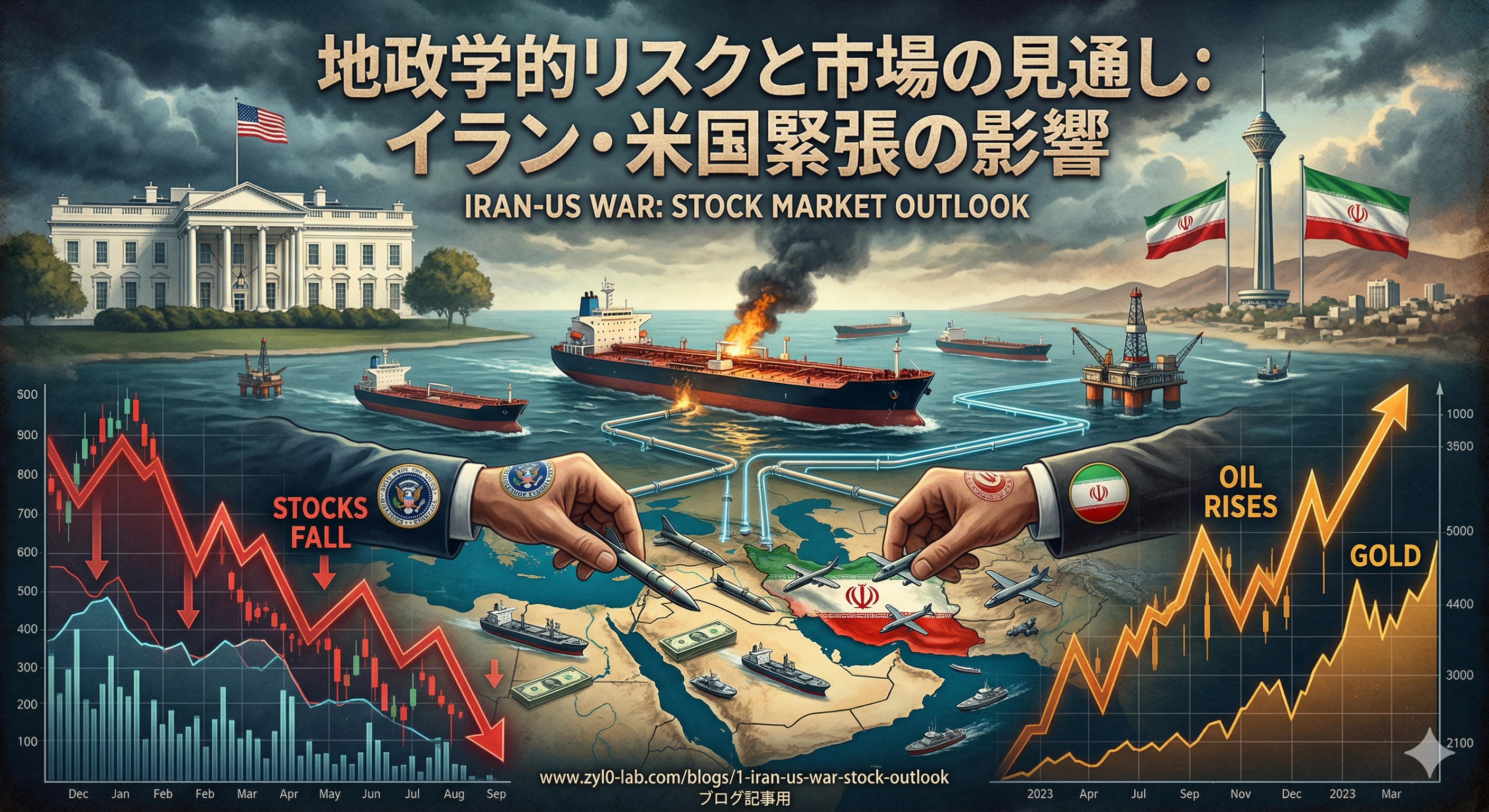
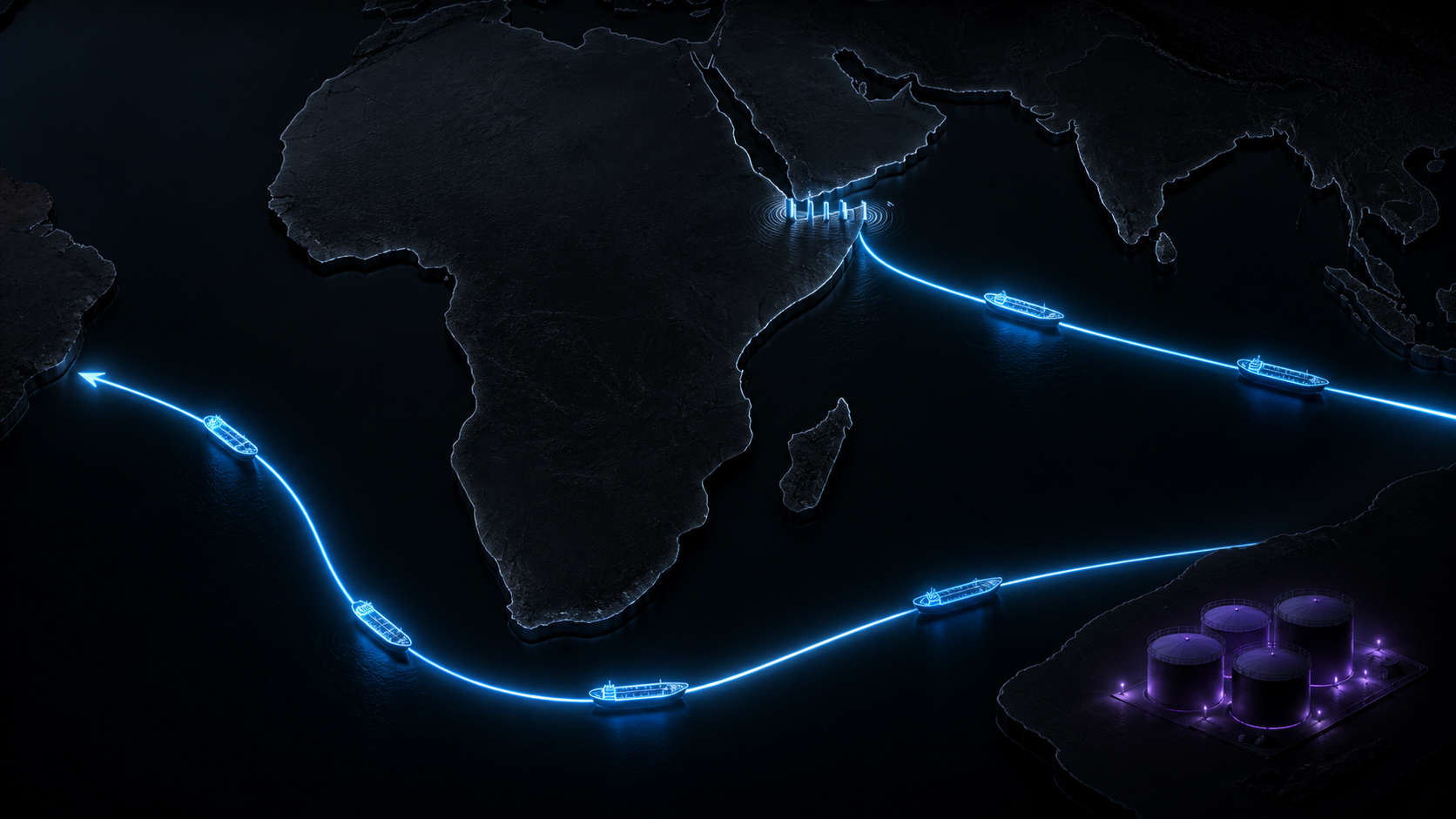
As covered in Part 1, Brent has pulled back to $86-88, roughly 25% off its $112-115 peak. Taken in isolation, that reads like "the crisis has passed its worst." My read is the opposite. Price mean-reverted. Transport, insurance, and stockpile structure did not — and that's the single point I want to hammer home in this piece.
Hormuz traffic still sits roughly 90% below baseline. Freight and insurance costs remain elevated. Reserves have been drawn down and eventually need refilling. If you only watch the headline price, you miss this structural gap entirely — and that gap is where I think the investable opportunity lives.
Tanker Stocks: Riding the Freight Cycle
Start with the most legible part of the story. VLCC rates from the Persian Gulf to China spiked to a record $423,000 a day in early March. Rates have since cooled, but most analysts still expect ECO tankers without scrubbers to earn spot rates averaging around $87,000/day through 2026-2027 — well above pre-war norms. That's the "new normal" worth underwriting to, not the headline spike.
At the single-name level: Frontline (FRO) hit a 52-week high, as noted in Part 1. Scorpio Tankers (STNG) posted the strongest quarter in company history in Q2 2026, moving to a $1.3 billion net cash position and cutting its daily cash break-even rate to a record-low $11,000. DHT Holdings (DHT) posted Q1 EPS of $1.02, nearly double the $0.53 forecast, securing 905 of 1,025 spot days at an average rate of $168,300/day. International Seaways (INSW) runs a 7% loan-to-value ratio with 82% spot-market exposure — a balance sheet built to capture rate volatility to the fullest.
One note on a legacy name: Euronav, once a tanker bellwether, merged with Golden Ocean in August 2025 and renamed to CMB.TECH (NYSE/Euronext: CMBT). It no longer trades as a standalone pure-play tanker name — if included, it should be framed as mixed tanker/drybulk exposure, not a Hormuz pure-play.
| Ticker | Name | Notes |
|---|---|---|
| FRO | Frontline | 52-week high, VLCC-focused |
| STNG | Scorpio Tankers | Best quarter in company history, $1.3B net cash |
| DHT | DHT Holdings | Q1 EPS ~2x forecast, avg. $168,300/day contracted |
| INSW | International Seaways | 7% LTV, 82% spot exposure |
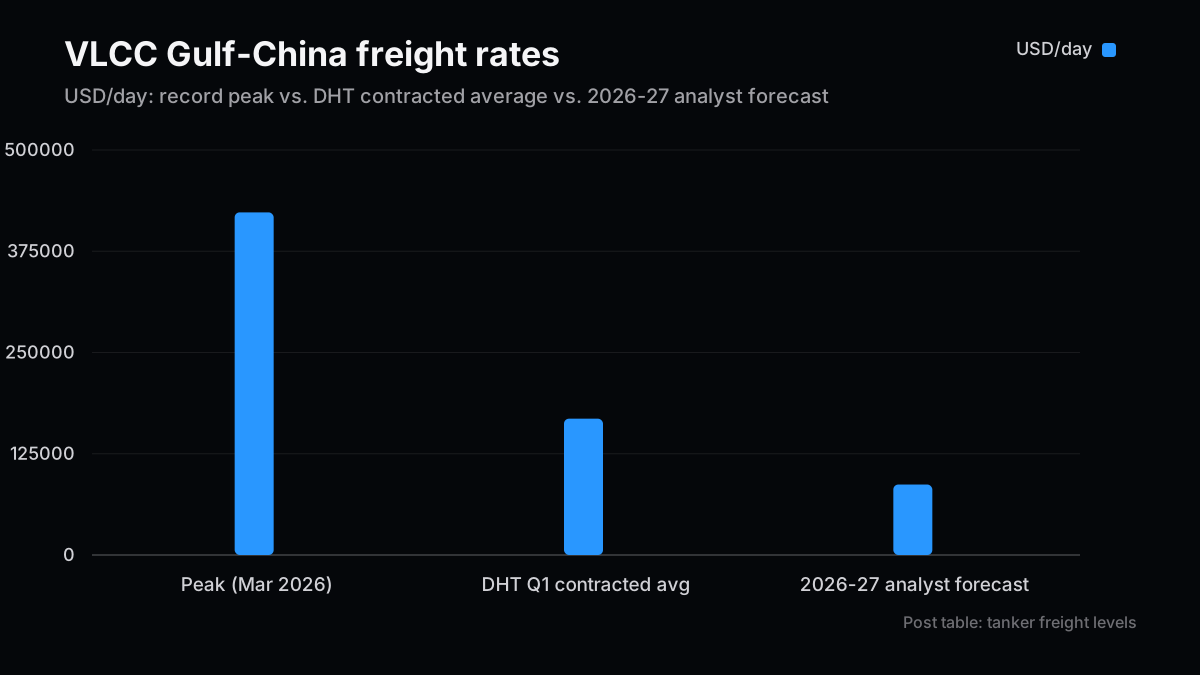
I once caught a valuation overreach in an EV storage deal during the investment review and argued against it in front of the investment committee with the data to back it up. The lesson I keep relearning: extrapolating a peak print into the future is where you get burned. $423,000/day makes for a great headline, but $87,000/day — the analyst forecast — is the number I'd actually underwrite to.
Marine War-Risk Insurance: A Less Obvious but Real Angle
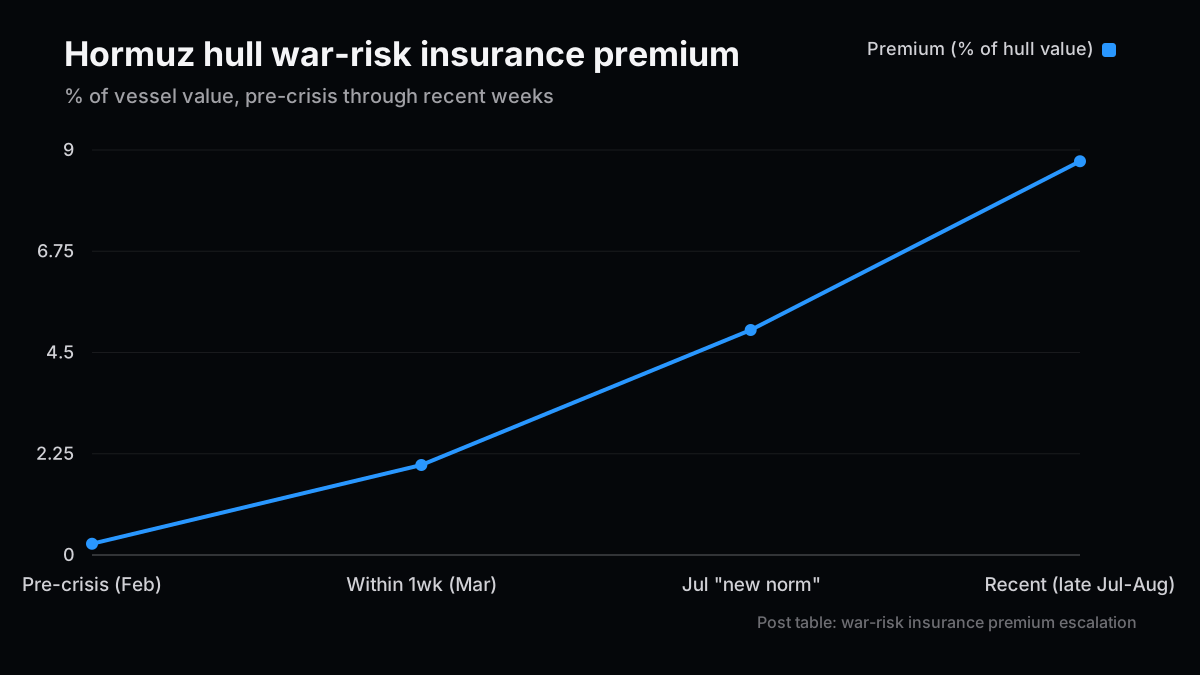
Behind the freight story, insurance costs have moved just as dramatically. Pre-crisis (Feb 2026), hull war-risk premiums on Hormuz VLCC transits sat around 0.25% of vessel value. Within 48 hours of the Feb 28 strikes, premiums jumped fivefold, and some insurers cancelled existing coverage and re-quoted at roughly 60 times pre-crisis rates. Within a week, quoted rates had moved into the 1-3% range — for a $150 million tanker, a single-transit insurance bill jumping from roughly $375,000 to $1.5-4.5 million.
By July, 5% had become "the new market norm," according to reporting; in recent weeks Marsh's data shows rates pushing further to 7.5-10%. The June MOU brought a temporary softening, but every subsequent attack on a vessel has pushed rates back up — this is a volatile, event-driven market, not a steady one.
Two dedicated consortia have launched at Lloyd's to serve this market. Chubb (NYSE: CB) leads a consortium offering up to $200 million of hull/P&I capacity plus another $200 million dedicated to cargo, live since June 19, 2026. Beazley (LSE: BEZ) launched a separate $1 billion consortium in April — $500 million hull war, $500 million cargo war.
Worth being upfront here: both Chubb and Beazley are diversified specialty insurers, and Hormuz-related underwriting is a small slice of either portfolio. As a pure-play expression, it's diluted — I'd treat this as small optionality, not a core position.
| Insurer | Consortium size | Live since |
|---|---|---|
| Chubb (CB) | $200M hull/P&I + $200M cargo | June 19, 2026 |
| Beazley (BEZ) | $500M hull war + $500M cargo war | April 2026 |
SPR Refill and LNG Alternative Supply: One Story That's Over, One That Isn't
As established in Part 1, the US SPR's 172-million-barrel release largely wrapped up by mid-July. Here's a distinction worth making explicit: the SPR release itself is already "over." What's coming next is the refill phase, where government purchasing acts as a demand floor. ConocoPhillips (COP), a continuity name from Part 1's framework, remains a candidate here; Diamondback Energy (FANG), a Permian pure-play, is a newer name worth watching for the same dynamic.
LNG runs on a completely different clock. Qatar's Ras Laffan facility carries a hardened 3-5 year repair estimate, and that supply gap doesn't close on any near-term timeline. Cheniere (LNG) remains a strong continuity name, but the fresh addition here is Venture Global (NYSE: VG). Its Plaquemines facility is targeting commercial operations (COD) in Q4 2026, but LNG produced during the commissioning phase can be sold on the spot market — and notably, reporting indicates the company has already sold roughly 100 commissioning cargoes to QatarEnergy itself. Qatar is effectively buying US LNG to plug its own shortfall. About 69% of Venture Global's expected 2026 cargoes are already contracted, leaving roughly 31% available for spot sales — the slice that captures the Qatar-gap premium most directly.
| Sector | Ticker | Position character |
|---|---|---|
| SPR refill | ConocoPhillips (COP) | Continuity name |
| SPR refill | Diamondback Energy (FANG) | Permian pure-play |
| LNG alternative supply | Cheniere (LNG) | Continuity name, structural long |
| LNG alternative supply | Venture Global (VG) | Spot sales capture the Qatar gap directly |
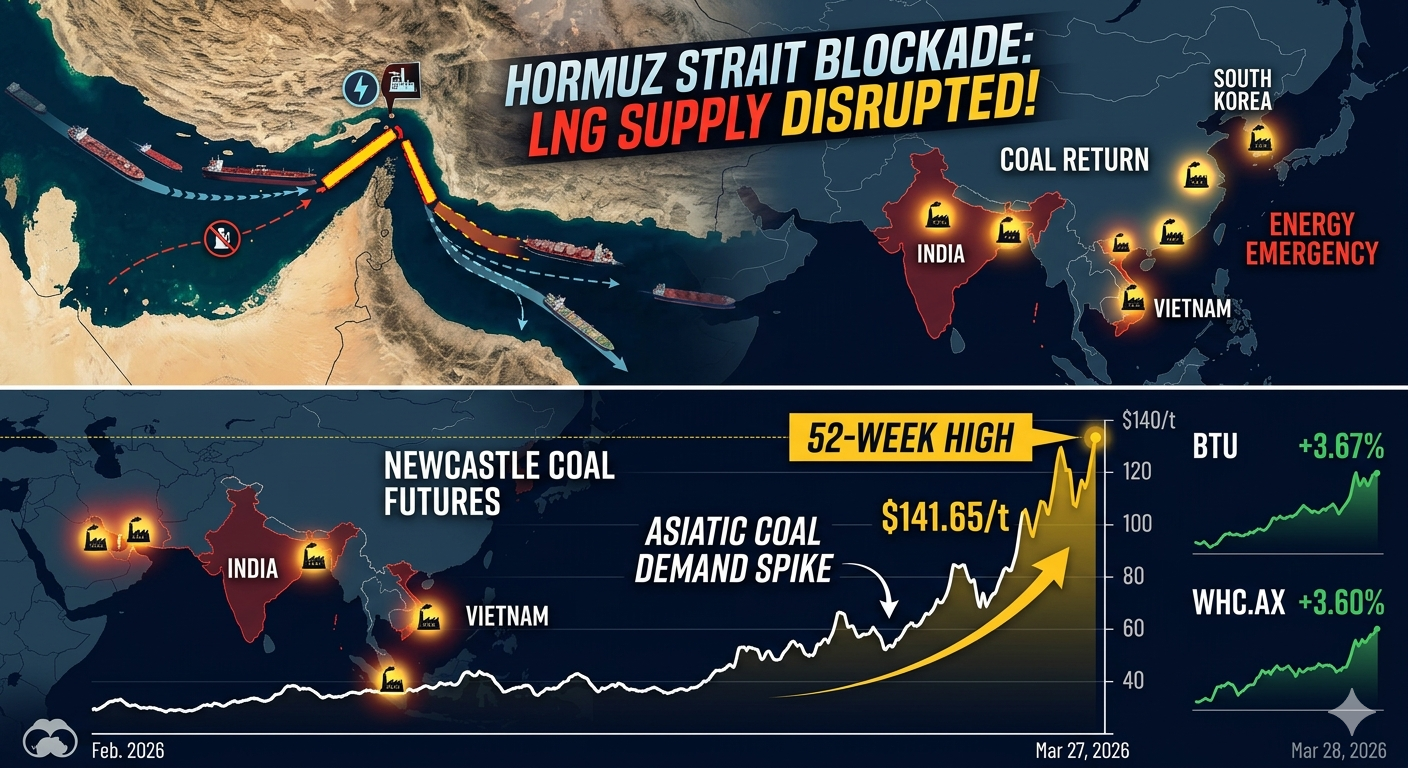
Coal names (BTU, WHC, HCC, ARLP, NRP) were already covered in the March piece and aren't re-analyzed here — but they remain worth running in parallel as an independent relative-long inside the energy sector.
Scenario-Based Positioning
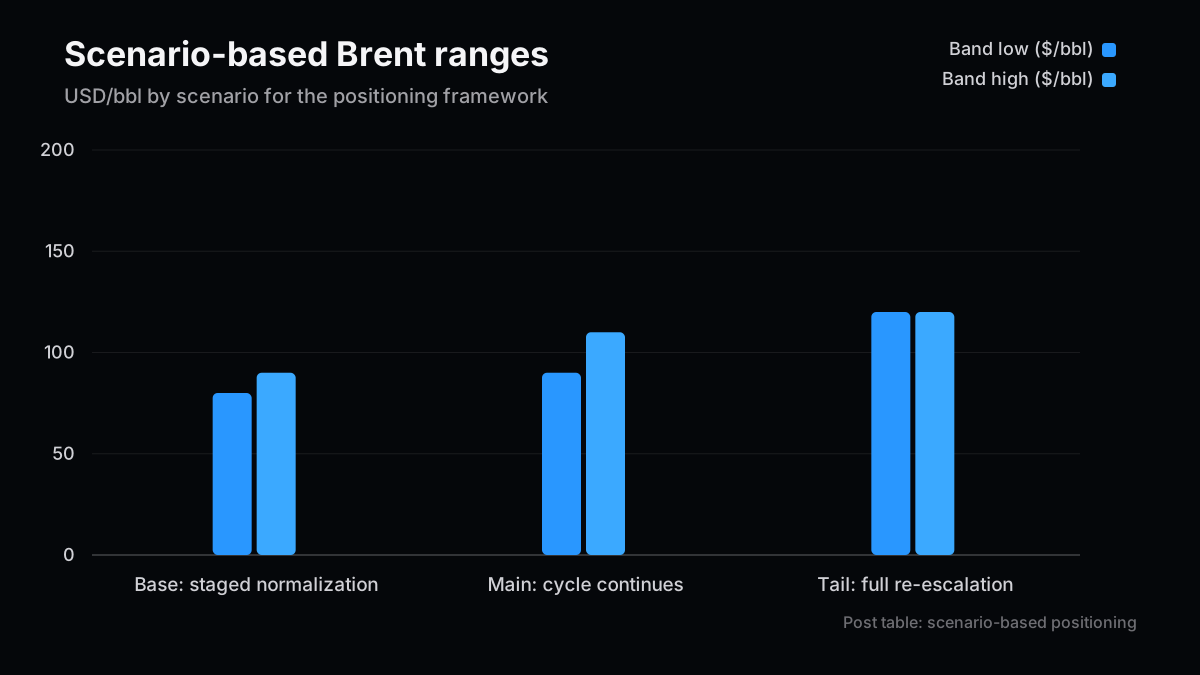
Tying this back to Part 1's base/main/tail framework, the pivot question is whether the August 25 shift toward economic sanctions really marks the start of de-escalation.
| Scenario | Description | Brent | Tanker rates | Recommended positioning |
|---|---|---|---|---|
| Base: staged normalization | Sanctions shift holds; Iran-Oman corridor becomes functional | $80-90/bbl | Ease off peak but stay above pre-war norms | Trim the tanker basket; shrink insurance exposure |
| Main: the cycle continues | The ceasefire-breakdown pattern since April repeats | $90-110/bbl | Stay structurally elevated | Keep the tanker basket as core; hold insurance as a satellite |
| Tail: full re-escalation | Mining resumes; military escalation returns | $120+ | Retest $200k+/day | Add to tankers and insurance; overweight LNG alternative supply |
My own positioning: the tanker basket (FRO/STNG/DHT/INSW) as the highest-conviction structural position, with Chubb and Beazley as small optionality rather than core holdings. I'm not adding fresh weight to SPR-refill names — that trade is closer to "already happened" than "about to happen." Cheniere and Venture Global stay in as multi-year structural longs, tied to Ras Laffan's 3-5 year rebuild timeline.
Here's the condition that would change my mind: if Hormuz transits hold above 100 vessels a day for 60 consecutive days with no new blockade episode, and VLCC time-charter equivalent rates fall back under $50,000/day, that's my signal the freight repricing was cyclical, not structural — and I'd unwind the tanker overweight.
Next Issue Ideas
- Idea 1: Coal vs. tankers, a relative-value read — Compare two sectors trading on the same Iran-crisis catalyst by risk-return profile.
- Idea 2: The marine war-risk insurance cycle, revisited — Six months after Lloyd's consortia launched, how premium rates have moved and how this kind of cycle typically ends.
- Idea 3: Grading the August 25 sanctions call — Was the market right to read it as de-escalation? A check-in a few months out with the actual data.
Related Posts
- Oil's New Map, Six Months Into the Iran War — Part 1: How Routes and Stockpiles Actually Shifted — The route and stockpile data this article's investment thesis is built on.
- Iran War Sparks a Reversal in Coal Stocks — A parallel sector thesis on the same Iran crisis, independent of the tanker/insurance angle here.
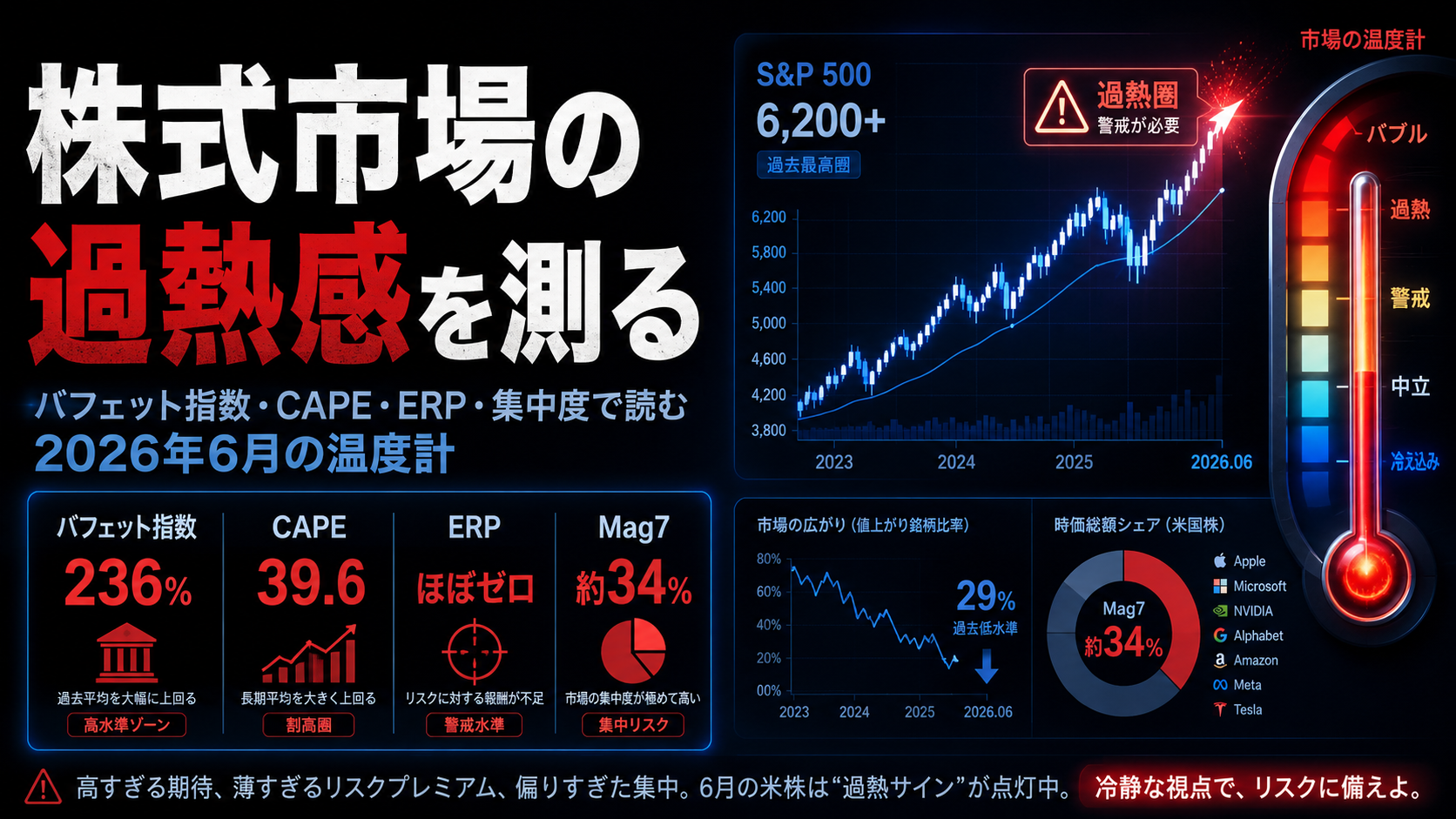
- Measuring Stock-Market Froth: Reading June 2026 Through the Buffett Indicator, CAPE, ERP, and Concentration — Useful context on how much valuation room the broader market has for a sector rotation like this one.
- Kharg Island, the Single Point of Failure: How Terminal Concentration Creates Asymmetric Oil Risk — Part 3, shifting the lens from the sea lane to the loading terminal.
References
The factual and numerical assumptions in this article are anchored to primary or public materials that readers can revisit during AdSense review and future updates.
- Chubb launches $400m Hormuz war risk consortium at Lloyd's (Lloyd's List)
- Middle East shipping insurance costs rise on Hormuz risks: Marsh (S&P Global)
- Venture Global says it exported 29 cargoes from Plaquemines LNG plant in Q1
- U.S. Energy Information Administration oil market data
- U.S. Treasury sanctions programs and country updates
This article is for informational purposes only and does not constitute investment advice or a recommendation of any specific stock, service, or contract structure. The author may hold positions or interests related to companies or services mentioned. Generative AI was used for parts of research, translation, and proofreading, with final review by ZYL0. See the disclaimer for details.