Power, Not Compute: Mapping the AI Electricity Bottleneck Across Power Semiconductors and the Grid
AI is no longer compute-constrained -- it is power-constrained. Mapping where the next dollar of power capex lands, from interconnection queues to power semiconductors.

AI is no longer compute-constrained -- it is power-constrained. Mapping where the next dollar of power capex lands, from interconnection queues to power semiconductors.


Power, Not Compute: Mapping the AI Electricity Bottleneck Across Power Semiconductors and the Grid
I will admit I almost skipped the G20 Innovation Ministerial in Chapel Hill on September 1, 2026. Then Elon Musk's remarks, delivered virtually, started circulating, and one line made me stop scrolling: there "actually is quite a crisis of power" for AI, and it is not a distant problem -- it is already here. My first association was not chips or model benchmarks. It was a deal from my prior CVC job where an interconnection timeline nearly killed an investment thesis that had nothing wrong with its underlying technology.
In the August 28–September 24, 2026 Search Console window, this page received 3 clicks from 158 impressions (about 1.9% by calculation). Inrush, short-circuit isolation, and branch selectivity sit beyond the conversion map; the 800 V rack protection case study separates those layers using TI published test conditions.
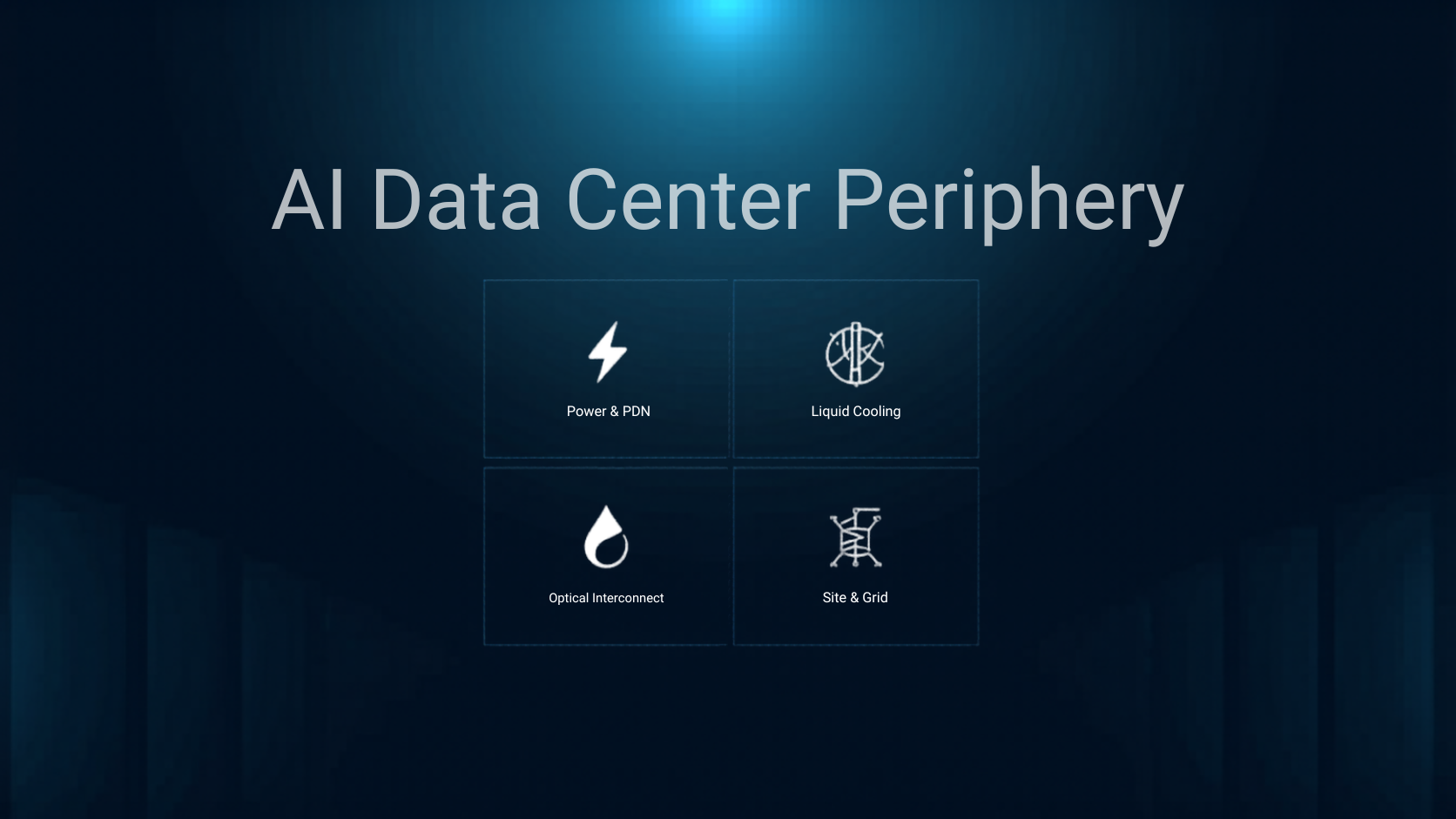
Power is an unglamorous theme. It does not generate the same headlines as a new GPU generation or a benchmark leaderboard. But when I mapped AI infrastructure's "silicon periphery" in Part 19 of this series, power was the one segment I flagged as furthest from resolution among the four -- power, cooling, optics, and site. Four months later, the situation has not improved; it has escalated to the point where "crisis" is the word used from a G20 stage. This piece cuts one layer deeper into that power segment and redraws the map of where $100 of AI-related power capital expenditure actually lands.
"The Power Crisis Is Already Here" -- What Musk Actually Told the G20
Reading that line, I was half surprised and half not.
Strip Musk's G20 remarks down to their skeleton and the logic is simple. AI chip production capacity is growing roughly 40-50% a year, while power generation capacity outside China is growing only 10-20% a year. Compound that gap and you get the number he cited: a consensus estimate of at least a 15-gigawatt power shortfall for AI by 2027. In his words, the power crisis for AI "is already here, it is not a far-off thing."
| Metric | Figure | Source |
|---|---|---|
| AI chip production, annual growth | 40-50% | Musk, G20 remarks (Sep 1, 2026) |
| Power generation ex-China, annual growth | 10-20% | Same |
| Projected 2027 power shortfall | 15+ GW | Same, industry consensus estimate |
| Global data center electricity use | 485 TWh in 2025 to 950 TWh in 2030 (2026 updated outlook) | IEA: Key Questions on Energy and AI |
Here I want to make a correction, because I have seen it get garbled. A number from this same event -- that physical AI could be worth roughly ten times as much as digital AI -- has been circulating attributed to NVIDIA's Jensen Huang. As far as I can verify, that ten-times figure is Musk's, not Huang's. Huang did attend the same G20 event, but the quotes I could actually confirm from him were different: "every single country needs to build infrastructure so you can support your own local economy," and a concrete cost benchmark -- roughly $50-60 billion to build one gigawatt of AI infrastructure. Related territory, different speaker. Attributing one person's number to another is a common failure mode in reporting on events like this, and since this piece runs on numbers, I want to be careful about it.
Musk went on to estimate that digital AI alone could add 20-30% to the global economy, roughly $20-30 trillion a year, and that the physical layer -- humanoid robots and the like -- could push that multiple by a factor of 10 or more. He floated a conservative estimate of over a billion humanoids, each about five times as productive as a human. Whether those numbers hold up is outside the scope of this piece. What I want to focus on is the less exciting, more investable problem sitting just upstream of it: the physical constraint of electricity supply.
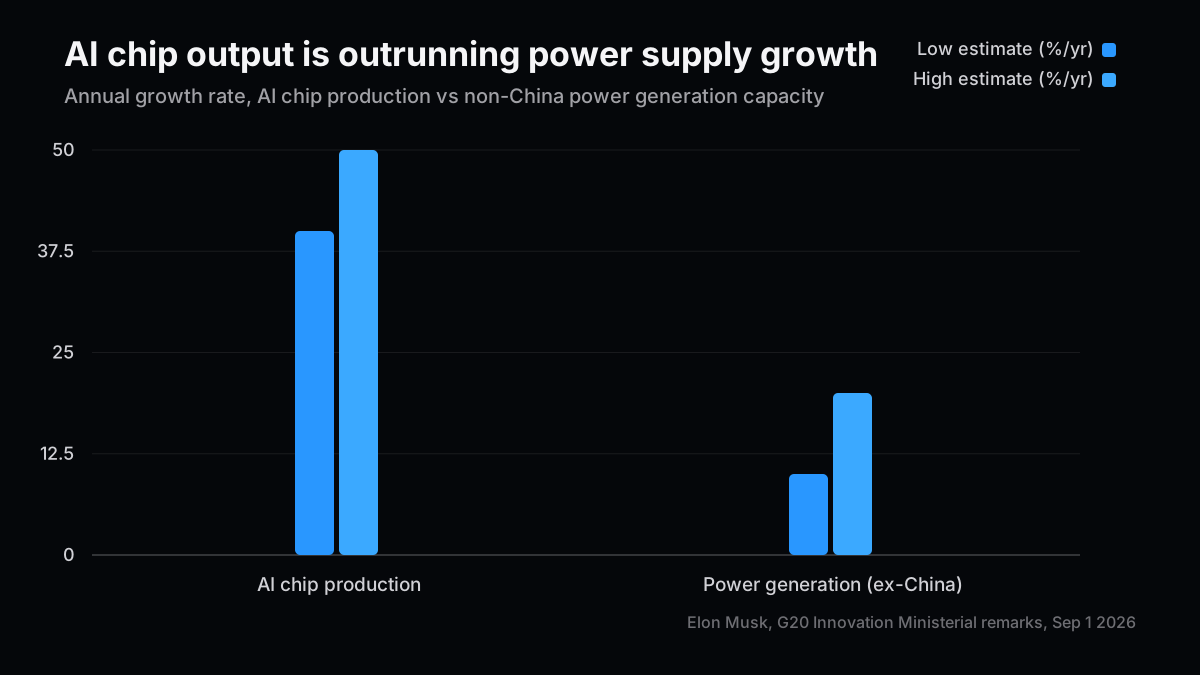
Lay the chip curve and the generation curve side by side and the gap widens every year rather than closing. From my time in semiconductor process work, when a demand curve is this exponential and a supply curve is close to linear, the bottleneck resolves only through demand deceleration -- not through anyone simply building faster.
Where the Rate-Limiting Step Actually Sits: Interconnection and Transformers as an Invisible Traffic Jam
From here I want to bring the abstraction down to a resolution I can actually use to make investment decisions.
The First Gate: The Interconnection Queue
The first wall any new data center hits is grid interconnection. In PJM, the largest US grid operator, AI-related large-load projects entering service average more than seven years from application to energization -- more than three years to reach an interconnection service agreement, and another four-plus years after that to actually come online. Industry estimates put CAISO at five to six years and MISO at around five. The LBNL (Lawrence Berkeley National Laboratory) national median, across all fuel types, has crossed five years for projects reaching commercial operation in 2025.
The harder number is the completion rate: of projects that requested interconnection between 2000 and 2020, only 13% had reached commercial operation by the end of 2025. Seventy-five percent were withdrawn; 10% are still sitting in the queue. In ERCOT, Texas's grid, the large-load interconnection queue -- which includes data centers -- grew from 63 GW at the end of 2024 to 226 GW by November 2025, nearly quadrupling in under a year, with roughly 77% of that load coming from data centers.
| Grid / Region | Wait time / scale | Source |
|---|---|---|
| PJM (large AI projects) | 7+ years total (3+ to ISA, 4+ more to energize) | Data Center Knowledge |
| CAISO | 5-6 years (industry estimate) | Industry estimate |
| MISO | ~5 years (industry estimate) | Industry estimate |
| National median (2025 completions) | 5+ years; only 13% of 2000-2020 requests reached operation | LBNL Queued Up 2026 |
| ERCOT large-load queue | 63 GW (end 2024) to 226 GW (Nov 2025); ~77% data centers | Latitude Media |
Sitting with these numbers, "waiting in line" feels like too gentle a phrase. Seven years spans two or three GPU generations. By the time a project clears the queue, the chip assumptions it was originally planned around are already dated.
The Second Bottleneck: Transformers
Clear the interconnection queue and the next wait is for transformers. As of 2026, standard power transformer lead times run around 128 weeks, generator step-up units (GSUs) around 144 weeks, and specialty high-capacity units are being quoted at up to four years out. One transmission-industry source put it bluntly: the substation is "the longest pole in the tent" -- the building goes up in months, but the equipment to energize it does not.
The real constraint here is not steel or capital -- it is labor. The US transformer manufacturing workforce, the people who hand-wind copper coils, numbers around 15,000, and meeting projected demand would require roughly tripling that headcount. Coil winding is closer to a craft than an assembly-line task; it is not something you train in a matter of weeks. Since 2019, prices are up roughly 77% for power transformers, 45% for GSUs, about 100% for grain-oriented electrical steel, and about 50% for copper.
These two gates -- interconnection and transformers -- move on a completely different clock than AI chip production. Which raises the next question: given all that friction, where does $100 of power capital expenditure actually land?
Where $100 of Power Capex Actually Lands: Decomposing the Value Chain
In Part 19, I broke AI data center infrastructure into four peripheral segments -- power, cooling, optics, and site -- and concluded that L2 (peripheral silicon) and L3 (the physical layer) deserved an overweight. This piece extends that conclusion into the power layer itself, decomposing where $100 of AI-related power capex actually lands, as my own working framework.
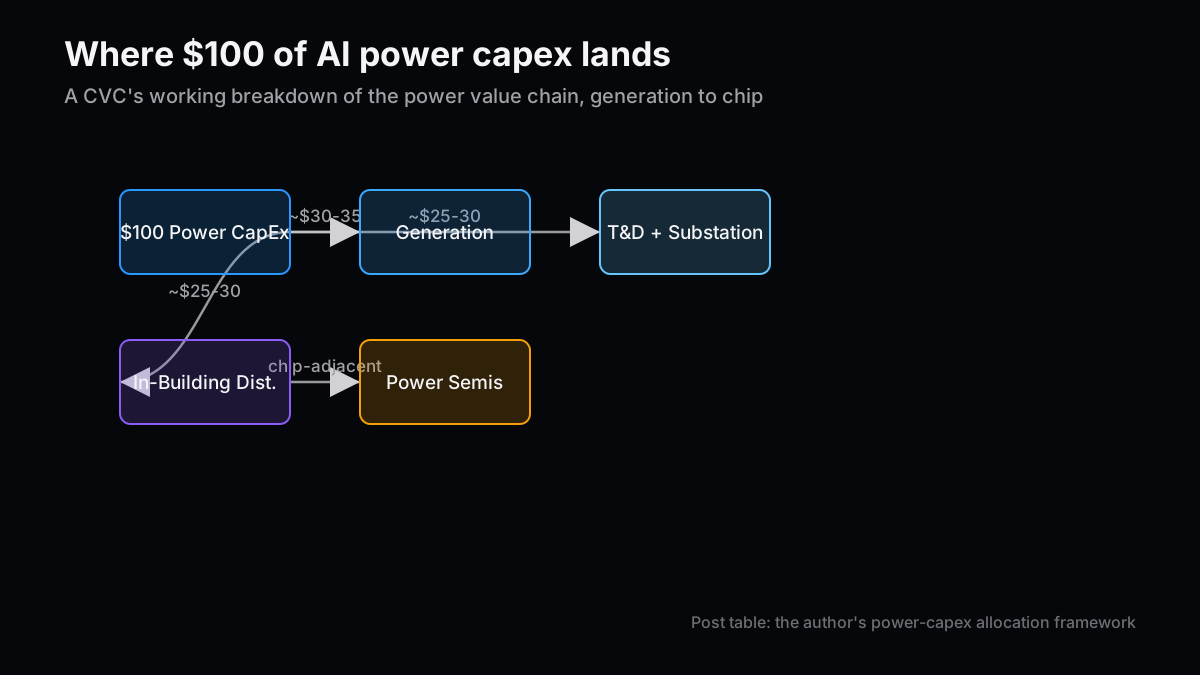
To be clear, there is no single source for this exact split; what follows is my own estimate, built by cross-referencing several primary data points. Industry data puts power infrastructure -- substations, switchgear, generators, UPS systems, and distribution -- at 40-45% of a data center's hard construction cost. Air-cooled Tier III facilities run $8-14 million per critical IT megawatt in 2026; direct-to-chip liquid-cooled facilities run $17-25 million. Working from those anchors, the allocation I actually use is roughly this: $30-35 to generation (gas turbines, SMRs), $25-30 to transmission and substations (including transformers and switchgear), and $25-30 to in-building distribution (rack-level step-down, the shift to 800V DC).
Silicon Carbide and Gallium Nitride: The Last Mile
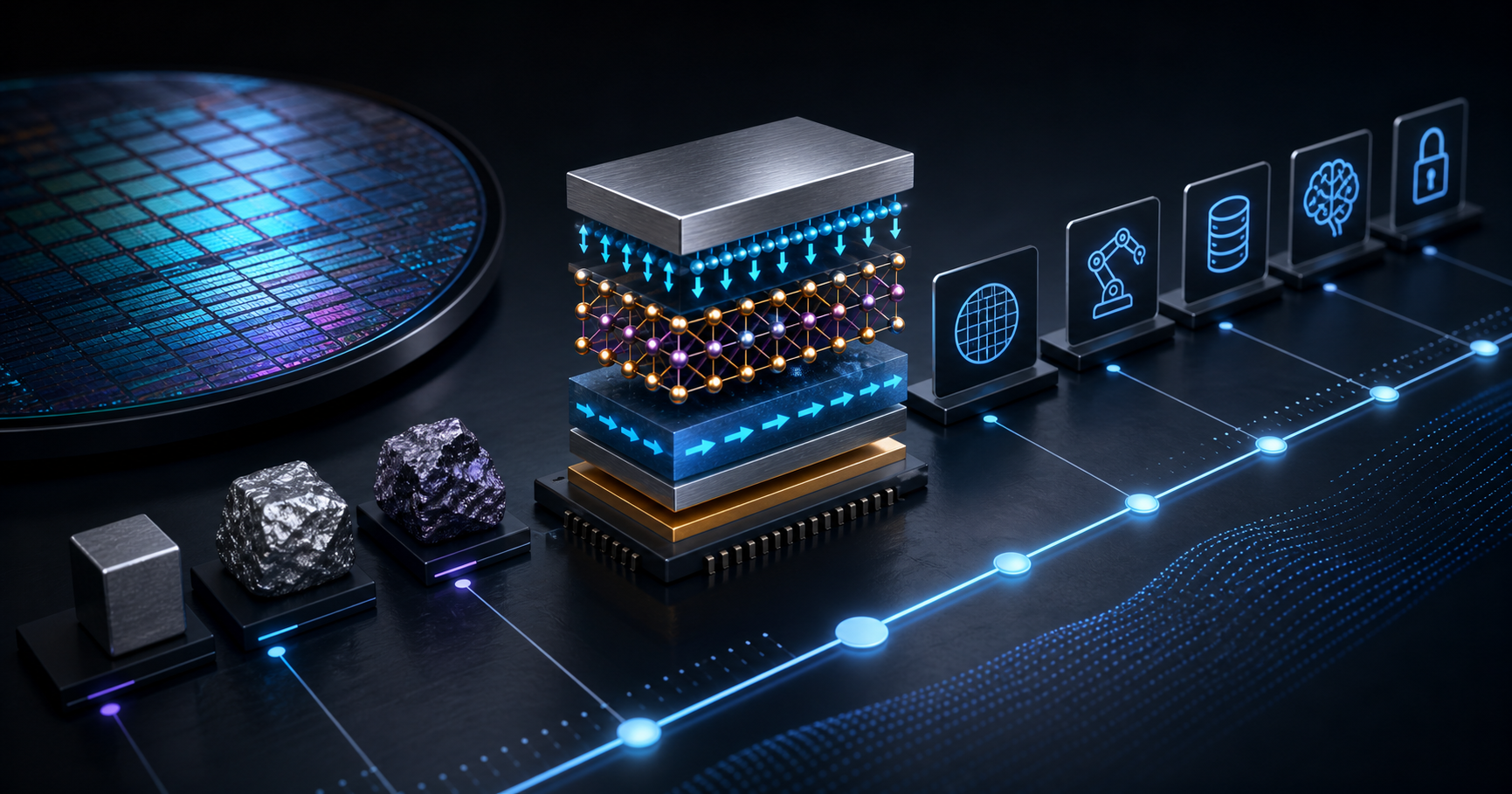
Inside that in-building distribution slice is where wide-bandgap semiconductors are displacing silicon. The data center power semiconductor market is projected to grow from roughly $2.0 billion in 2025 to about $4.3 billion by 2032, an 11% CAGR overall -- but the wide-bandgap segment specifically, SiC and GaN, is growing at more than 25% a year, well ahead of the market. SiC is winning in high-voltage, high-temperature applications -- UPS systems and power distribution; GaN is scaling fastest in high-frequency server power supplies. The efficiency payoff is concrete: combining advanced wide-bandgap devices has been shown to cut power delivery network losses from roughly 17% down to about 9%.
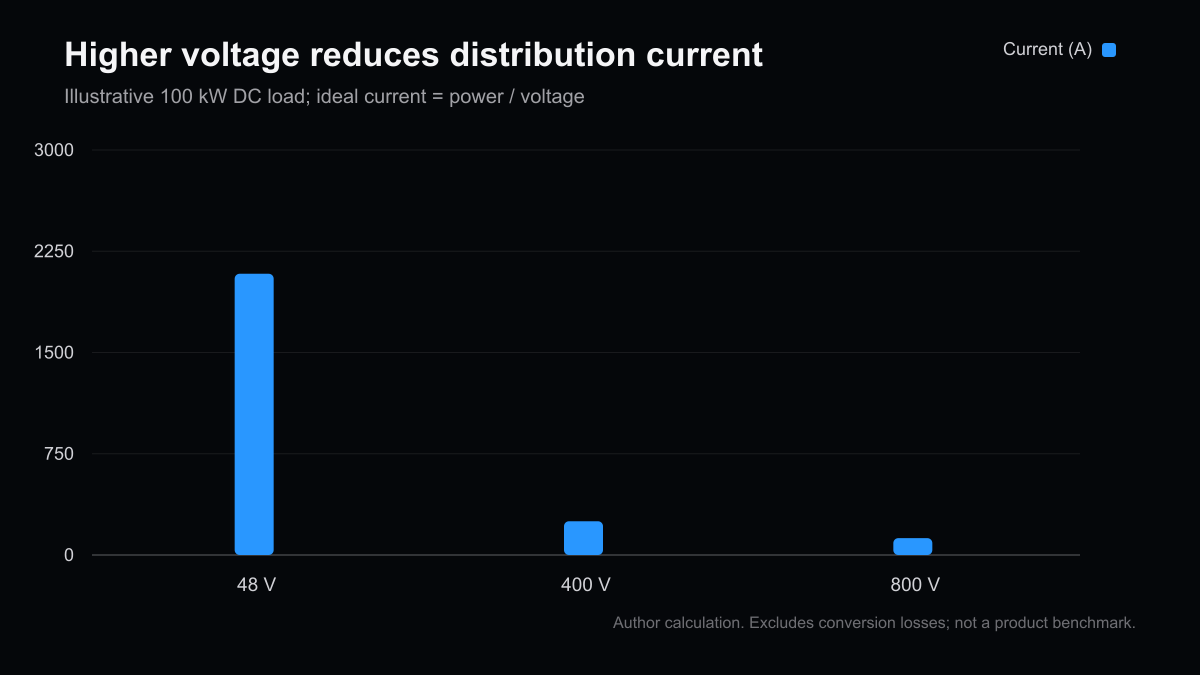
The second structural shift is NVIDIA's push toward 800V DC distribution. Compared with legacy 415V AC, the same conductor size can carry roughly 85% more power, while copper use drops by around 45%. A 1 GW data center built on the legacy approach could require up to 200,000 kg of copper -- and that copper demand runs into the same supply constraints as transformers. The claimed benefits are up to 5% better end-to-end efficiency, up to 70% lower maintenance cost, and up to 30% lower total cost of ownership, but full-scale volume production is timed to arrive alongside NVIDIA's Kyber racks in 2027 -- somewhat sooner than I had it penciled in six months ago.
| Layer | Listed anchors | My current stance |
|---|---|---|
| Generation / turbines | GE Vernova (GEV), Vistra (VST), Constellation (CEG) | Neutral, shifting toward overweight |
| Transmission / substation equipment | Hitachi Energy, ABB (ABBN), Eaton (ETN) | Overweight |
| In-building distribution / UPS | Vertiv (VRT), Schneider Electric (SU) | Overweight |
| Power semiconductors (SiC/GaN) | Infineon (IFX), onsemi (ON), Monolithic Power (MPWR), Navitas (NVTS) | Overweight, selective |
When I led an investment into a North American second-life EV battery stationary-storage startup at my previous CVC job, the part of the review that consumed the most time was not the cell degradation curve or the chemistry review. It was interconnection timing and contract structure -- specifically, whether the system would sit behind the meter (self-consumption, no grid connection required) or be grid-tied through a formal interconnection agreement. Choose the latter, and the project's economics stop being about battery performance and start being about where in the regional interconnection queue you happen to land. That deal was originally framed around peak shaving, but the lesson stuck: in power infrastructure, profitability is set less by whose technology is better and more by where you sit in the queue. Seeing this same structure show up in today's interconnection data was, frankly, not a surprise.
Scenarios and Positioning: Carrying the Power Bottleneck Trade Into 2027
In Part 49, I wrote that the ratio of incremental debt financing to capital expenditure across the four hyperscalers rose from 9% in FY24 to 32% on a 2026 trailing-twelve-month basis. That piece was framed around interest rates, but power capex adds a second layer of spending onto the same capital structure. Interconnection, transformers, and in-building distribution are usually funded by utilities and data center operators rather than the hyperscalers directly, but trace the money back far enough and it runs through the same credit markets. If rates rise, both AI capex and power infrastructure capex can tighten at once. That is the same fragility Part 49 flagged, just wearing a different hat.
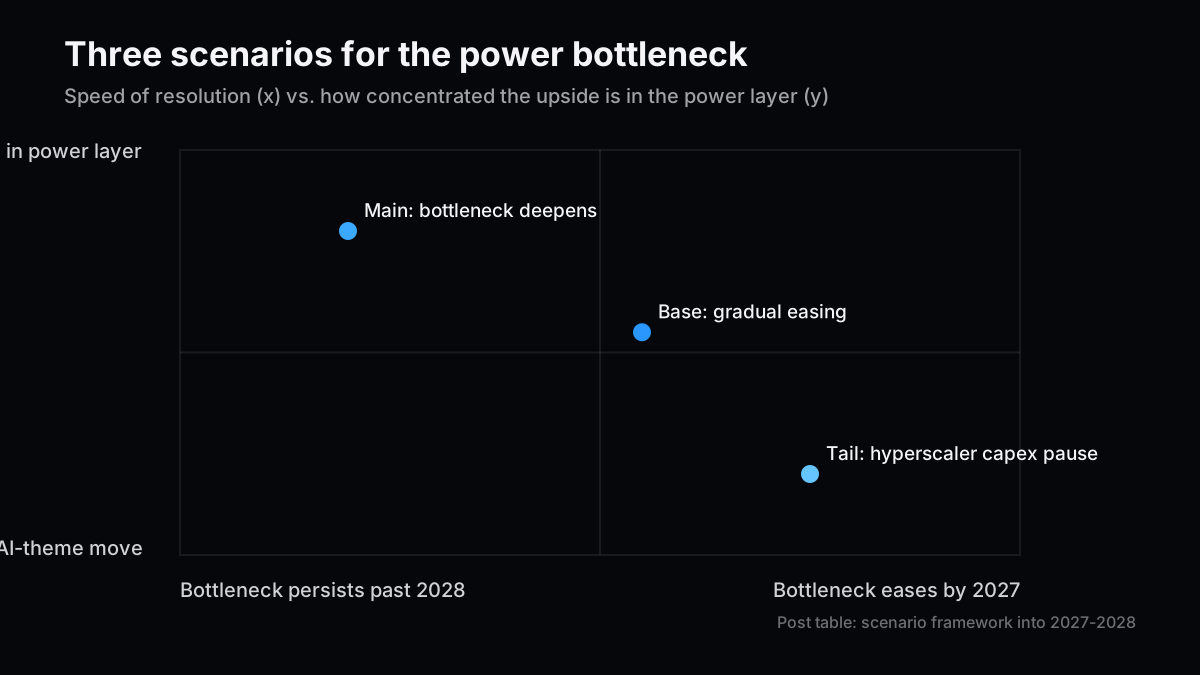
Three scenarios, laid out.
| Scenario | Subjective probability | Content | Implication for the power layer |
|---|---|---|---|
| Base | 50% | Grid buildout and transformer supply improve gradually; pressure eases through 2028 | Maintain selective overweight |
| Main | 35% | The bottleneck actually deepens through 2027; capital rotates harder into the power layer within the AI theme | Sharp outperformance for the power layer |
| Tail | 15% | Hyperscalers pause capex execution out of frustration with power constraints | Broad decline, power names caught in the downdraft short term |
My current position is to hold transmission/substation equipment and in-building distribution/UPS -- what Part 19 called L2 and L3 -- as the core overweight, with power semiconductors held selectively overweight by name. Generation is more exposed to utility regulatory swings, so I am running that at neutral, shifting gradually toward overweight rather than committing outright.
Let me also state what would change my mind. If FERC's interconnection rule reforms actually bite and new AI projects in PJM start reaching energization within three years, the weight of the interconnection gate itself lightens, and the premise behind this whole capital rotation into the power layer weakens. At that point I would trim power infrastructure exposure and look back toward chips and the model layer instead.
From my time tracing a yield problem that had been blamed on equipment back to its real process-level root cause, one lesson stuck: behind whatever is visible and glamorous -- the GPU, the model, the benchmark -- there is almost always a duller rate-limiting step underneath. Right now, AI investing looks like it has finally arrived at the point where that rate-limiting step has moved from compute to power.
Next Issue Ideas
- Idea 1: Ranking power-semiconductor names by SiC/GaN mix — Compare Infineon, onsemi, Monolithic Power, and Navitas on data-center revenue exposure and wide-bandgap mix against current valuations.
- Idea 2: Pricing behind-the-meter and SMR economics — Model how many years and dollars a self-generation or SMR-co-located data center actually saves versus waiting in the interconnection queue.
- Idea 3: Scoring FERC interconnection reform — Track implementation of the FERC reforms flagged as this piece's what-would-change-my-mind trigger, and check how much PJM timelines have actually compressed.
Related Posts
- 800V AI data centers: GaN, SiC, and power-loss economics — Separate distribution from generation and calculate the value of an efficiency improvement under explicit assumptions.
- The Investment Map of AI Infrastructure's "Silicon Periphery": Power, Cooling, Optics, and Site Plays Hiding in Plain Sight — The source of the L1-L4 layering framework this piece extends into the power layer.
- Physical AI: The Next Investment Frontier — Where I first laid out physical AI and humanoid robotics as an investment theme, ahead of Musk's G20 remarks.
- The Warsh Shock — Part 2: How Far Rate Risk Reaches Into Tech Capex — The source for the funding-structure risk this piece extends to power capex.
References
Updated September 12, 2026: replaced the IEA electricity-consumption row with its updated outlook and added the 800V follow-up.
The factual and numerical assumptions in this article prioritize primary and official sources readers can verify themselves.
- Musk warns G20 of looming AI power crunch (Kaohoon International)
- Nvidia's Huang urges G20 to speed AI adoption, spur growth (The Spokesman-Review)
- Nvidia's Jensen Huang pitches AI as national infrastructure at G20, pegging one gigawatt at $50-60 billion (Crypto Briefing)
- Only 13 percent of US power projects in the grid queue reach commercial operation (GCN, citing LBNL Queued Up 2026)
- Why AI Data Center Projects Face Years of Delays After Approval (Data Center Knowledge)
- ERCOT's large load queue has nearly quadrupled in a single year (Latitude Media)
- The Grid-Scale Transformer Shortage Is a Three-Year Backlog (Manufacturing Mag)
- NVIDIA 800 VDC Architecture Will Power the Next Generation of AI Factories (NVIDIA Technical Blog)
This article is provided for informational purposes only and is not a recommendation or investment advice regarding any specific security, service, or contract terms. The author may hold positions or have interests in the names discussed. Generative AI was used for parts of the research, translation, and proofreading. The additions and corrections dated September 12, 2026 were automated. Please see the disclaimer for details.