Space Business Series ③: When Does Carrying Passengers to Space Become a Business?
The final part lines up prices and flight records for stratospheric balloons, suborbital flights and orbital stays, reads where Virgin Galactic, Axiom Space, Vast, Iwaya Giken and others stand, and explains why passenger flights nearly stopped in 2026.
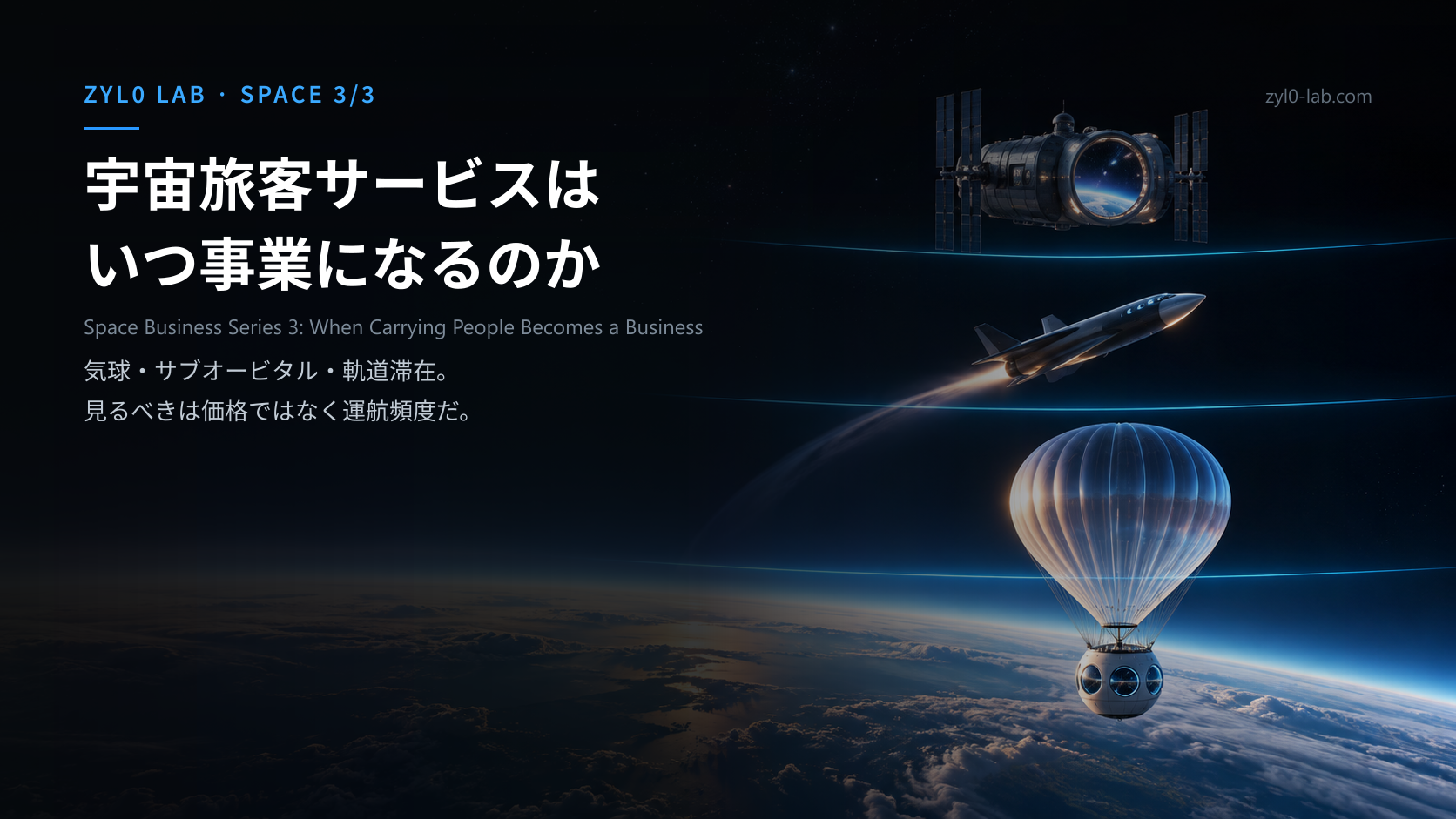
The final part lines up prices and flight records for stratospheric balloons, suborbital flights and orbital stays, reads where Virgin Galactic, Axiom Space, Vast, Iwaya Giken and others stand, and explains why passenger flights nearly stopped in 2026.


Space Business Series ③: When Does Carrying Passengers to Space Become a Business?
Of the three parts, this is the one I hesitated most to write. Microgravity and communications at least had numbers moving forward. Passengers do not. In 2026, suborbital flights carrying customers stopped after a single flight in January.
Note: this piece is an outside-in read based solely on public information — company releases, product pages, papers, and press coverage.
As of October 11, 2026. Flight records, funding and schedules come from company announcements and press reports. Seat prices include figures from press and guide sites, flagged as such. Yen amounts are converted at a rough ¥150 to the dollar; multiples, totals and evidence stages are my own calculations and judgment.
In 2026, Passenger Flights Nearly Stopped
Start with the facts. Both suborbital operators are on the ground at the same time.
On January 30, 2026, Blue Origin said it would pause New Shepard flights for at least two years, to move people and money to its crewed lunar lander. By the company's count, New Shepard has flown 38 times and carried 98 people above 100 kilometers. The last flight was on January 22.
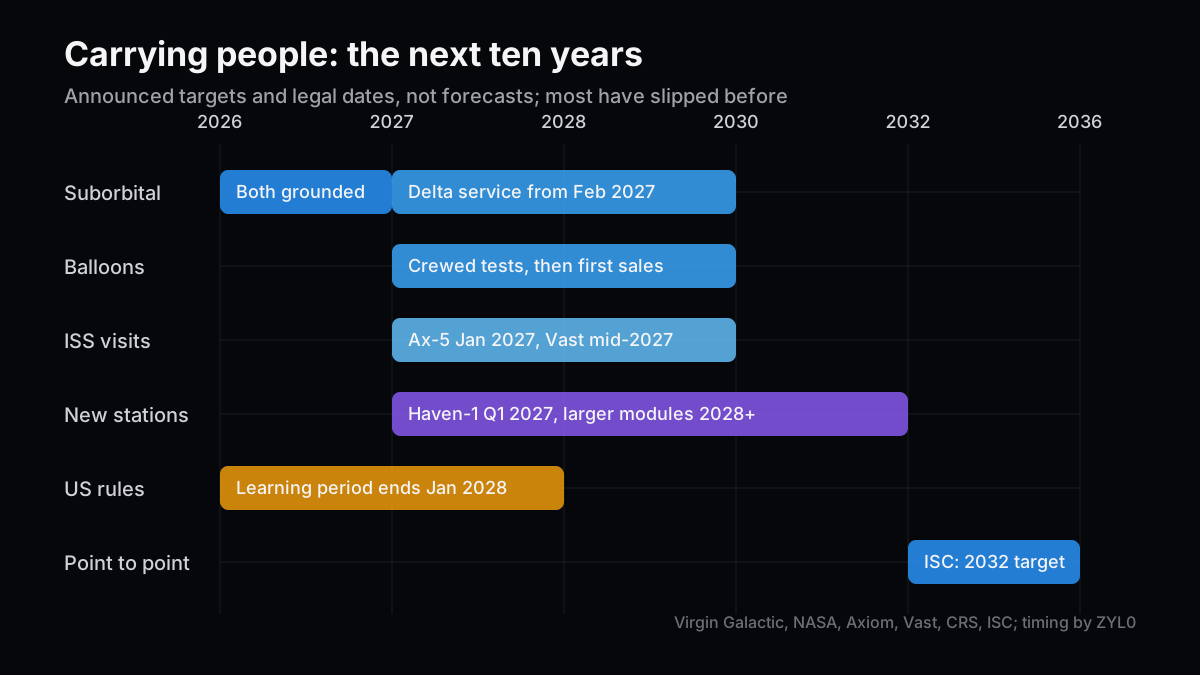
Virgin Galactic flew seven commercial missions on its first vehicle, VSS Unity, between June 2023 and June 2024, then retired it. The next-generation Delta is still in development. In its August 12 update the company moved the first commercial flight from the fourth quarter of 2026 to February 2027 at the earliest.
Right now, no vehicle anywhere is flying suborbital customers.
What about orbit? Axiom Space has run four private missions to the ISS between 2022 and 2025. The fifth is planned for no earlier than January 2027. Roughly one a year is the demonstrated pace so far.
Here is the ladder of evidence I have used through this series, translated to passengers.
| Stage | Evidence you can see | What you still cannot say |
|---|---|---|
| 1. Crewed test | People have flown on it | Whether paying customers can |
| 2. First commercial flight | A paying customer has flown | Whether it repeats |
| 3. Repeat | Several commercial flights completed | Whether it can fly every month |
| 4. Scheduled operations | Several flights a month, sustained | Whether each flight makes money |
| 5. Unit economics | Operating profit funds more vehicles | How many years demand lasts |
Blue Origin and Virgin Galactic both reached stage 3 and then returned to the ground. No company has reached stage 4.
Prices and track records, ordered by altitude:
| Type | Experience | Price per seat | Commercial record | Next milestone |
|---|---|---|---|---|
| Stratospheric balloon | 20 to 30-plus km, several hours, no weightlessness | $50,000 to $195,000 (press and guide sites) | None | Crewed tests targeted for 2027 |
| Suborbital | 80 to 100 km, a few minutes of weightlessness | $750,000 (Virgin Galactic) | Seven on Unity; 98 people on New Shepard | Delta commercial flight (Feb 2027 or later) |
| Orbital (ISS visit) | About 400 km, about two weeks | Estimated near $55 million (reported) | Four by Axiom | Fifth mission (Jan 2027 or later) |
| Commercial station stay | A dedicated habitat module | Not disclosed | None | Haven-1 (Q1 2027) |
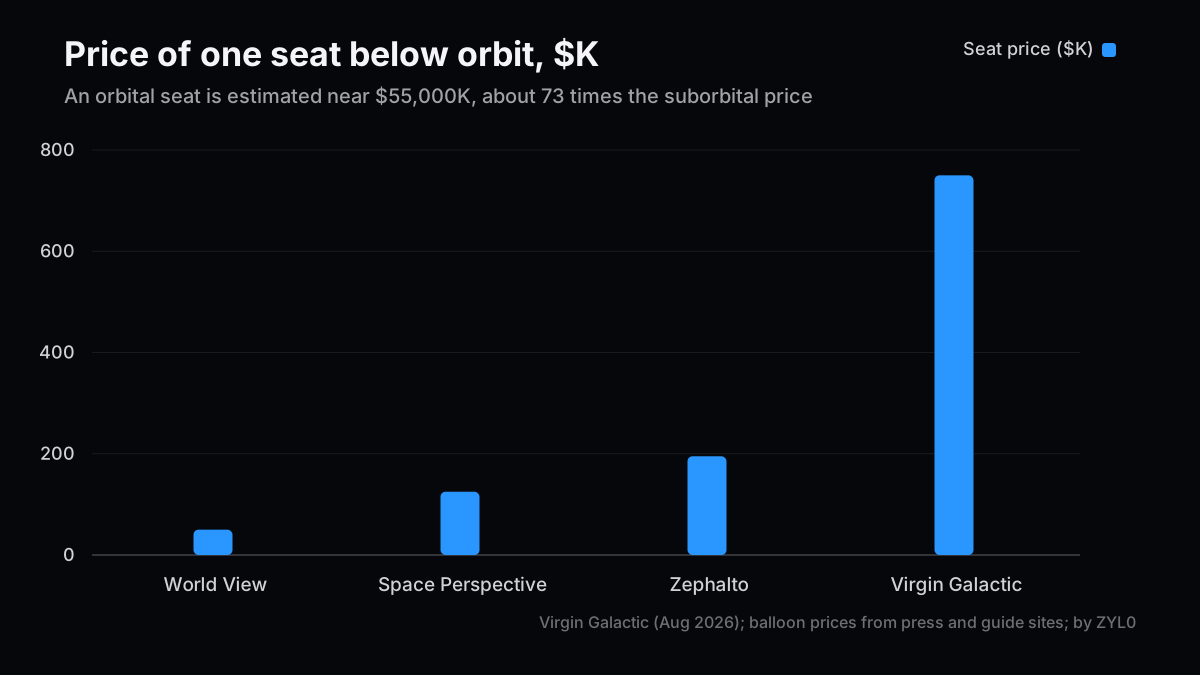
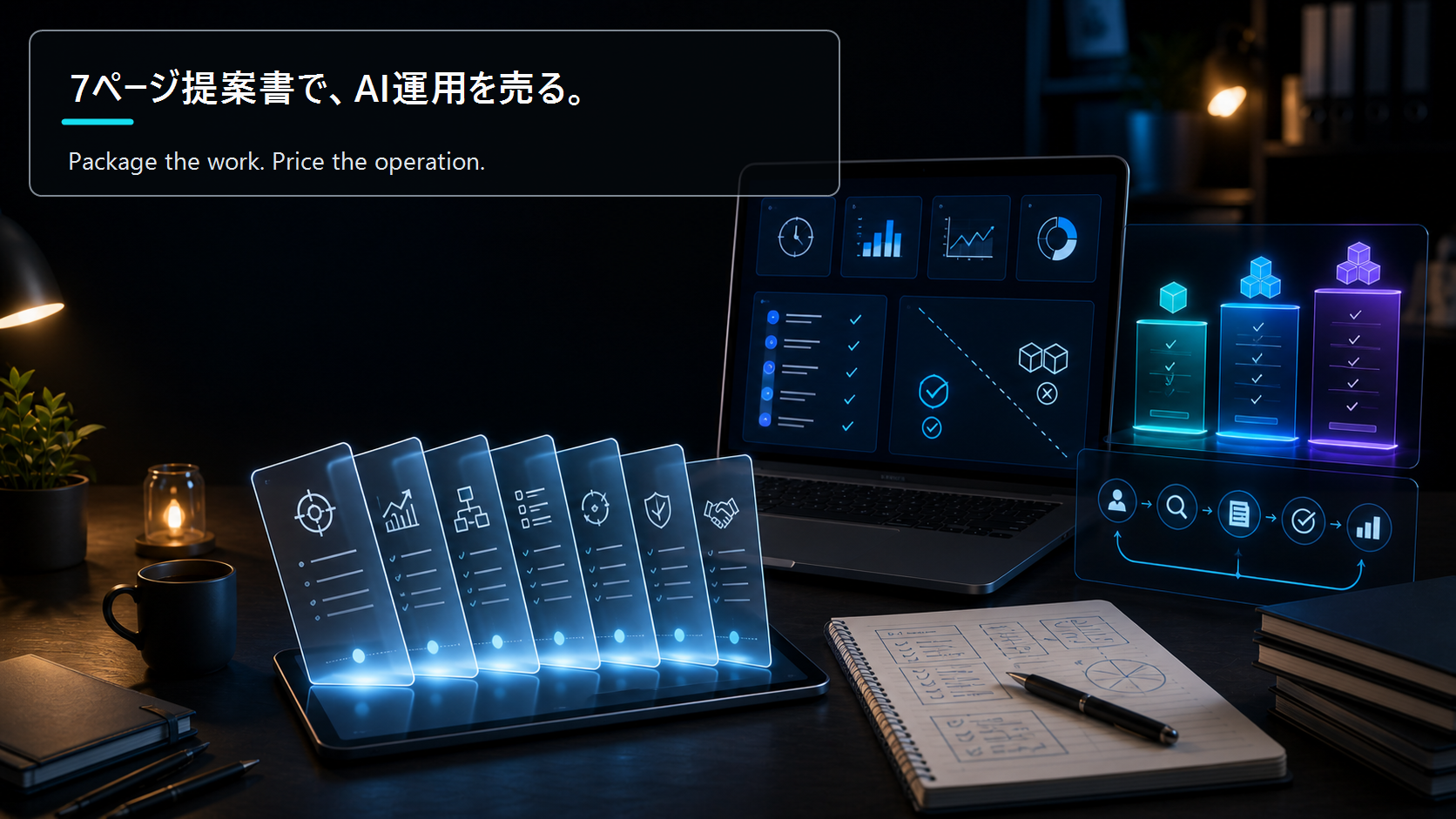
From $750,000 for a suborbital seat to about $55 million for an orbital one is a gap of roughly 73 times (my calculation). Nothing is on sale in between. The rungs of this ladder are simply too far apart.
Why It Stops: Cadence, Rebuilding and Priorities
Listing the reasons, I found myself thinking about automotive mass production.
In automotive-grade manufacturing, it was normal to requalify every time a design or a process step changed. In Physical AI Series ③ I wrote that between a working prototype and building the same quality again and again lies a separate branch of engineering. Crewed vehicles are no different. Build a new vehicle and the track record does not carry over. Unity's seven commercial flights are not Delta's record.
The reason Virgin Galactic gave for its delay is telling. There was no single major fault. By its account, hundreds of small installation tasks remained, and some components were a few thousandths of an inch taller or shorter than specified. From my time around structural analysis, the thing to fear is less the individual part than the stack-up of tolerances. The difficulty of assembling the first unit sits somewhere other than the difficulty of designing it.
Here are the choke points I ended up with. There turned out to be six.
| Bottleneck | What it is | What happened in 2026 | Companies involved |
|---|---|---|---|
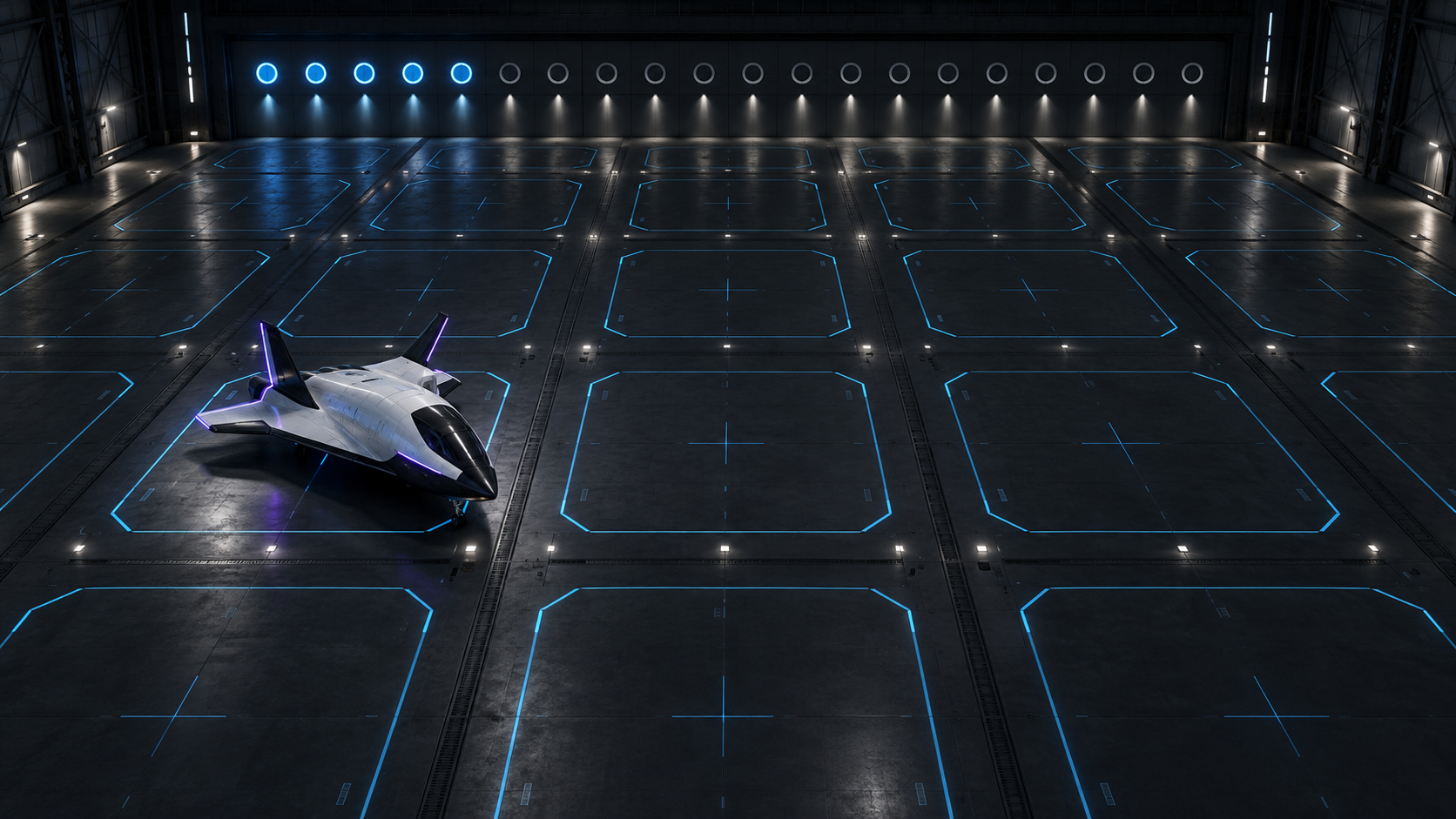
| Cadence | Fixed costs are only recovered by flying every month | Virgin Galactic set a target of ten flights a month by end of Q2 2027 | Virgin Galactic |
| Rebuilding | A new vehicle restarts testing and qualification | Delta's first commercial flight moved to February 2027 or later | Virgin Galactic |
| Priorities | Passengers get deferred when a bigger contract arrives | Blue Origin prioritized its lunar lander and paused New Shepard | Blue Origin |
| Destinations | In orbit the only destination today is the ISS | Haven-1 moved to Q1 2027; NASA's successor procurement is unsettled | Vast, Axiom Space, Starlab |
| Regulation | US law currently defers occupant-safety rulemaking | The deferral still expires on January 1, 2028 | Everyone |
| Proof of safety | No balloon has yet flown a paying passenger | Crewed test targets moved into 2027 | World View, Zephalto, HALO Space, Iwaya Giken |
The third row is the one I took most seriously. Blue Origin holds a $3.4 billion NASA contract to develop a crewed lunar lander. Virgin Galactic's new $750,000 ticket tranche, on sale since March 2026, sold more than 50 seats for more than $50 million in bookings. The second figure is about 1.5% of the first (my calculation). Ask where the same engineers should go and the answer is obvious. The passenger business did not lose to technology. It lost an internal contest for resources.
The regulatory clock is running too. Since 2004, US law has deferred the regulator's authority to write safety rules for people on commercial spacecraft, on the theory that the industry should be allowed to learn until something goes wrong. The current expiry is January 1, 2028. According to the Congressional Research Service, the Federal Aviation Administration estimated in 2024 that, without an extension, final rules would take effect around April 2028. Whether it is extended is up to Congress.
The Companies, Altitude by Altitude
Ordered by altitude, the money turns out to sit not with those who carry passengers but with those who build somewhere for them to go.
Stratospheric balloons: World View, Space Perspective, Zephalto, HALO Space, Iwaya Giken
A balloon looks like the gentlest technology of all. No rocket: it rises to the stratosphere over a few hours, shows you a black sky and the curve of the Earth, and comes down. Even so, no company has yet flown a paying customer.
World View, in the US, advertises $50,000 a seat, though guide sites describe its tourism business as dormant. Space Perspective, also American, sold seats at about $125,000, was reported to have been acquired by a Spanish company after running short of money, and has not begun operations. France's Zephalto lists about $195,000 and targets 2027, and Spain's HALO Space places crewed tests in late 2027. These prices and dates come from press and guide sites, not company filings, and may change.
Japan's Iwaya Giken, based in Hokkaido, reached 20,816 meters on a crewed test in July 2024. It originally planned commercial operations for 2023 to 2024 and has not yet started. On flight evidence it is one of the furthest along among the balloon companies.
Why balloons are not moving faster, I honestly cannot say with confidence. I have a hypothesis: it is not the technology but crewed certification, insurance, and enough capital to survive until opening day. A product priced at $50,000 to $200,000 a seat does not attract rocket-scale funding.
Suborbital: Virgin Galactic
Virgin Galactic is a listed company (SPCE) and the only one at this altitude with a published restart schedule. First commercial flight: February 2027 at the earliest. A second ship is planned to enter commercial service in the second quarter of 2027, with a goal of ten flights a month by the end of that quarter. Its record so far is seven flights in about a year. Ten a month would be about 17 times that pace (my calculation).
Orbit and stays: Axiom Space, Vast, Starlab
Axiom Space is the only company to have flown four private missions to the ISS. The change in who rides is the interesting part. On the first mission in 2022, the three seats beside the company's commander went to private individuals. On the third in 2024 and the fourth in 2025, the same three seats were all filled by government astronauts: Italy, Türkiye and Sweden, then India, Poland and Hungary. The "passenger" in orbit has shifted from tourist to the astronaut of a country with no crewed vehicle of its own.
The company announced $350 million in financing in February 2026 and a final close of more than $525 million on June 4, with MUFG Bank joining as a new investor. The money goes to its own station and to spacesuits for NASA.
Vast raised $500 million in March: $300 million of equity led by Balerion Space Ventures and $200 million of debt, with the Qatar Investment Authority, Mitsui, MUFG and Nikon among the participants. Total funding is reported to exceed $1 billion. Its single-module Haven-1 is planned for the first quarter of 2027, to be visited by a crew of four. Vast also won NASA's sixth private astronaut mission to the ISS, the first time a company other than Axiom has taken one of those slots.
Starlab is led by Voyager Technologies (VOYG), with Airbus and Mitsubishi Corporation among its partners. Launch is not expected before 2028.
Compare the investor column with the earlier parts. Part 1 had Lux Capital, Founders Fund and Bessemer; Part 2 had Kleiner Perkins and a16z. Here the names are sovereign funds, banks, trading houses and manufacturers. Carta's Q1 2026 report shows more than 60% of capital raised going to AI companies. It is no surprise that money from funds working to a roughly ten-year horizon does not flow easily to crewed businesses whose payback is distant. What has come in instead, on my hypothesis, is capital that decides on the basis of national space policy or a link to its own business.
Spaceplanes and point-to-point: Radian Aerospace, Venus Aerospace, Innovative Space Carrier
Vehicles that take off from runways, and plans to link two points on Earth through space, belong to the 2030s. Radian Aerospace, in the US, is pursuing a single-stage spaceplane; as far as public information shows, it has not yet flown a vehicle. Venus Aerospace flight-tested a rotating detonation rocket engine in May 2025 and raised a $91 million Series B in 2026.
Japan's Innovative Space Carrier (ISC) raised about ¥3.2 billion in March 2026. Its roadmap targets crewed space transport in 2032. It abandoned a planned flight test of its demonstrator in the US after permitting delays and switched to testing in Japan. Here again the pace is set by permission more than technology, the same shape as Varda's first capsule waiting eight months for clearance to land in Part 1.
| Company | Type | 2026 funding or bookings | Operating evidence | Stage (my read) |
|---|---|---|---|---|
| Virgin Galactic | Suborbital | 50+ seats at $750,000; over $50M in bookings | Seven commercial flights on Unity (retired); Delta unflown | 3 (new vehicle unflown) |
| Blue Origin | Suborbital | Not disclosed | 38 flights, 98 people; pause of two years or more | 3 (paused) |
| Axiom Space | Orbital | Over $525M (final close in June) | Four ISS visits | 3 |
| Vast | Orbital, stays | $500M ($300M equity + $200M debt, March) | Not yet flown; Haven-1 in Q1 2027 | 0–1 |
| Iwaya Giken | Balloon | Not disclosed | Crewed test to 20,816 m (July 2024) | 1 |
| Venus Aerospace | Propulsion | $91M Series B | Engine flight test (May 2025) | 0 |
| Innovative Space Carrier | Point-to-point | About ¥3.2B (March) | Demonstrator in testing | 0 |
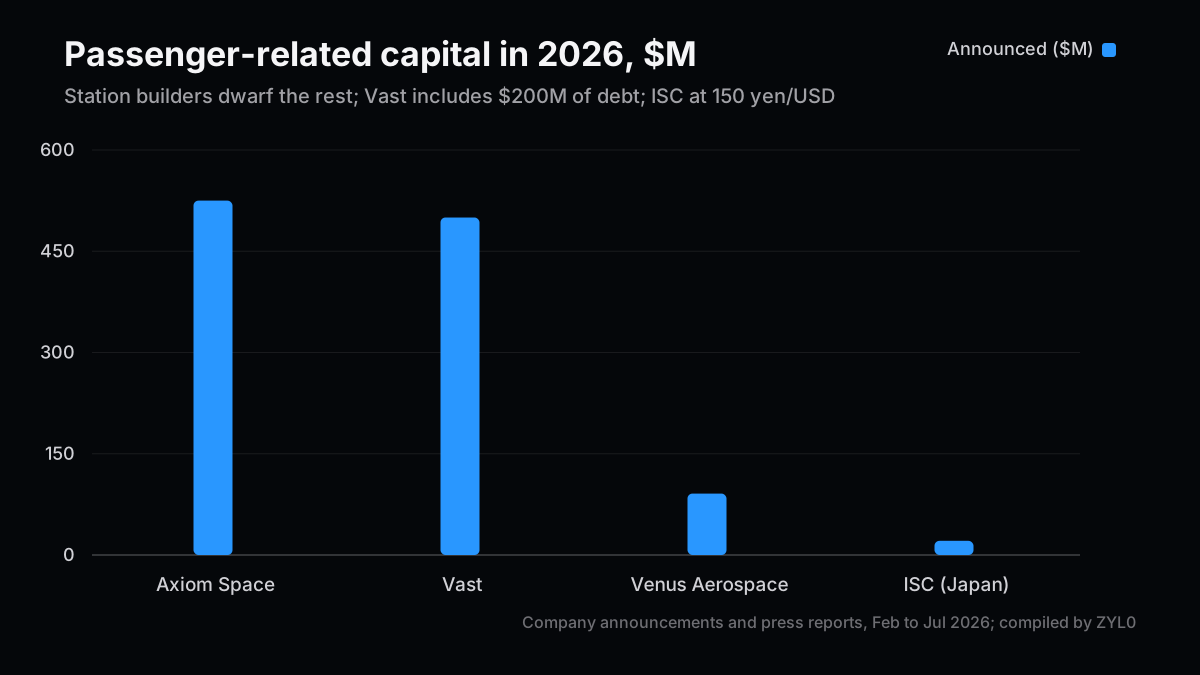
The two station builders raised about $1.03 billion between them (my sum), roughly 20 times Virgin Galactic's new bookings. Capital is gathering on the side that builds the destination, not the side that carries the customer.
Scenarios for the Next Decade and the Investment Call
My conclusion first: I am neutral on passenger carriers in both the short and the medium term. Until there is stage 4 evidence, meaning monthly operations sustained for several months, I will not move.
Station companies I value in a different frame. Not as a passenger business, but as the hosting layer from Part 1, and as the place that receives astronauts from countries without a crewed vehicle. There I am medium-term positive, though almost all of it is private.
In my March post on eight megatrends I listed space tourism among the uses of commercial stations, and wrote "one commercial station begins operations" into my base case. Six months on, the first one has moved to 2027, and if tourism stays in the list of uses, it goes last. I am revising that view.
Direct public-market exposure is close to one name: Virgin Galactic (SPCE), a stock whose outcome depends heavily on the first flight in February 2027 and the cadence after it. For Mitsui (8031), Mitsubishi UFJ Financial Group (8306) and Nikon (7731), which invested in Vast, the effect is tiny relative to their size.
| Scenario (2026–2036) | Condition | Evidence to watch | Implication |
|---|---|---|---|
| Base | One suborbital operator restarts at a few flights a month; orbital riders remain mostly national astronauts | Delta's monthly flight count; crew make-up on private missions | Passengers stay a small market; stations work on government demand |
| Main | Around 2030 a commercial station is permanently crewed, hosting passengers, research and national astronauts | Haven-1's outcome; NASA's selection; larger modules from 2028 | The hosting layer from Part 1 and passengers are valued together |
| Tail (downside) | An accident, or the 2028 regulatory switch, grounds operations for a long time | Whether the deferral is extended; incident reports | Carriers' survival is in question; capital stays only with destinations |
| Tail (upside) | A large crewed vehicle enters service and cuts orbital seat prices by an order of magnitude | Crewed flight record; published seat prices | Tourism becomes a volume market for the first time; the rungs close up |
What would change my mind: if Delta sustains eight or more flights a month for three months during 2027 and the company discloses profit or loss per flight. I would then move suborbital to medium-term long. Once there is evidence of cadence, the argument about demand tends to follow.
Watch Points
- Whether Virgin Galactic's Delta begins commercial flights in February 2027, and the monthly count after that
- Whether Vast's Haven-1 launches in Q1 2027 and its first crew completes a stay
- Whether the crew of Axiom's fifth mission are individuals or national astronauts
- Whether Congress extends the deferral before the January 1, 2028 expiry
- Which balloon company is first to fly a paying customer
Closing the series
All three parts in one table:
| Part | Layer | Who pays cash today | Most advanced evidence | My call |
|---|---|---|---|---|
| ① | Microgravity | Governments testing re-entry conditions | Varda's six re-entries | Medium-term long the return layer |
| ② | Communications | Subscribers, mobile operators, governments | Starlink's 12 million subscribers | Medium-term long parts, ground and relay |
| ③ | Passengers | Countries without a crewed vehicle of their own | Axiom's four ISS visits | Neutral until there is evidence of cadence |
Before I started, I thought of these three layers as separate markets. Side by side, what stands out is what they share. In every layer the most reliable customer was a government. And capital gathered not on the headline product but on the connective parts that support it: the ride home, ground stations and relay, and the destination.
If I am reading the next ten years of space business, I will count who managed to repeat the same thing, and how many times, before I ask what can be done in space. It is not glamorous. But after writing three parts, I think it is the reading least likely to be wrong.
Related Posts
- Space Business Series ①: The Startups Turning Microgravity Into an R&D Platform — Drug and crystal demonstrations, and why the ride home sets the pace
- Space Business Series ②: The Startups Building Communications Infrastructure in Orbit — Direct-to-phone, optical relay, satellite buses and ground stations
- 8 Megatrends in Space Startup Investing — The March overview; this post revises its view on commercial stations
- Physical AI Series ③: Hardware Is the Last Bottleneck — The same point about the engineering between prototype and production
References
- Blue Origin: New Shepard to pause flights for no less than two years (Jan 30, 2026)
- Engadget: Virgin Galactic postpones its first commercial flight to 2027 (Aug 13, 2026)
- Axiom Space: Oversubscribed financing closes at more than $525M (Jun 4, 2026)
- Via Satellite: Vast and Sierra Space post new funding rounds (Mar 5, 2026)
- Congressional Research Service: Regulation of Commercial Human Spaceflight Safety
- THE BRIDGE: Innovative Space Carrier raises about ¥3.2B (Mar 2026)
- Carta: State of Private Markets: Q1 2026
Next Issue Ideas
- Idea 1: A capital-allocation table for the three space layers — Re-sort the companies from all three parts into return, communications suppliers and destinations, and lay out public and private exposure in one table.
- Idea 2: Who is paying for private-mission crews? — Split ISS-visit crews into individuals and governments, and count from public information how many seats of demand come from countries without a crewed vehicle.
- Idea 3: Testing the plan for ten flights a month — Work backward from vehicle count, turnaround time and weather limits to an upper bound on suborbital flight cadence.
This article is for informational purposes only and is not investment advice or a recommendation to buy or sell any security. The author may hold securities of companies mentioned. Generative AI was used in parts of the research, writing and translation. Some seat prices and round sizes are reported but unconfirmed; multiples, totals, conversions and evidence stages are the author's calculations and judgment using the methods described. See the disclaimer for details.