GPT-5.5 Is Finally "AI That Works at Work" — But Mythos Is Still Far Ahead
A deep comparison of OpenAI's newly announced GPT-5.5 against Claude Mythos Preview and Gemini 3.1 Pro — strategic divergence, rising costs, and where the coding-AI race is heading from an investor's perspective.
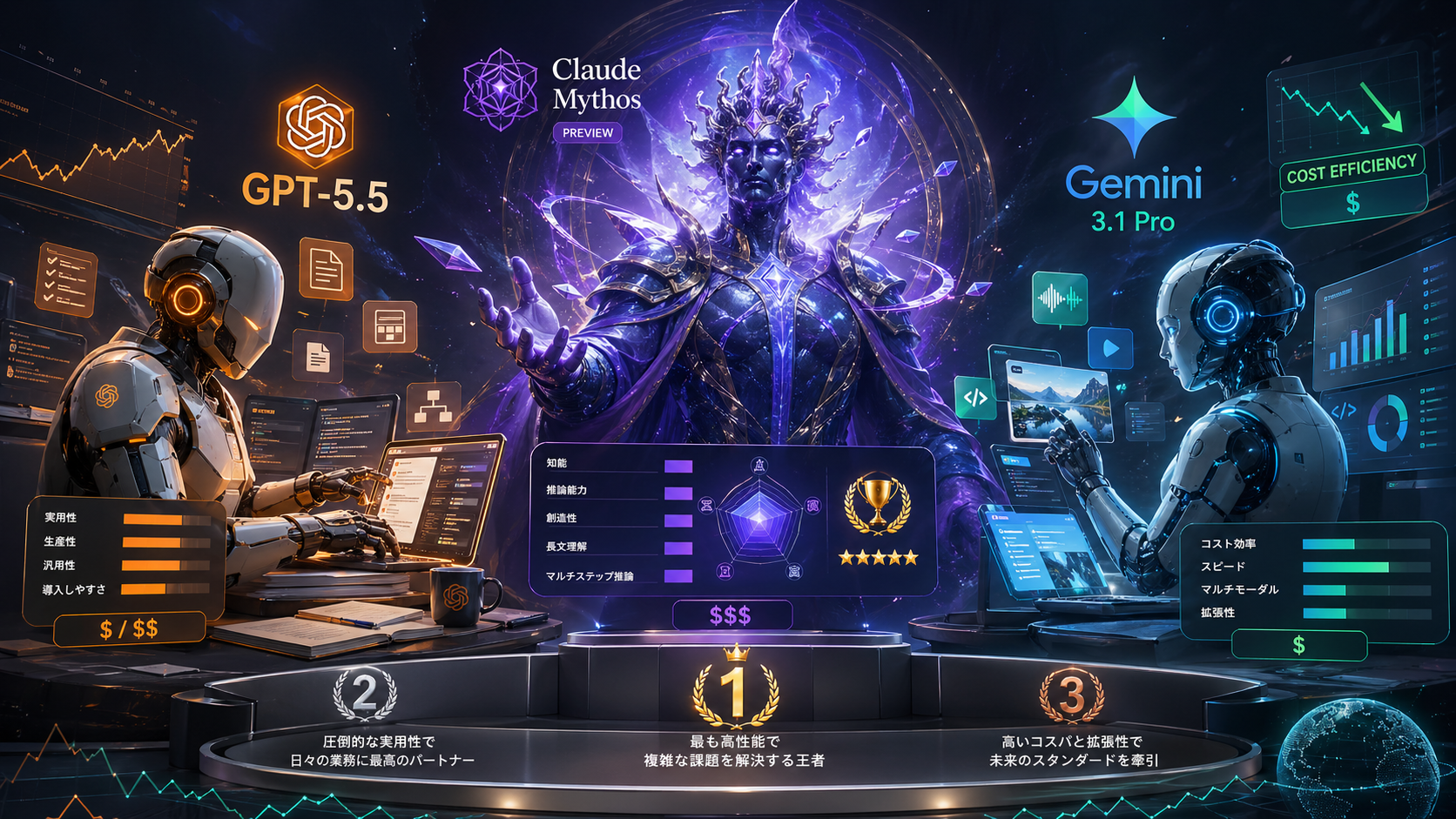
A deep comparison of OpenAI's newly announced GPT-5.5 against Claude Mythos Preview and Gemini 3.1 Pro — strategic divergence, rising costs, and where the coding-AI race is heading from an investor's perspective.


GPT-5.5 Is Finally "AI That Works at Work" — But Mythos Is Still Far Ahead
I run investment memos, earnings analyses, and English pitch-email triage through AI every day from the CVC seat, and I maintain this blog through Claude Code. I pay for all three flagships out of pocket and have enterprise accounts — which means I see where benchmarks diverge from real working feel. The three-way clash between GPT-5.5, Mythos, and Gemini 3.1 Pro is the most "live working feel changed my conclusion" moment of the last two years. The investor implications follow that hands-on read.
GPT-5.5 Has Arrived — But Claude Still Owns the Stage
Let me put the state of play down flat first.
On April 23, 2026, OpenAI announced its newest flagship, GPT-5.5 (codename "Spud"), shipped just six weeks after GPT-5.4 — an unusually short cadence. It is the first OpenAI model since GPT-4.5 trained from scratch as a foundation model, and the first to use a native omnimodal architecture that handles text, images, audio, and video in a single system.
To put it plainly: GPT-5.5 is finally "AI that actually works at work." Stronger pre-training has stripped reasoning waste, latency stays roughly on par with GPT-5.4, and end-to-end performance moves up. It can run plan → tool selection → self-verification cycles with minimal human intervention. AI has shifted, in my view, from "something I ask questions to" into "a partner that gets work done with me."
But — it has not reached the level of Mythos. Anthropic's Claude Mythos Preview was announced on April 7, and the shockwave has not faded. GPT-5.5 makes it brutally clear that catching up to Claude is not happening overnight. The benchmarks tell the story, and side-by-side use confirms it: Claude's raw "smarts" are visibly a tier above. The flip side is that Claude's solo lead is unlikely to be challenged for some time.
The Three Flagship Models in Detail
As of late April 2026, OpenAI, Anthropic, and Google have all refreshed their flagships in near lockstep, and the AI industry is in the most intense capability race we've seen.
OpenAI GPT-5.5 — The "Working Partner" Bet
GPT-5.5's design intent is unambiguous. OpenAI itself frames it as "a new intelligence class for real work and agents." The internal codename "Spud" (potato) feels apt: not flashy, but built to grind through mundane day-to-day work.
Context window: 1M tokens (API). The design assumption is that an agent loads an entire codebase or internal documentation set and works autonomously over it. Max output is 128K tokens. Training and inference run on NVIDIA GB200 and GB300 NVL72.
Benchmarks define the personality. Terminal-Bench 2.0 (CLI multi-step workflow evaluation) hits 82.7%, clearly ahead of Claude Opus 4.7 at 69.4%. But on SWE-Bench Pro — the harder real-world software-engineering benchmark — GPT-5.5 lands at 58.6%, behind Claude Opus 4.7's 64.3%. Translation: GPT-5.5 is strong on long, tool-using workflows, while Claude still leads on pure coding precision. That split is interesting.
For enterprise ChatGPT, OpenAI shipped Workspace Agents: cloud-resident agents that keep running after the user closes their laptop, integrated with Google Drive and other external apps. They effectively replace Custom GPTs. The pitch — eliminate cross-team manual work, automate long-running business processes — reads as a serious enterprise push.
Anthropic Claude Mythos Preview — The Birth of a "Monster"
Claude Mythos Preview is, without question, the biggest AI event of 2026. It is Anthropic's strongest frontier model ever, codename "Capybara." But it is not generally available. The reason is simple: it is too strong.
The numbers are out of distribution. SWE-bench Verified at 93.9% (Opus 4.6 was 80.8%). SWE-bench Pro at 77.8% (GPT-5.4: 57.7%). OSWorld autonomous PC control at 79.6%. USAMO 2026 math at 97.6%. It dominates every major benchmark.
The deepest reason for the limited release is cybersecurity capability. In Anthropic red-team tests, Mythos autonomously discovered thousands of zero-day vulnerabilities across Windows, macOS, Linux, and every major web browser. It even surfaced a 27-year-old OpenBSD vulnerability and auto-generated working exploit code. The U.S. Treasury Secretary and the Fed Chair reportedly held an emergency consultation about systemic risk to financial infrastructure — that scale of impact is the signal.
To redirect the capability to defense, Anthropic launched Project Glasswing, partnering with Apple, Google, Microsoft, NVIDIA, and others. Participating organizations get up to $100M of AI usage credits to proactively patch critical software. Mythos Preview API pricing is $25 per million input tokens and $125 per million output tokens — over 5× GPT-5.5.
The real question is why only Anthropic reached this level. My working hypothesis is the "secret sauce" — pre-training data curation quality, refined RLHF craftsmanship, and possibly an architectural combination involving latent-space reasoning and "Recurrent Depth." Not any one of these alone, but the compound effect, is what produces the raw intelligence. I don't think the gap closes in months.
Claude Opus 4.7, released April 16, should be read in this same context. It improves notably on Opus 4.6 but lacks Mythos-class breadth. Its real role is to be the first vehicle for testing Mythos-grade safety guardrails — a stepping stone for eventually shipping Mythos-class capability to the public.
Google Gemini 3.1 Pro — The "Quiet Strong" Dilemma
Gemini 3.1 Pro is Google DeepMind's latest, released February 19. It uses a Transformer MoE architecture and posted 77.1% on ARC-AGI-2 (more than 2× the prior generation), a step-change in abstract reasoning. At launch it actually overtook Claude Opus 4.6 and briefly held the top spot.
It also delivers strong product surface: 1M-token context, unified text/image/video/audio/PDF understanding, automated SVG animation, real-time data → dashboard generation. API pricing of $2 per million input tokens and $12 per million output tokens makes it the most cost-efficient flagship of the three.
The problem is positioning post-Mythos. Frankly, Google looks rattled. Jules (agentic coding tool) and Antigravity (agent development platform) are shipping fast, but their differentiation against Claude Code and OpenAI Codex is hard to read. The frustration of not topping pure model performance is visible.
That said, Google still has the Android ecosystem, Workspace integration, and best-in-class cost efficiency — a distribution moat. There is a real "different way to win" beyond raw capability that should not be underestimated.
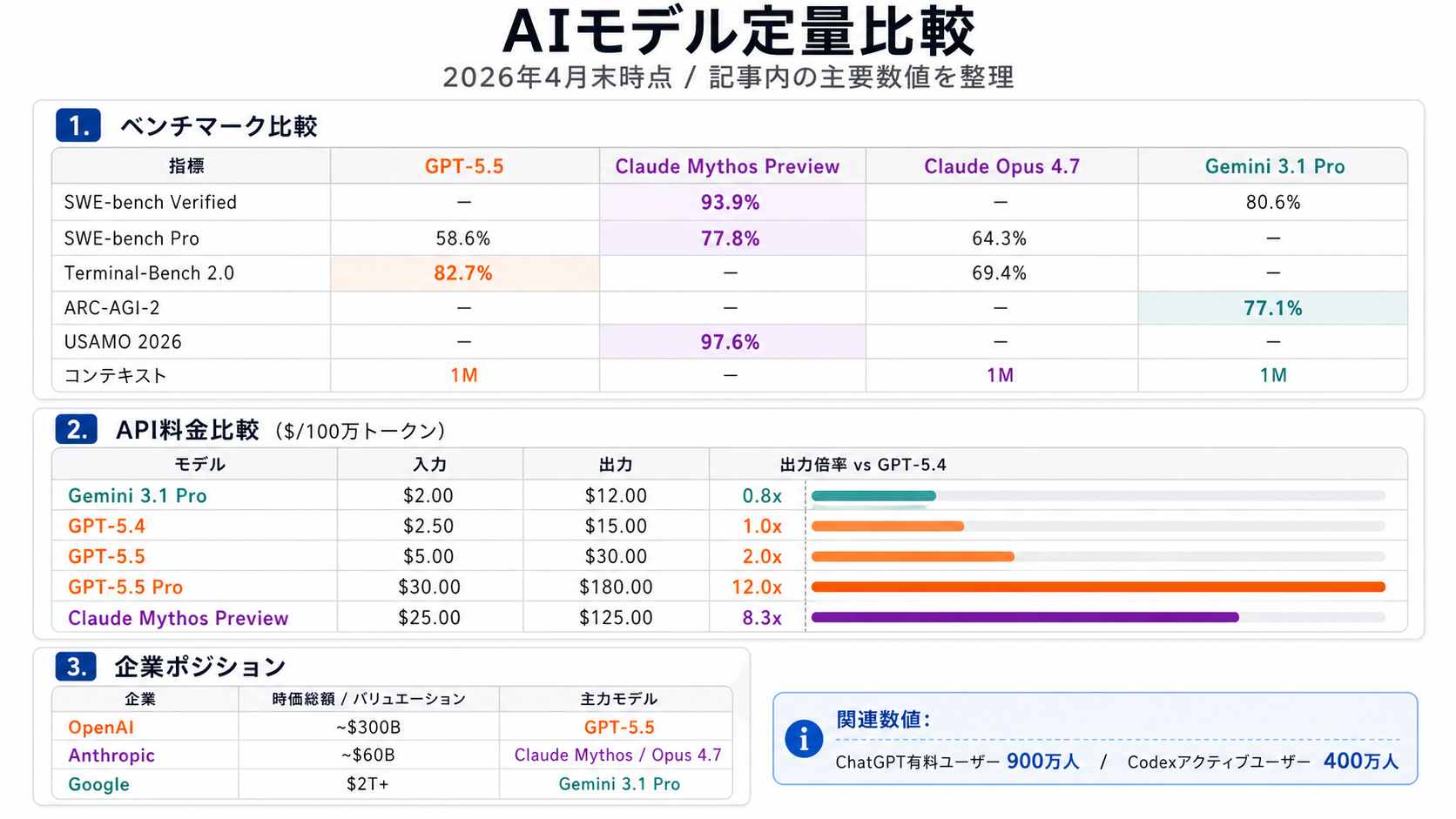
| Metric | GPT-5.5 | Claude Mythos Preview | Claude Opus 4.7 | Gemini 3.1 Pro |
|---|---|---|---|---|
| SWE-bench Verified | — | 93.9% | — | 80.6% |
| SWE-bench Pro | 58.6% | 77.8% | 64.3% | — |
| Terminal-Bench 2.0 | 82.7% | — | 69.4% | — |
| ARC-AGI-2 | — | — | — | 77.1% |
| USAMO 2026 | — | 97.6% | — | — |
| Context | 1M tokens | — | 1M tokens | 1M tokens |
| API input $/1M tokens | $5.00 | $25.00 | — | $2.00 |
| API output $/1M tokens | $30.00 | $125.00 | — | $12.00 |
Surging Costs and the Emerging "AI Divide"
The most overlooked storyline in the three-way comparison — and the one I care about most as an investor — is the sharp rise in inference cost.
GPT-5.5 API pricing is $5 per million input tokens and $30 per million output tokens — exactly 2× GPT-5.4 ($2.50/$15). The premium GPT-5.5 Pro is $30/$180. Claude Mythos Preview at $25/$125 is over 5× GPT-5.5 and more than 10× Gemini 3.1 Pro.
This pricing structure carries real risk of generating an "AI divide" — a widening gap in productivity, creativity, and information access between those who can wield frontier models and those who cannot. Free users won't get GPT-5.5 and will stay on the prior generation. A world where Plus ($20/month) is the de facto floor moves in the opposite direction of "democratizing AI."
| Model | Input $/1M | Output $/1M | vs GPT-5.4 (output) |
|---|---|---|---|
| Gemini 3.1 Pro | $2.00 | $12.00 | 0.8× |
| GPT-5.4 | $2.50 | $15.00 | 1.0× (baseline) |
| GPT-5.5 | $5.00 | $30.00 | 2.0× |
| GPT-5.5 Pro | $30.00 | $180.00 | 12.0× |
| Claude Mythos Preview | $25.00 | $125.00 | 8.3× |
Agentic workloads in particular tend to balloon output tokens via tool retries and self-correction. "My monthly bill came in way over plan" is going to be an extremely common story going forward. Larger, smarter models inevitably mean rising infrastructure cost — a tailwind for NVIDIA, but a headwind on the breakeven economics of every AI startup.
The Coding-AI Race — Who Takes the Next Crown?
The hottest contested battlefield of the past few months is coding AI. OpenAI's Codex (4M active users), Anthropic's Claude Code, Google's Jules / Gemini Code Assist / Gemini CLI — all three labs have made agentic software development their top priority.
Why coding? Because it is the cleanest place to demonstrate visible AI productivity gains. An agent that can read a GitHub issue, find the relevant code, fix it, run tests, and open a PR multiplies engineer output. And enterprise customers are willing to pay real money for that value.
GPT-5.5's Codex extends browser control: web app interaction, full test-flow execution, screenshot capture, and iterative refinement. But on coding accuracy benchmarks (SWE-bench family), Claude still leads. Mythos Preview's SWE-bench Verified at 93.9% means autonomous code repair is approaching senior-engineer level. That number is genuinely jarring.
The other thing to watch is "AI training AI" via synthetic data. Using model-generated data to train the next generation secures quality and diversity, but risks amplifying biases across generations. Differentiation in this layer is, I suspect, the next inflection point for model performance. Looking at Mythos's level, my prior is high that Anthropic has some kind of breakthrough here.
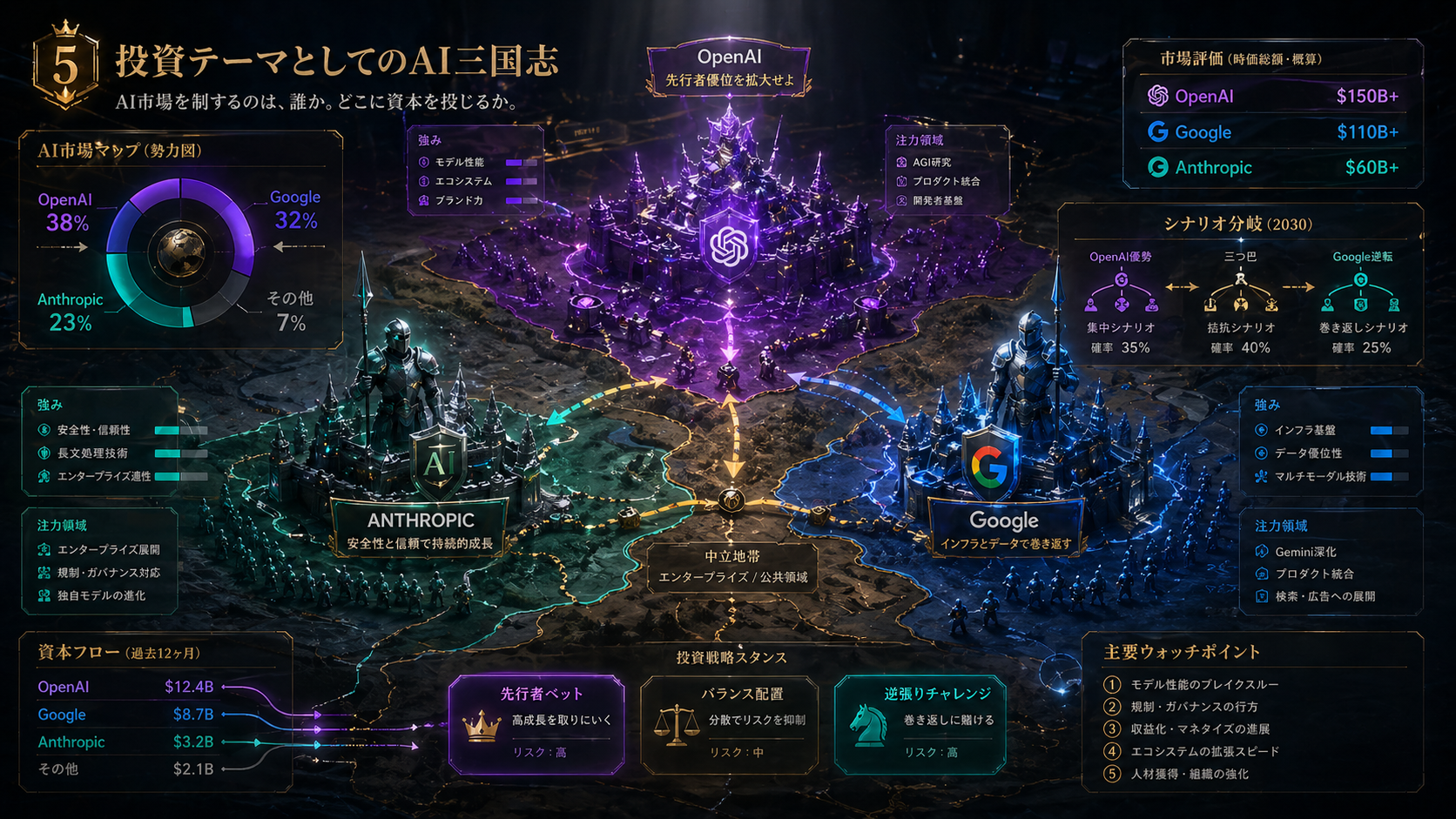
AI as an Investment Theme — A Three-Kingdoms View
Strategic Positioning of the Three Players
| Company | Valuation | Flagship | Differentiation | Revenue model |
|---|---|---|---|---|
| OpenAI | ~$300B (est.) | GPT-5.5 | Practical agents + Codex | Subs $20–$200/mo + API |
| Anthropic | ~$60B (est.) | Claude Mythos / Opus 4.7 | Technical lead + safety | API + Claude Code + enterprise |
| $2T+ (GOOGL) | Gemini 3.1 Pro | Ecosystem + cost efficiency | Ads + Cloud + subs |
Three distinct shapes are emerging. OpenAI pushes "practical at work" to win enterprise. Anthropic holds the summit through technical dominance. Google goes wide and thin on ecosystem and pricing. The AI version of "Windows vs Mac vs Linux" is taking form.
Scenario Analysis
| Scenario | Likely path | Investment implication |
|---|---|---|
| Base case | The three converge on capability; differentiation moves to ecosystem and use cases | Google's distribution moat shines. Stable GOOGL |
| Main case | Claude's technical lead persists; Mythos-class GA ships in 2027+ | Anthropic IPO becomes a marquee 2027 theme; pre-IPO opportunity |
| Tail (upside) | AI capability hits a fast ceiling; differentiation shifts to the application layer | Application companies benefit more than infra (NVIDIA et al.) |
| Tail (downside) | Cost spike calls AI ROI into question; "AI bubble" concerns surface | Tech sees broad correction pressure, but bottom is shallow given AI's now-essential nature |
What to Watch Next
Mythos GA timing — As guardrails mature, a phased release is plausible, but the schedule is unclear. Once it ships, the industry power map can flip overnight.
OpenAI IPO trajectory — 9M paying ChatGPT users and 4M Codex users underwrite the valuation, but cost-structure sustainability is the open question. Watch how the GPT-5.5 2× price hike affects growth.
Inference-cost reduction tech — Distillation, quantization, and inference-specific silicon will determine the total addressable market. NVIDIA's next-gen chip roadmap, Google's TPU cadence, and Amazon's Trainium are key signals.
Agentic workflow B2B adoption — How well GPT-5.5 Workspace Agents, Claude Code, and Gemini Agents penetrate enterprise will dictate revenue growth. H2 2026 adoption data is the first real test.
AI regulation acceleration — Mythos's "too strong to ship" precedent has added a new dimension to the regulatory conversation. EU AI Act alignment and government responses will move sector valuations.
The bottom line: AI competition is shifting from "peak capability" to "practical adoption." GPT-5.5 has matured into an "AI that works at work." Mythos has proven Anthropic's technical lead. Google is hunting a different win via cost and ecosystem. The strategic gap between the three has never been this sharp — for investors, it's a real moment to size positioning carefully.
Next Issue Ideas
- Idea 1: A data-updated follow-up — Revisit the thesis with fresh numbers and separate what strengthened from what broke.
- Idea 2: A practical template edition — Turn the article into a checklist readers can reuse for investing, pricing, or technical operations.
- Idea 3: The bear-case test — Define the conditions that would invalidate this view and map the indicators to watch next.
Related Posts
- Kimi K3 vs Claude Fable 5 vs GPT-5.6: Benchmarks, Pricing, and When to Use Which — The next-generation follow-up to this comparison: the July 2026 frontier trio.
- Claude vs Gemini vs ChatGPT: A VC's Guide to the Latest Models — Claude Opus 4.7, Gemini 3.1 Pro, and GPT-5.4 Pro side-by-side in real VC workflow (April 2026).
- Reading the HalluHard Paper: Why Claude Hallucinates More in Long Conversations, and 4 Implementation Patterns for Claude Code/MCP — Past three conversational turns, even the strongest models hallucinate ~30%.
References
The factual and numerical assumptions in this article are anchored to primary or public materials that readers can revisit during AdSense review and future updates.
This article is for informational purposes only and does not constitute investment advice or a recommendation of any specific stock, service, or contract structure. The author may hold positions or interests related to companies or services mentioned. Generative AI was used for parts of research, translation, and proofreading, with final review by ZYL0. See the disclaimer for details.