The Memory Squeeze Runs to 2031: How Samsung 70 Percent Lock-Up Rewires HBM Supply and the Back-End Value Chain
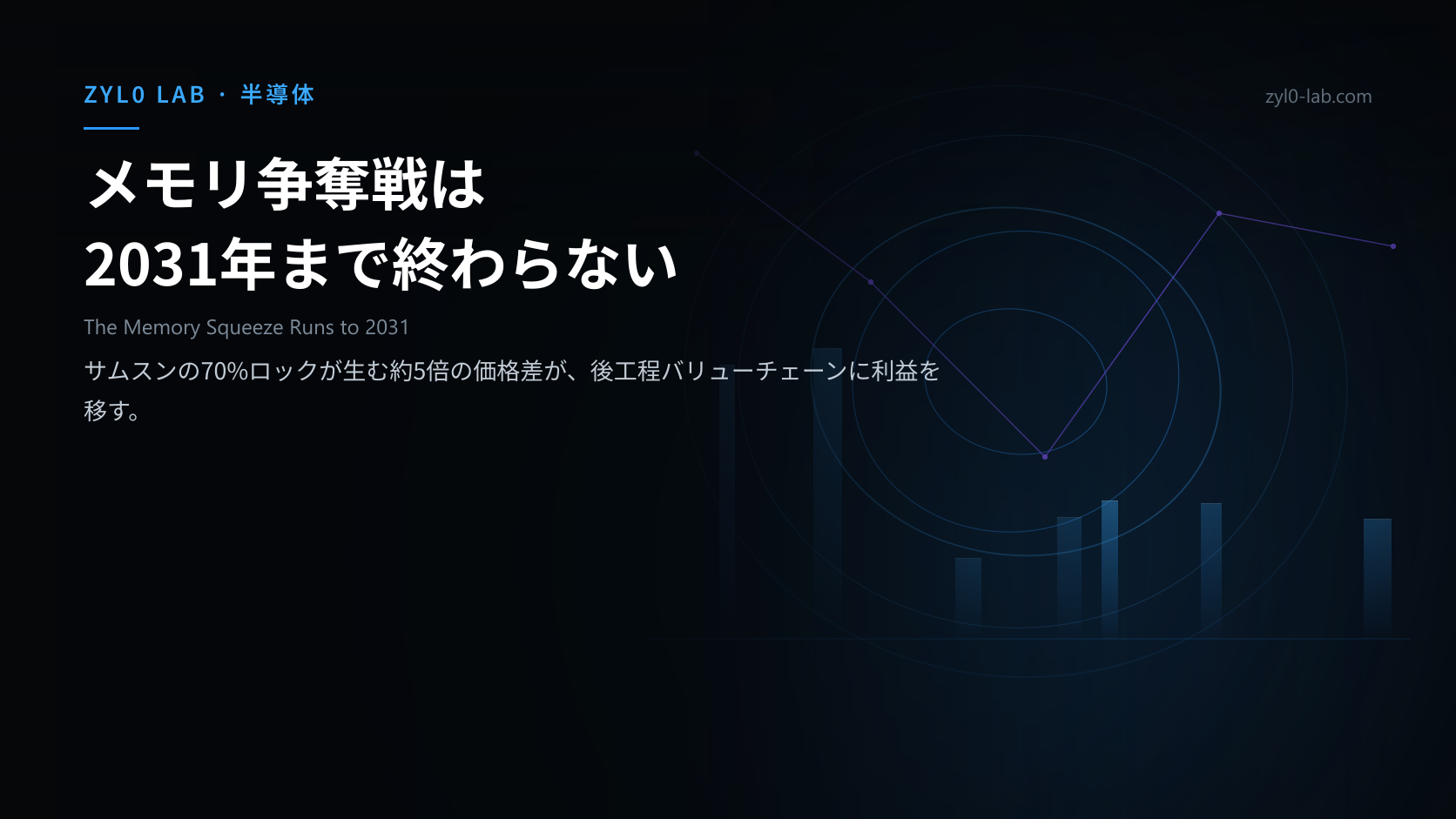
Samsung has locked roughly 70 percent of its memory capacity into long-term deals running to 2031. The real story is not scarcity but a roughly five times spot-to-contract price gap that reallocates profit toward the back end of the value chain.
Samsung has locked roughly 70 percent of its memory capacity into long-term deals running to 2031. The real story is not scarcity but a roughly five times spot-to-contract price gap that reallocates profit toward the back end of the value chain.


The Memory Squeeze Runs to 2031: How Samsung 70 Percent Lock-Up Rewires HBM Supply and the Back-End Value Chain
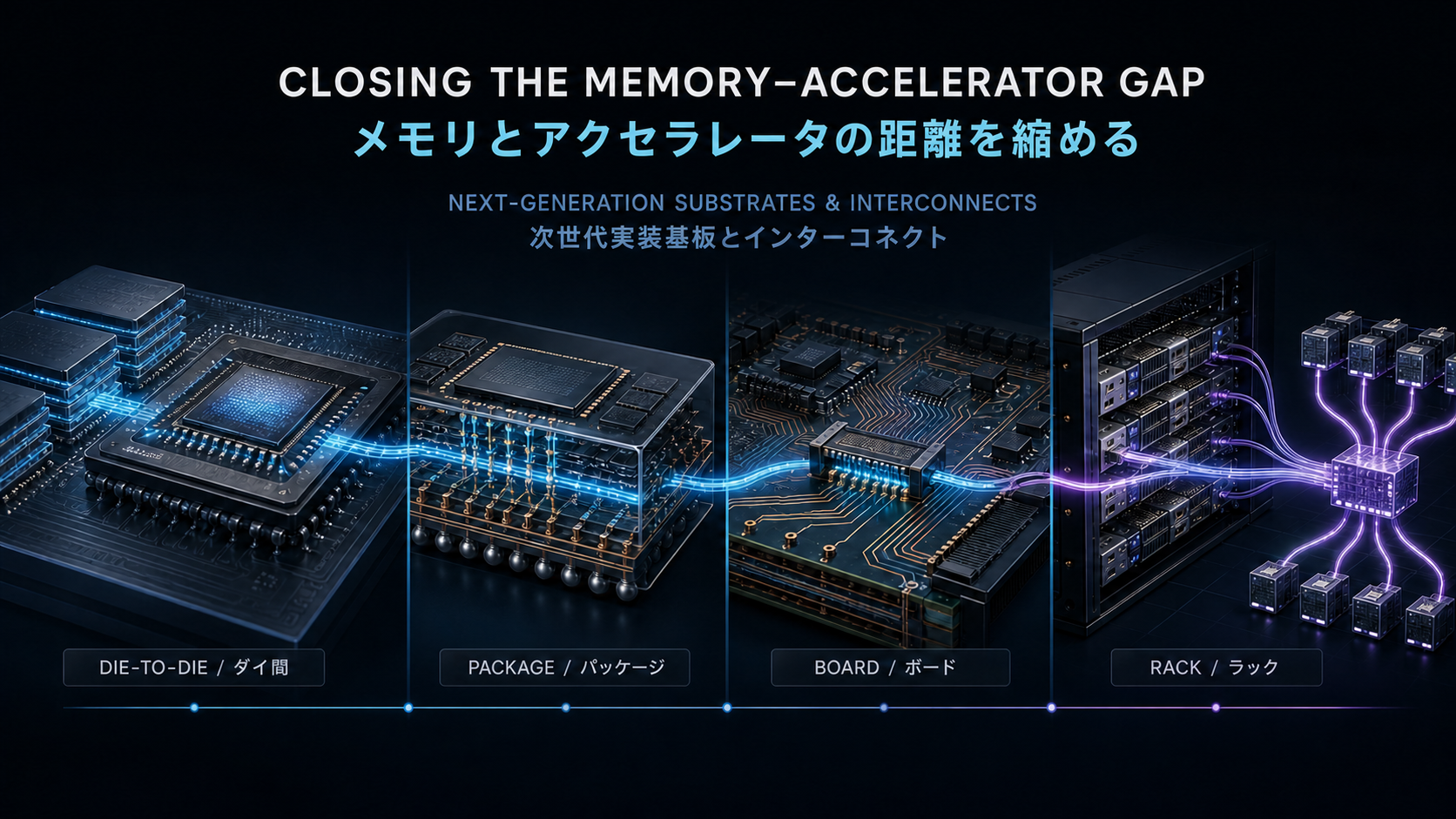
When I wrote about substrate technology closing the physical distance between memory and accelerators in a previous piece, I sorted Elephantech, Absolics, and Eliyan along a "shrinking distance versus nullifying distance" axis. Ever since finishing that post, I have kept wondering how much actual capital and valuation weight sits on that substrate-and-back-end layer. When the headline hit in late August — Samsung locking roughly 70 percent of its memory production capacity into long-term agreements (LTAs) running through 2031 — I felt like I finally had the shape of an answer.
I will admit my first reaction was to skim past it as just another supply-shortage headline. Then I looked at the actual pricing. The same 36GB HBM3E module trades for roughly $2,100 on the spot market and roughly $300 to $400 under a long-term contract — a gap of roughly five times. That is not simply a story about scarcity. It reads to me as a switchboard that decides who pays the five-times spread and who gets to avoid it. This piece follows where that switchboard actually routes the current — the profit — through the back-end value chain.
Samsung's "70 Percent" Is Not a Supply Story
Start with the numbers as reported.
| Category | Price | Ratio to spot |
|---|---|---|
| Spot market | ~$2,100 | 1.0x |
| LTA (low end) | ~$300 | ~0.14x (spot is ~7x) |
| LTA (high end) | ~$400 | ~0.19x (spot is ~5x) |
Samsung has used that price gap as leverage to lock roughly 70 percent of its memory capacity into LTAs through 2031. Confirmed customers include Microsoft, Nvidia, and Google. Press reports say Samsung has finalized deals with five data-center customers and is in final-stage negotiation with five more, reportedly including Amazon and Meta. I could not independently verify that specific five-plus-five breakdown against a primary source, so I am treating it as press-reported rather than confirmed.
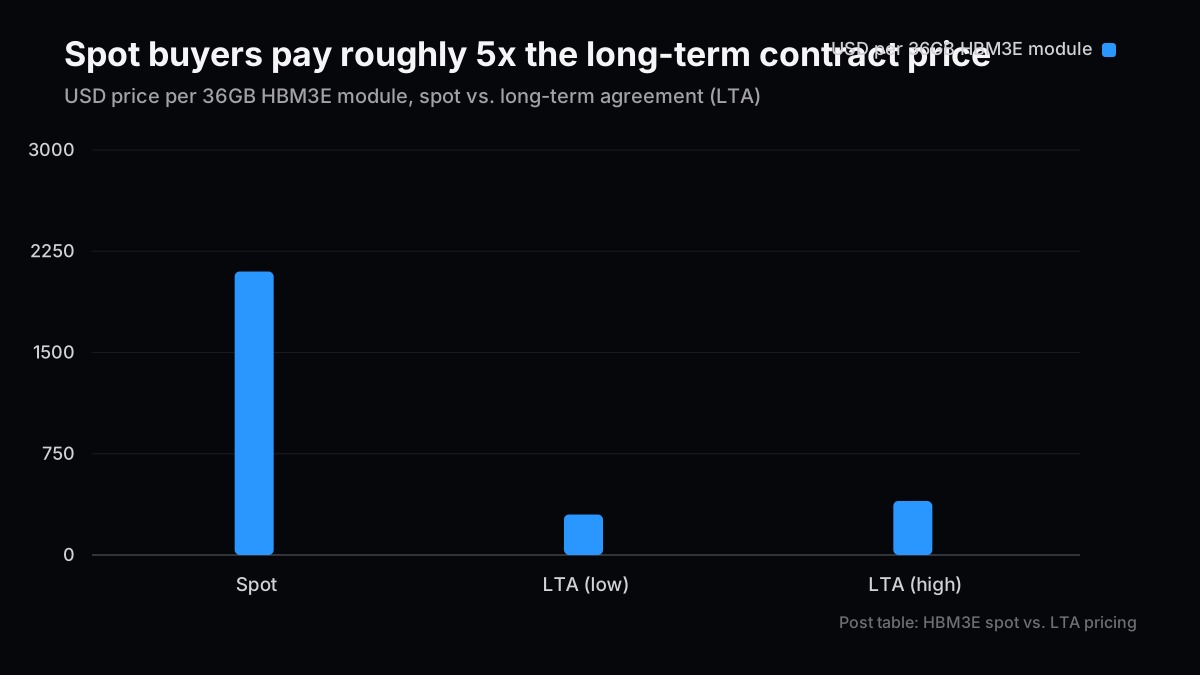
Worth pausing on this: what does the 70 percent figure actually describe? To me, it says less about total supply than about how allocation is being frozen in place. Buyers who did not get an LTA slot are left fighting over the remaining 30 percent — at roughly five times the price. This is not pure scarcity; it is a first-come, first-served structure for the cheap tranche. It resembles the relationship between long-term offtake contracts and the spot market in oil. More than a volume problem, it looks to me like a problem of who got in line first.
The Five Times Spread as a Repricing Machine
Push a little further into that five-times number. SK Hynix's CFO has said the company sold out its entire 2026 HBM supply, and its board approved 54.3 trillion won (roughly $38.3 billion) in investment through 2031, with the CEO saying the shortage could persist through 2030. Micron's HBM capacity is likewise booked through 2026. All three companies are effectively lined up in the same place: the next several years of allocation are already spoken for.
| Company | Commitment status | Scope / timeframe | Note |
|---|---|---|---|
| Samsung | ~70% of memory capacity locked via LTA | Total memory, through 2031 | Microsoft, Nvidia, Google confirmed as customers |
| SK Hynix | Entire 2026 HBM supply sold out (CFO statement) | HBM only, 2026 | Board approved 54.3T won investment through 2031 |
| Micron | HBM capacity booked through 2026 | HBM only, 2026 | Ground broken on a $4B HBM packaging facility in Indiana (SK Hynix targets 2029 output) |
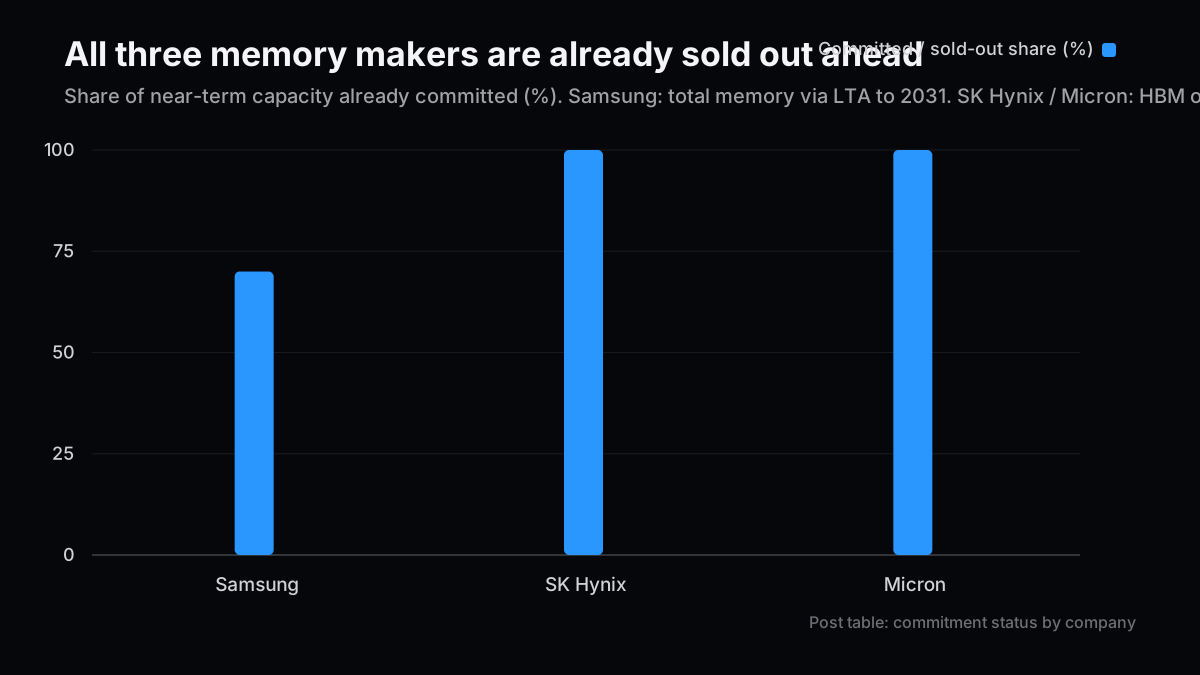
What jumps out from that table is that the three companies' "sold out" statements are not measuring the same thing. Samsung's 70 percent covers total memory capacity; SK Hynix's and Micron's sellouts are scoped to HBM only. Stacking them as if they were directly comparable would be a misread. What they do share is a structural feature: demand that misses the LTA window gets pushed straight into the spot market. TrendForce's latest survey projects conventional DRAM contract prices rising 13 to 18 percent quarter over quarter in the third quarter of 2026, with server-priority production squeezing supply available for PC DRAM. The more wafers get diverted to HBM, the more the squeeze lands on commodity DRAM. That tug-of-war between AI demand and consumer devices is playing out quietly but unmistakably.
Is that really the full picture, though? Or, more precisely: reading Samsung's 70 percent in isolation and drawing inventory-strategy conclusions from it alone is risky. It is only once you line up all three companies' commitment status that the real structure appears — where demand that missed an LTA window actually gets pushed. Numbers alone rarely carry the argument; they carry it once you set them side by side, which is the same lesson I took away from the previous piece on substrates.
Yield and Changeover Decide the Real Bottleneck
This is the part of the piece I most wanted to write.
Back when I was developing automotive EEPROM process technology, I once ran into a production line where yield on a particular step kept degrading. The floor report said, flatly, "equipment problem." We called in the equipment vendor, swapped parts, re-tuned process conditions — nothing improved. When I finally reran the process window in TCAD, the actual root cause was not the equipment at all: a specific combination of material lots was pushing the process margin right to its edge under certain conditions. The tool had been operating normally the entire time. The margin itself had simply been thinner than anyone assumed.
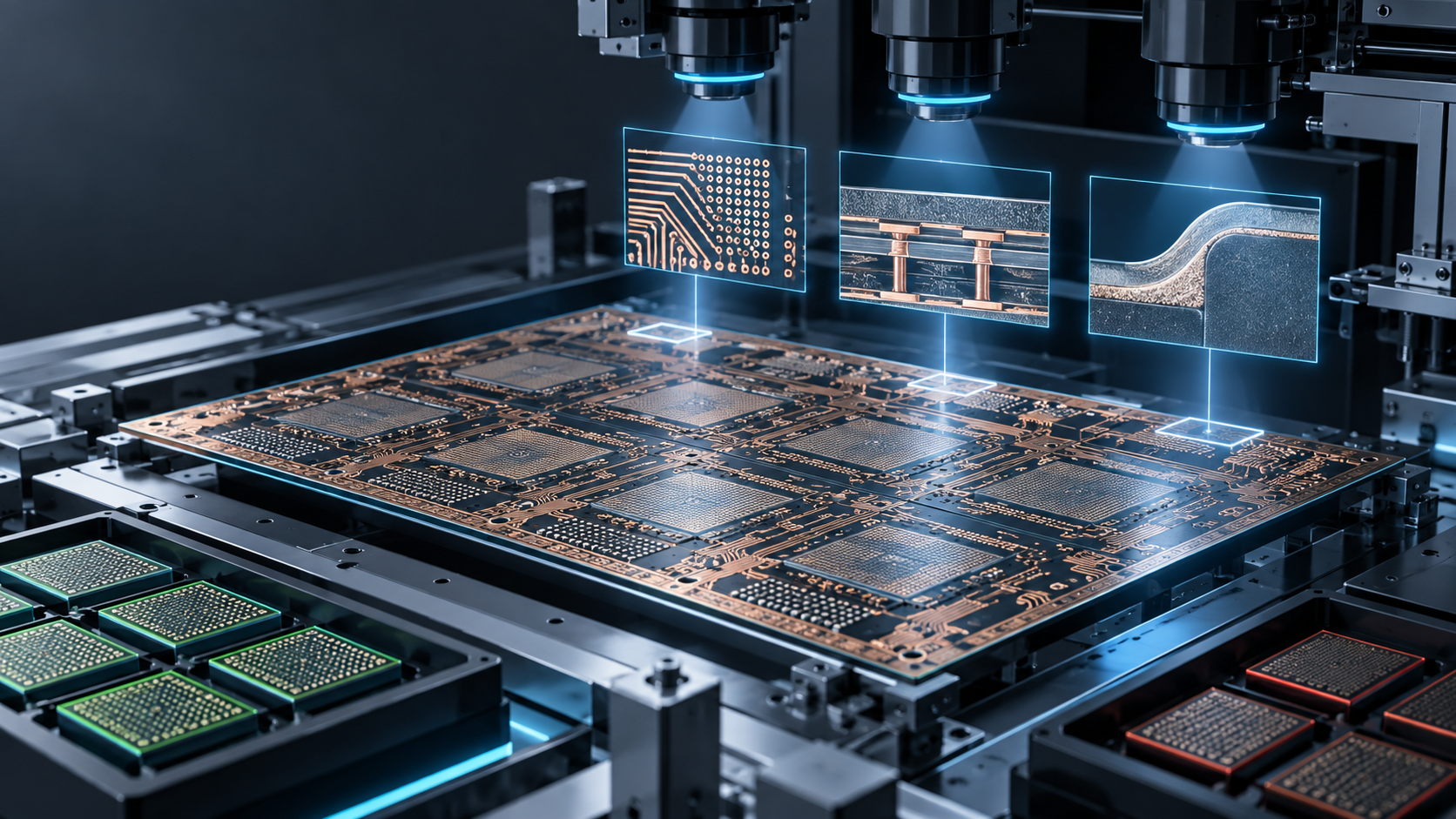
That experience maps directly onto what is happening in HBM back-end production today. According to SemiAnalysis, HBM capacity is now quoted in terms of TSV (through-silicon-via) capacity rather than raw wafer starts, because converting a DDR wafer into an HBM wafer is the real rate-limiting step. Yield degrades exponentially as layer count rises — a simplified model puts an 8-layer stack at roughly 92 percent total yield off a 99-percent-per-layer baseline, dropping to roughly 87 percent at 12 layers. The most telling illustration is a bonding-tool dispute between Hanmi Semiconductor and SK Hynix that disrupted production for months despite ample wafer capacity, once field service was withdrawn. Adding more tools and adding effective capacity are not automatically the same thing. The lesson I learned on an EEPROM line is repeating itself here, at an entirely different order of magnitude.
That read is backed by real capital deployment on the back-end side. In June 2026, Hanmi Semiconductor won a 44.2 billion won order from SK Hynix for a new TC bonder — the "TC Bonder 4.5 Griffin" — built for HBM4 and destined for SK Hynix's post-package-and-test facility in Cheongju. ASMPT, Hanwha Semitech, and Kulicke & Soffa are all competing for the same share. Industry body SEMI projects global assembly and packaging equipment sales rising to roughly $7.0 billion in 2026 (up 9.2%) and $7.5 billion in 2027 (up 6.9%), with test equipment climbing to roughly $12.5 billion in 2026 (up 12.0%) and $13.4 billion in 2027 (up 7.1%) — with AI and HBM demand named explicitly as the driver.
| Layer | Company | Recent move |
|---|---|---|
| TC bonder (HBM4) | Hanmi Semiconductor | Won a 44.2B won order from SK Hynix for the "TC Bonder 4.5 Griffin," Cheongju P&T facility (June 2026) |
| TC bonder (competitors) | ASMPT, Hanwha Semitech, K&S | Competing for bonder share across both HBM and next-gen HBF |
| Assembly & packaging, industry-wide | SEMI | Projected ~$7.0B in 2026 (+9.2%), ~$7.5B in 2027 (+6.9%) |
| Test equipment | SEMI | Projected ~$12.5B in 2026 (+12.0%), ~$13.4B in 2027 (+7.1%) |
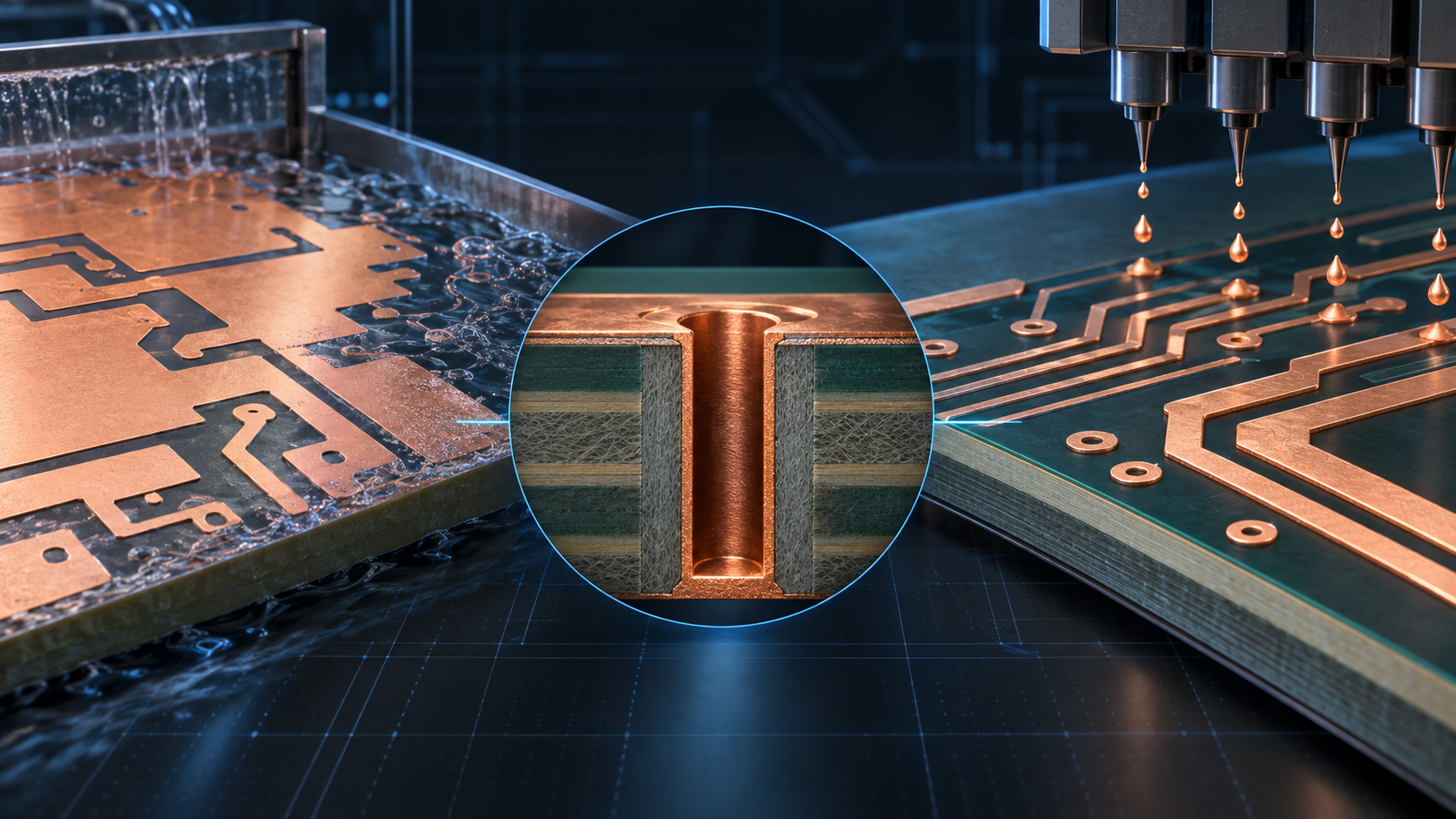
Last time, I described Absolics' glass-core substrate and Elephantech's additive copper wiring as turning "a passive supporting substrate into an actively engineered part of the system." What has come into focus now is that the same shift is happening at the same time in TC bonders and test equipment. Hyperscaler capex, as I laid out in Part 2 of the Warsh Shock series, has swelled to roughly $725 billion combined across four companies, up 77% year over year. Not all of that flows straight into GPUs. A meaningful slice, I think, is flowing at the same pace into the back-end operations that assemble the memory those GPUs depend on.
Does 2027 Capacity Relieve the Squeeze
With that groundwork laid, here is how I would frame the scenarios heading into 2027.
| Scenario | Premise | Implication for the price spread | Implication for the back-end value chain |
|---|---|---|---|
| Base: relief | Front-end wafer additions and back-end (TSV, bonding, substrate, test) yield ramps advance together | Spot-to-LTA spread narrows | Order momentum at equipment and substrate makers cools off |
| Main: uneven build-out | Wafer capacity is added, but back-end yield ramp and tool changeover fail to keep pace | Spread stays elevated | Orders continue flowing to bonder, TSV, substrate, and test names |
| Tail: demand accelerates further | AI data-center capex plus physical-AI and humanoid demand outrun both front-end and back-end additions | Spread widens further | Back-end equipment becomes the central bottleneck and pricing power |
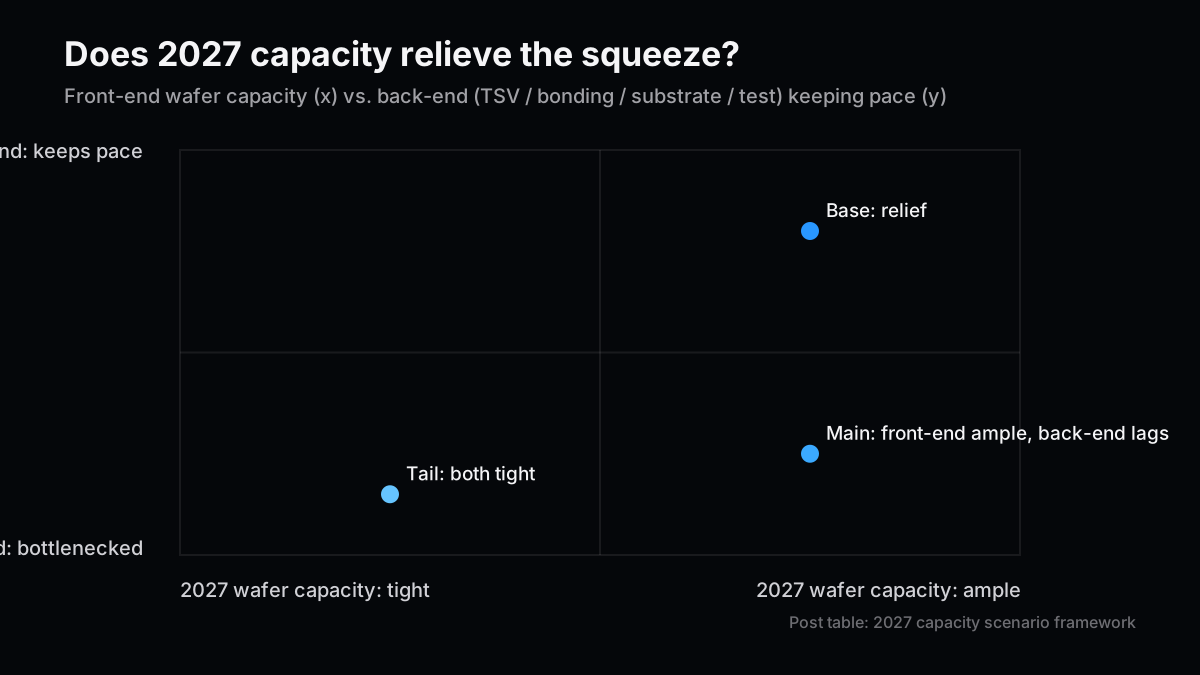
The scenario I currently assign the most weight to is the main case. Wafer starts themselves will almost certainly rise into 2027, given that Samsung, SK Hynix, and Micron are all expanding in parallel. But given that new TC bonder orders only really started accelerating in the back half of 2026, it is hard for me to believe back-end yield ramp — bonding and test in particular — keeps pace with that front-end build-out. Ramping yield takes more than installing tools; it takes time to establish a process window and carry it into volume. That much overlaps directly with what I lived through in the EEPROM years.
Let me also state plainly what would change my mind. If, by the first half of 2027, back-end equipment makers' (TC bonder and test) order backlogs are shown to be climbing at the same pace as front-end wafer capacity, without an accompanying rise in pricing power, the back-end-bottleneck thesis weakens, and front-end wafer capacity itself likely becomes the dominant constraint again. Conversely, as long as back-end equipment makers' order backlogs and unit pricing keep outrunning the pace of front-end expansion, I will hold the main scenario.
How I Would Hold the Back-End Value Chain
My conclusion is that I do not want to reduce this theme to "buy memory stocks." I would rather frame it as: the back end (bonding, TSV, substrate, test) is more likely than the front end (wafer) to carry a thicker margin through this cycle. The reasoning is straightforward. Front-end capacity expansion is comparatively forecastable — if you have the capital, you can plan the build-out. Back-end yield ramp does not resolve with capital alone; it depends on process know-how and experience, which is a much harder variable to buy your way past. Scarcity concentrates on the side that is hard to replicate, not the side that is easy to copy.
Concretely, I think it makes sense to spread exposure across four layers: TC bonders, TSV-related equipment, advanced substrates (the same Absolics- and Elephantech-type names from the previous piece), and back-end test. Every one of those layers sits directly downstream of the capex cycles at Samsung, SK Hynix, and Micron, which spreads out the risk of depending on any single one of the three. My current stance is neutral in the near term and selectively long the back-end value chain over the medium term.
Next Issue Ideas
- Idea 1: Scoring TC bonder and TSV equipment names side by side — Compare disclosed order backlogs and unit pricing at Hanmi Semiconductor, ASMPT, and Besi to stress-test the back-end-bottleneck thesis with real data.
- Idea 2: Tracking the HBM vs. commodity DRAM bit fight in numbers — Cross-reference PC and smartphone DRAM price momentum against the pace of wafer reallocation toward HBM.
- Idea 3: Who gets Samsung's remaining 30 percent — Follow the spot-buying strategies of customers that missed the LTA window, and how it hits their gross margins at the single-name level.
Related Posts
- Closing the Distance Between Memory and Accelerators: What Elephantech, Absolics, and Eliyan Reveal About the Next-Generation Substrate — The prior piece on the substrate layer of the same back-end value chain this article covers.
- The Warsh Shock — Part 2: How Far Rate Risk Reaches Into Tech Capex — The hyperscaler capex figures cited here as the demand-side backdrop.
- Open vs. Closed AI Models: What the Kimi K3 Shock Reveals About Value, Moats, and the Investor Playbook — A look back at a moment when AI-related valuations wobbled, useful context for how durable long-term memory contracts imply demand really is.
References
Facts and figures in this piece prioritize primary and official sources readers can verify themselves.
- The Memory Shortage Isn't Close to Ending — Samsung Just Locked Up 70% of HBM Capacity Through 2031 (24/7 Wall St.)
- The Memory Shortage Isn't Close to Ending (Yahoo Finance / 24/7 Wall St.)
- Samsung Locked Up 70% of Its AI Memory for Microsoft, Google, and Nvidia Through 2031 (gagadget)
- Scaling the Memory Wall: The Rise and Roadmap of HBM (SemiAnalysis)
- HBF Spurs Equipment Race; Hanmi Semiconductor Eyes First TC Bonder Deliveries in 2H26 (TrendForce)
- Hanmi Semiconductor Wins First HBM4 TC Bonder Order From SK hynix (The Elec)
- Global Semiconductor Equipment Sales Projected to Reach a Record of $156 Billion in 2027, SEMI Reports (PR Newswire / SEMI)
This article is for informational purposes only and does not constitute investment advice or a recommendation to buy any specific stock, company, product, or service. The author may hold positions or have interests in the names discussed. Performance figures, investment amounts, and order values are vendor-reported or press-reported and do not guarantee future results. Generative AI was used for parts of the research, translation, and proofreading, but the final content has been reviewed by ZYL0. See the disclaimer for details.