The AI Operations Proposal Template, Fully Filled In — 7 Pages, Price Table, and Scope-Creep Language You Can Paste
A fully filled-in seven-page AI operations proposal template covering tiered pricing, revision caps, and scope-creep clauses you can copy and paste.
A fully filled-in seven-page AI operations proposal template covering tiered pricing, revision caps, and scope-creep clauses you can copy and paste.


The AI Operations Proposal Template, Fully Filled In — 7 Pages, Price Table, and Scope-Creep Language You Can Paste
After the last two posts on pricing and operating design, the most common question was not about price at all. It was, "Okay, but how do I actually write the proposal?" People understood the pricing logic, understood the operation — and still had no single document to put in front of a client. Honestly, that was me too, at first.
So this post pulls everything scattered across the previous post on creator pricing and the mid-size company AI operations package into one thing: a seven-page proposal template you can copy and fill in. Headings, a tiered price table, a revision cap, and scope-creep language — all in paste-ready form.
Why Seven Pages
Long proposals do not get read. I learned this the hard way on client work. You build a polished 30-page deck, and the founder reads exactly two pages: the cover and the price. So why not start with a proposal that is actually read?
There is nothing magical about seven. It just happened to be the middle ground I kept landing on — fewer than that and buyers feel uneasy, more than that and nobody finishes it. Think of each page as one section.

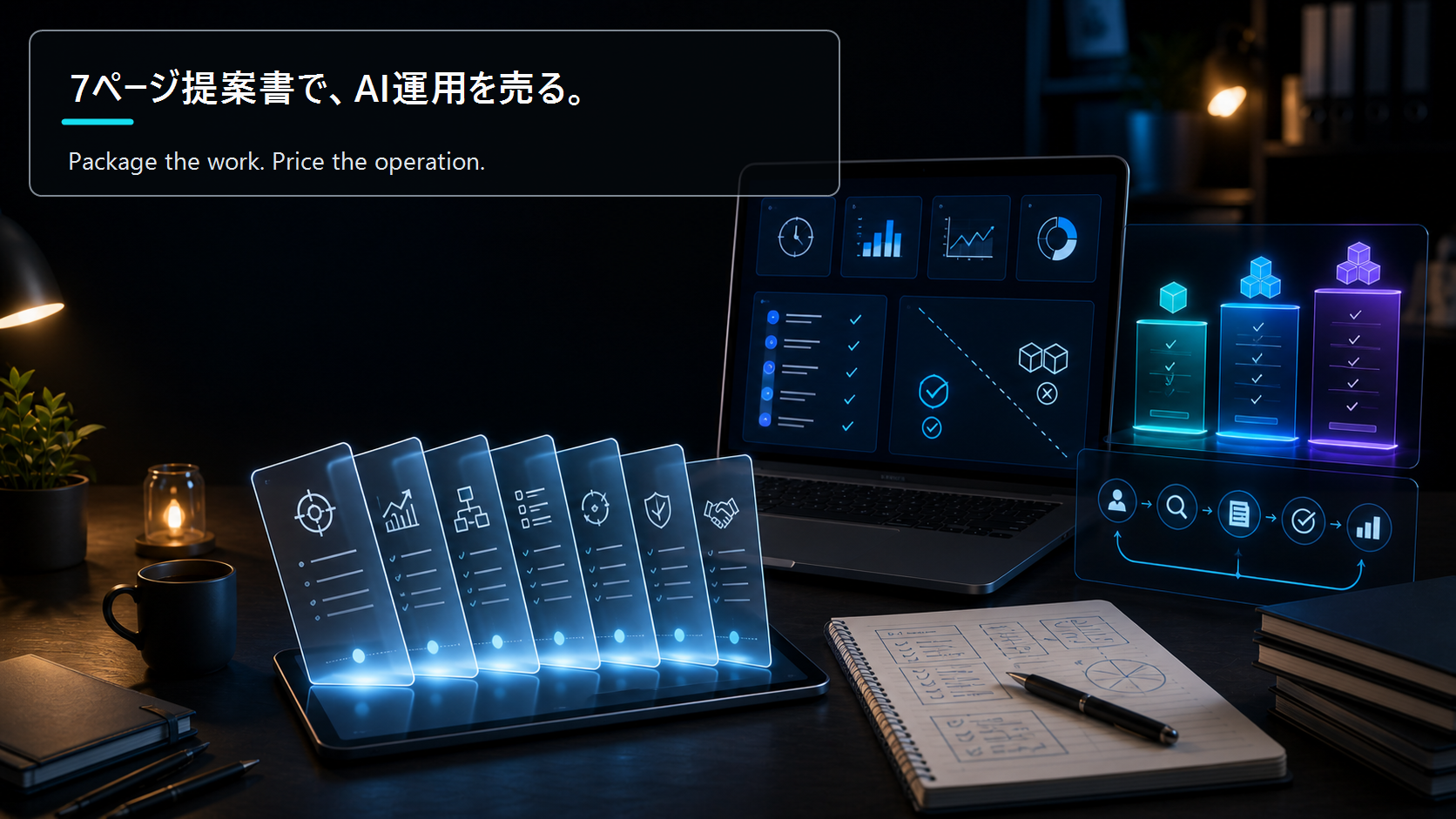
The Whole Template at a Glance
Here is the map. You can drop this table straight in as your proposal's table of contents.
| Page | Section | What goes here | Goal |
|---|---|---|---|
| 1 | Cover and problem summary | Their current pain in three lines | Make them think "this is about us" |
| 2 | Goals and KPIs | From X hours to Y hours; the number you track | Move the decision from "AI" to "time" |
| 3 | Scope and deliverables | What's in, what's out | Lock expectations early |
| 4 | Monthly operating flow | Interview → draft → review → publish → improve | Show that it "runs every month" |
| 5 | Price table (tiered) | Three tiers with monthly fee and scope | Sell operations, not unit price |
| 6 | Risk control and scope-change clauses | Approval, confidentiality, revision cap, add-ons | Defuse future disputes up front |
| 7 | Getting started | Month-one plan and next action | Answer "so, where do we begin?" |
Notice that nothing here is technical. No Claude, no MCP, no Skills in the body of the proposal. What the buyer is purchasing is the feeling that the messy work is finally handled — not a list of tool names.
Pages 1–2: Problem Summary and KPIs
This is the part of the template you rewrite the most. Here is the shape I use for page one.
The page-one body (cover and problem summary) needs just three lines:
- Now: your X publishing work depends on N people doing it by hand.
- Impact: X hours disappear each month, and when updates stall, inquiries stall too.
- Proposal: replace that work with an AI operation that runs every month.
For page two (goals and KPIs), the trick is to pick one number. Make everything a KPI and your scope of responsibility blurs. I make hours saved the primary KPI and consistent output count the secondary one.
| Metric | Before | After | How it's measured |
|---|---|---|---|
| Monthly work hours | 40 hours | 7 hours | Workflow breakdown sheet, monthly |
| Monthly output | Irregular (some months zero) | 2 blog posts + 12 social posts | Publishing log |
| Pre-publish rework rate | High | Reduced | Review checklist |
Do not write an outcome guarantee like "+X% conversions" here. As I said last time, the moment you commit to an outcome, you cannot get out of it. Operations support sells time and rhythm.
Pages 3–4: Scope and the Monthly Operating Flow
Honestly, eighty percent of whether a project goes sideways is decided on page three — by whether you wrote down what you will not do.
Page three (scope and deliverables) is two columns:
- Included: 2 blog posts, 12 social posts, one monthly review, pre-publish checks.
- Not included: filming, paid media, full design overhauls, unlimited add-on requests.
Page four (monthly operating flow) fixes the rhythm in words rather than a diagram. Here are the five steps I actually run every month.
- Interview (30 minutes, once a month, or shared materials)
- AI first draft (generated on my side; the client never sees it raw)
- Human review (I run it through a checklist)
- Publish (after the client's final approval)
- Improve (I send a one-page monthly review)
The point of putting these five steps in the proposal is to hand the buyer the feeling that this keeps running. That is the single biggest difference from one-off delivery.
Page 5: The Tiered Price Table
I get asked for numbers, so here they are, consistent with the previous post. They move with FX and complexity, but this is roughly where they land for me. Read these as an example of how to fill in the proposal — not as recommended prices.
| Tier | Monthly range | Scope assumption | Typical client |
|---|---|---|---|
| Solo operation (you alone) | $1.5K – $4K / month | 2 blog posts, 8–12 social posts, monthly review | Sole proprietors, regional small businesses |
| Small studio (2–4 people) | $6K – $15K / month | 4 blog posts, 30 social posts, 4 short videos, monthly meeting | Urban mid-market |
| Agency replacement (5+ people) | $25K – $60K / month | Full channel ops, brand design, production, paid integration | Enterprise business units |
In the proposal, showing all three tiers works better than one. Even if you only propose the middle one, the spread above and below tells the buyer "this is a designed price." Show one number alone and it reads like a number you made up.
One caution: do not skip tiers when you quote. Quote studio prices as a solo operator and the buyer expects studio-grade staffing. AI speeds up the work, but review responsibility and incident response still need humans. Projects that ignore that line almost always blow up.
Page 6: Risk Control and Scope-Change Clauses (Paste-Ready)
This page is the heart of the template. The "always define this in the contract" items from the last two posts, turned into sentences you can drop into a proposal. Copy them and fill in the client's name and counts.
Scope and revisions:
The deliverables under this agreement are, by default, 2 blog posts per month, 12 social posts per month, and one monthly review. Each deliverable includes up to two rounds of revision. A third revision round, and any request beyond the baseline counts, will be quoted separately.
Scope additions (scope-creep control):
If a request outside scope arises after the engagement begins — new channels, filming, paid media, a full design overhaul — it will be discussed at the monthly review and handled as a separate estimate or as a scope revision from the following month onward. It is not included in the monthly fee.
Responsibility and risk:
Final pre-publish approval is the client's. Fact-checking and final responsibility for content rest with the client; our role is operations support, first drafts, and review. The scope of confidential information entered into AI tools is limited to what is agreed in advance. This engagement is operations support and does not guarantee any specific business outcome.
With just these three in place, ninety percent of the "this was included too, right?" requests that show up later can be handled calmly at the monthly review. The faster AI makes the work, the faster the client's add-on asks come. Scope creep got worse in the AI era, not better. Which is exactly why you draw the line at the proposal stage.
Page 7: Getting Started
The last page answers the buyer's "so, where do we begin?" in one line each. The shape I use:
- Month one: workflow audit + template creation + first delivery (a proof period).
- Contract: $X/month, three-month minimum, monthly review.
- Next action: a 30-minute kickoff meeting by date.
I put the proof period first to give the buyer something short enough to try. Do not underprice — but do not push a one-year contract out of the gate either. That balance is what actually gets you to signature.
Closing: Seven Pages That Get Read Are Enough
To pull it together: an AI operations proposal does not need to be an impressive deck. Seven pages that get read, plus language that prevents disputes later, is enough. What I learned doing client work is that the game is won not on the technical explanation, but on where you draw the lines around scope and risk.
Concrete first step: copy the seven-page table from this post today and fill in the name and counts of one real client. The cells you cannot fill in are the points you have not nailed down for that project yet.
Revisit Checklist: Pass-Fail Line Before Sending the Proposal
- If the client cannot define success in one sentence, agree on evaluation metrics before showing the price table.
- Do not overload month one with deliverables; make the ongoing value visible through reporting from month two onward.
- Spell out revision limits, response time, AI usage, and rights before work starts. Next Issue Ideas
- Idea 1: From a 30-minute founder interview to articles, social posts, and FAQ in one pass — Unpacking page four's monthly operating flow into a step-by-step process that turns one conversation into material for three channels, shown with real examples from my ZYL0 setup.
- Idea 2: Everything to do in the 30-minute AI-ops kickoff — After the proposal is signed, how to fit the audit, KPI agreement, and approval-flow confirmation into the first 30-minute meeting, as a checklist.
- Idea 3: A one-page monthly review template — Tied to pages six and seven, the seven-item review you send every month to lower churn, with paste-ready items and example wording.
Related Posts
- How to Build a Mid-Size Company AI Operations Package Before Selling It for $3K a Month — For solo creators moving into corporate work in the AI era, sell "running operations" — not "tool deliveries." Designi…
- The Shortest Path to Connecting Internal Knowledge over MCP: Wiring Research Notes, Past Proposals, and Meeting Minutes into Claude Code in 30 Minutes — A 30-minute build log: a minimal MCP server that lets Claude Code search research notes, past proposals, and meeting minutes.
References
The factual and numerical assumptions in this article are anchored to primary or public materials that readers can revisit during AdSense review and future updates.
- OpenAI API documentation
- Anthropic Claude documentation
- U.S. Small Business Administration business guide
This article is for informational purposes only and does not constitute investment advice or a recommendation of any specific stock, service, or contract structure. The author may hold positions or interests related to companies or services mentioned. Generative AI was used for parts of research, translation, and proofreading, with final review by ZYL0. See the disclaimer for details.