Space Communications Startups Mapped: AST SpaceMobile, Kepler, K2 Space and Northwood (Space Business Series ②)
Starlink has 12 million subscribers, so demand for space connectivity is proven. This piece maps where AST SpaceMobile, Kepler, Warpspace, K2 Space, Northwood and others sit across direct-to-phone, optical relay, satellite buses and ground stations, with their funding. Part 2 of the series.
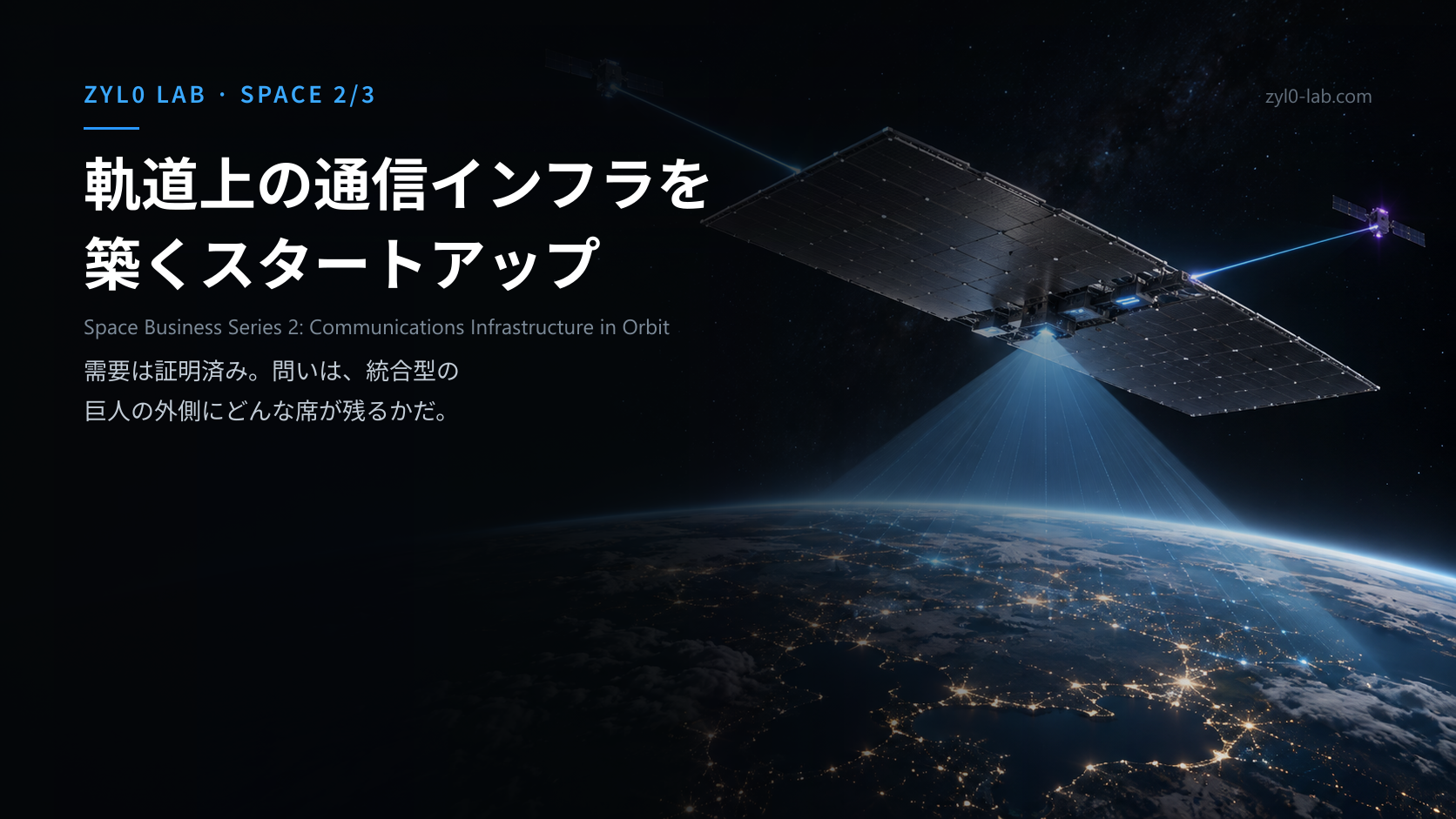
Starlink has 12 million subscribers, so demand for space connectivity is proven. This piece maps where AST SpaceMobile, Kepler, Warpspace, K2 Space, Northwood and others sit across direct-to-phone, optical relay, satellite buses and ground stations, with their funding. Part 2 of the series.


Space Business Series ②: The Startups Building Communications Infrastructure in Orbit
In Part 1, demand for microgravity research was itself still being proven. Communications is the opposite. Demand was proven long ago and the cash is already flowing. So the question this time is not whether there is a market. It is how many seats are left for startups outside the vertically integrated giants.
Note: this piece is an outside-in read based solely on public information — company releases, product pages, papers, and press coverage.
As of October 11, 2026. Round sizes, valuations, financial results and satellite counts come from company announcements and press reports; anything reported but not confirmed is flagged. Totals, ratios and evidence stages are my own calculations and judgment.
Demand Is Proven; the Open Question Is Whose Share It Is
Before the numbers, my read: there are almost no seats left for a newcomer selling connectivity directly to consumers.
SpaceX listed on Nasdaq on June 12, 2026 and raised $75 billion, the largest IPO on record. According to its prospectus and second-quarter report, Starlink grew from 10.3 million subscribers at the end of March to 12 million at the end of June. Connectivity revenue for 2025 was $11.4 billion, up 83% from the year before. Meanwhile, monthly revenue per subscriber fell 18%, from $99 in 2023 to $81 at the end of 2025.
Subscribers up, price per subscriber down. Starlink has left the phase where it sells at a premium and entered the phase where it earns on volume.
The chaser, Amazon Leo (formerly Project Kuiper), reached 396 satellites in orbit with its July 2 launch. It did not meet the Federal Communications Commission's requirement to deploy half its planned constellation by July 30, 2026, and received a limited waiver on June 5. The deadline for the full constellation is July 30, 2029. Amazon says it will begin commercial service this year.
| Item | Starlink (SpaceX) | Amazon Leo |
|---|---|---|
| Subscribers, service | 12 million subscribers (end of Jun 2026) | Enterprise preview; commercial this year |
| Satellites in orbit | Added continuously on its own rockets | 396 (Jul 2, 2026) |
| 2025 revenue | $11.4B in connectivity, up 83% | Not disclosed |
| Funding | $75B IPO (Jun 2026) | Funded by Amazon |
| Regulatory milestone | FCC approved transfer of EchoStar spectrum | Missed half-deployment date; waiver |
Here is the ladder of evidence from Part 1, translated to communications.
| Stage | Evidence you can see | What you still cannot say |
|---|---|---|
| 1. Demonstration | A call or connection worked once | Whether satellites can be built at volume |
| 2. Satellites in orbit | Several operational satellites are flying | Whether spectrum and licenses are in hand |
| 3. Spectrum and license | Commercial authorization, operator contracts | Whether the link stays up without gaps |
| 4. Continuous coverage | Always-on service in the target region | Whether users keep paying |
| 5. Recurring revenue | Disclosed subscribers and revenue per user | Margins and capacity to reinvest |
Starlink's fixed broadband sits at stage 5. Most startups are at stages 2 to 3. With that gap in mind, here is where things are actually stuck.
Where It Is Stuck: Spectrum, Launch and the Ground
Writing out the bottlenecks, I noticed that most of what limits the pace is not the satellite itself. It is everything around it.
I have a sore memory here. When I built and ran a river flood-detection system on AWS, the hardest part was not the sensors or the cloud. It was installation sites with no mobile signal. Rivers run through places with few base stations. Since then I have judged space communications by one test: does the user have to add anything to the device? Systems that need a dedicated terminal or antenna rarely spread in the field.
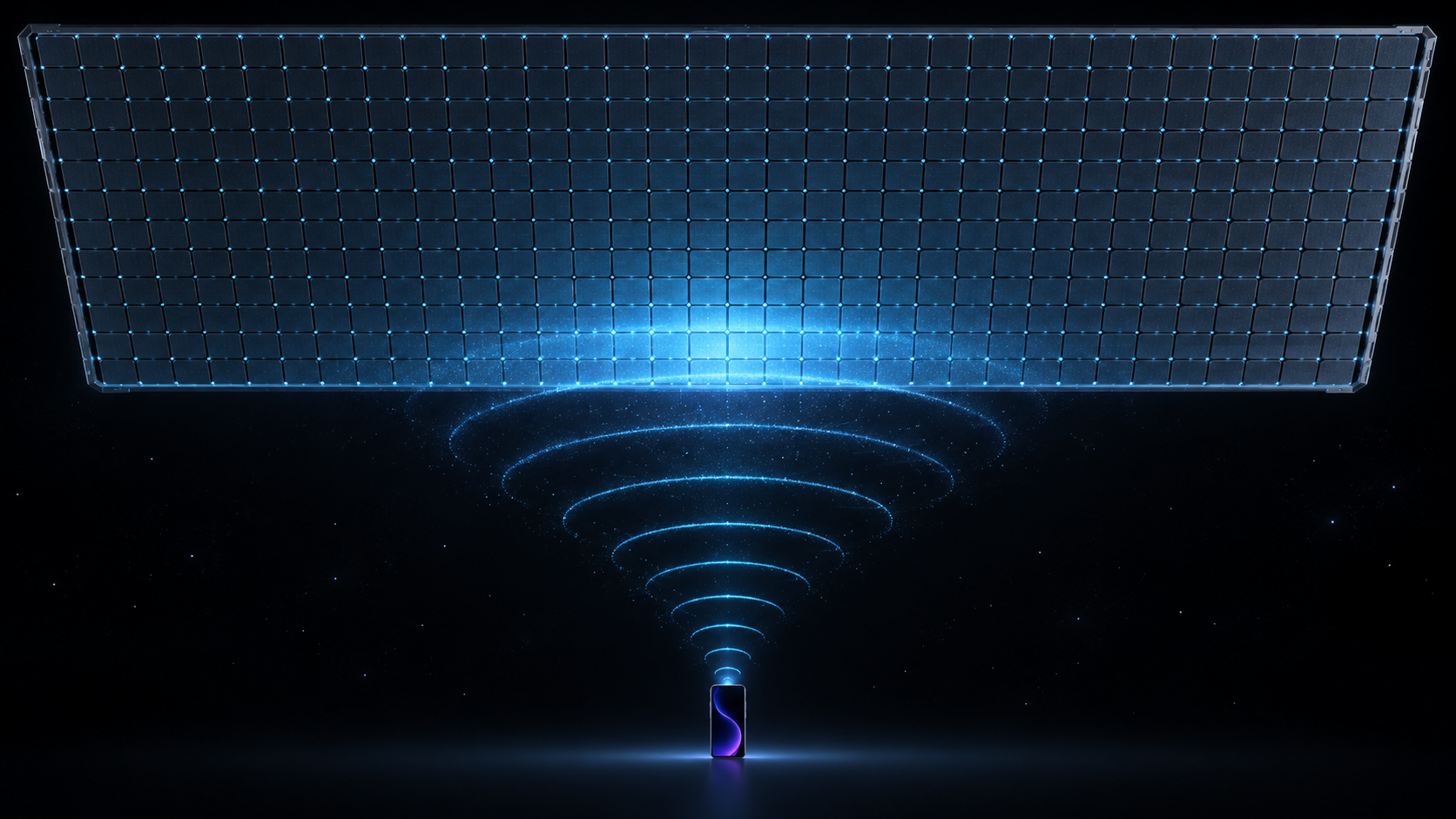
Decide not to change the device, and the whole burden moves to the satellite. A phone's antenna is small and its transmit power is fixed. To pick up a faint signal several hundred kilometers up, the only option is a bigger antenna in space. AST SpaceMobile's current-generation satellites unfold an array of up to about 223 square meters, close to the size of a tennis court.
Here are the choke points, next to what actually happened in 2026. There turned out to be six.
| Bottleneck | What it is | What happened in 2026 | Companies working on it |
|---|---|---|---|
| Spectrum | Bands a phone can use are limited and cannot be added | EchoStar's bands went to SpaceX (about $17B and $2.6B); FCC approved transfer on May 12 | Elveo, AST SpaceMobile |
| Launch | A finished satellite is worth nothing until it reaches orbit | AST's BlueBird 7 was placed in a lower-than-planned orbit in April and lost | (everyone) |
| Satellite production | One-off builds never reach the numbers needed | K2 Space raised $500M; Apex raised $200M | K2 Space, Apex, CesiumAstro |
| Ground stations | A dish tracks one satellite at a time | Northwood is producing flat-panel ground stations at eight a month | Northwood Space |
| In-orbit relay | Data comes down only while over a ground station | Kepler announced commercial optical data relay service in August | Kepler, Warpspace |
| Devices | Dedicated terminals do not spread | Hubble Network raised $200M to connect unmodified Bluetooth chips to satellites | Hubble Network, Elveo |
The spectrum row needs a little more explanation. EchoStar sold its bands to SpaceX in two transactions worth about $19.6 billion in total (my sum). Not satellites, not rockets: rights to radio waves fetched that price. In direct-to-phone service, spectrum is the scarcest asset there is.
Taking a Seat Outside the Giants
Lined up by layer, the companies have found four different ways to take a seat.
Direct to the phone: AST SpaceMobile, Elveo
AST SpaceMobile is a listed company (ASTS) and hard to call a startup any more, but it is the reference point for this layer, so I put it first. It owns no spectrum. It borrows bands from mobile operators and connects directly to their subscribers' phones. Second-quarter 2026 revenue was about $31.5 million and the net loss about $230.9 million. It reaffirmed full-year revenue guidance of $150 million to $200 million.
I stopped calculating for a moment here. One quarter's net loss is larger than the top of the full-year revenue range. Investors stay with it because the count in orbit is rising: launches in June and August added six satellites within 50 days, bringing the total to 13. The company says it will start a beta service this year using 3,000 cells across the continental United States. In Japan, Rakuten Mobile is targeting the fourth quarter of 2026. KDDI already offers direct-to-phone service using Starlink.
Elveo was formed on August 17 by the merger of Lynk Global and Omnispace. The October 2025 announcement had targeted completion in late 2025 or early 2026, so it slipped by several months. Satellite operator SES is a strategic shareholder. The plan combines Omnispace's 60 MHz of S-band spectrum with Lynk's satellites, and the company says it has agreements with more than 50 mobile operators in 60 countries. Once again, the reason for the deal is spectrum.
Backbone and relay: Kepler, Aalyria, Warpspace
Canada's Kepler Communications links satellites by laser and relays data from Earth-observation and other spacecraft while still in orbit. It launched ten optical relay satellites in January 2026 and announced commercial service on August 24. It has now launched 33 satellites in all. The network is compatible with the US Space Development Agency's optical standard, and the next expansion, from 2028, is planned to carry terminals of up to 100 Gbps.
Aalyria, spun out of Alphabet, builds software that orchestrates networks across satellites, aircraft and ground stations. Rivada Space Networks has said it will use it to run its planned constellation. It is an interesting case of taking a seat without owning a satellite.
Japan's Warpspace, from Tsukuba, offers support for adopting optical communications and aims to build a relay network. In February 2026 it won a JAXA study contract on the concept of an optical relay system between the Moon and Earth. On commercial relay service Kepler is ahead, and Warpspace's evidence is still to come.
Building satellites at volume: K2 Space, Apex, CesiumAstro
K2 Space builds large, high-power satellites as a production item. On July 30 it announced a $500 million Series D at a $6.8 billion valuation, led by Kleiner Perkins and ICONIQ, with CapitalG, Lightspeed, Altimeter and others participating. Each satellite is reported to cost about $15 million.
Apex builds standard satellite buses ahead of orders. It raised $200 million in June, led by Glade Brook Capital Partners, at a reported $2.3 billion valuation. CesiumAstro makes phased-array communications hardware and announced $470 million in February: $270 million of equity led by Trousdale Ventures, and $200 million from the US Export-Import Bank and J.P. Morgan.
The ground and the gaps: Northwood Space, Astranis, Hubble Network
Northwood Space builds Portal, a flat-panel ground station that can track several satellites at once. It announced a $100 million Series B on January 27, led by Washington Harbour Partners and co-led by Andreessen Horowitz (a16z), alongside a $49.8 million US Space Force contract to modernize the Satellite Control Network.
Astranis puts small dedicated satellites in geostationary orbit instead of low Earth orbit. In May it announced $450 million in new capital: a $300 million Series E co-led by Snowpoint Ventures and Franklin Templeton, plus a credit facility of up to $155 million, taking its total past $1.2 billion. Hubble Network receives signals from off-the-shelf Bluetooth chips by satellite. It announced a $200 million Series C on September 23 at a $1.6 billion valuation. What it has in orbit is six demonstration cubesats.
| Company | Layer | 2026 funding and results | Operating evidence | Stage (my read) |
|---|---|---|---|---|
| AST SpaceMobile | Direct to phone | Q2 revenue $31.5M; full-year guidance $150M–$200M | 13 in orbit; beta this year | 3 |
| Elveo | Direct to phone | Merger closed in August; funding not disclosed | 50+ operator agreements (company claim) | 3 |
| Kepler | Optical relay | Not disclosed | 33 launched; commercial service in August | 4 |
| K2 Space | Satellite production | $500M Series D at $6.8B (July) | Not confirmed for this post | 2 |
| Apex | Satellite production | $200M at $2.3B (June) | Supplies standard buses built to stock | 3 |
| CesiumAstro | Comms hardware | $470M ($270M equity + $200M debt, February) | Supplies government and commercial users | 3 |
| Northwood Space | Ground stations | $100M Series B; $49.8M Space Force contract (January) | Producing eight Portals a month | 3 |
| Astranis | Small GEO satellites | $450M ($300M equity + credit, May); over $1.2B total | Builds for commercial and US military use | 4 |
| Hubble Network | Direct to device (IoT) | $200M Series C at $1.6B (September) | Six demonstration cubesats | 2 |
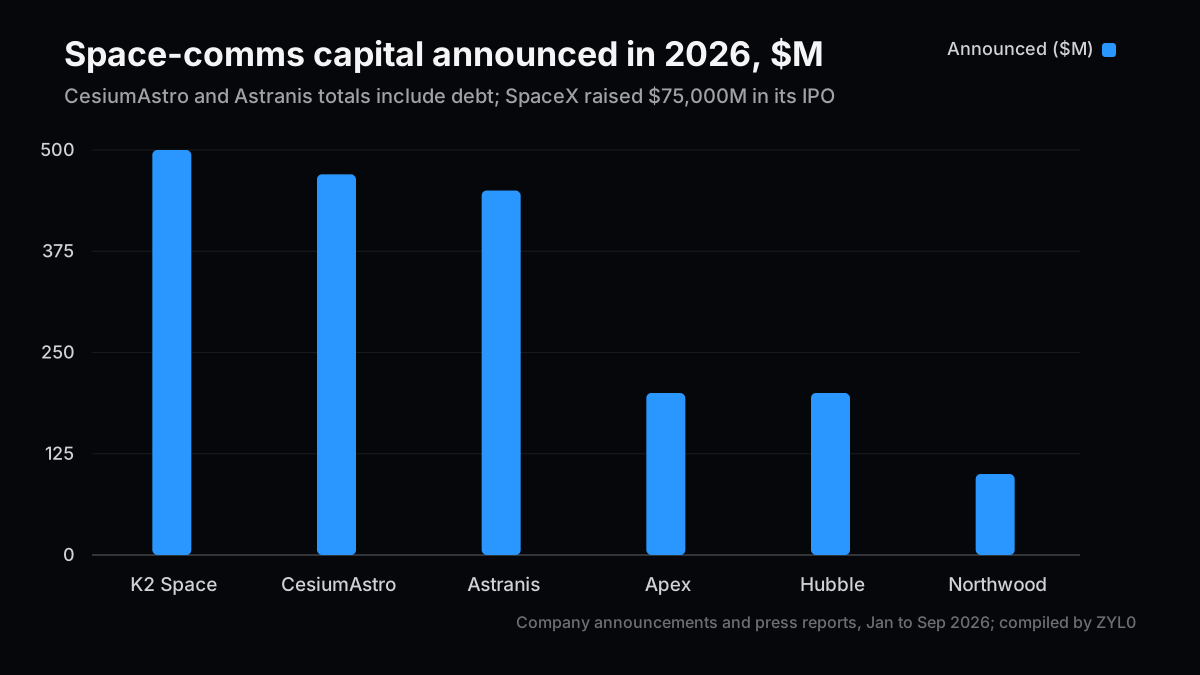
Let me do the addition. The six companies in the chart announced about $1.57 billion of equity in 2026 (excluding debt; my sum). That is roughly 2% of the $75 billion SpaceX raised in its IPO.
I did not read that gap as startups losing. If anything it is the reverse: not one of the six sells connectivity to consumers. Their customers are mobile operators, governments and other satellite companies. The decision not to step into the same ring as the giants shows up in how the money has gathered.
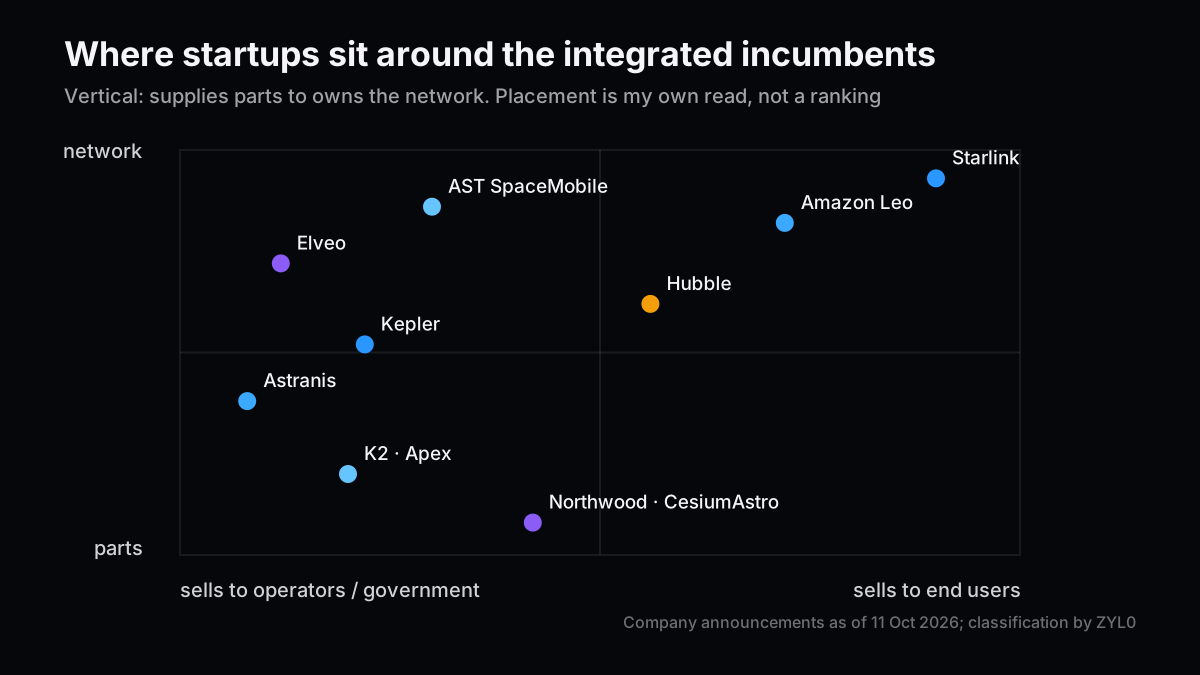
One more thing I noticed: government keeps appearing in the customer column. Northwood has the Space Force, Astranis builds satellites for the US military, Kepler follows the Space Development Agency standard. It is the same pattern as in Part 1, where the reliable customer for return capsules turned out to be a government, not a drug maker.
Scenarios for the Next Decade and the Investment Call
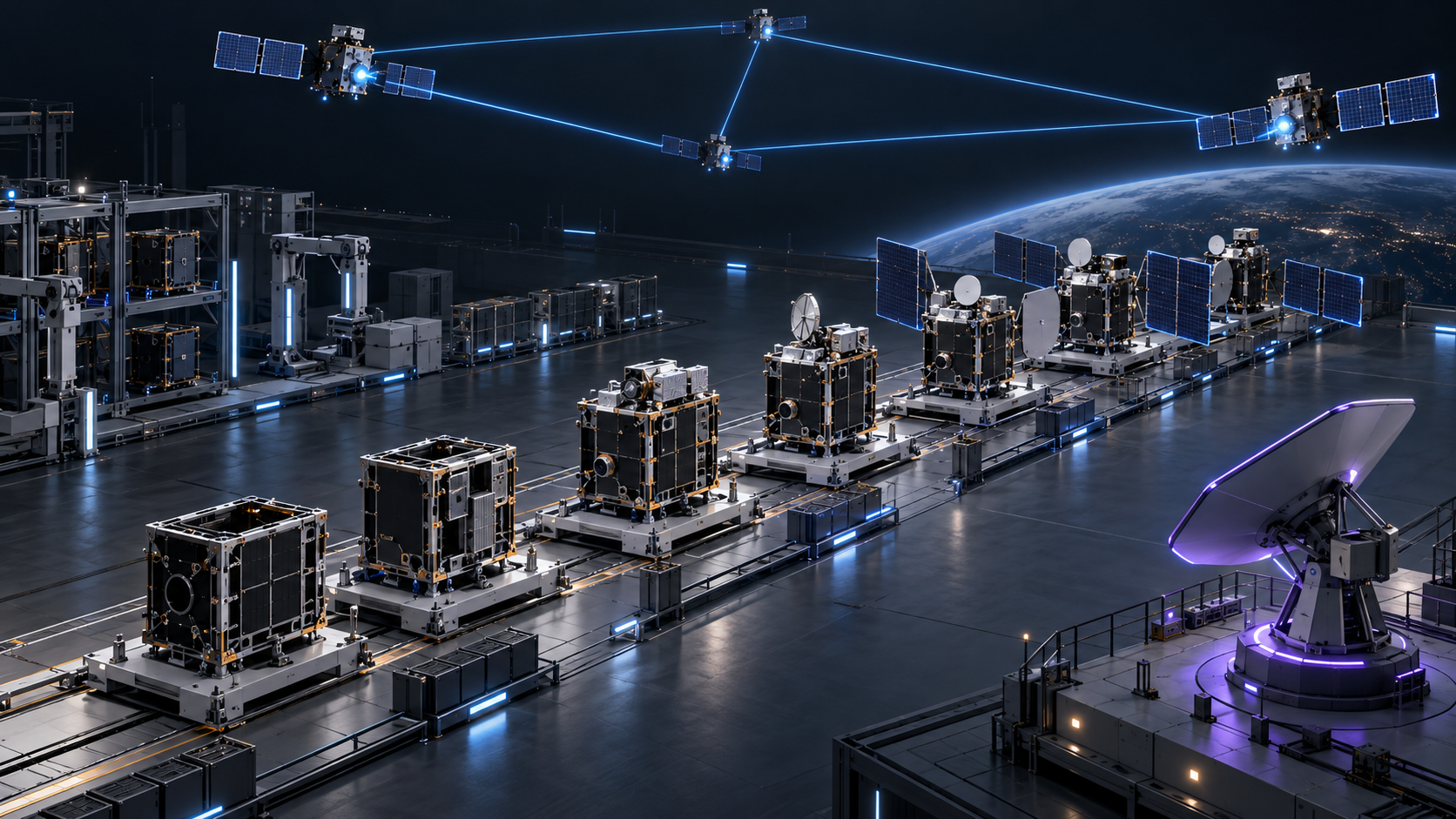
My conclusion: medium-term long the layer of satellite buses, hardware, ground stations and relay; neutral on independent direct-to-phone players until stage 4 evidence appears.
The case for the first group is that its customers are not tied to one constellation. Whichever network wins, it needs buses, ground stations and relay links. Carta's Q1 2026 report called hardware "the quiet winner," and looking at the rounds in this layer, the phrase fits. The prices are no longer cheap, though. K2 Space's $6.8 billion valuation has arrived ahead of its record in orbit. In the short term I stay neutral.
Direct-to-phone is harder to read as a business than as a technology. AST borrows spectrum from mobile operators. Starlink bought its own. The first shares revenue with operators; the second can end up competing with them. SpaceX has in fact been reported to be considering its own mobile service. Which side operators choose is still split.
In my March post on eight megatrends I named satellite IoT as a growth layer. Six months later Hubble Network carries a $1.6 billion valuation. The direction was right, but I did not expect a company with six demonstration satellites to be priced there. Frankly, I think the price has overtaken the evidence.
In public markets, the direct names are SpaceX (SPCX), AST SpaceMobile (ASTS), EchoStar (SATS), which holds SpaceX stock received for its spectrum, and Amazon (AMZN). In Japan, KDDI (9433) and Rakuten Group (4755) each sit on the side that delivers a different camp's service to its own subscribers.
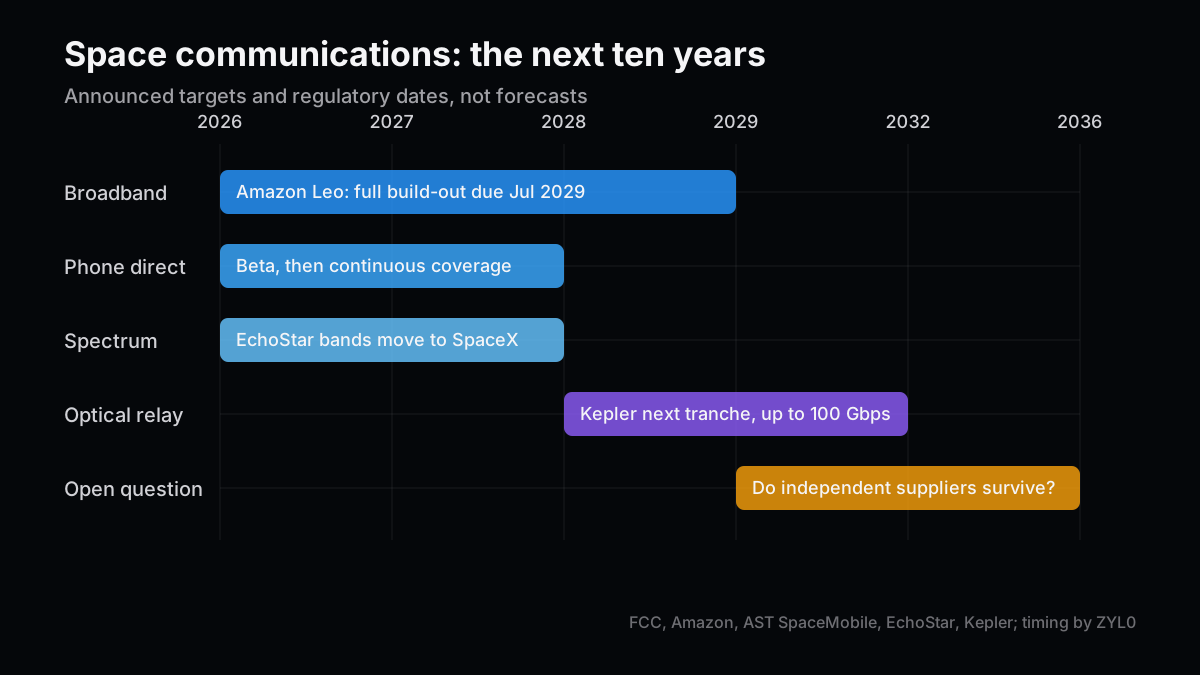
| Scenario (2026–2036) | Condition | Evidence to watch | Implication |
|---|---|---|---|
| Base | Two integrated players hold the consumer market; independents earn on parts and links for operators and governments | Starlink's revenue per user; Amazon Leo's launch; government revenue share | The supplier layer is solid but customers are concentrated |
| Main | Direct-to-phone becomes a standard phone feature; operator-aligned independents reach continuous coverage | AST's satellite count and beta results; Rakuten Mobile's launch timing | Value accrues to those with spectrum and very large antennas |
| Tail (downside) | Launch failures or spectrum reshuffles drain independents, which are then acquired | Launch failure rate; spectrum sales; down rounds | Independents are absorbed for parts and valuations shrink |
| Tail (upside) | Countries order their own constellations; orders pile up for buses, ground stations and small GEO satellites | Government constellation orders; use of export credit | Volume producers gain one customer per country |
What would change my mind: if the two integrated players start selling satellite buses, ground stations or relay capacity to outsiders at scale. That would remove the premise of a supplier layer that does not compete with the giants. I would drop the long on suppliers and keep only the companies that own spectrum.
Watch Points
- Whether AST SpaceMobile's beta starts this year, and how many satellites are in orbit when it does
- Whether Amazon Leo begins commercial service this year
- Whether Rakuten Mobile's satellite service starts in the fourth quarter of 2026
- What record K2 Space's large satellites establish in orbit
- Whether Kepler discloses relay customers ahead of its 2028 expansion
Having written this, what strikes me is that this is the least "space-like" layer of the three. The issues are spectrum, volume production and customer concentration, which is nearly the same list as in terrestrial telecoms or semiconductors. That is exactly why it is also the most readable layer for the next decade. Next time I turn to the opposite case, the hardest one to read: carrying people.
Related Posts
- Space Business Series ①: The Startups Turning Microgravity Into an R&D Platform — Drug and crystal demonstrations, and why the ride home sets the pace
- Space Business Series ③: When Does Carrying Passengers to Space Become a Business? — Flight records and economics for balloons, suborbital flights and orbital stays
- 8 Megatrends in Space Startup Investing — The March post that named satellite IoT as a growth layer
- Physical AI Series ①: The Startups Building the Data, Simulation and Ops Stack — The same issue of operating where connections drop
References
- AST SpaceMobile: Business update and second quarter 2026 results (Aug 10, 2026)
- EchoStar: Spectrum sale and commercial agreement with SpaceX
- CNBC: Amazon Leo's deployment and service launch this year (Jul 2, 2026)
- Cooley: K2 Space's $500M Series D (Jul 30, 2026)
- Kepler Communications: Commercial optical data relay service (Aug 24, 2026)
- SatNews: Northwood Space's $100M Series B and Space Force contract (Feb 7, 2026)
- Carta: State of Private Markets: Q1 2026
Next Issue Ideas
- Idea 1: Pricing one megahertz of spectrum — Put EchoStar's sale, the Omnispace merger and national allocations on the same unit to compare the cost of entering direct-to-phone service.
- Idea 2: Does volume production really make satellite buses cheaper? — Line up published prices and lead times from K2 Space, Apex and established manufacturers to see how much of a scale effect has appeared.
- Idea 3: Measuring dependence on government revenue — Add up the disclosed government contracts for the companies in this post and test whether commercial demand alone can explain their valuations.
This article is for informational purposes only and is not investment advice or a recommendation to buy or sell any security. The author may hold securities of companies mentioned. Generative AI was used in parts of the research, writing and translation. Some round sizes and valuations are reported but unconfirmed; totals, ratios and evidence stages are the author's calculations and judgment using the methods described. See the disclaimer for details.