Open vs. Closed AI Models: What the Kimi K3 Shock Reveals About Value, Moats, and the Investor Playbook
Kimi K3 erased an estimated $314 billion from OpenAI and Anthropic's implied valuations and briefly pushed semiconductor stocks into a bear market. A look at what actually separates open-weight and closed models, and what investors should watch next.
Kimi K3 erased an estimated $314 billion from OpenAI and Anthropic's implied valuations and briefly pushed semiconductor stocks into a bear market. A look at what actually separates open-weight and closed models, and what investors should watch next.


Open vs. Closed AI Models: What the Kimi K3 Shock Reveals About Value, Moats, and the Investor Playbook
Last weekend I was watching 1on1 Tech, a YouTube show aimed at Silicon Valley investors, when a headline stopped me cold: OpenAI and Anthropic's IPO prospects were suddenly "in jeopardy." Having just spent No. 39 and No. 40 picking apart Kimi K3's benchmarks and its makers' research lineage, I couldn't scroll past that.
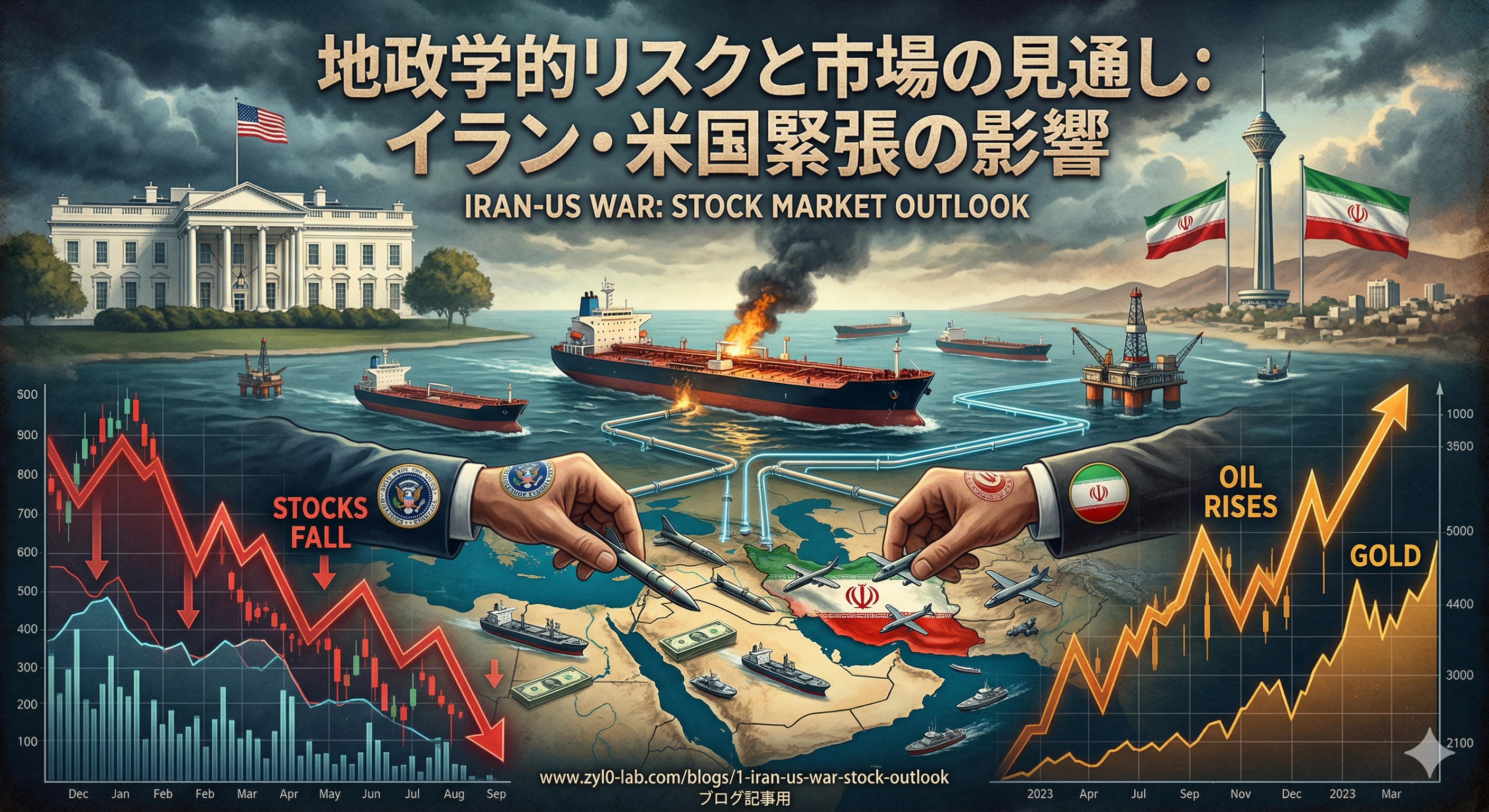
The numbers behind the headline were grimmer than I expected. In the days after Kimi K3's July 16 release, analyst estimates put the combined hit to OpenAI and Anthropic's implied valuations at $314 billion. Global semiconductor stocks lost roughly $3.3 trillion in market value within days, and the Philadelphia Semiconductor Index (SOX) fell more than 20% from its late-June high, crossing into bear-market territory. I hold no direct position in either lab or in the SOX — both labs are private, which makes that easy — but the episode forced a more practical question on me: as an investor, which side of this fight am I actually supposed to bet on?
This post works through the technical balance of power first, then the pricing collapse and the diverging business models, then what capital markets actually did with the numbers, and closes with where I think investors should be looking now.
Version note: Valuations, index scores, and market reactions are as reported and analyzed as of August 10, 2026. Private-company valuations here are either analyst-estimated, market-implied figures or reported private-round prices — neither is a liquid trading price. Sources are listed in the References section.
TL;DR: What You'll Learn
| Topic | What you'll learn |
|---|---|
| The real technical gap | Kimi K3 scores 57 on the AA Intelligence Index, within reach of Fable 5 (60) and GPT-5.6 (59) — but the training pipeline behind it stays closed |
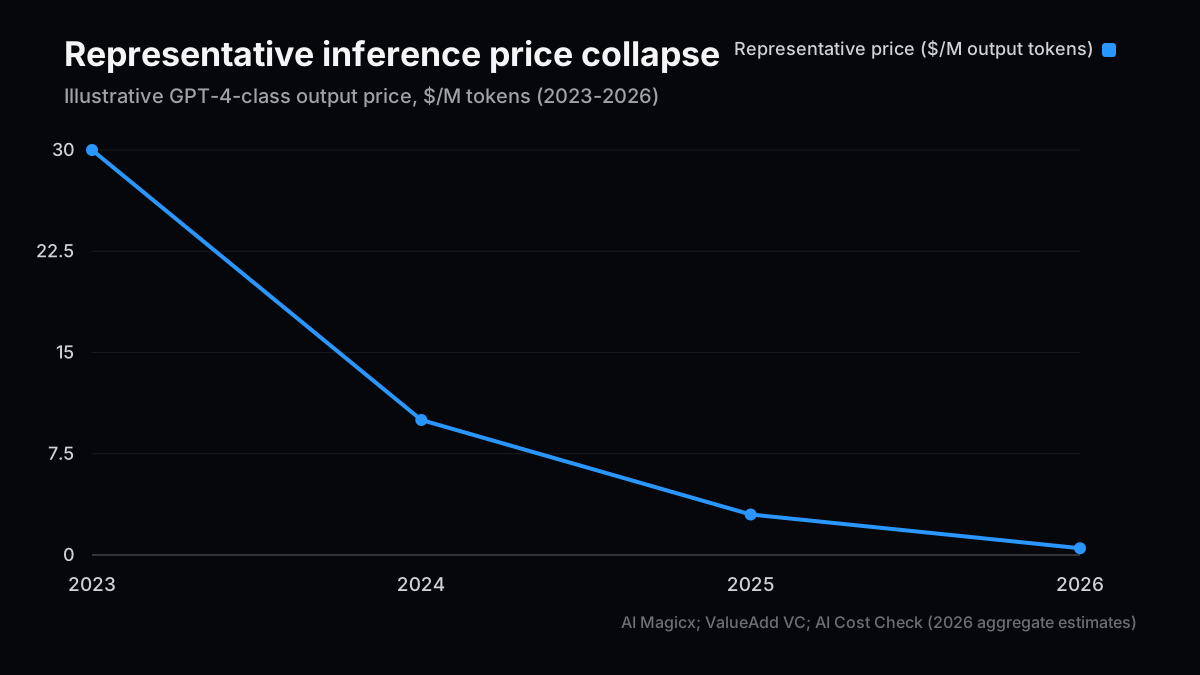
| The pricing collapse | Representative GPT-4-class inference pricing fell from roughly $30/M to $0.50/M between 2023 and 2026 |
| How capital reacted | Kimi K3 erased a combined $314B from OpenAI and Anthropic's implied valuations, and $3.3T from global semiconductor market caps |
| The investor move | Vertical integration into office apps and OS-layer agents, semis as a dip to buy, and open-model upside concentrated in infrastructure and tuning companies |
What "Open Weights" Doesn't Measure — The Real Gap Between Open and Closed
My conclusion up front: this is no longer a gap of "generation." It's a gap in what gets published.
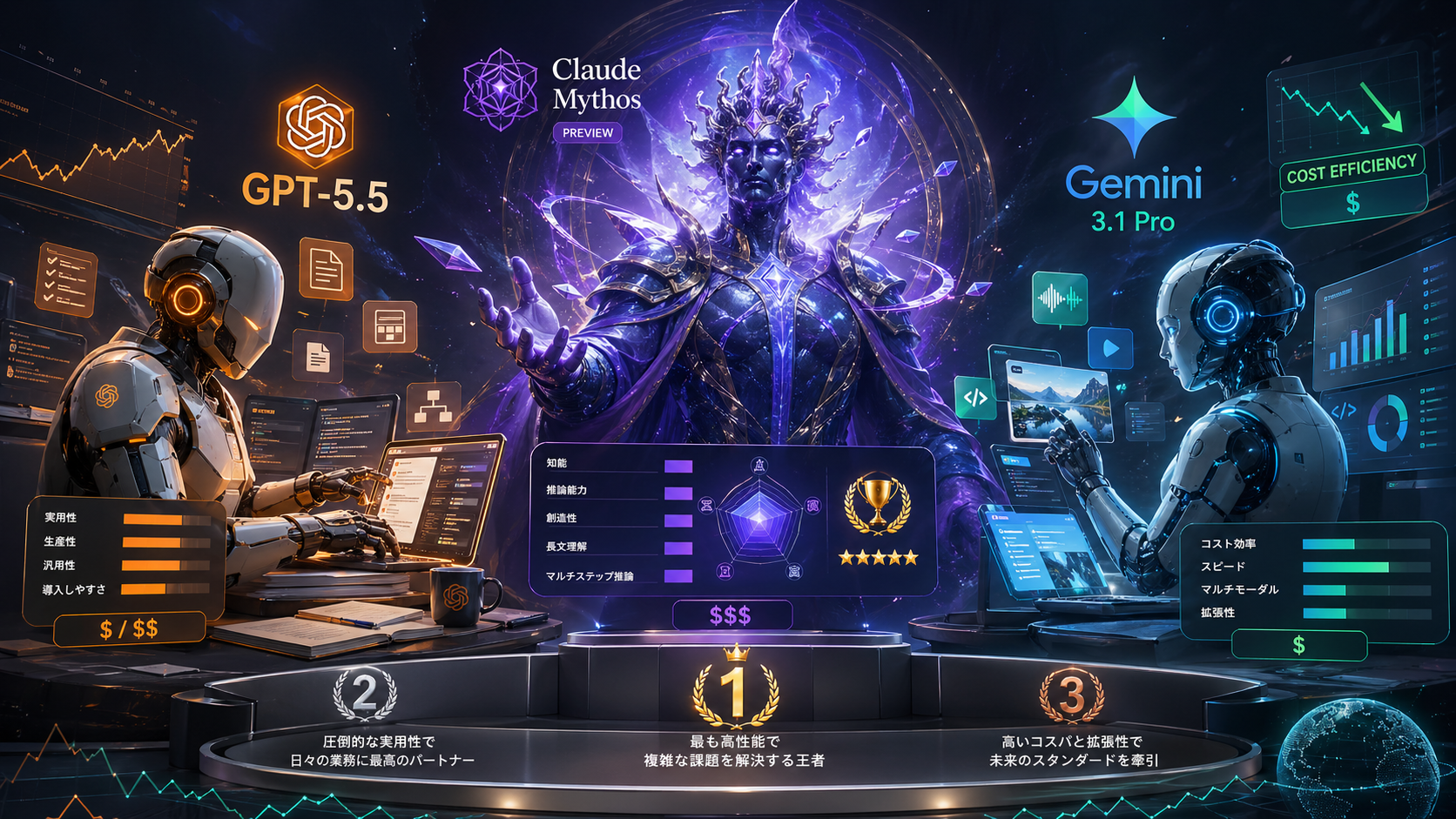
As I wrote in No. 39, the Artificial Analysis Intelligence Index (v4.1) as of July 23, 2026 had Claude Fable 5 at 60, GPT-5.6 Sol at 59, and Kimi K3 at 57 — all within three points of each other. That was the first time an open-weight model reached #4 out of 189 on the aggregate index. AI Buzz reports that several open-weight models released between February and April 2026 crossed into the 50s; a year earlier, the same category topped out in the low 30s. That is not incremental progress in my reading.
| Model | Lab | AA Intelligence Index | Weights | Training pipeline (RL environments, task generation) |
|---|---|---|---|---|
| Claude Fable 5 | Anthropic | 60 | Closed | Closed |
| GPT-5.6 Sol | OpenAI | 59 | Closed | Closed |
| Kimi K3 | Moonshot AI | 57 (#4 of 189) | Open (staged) | Closed |
The last column of that table is the thing I most want to flag. Digging through coverage of Kimi K3, an analysis from the outlet Trans-N caught my attention: what actually gets released is the weights — the parameters — while the pipeline that produces the next model, the reinforcement-learning environments and task-generation systems, stays closed even at a lab that flies the open-weight banner. You can download Kimi K3 for free and fine-tune it on your own data, but you cannot buy the capability to build Kimi K4 yourself. I doubted that framing at first — is that really true? — but the more I checked, the more it held up. The real boundary between open and closed is not the model's weights; it's the blueprint for the factory that keeps producing new models. Once you see it that way, the whole episode reads differently.
Which is why I want to reposition the models on two axes instead of a binary open/closed label: how open the weights are, and how deep the resulting moat runs.
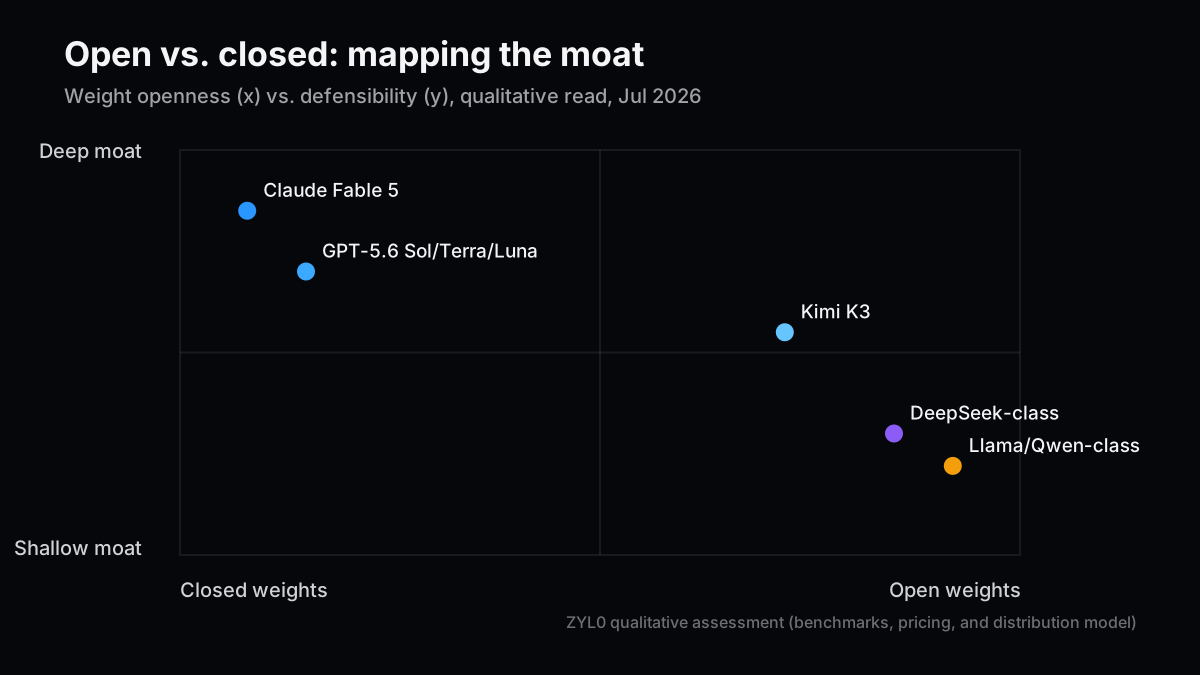
Claude Fable 5 and GPT-5.6 keep their weights closed and turn the product design itself — safety classifiers, price tiers — into the moat. That is exactly the founding logic I described in No. 40: Anthropic's scaling-law-driven caution about capability translating directly into a shipped API behavior. Kimi K3, by contrast, opens the weights while guarding the training pipeline as its core asset, which in my reading places it toward the upper-right of the chart — not a full commodity. Broad open-weight releases in the Llama or Qwen class, and DeepSeek-class models, carry less differentiation and tend to sink toward the lower-right, commodity corner. Treating "open-weight" as one undifferentiated bucket is, at this point, roughly half wrong.
Price Collapse and the Office-App/OS Pivot — Where the Revenue Is Moving
Looking only at price tags, you miss that both camps are running in the same direction.
The inference-price decline has not stopped as I write this. Cross-referencing several aggregator pieces (AI Magicx, ValueAdd VC, AI Cost Check), the representative price for GPT-4-class output quality has fallen from roughly $30 per million tokens in 2023 to around $0.50 in 2026. Annualized, the "90% a year" figure in the source video's title is somewhat generous, but not wildly off-direction. DeepInfra's own numbers show the same production workload costing about $2,275 a month on GPT-5.2-class infrastructure versus $168 a month on DeepSeek V3.2-class infrastructure — the open-weight side is falling even faster.
What's interesting here is that OpenAI and Anthropic are not fighting this price pressure head-on. Instead, both are trying to move the revenue itself up and out of per-call API billing.
| Company | Product | Rollout | Aim |
|---|---|---|---|
| OpenAI | ChatGPT Work | Rolled out July 10, 2026 | A productivity super-app bundling Codex and Atlas, with scheduled task execution |
| OpenAI | ChatGPT for Excel/Google Sheets | GA May 5, 2026 (GPT-5.5) | Native embedding inside spreadsheet software |
| Anthropic | Claude Cowork | Preview Jan 2026 → expanding enterprise rollout | A system-level agent that operates the desktop and files, deployed with PwC across roughly 30,000 staff |
| Microsoft | Switching to in-house MAI models | Reported through 2026 | Replacing some OpenAI/Anthropic-served prompts in Excel/Outlook with Microsoft's own models to cut cost |
What surprised me most is the last row. At the exact moment OpenAI and Anthropic both concluded that "the API commoditizes, so we earn at the app and OS layer instead," their single largest distribution partner, Microsoft, announced it would replace even that app layer with its own MAI models to cut costs. Vertical integration into office apps and the OS is a shield against Kimi K3 — and, at the same time, a shield they need against their closest ally. That struck me as more than a little ironic.
Capital Markets Answered With $314 Billion and $3.3 Trillion
Lining the numbers up, the market's reaction sits somewhere between "rational repricing" and "panic." I think reasonable people disagree on which.
An IG Group analyst estimated that in the days following Kimi K3's release, OpenAI and Anthropic's combined market-implied valuation fell by $314 billion — OpenAI down $82B (-5.62%) and Anthropic down $232B (-7.31%). At the same time, TechTimes reported global semiconductor stocks lost roughly $3.3 trillion in market value, and the Philadelphia Semiconductor Index (SOX) fell more than 20% from its late-June high, crossing into bear-market territory. Taiwanese equities reportedly fell more than 6%, and Japanese equities around 4%.
| Item | Before Kimi K3 | After | Change |
|---|---|---|---|
| OpenAI (IG analyst, market-implied) | $1,320B | $1,238B | -$82B (-5.62%) |
| Anthropic (same) | $1,789B | $1,557B | -$232B (-7.31%) |
| Philadelphia Semiconductor Index (SOX) | Late-June high | July 18 | -20%+ (bear market) |
| Global semiconductor market cap (TechTimes) | Pre-release | Within days | ~-$3.3T |
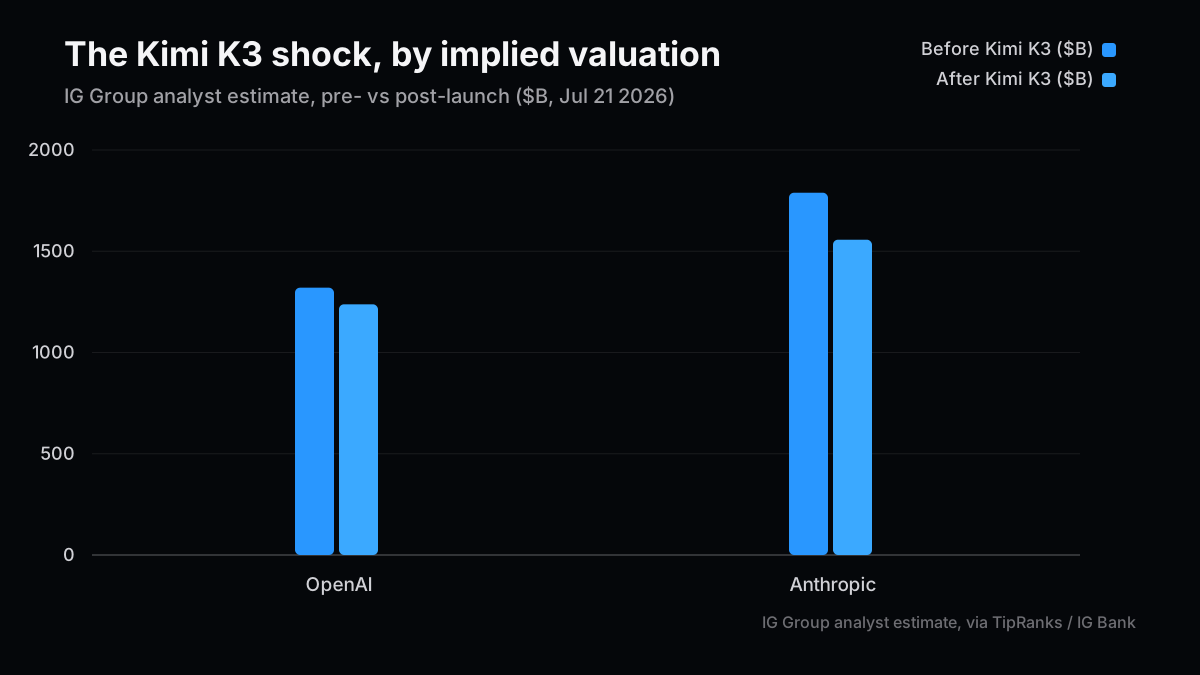
Here's an honest wrinkle I want to flag. In No. 40, I cited Anthropic's latest private round at $965B (Series H, May 2026) and OpenAI's at $852B (March 2026). Yet the IG analysis's pre-Kimi-K3 baseline puts Anthropic at $1,789B and OpenAI at $1,320B — roughly 40% above the private-round marks from just two or three months earlier. That's not a contradiction: IG's figures are not private-round transaction prices, but a market-implied valuation backed out from public AI-adjacent stocks' multiples — a different methodology entirely. Still, the size of that gap says something on its own about how much a private AI lab's "valuation" can swing depending on the assumptions behind it.
The capital story isn't only about betting on individual models. In July 2026, Nvidia led an $800 million investment into open-weight-focused Reflection AI, pushing its valuation to roughly $25 billion; Reflection AI's cap table also includes Sequoia Capital and Lightspeed. In Europe, Mistral AI — backed as top shareholder by chip-equipment giant ASML — reportedly entered talks in June 2026 to raise about €3 billion at a roughly €20 billion valuation. And Carta's Q1 2026 data (from the insights team led by Peter Walker) shows more than 60% of VC dollars flowing into AI companies — the highest concentration on record.
| Company | Round / valuation | Key investors | What it signals |
|---|---|---|---|
| Reflection AI | $800M (Jul 2026, Nvidia-led), ~$25B valuation | Nvidia, Sequoia Capital, Lightspeed | The largest closed-model infrastructure player putting capital directly behind the open-weight camp |
| Mistral AI | ~€3B in talks, ~€20B valuation (as of Jun 2026) | ASML (top shareholder), Samsung reportedly in talks | A chip-equipment giant leading capital into Europe's open-weight champion |
| Carta Q1 2026 | 60%+ of VC dollars into AI companies | Peter Walker (Head of Insights) | Record concentration of capital into AI overall, regardless of open or closed |
The fact that semiconductor-adjacent capital is flowing toward the open-weight camp too reads, to me, as a rebuttal of the simple pessimist case that open models shrink GPU demand. Nvidia isn't betting on which single model wins; it's betting on the number of entities building and running models at all.
The Investor Mindset — and a Read on the Names
With those numbers in hand, here's how I'm actually sizing positions.
Short term (3-6 months), I'm treating semiconductors as a dip to buy. In the early-2025 DeepSeek shock, the market took a few weeks to settle back into reading "price declines expand the total addressable market, they don't destroy demand." I think the current SOX drawdown of 20%+ is largely in overshoot territory too. That said, this shock is bigger in absolute terms ($3.3T) than DeepSeek's was, so confirming the bounce will likely take a bit longer.
Medium term (6-18 months), I think the evaluation frame for the two closed labs needs to change entirely. Assume API unit prices keep falling, and instead score them on how deeply ChatGPT Work and Claude Cowork embed into enterprise workflows — retention, and conversion to seat-based billing. On the open side, I find more edge in infrastructure companies that sell self-hosting, tuning, and inference optimization — the kind of company I profiled in No. 41, like MangoBoost — rather than in the models themselves.
This two-layer judgment echoes an earlier experience of mine, building a new business around our company's power-management ICs and energy harvesters. We faced a genuine fork: buy a generic power IC cheaply from an outside vendor to get a production line running fast, or commit our own analog design assets to build a proprietary chip. We chose both. The initial production lots shipped on externally sourced parts to move fast, while we switched to in-house design only on the high-value lines where differentiation actually mattered. I see the same structure in how the AI labs are choosing. Office apps and the OS layer are the "high-value line" worth building in-house; the API layer, where commoditization is unavoidable, gets defended on price — or opened up entirely to capture the surrounding infrastructure and tuning demand instead. That experience taught me to read this whole episode as a layer-by-layer management decision, not an open-versus-closed binary.
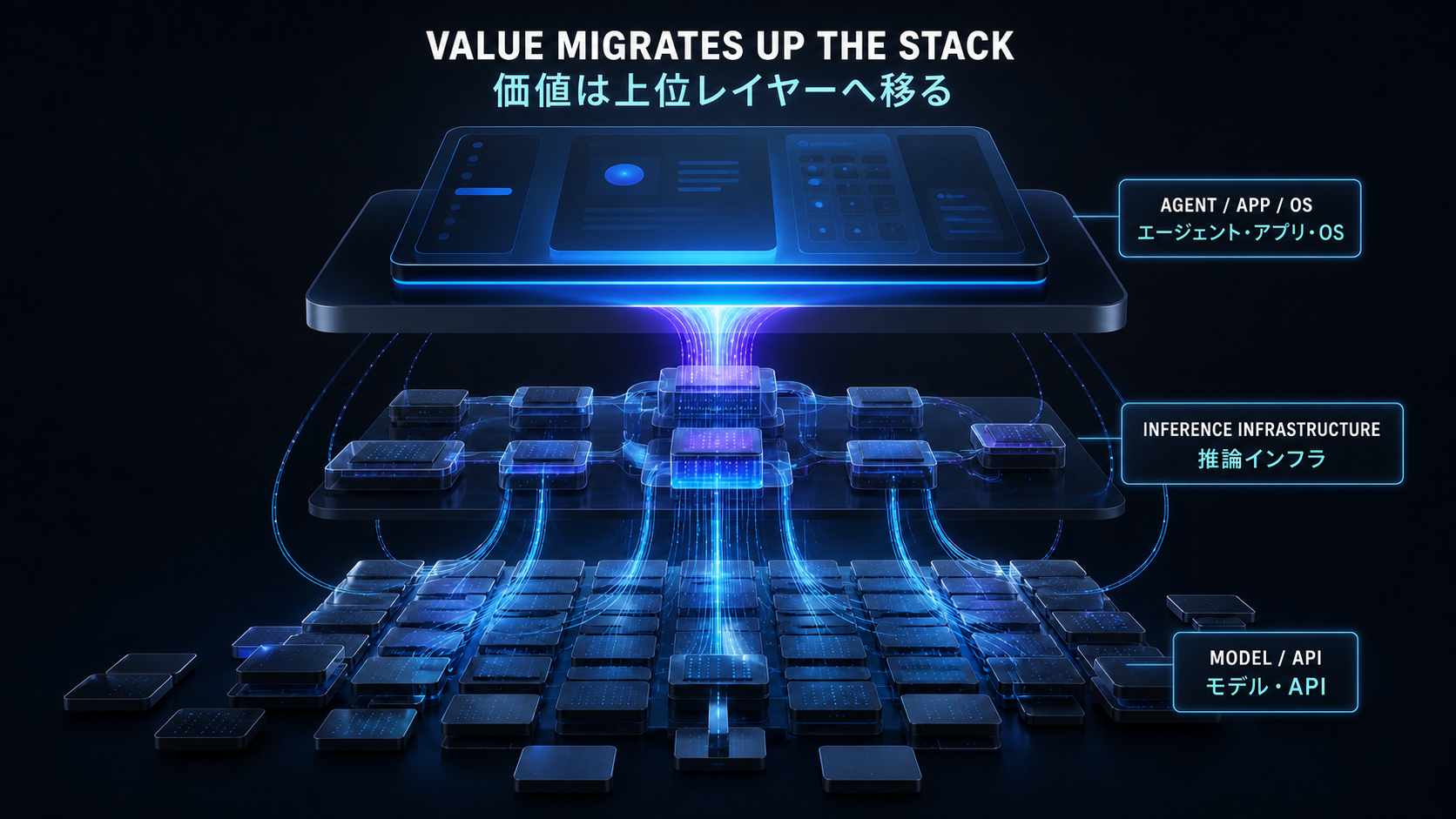
A quick read by name and theme. Nvidia stays neutral-to-positive as long as the game remains about the number of entities building and running AI rather than which single camp wins. Semiconductors broadly are a short-term dip, judged medium-term on aggregate data-center capex. OpenAI and Anthropic stay on the watchlist as long as IPO speculation continues, but always read their valuations with the methodology labeled — private-round price versus market-implied estimate. Moonshot AI has a reported Hong Kong listing on the horizon, and the thing to watch is whether its ARR growth and valuation multiple (as noted in No. 40, roughly 100x on ARR above $200M against a $20B+ valuation) survive the scrutiny of an actual listing process.
Scenarios and the Next 12 Months' Watch Points
To close, here's where this read could break — laid out on purpose.
| Scenario | Assumption | Implication for open | Implication for closed | Implication for semis |
|---|---|---|---|---|
| Base case (my lead scenario) | Open closes the gap on price and select benchmarks, but keeps trailing the frontier narrowly because the training pipeline stays closed | Opportunity concentrates in infrastructure and tuning companies | API price erosion offset by agent/enterprise revenue; IPO plans proceed | Roughly neutral to positive — expanding total demand outweighs falling prices |
| Bull-open scenario | Openness spreads to RL environments and task-generation pipelines; open catches the frontier fully within six months | Upside; self-hosting and MLOps companies take center stage | API revenue decelerates faster than expected; pressure on IPO pricing | Short-term drag, offset medium-term by rising data-center demand |
| Tail risk | Data-residency and export rules restrict adoption of Chinese open weights, while US closed labs face a higher cost of capital | Adoption slows in regulated markets, accelerates elsewhere — the market fragments | Deteriorating funding conditions delay IPOs; the race against burn rate tightens | Semiconductor cyclicality volatility amplifies, making stock selection harder |
I'll name one condition, explicitly, that would break this read: if the open-weight camp opens not just the weights but the RL environments and task-generation pipeline too, and companies self-hosting that stack start offering SLAs comparable to the major clouds, the closed labs' "safety gate plus enterprise integration" differentiation loses its footing. If even one such sign appears within six months, I'll retract this piece's medium-term call.
Three things to watch: how concrete Moonshot AI's reported Hong Kong listing gets; what OpenAI and Anthropic actually disclose in IPO filings (S-1-equivalent documents); and how far Microsoft extends its in-house model substitution inside Office. That last one reads on the surface like a simple cost-cutting story, but to me it looks like a check thrown directly at OpenAI and Anthropic's own "earn at the app layer" strategy.
Closing — Not Open vs. Closed, But Which Layer You're Betting On
Having written all this out, I think I had the question half wrong from the start. The real fork isn't "open or closed" — it's which layer you're actually betting on. Model weights, published or not, are going to keep getting cheaper. The value that survives sits in the app and OS layer that turns those weights into a concrete replacement for real work, and in the infrastructure layer underneath it. What Kimi K3 actually forced into the open wasn't "does China win or does the US win" — it was the quieter, longer-lasting lesson that valuations get cut first from whichever company bet on the wrong layer.
Next Issue Ideas
- Idea 1: A Real-World Comparison of Claude Cowork and ChatGPT Work — Measuring Substitution Rate and Cost on the Same Workflow — Run identical expense-reporting and report-drafting workflows through both agents and turn success rate, time-to-completion, and monthly cost into data usable for an investment call.
- Idea 2: Auditing Moonshot AI's Hong Kong IPO Speculation — Does $200M+ ARR Justify a $20B+ Valuation at Listing? — Once the listing speculation firms up, check the disclosed financials against the implied multiple.
- Idea 3: Is the Post-Kimi-K3 Semiconductor Dip Real? Checking Fund Flows and Positioning — Use fund-flow data on SOX constituents to test whether the "expanding total demand" scenario actually holds up.
Related Posts
- Kimi K3 vs Claude Fable 5 vs GPT-5.6: Benchmarks, Pricing, and When to Use Which — The benchmark and pricing analysis this post's technology comparison builds on.
- The Researchers Behind Kimi K3, Fable 5, and GPT-5.6: Founding Lineages of Moonshot, Anthropic, and OpenAI — Covers the three labs' founding stories and their latest private-round valuations.
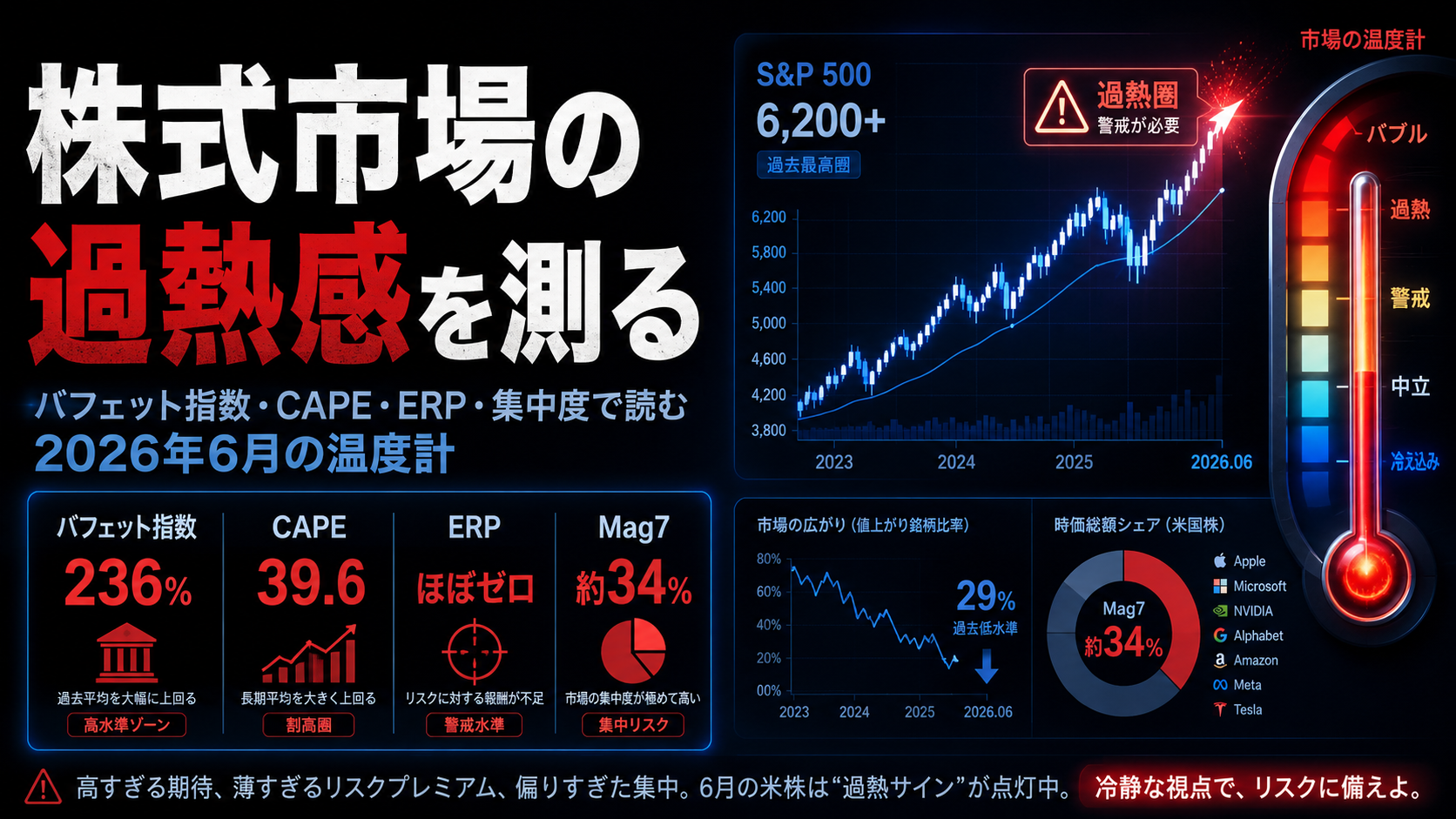
- Measuring Stock-Market Froth: Reading June 2026 Through the Buffett Indicator, CAPE, ERP, and Concentration — The broader-market froth context for reading this post's semiconductor sell-off.
References
The figures and facts in this post are anchored to the following sources readers can verify (as of August 10, 2026).
- 1on1 Tech: OpenAI and Anthropic's IPO Prospects "In Jeopardy" as Model Value Plunges (YouTube)
- TipRanks: China's Kimi K3 Erases $314B From OpenAI and Anthropic in DeepSeek Redux
- TechTimes: Kimi K3 Wipes $3.3T From Chip Stocks
- Dataconomy: OpenAI Launches ChatGPT Work Productivity App
- VentureBeat: Anthropic Says Claude Code Transformed Programming. Now Claude Cowork Is Coming for the Rest of the Enterprise.
- TechCrunch: Mistral Is Rumored to Be Raising €3B at €20B Valuation
- Open Source For You: Nvidia Backs Reflection AI With $800M in Pursuit of Open-Weight AI
- Carta: State of Private Markets Q1 2026
This article is for informational purposes only and does not constitute investment advice or a recommendation of any specific stock, company, or service. Valuations and index figures are analyst estimates or reported private-market prices and do not guarantee any market price. The author may hold positions in securities mentioned in this article. Generative AI was used for parts of research, translation, and proofreading, with final review by ZYL0. See the disclaimer for details.