Creator Pricing in the AI Era — How to Price Writing, Social, Video, and Monthly Operations Support
Creators who price per-article or per-video are getting hit hardest by 2026's AI price collapse. How to price by hours saved on the client side and monthly operations instead — with worked examples, tier ranges, and the script for defending price when the client says "I can just do this with Claude myself."

Creators who price per-article or per-video are getting hit hardest by 2026's AI price collapse. How to price by hours saved on the client side and monthly operations instead — with worked examples, tier ranges, and the script for defending price when the client says "I can just do this with Claude myself."


Creator Pricing in the AI Era — How to Price Writing, Social, Video, and Monthly Operations Support
In the previous post, I walked through how I would design a $3K/month AI operations package for mid-size companies. The most common reply was not about the proposal or the contract clauses. It was about price. "How do you actually justify $3K?" This post is the follow-up — pricing for solo creators and small studios in the AI era.
The short version: in 2026, creators still pricing "per article" or "per video" are sitting in the exact spot AI is eating fastest. The deliverable-unit playing field itself is the thing to step off.
Why "Per Unit" Pricing Became a Trap
I fell into this trap a few times myself. You take a $300 article, AI makes the first draft come out in 30 minutes, your hourly rate jumps, you feel great — for about six months. Then the next RFP comes in and a different creator writes "same quality, $100 per article" on the line below yours.
What is happening, technically, is simple. Once AI drives the first-draft cost close to zero, deliverable prices fall toward marginal cost. Writing, thumbnails, social posts, and short-form video all moved through that compression between 2024 and 2025, more or less in that order.
The harder part is that buyers finished learning this too. "Couldn't I just do this with ChatGPT myself?" is no longer a question. It is a greeting. Every time a creator answers, "Well, AI alone has these weak spots…" the buyer's brain is silently overwriting it as "so this is actually something I can do." The only way out is to change the playing field. There are three exits that look workable to me right now.
Three Pricing Lenses
These are the lenses I use on my own ZYL0 blog work and on the projects I see in advisory calls. None of them is the perfect answer. Treat them as wordings that actually land in real conversations.
| Lens | What you are selling | Why the buyer pays | Best fit |
|---|---|---|---|
| Hours saved | Reduction in their internal hours | Their staff and founder get their time back | Mid-size company publishing, recruiting, sales decks |
| Outcome | Leads, applications, retention, recruiting results | Tied directly to a number | E-commerce, SaaS, employer brand |
| Retainer / monthly ops | A workflow that keeps running every month | Cadence and freedom from single-person dependency | Ongoing blog, social, newsletter operations |
Notice that none of them say "per deliverable." That is the point.
For solo creators, the most realistic combination at this point looks like hours saved + retainer. Outcome-linked pricing is dangerous outside cases where the number is genuinely measurable. Once you hit one "conversions didn't move, so we can't pay" conversation, you do not want to repeat it.
Concrete Price Ranges (2026, North America / Japan blended)
I get asked this a lot, so here are specific numbers. They move with FX and project complexity, but in what I see, the ranges converge around this.
| Tier | Monthly range | Scope assumption | Typical client |
|---|---|---|---|
| Solo creator (you alone) | $1.5K – $4K / month | 2 blog posts, 8–12 social posts, light review | Sole proprietors, regional small businesses |
| Small studio (2–4 people) | $6K – $15K / month | 4 blog posts, 30 social posts, 4 short videos, monthly meeting | Urban mid-market, IPO-prep companies |
| Agency replacement (5+ people) | $25K – $60K / month | Full channel ops, brand design, production, paid integration | Enterprise BU, brands going cross-border |
The important rule here is: do not skip tiers when you quote. If a solo creator quotes $8K/month, the buyer expects agency-grade staffing. AI speeds up the work, but review responsibility and incident response still need humans. I personally know three studios that got burned this year by ignoring that line.
If you still take one-off projects, set a minimum. I will not take a blog draft under about $500. I will not take a short video under about $300. Trying to win below that, against creators using the same AI tools you use, just lets the AI erase the difference between you.
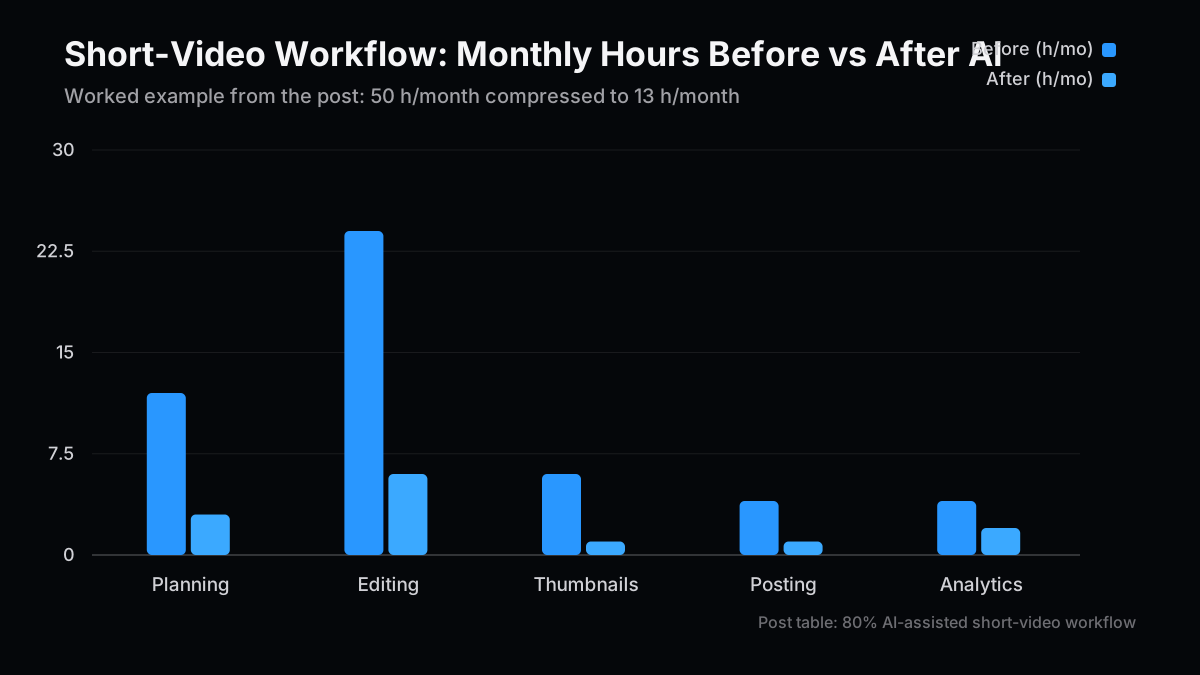
Worked Example: Pricing an 80% AI-Assisted Short-Video Workflow
This one is hard to picture abstractly, so let me walk through a project as if I were quoting it today.
The setup: a regional D2C brand. They want two Instagram Reels per week and one TikTok per week, for six months. They film on iPhone in-house. Editing, captions, structure, thumbnails, and analytics all sit with us. AI does first drafts; I do human review.
| Stage | Before (monthly hours) | After (monthly hours) | Owner |
|---|---|---|---|
| Planning and structure | 12 | 3 | Me + Claude |
| Editing and captions | 24 | 6 | CapCut + AI captions + me |
| Thumbnails and covers | 6 | 1 | Canva + Claude Design |
| Posting and scheduling | 4 | 1 | Me |
| Analytics and improvement notes | 4 | 2 | Me |
Total goes from 50 hours/month to 13. About 37 hours disappear from the client side.
Pricing this as "$100 per video x 12 = $1.2K" is how you lose. I would quote $4.5K/month, six-month minimum. Three reasons.
- Hiring an in-house social person would cost them at least $3.5K–$4.5K/month all-in.
- On my side, the workflow runs in 13 hours plus a 2-hour monthly meeting (effective rate around $300/hour).
- AI tooling and supplemental caption help cost roughly $300/month on my side.
If you can explain this in the first 30 minutes of the call, the negotiation reframes from "$1.2K vs $4.5K" to "$4.5K vs an internal hire." Different playing field.
Answering "But I Can Do This with Claude or ChatGPT Myself"
Every creator in 2026 hears this line. I hear it too. If you answer "well, you really need a pro for the quality…" you have basically lost. They are asking the question after already trying it themselves.
Three lines I actually use, depending on the room:
- "Yes, you can. For the first one. The question is whether you can do it 30 times in a row, every week."
- "Anyone can use the tools. The work is building a Skill loaded with your voice, your product, and your customer, plus a review standard that keeps it consistent. That's the part I run."
- "Compare your founder's or staff member's hourly rate times 40 hours per month, against my retainer. Decide on that ratio, not on the tool."
All three pivot away from defending AI quality and toward the ongoing cost of running it well. The better AI gets, the stronger this framing becomes, because the gap between "post one" and "post thirty" stops being about tools and starts being about operating design.
Red Flags: Clients You Should Walk Away From
Pricing is half the work. Knowing which projects to refuse is the other half. The pattern I keep in my own notes:
- "Let's just try one cheap piece first" (no culture of moving to retainer)
- "If it works, we'll sign a real contract" (refusing to define what "works" means is the warning)
- "Since you're using AI, it should be cheaper, right?" (they see value through the tool, not the operation)
- They explain a previous vendor with insults rather than facts (you will be next)
- They refuse the monthly meeting (they want piecework, not operations)
- They will not put a cap on revision rounds (the doorway to infinite-revision hell)
In my experience, when two or more of these show up in the same conversation, the project almost always blows up. AI made the work faster, and clients raised their pace of asks just as much. Scope creep got worse in the AI era, not better.
The One-Page Monthly Review That Keeps Clients Renewing
One last tool, and probably the most practical thing in this post. Write a one-page monthly review and send it every single month. I use this on ZYL0 operations and recommend it to every solo creator I advise.
Seven items are enough.
- This month's deliverables (counts of articles, social posts, videos, decks)
- Estimated client-side hours saved this month
- Number movement (page views, followers, inquiries, applications)
- What worked this month (one or two items)
- What needs improvement (one or two items)
- Next month's themes and priorities
- Any scope-change conversation needed
Sending this every month visibly lowers churn. The reason is mundane: you are pre-writing the document the client's internal team would need to defend keeping you. When the founder or a manager asks "are we still getting value?" the answer is one forward of your review away.
Creators who do not send this leave the renewal decision to the client's memory. In the 2026 market, that is a much riskier place to sit than most people realize.
Closing: The Year to Step Off Unit Pricing
For solo creators, the right move in 2026 is not more output. It is rebuilding how you sell. Producing more units does not change the buyer's mental category — it stays in "things a tool can do." Switching the pricing lens from deliverables to hours saved and monthly operations changes that category. There is several years of space here before it closes.
Concrete first step: open the last invoice you sent and add one line — "this was the price for removing X hours from the client." If there is an invoice you cannot fill that line in for, that is the project to redesign next.
Revisit Checklist: Three Numbers Before Raising Prices
- Track how many client-side hours you remove each month, not only what you deliver per unit.
- Watch revision rounds, waiting days, and extra requests to separate pricing problems from scope-design problems.
- Treat AI time savings as capacity for operations, quality control, and reporting, not as an automatic discount. Next Issue Ideas
- Idea 1: A reusable AI operations proposal template, fully filled in — Turning the pricing and operating design from this post and the previous one into a seven-page proposal anyone can adapt, complete with headings, price tables, and risk-control language.
- Idea 2: From a 30-minute founder interview to articles, social posts, and FAQ in one pass — A practical Claude Skill plus MCP workflow that converts one conversation into material for three channels, shown with real examples from my ZYL0 setup.
- Idea 3: Surviving one-off projects in the AI era — Minimum unit prices and graceful refusal lines for the projects that will never move to retainer, because in reality you cannot reject all of them.
Related Posts
- Reading OpenAI and Anthropic's Consulting Pivot Through the Eyes of a Solo Creator: 3 Strategies for the Next 3 Years — May 2026: OpenAI embeds Forward Deployed Engineers inside customers, and Anthropic teams up with Blackstone to stand u…
- How Claude Cut My Video + Web Workflow to 1/5 the Time — Combining Skills, MCP, and Claude Design to run planning → design → video script → publishing as one continuous flow c…
References
The factual and numerical assumptions in this article are anchored to primary or public materials that readers can revisit during AdSense review and future updates.
- U.S. Bureau of Labor Statistics occupational wage data
- Upwork research and reports
- OpenAI API pricing and documentation
This article is for informational purposes only and does not constitute investment advice or a recommendation of any specific stock, service, or contract structure. The author may hold positions or interests related to companies or services mentioned. Generative AI was used for parts of research, translation, and proofreading, with final review by ZYL0. See the disclaimer for details.