Did the AI Bond Rush Push Up Long-Term US Yields? Hyperscaler Issuance and Neocloud Credit Stress
Hyperscalers sold more than 200 billion dollars of bonds in 2026. Did that push long Treasury yields up? Breaking the move apart points to the Fed hike instead; the weight of the borrowing shows up in corporate spreads and in neocloud bonds yielding near 15%.

Hyperscalers sold more than 200 billion dollars of bonds in 2026. Did that push long Treasury yields up? Breaking the move apart points to the Fed hike instead; the weight of the borrowing shows up in corporate spreads and in neocloud bonds yielding near 15%.


Did the AI Bond Rush Push Up Long-Term US Yields? Hyperscaler Issuance and Neocloud Credit Stress
This is an outside-in read based only on public information. I did not interview any company or use non-public material. Bond prices and yields come from news reports or public data unless noted.
On October 7, the 10-year Treasury yield touched 5.36% and the 30-year hit 5.73%, both the highest since 2002. A week later, bonds issued by the AI cloud provider CoreWeave fell below 80 cents on the dollar and yielded more than 15%.
Put those two numbers side by side and a story writes itself. Hyperscalers sold a mountain of bonds to pay for AI, the weight of that supply lifted long-term rates, and credit is now cracking at the weakest borrower.
It hangs together. I still wanted to take it apart with numbers before I believed it.
In September's piece on rate risk and tech capex, I wrote that a rate hike would make me more worried about a capex slowdown. The hike came on September 16: the Fed raised its target range by a quarter point to 3.75–4.00%, on a 12–0 vote. Capex plans did not shrink. If anything, the view that the four largest spenders will pass $1 trillion combined in 2027 has firmed. The pressure showed up somewhere other than where I expected.
My last post, on certification gates for 800V DC data centers, was about the permits needed to switch power on inside the building. This one is about the money that builds the building.
Where $200 Billion of Bonds Piled Up
The short version: what stands out about hyperscaler issuance is not just its size but how long it runs.
J.P. Morgan Asset Management counted $219 billion of investment-grade bonds sold by Alphabet, Amazon, Meta, Microsoft and Oracle in 2026 as of August 20, including about $62 billion in currencies other than the dollar. It expects their share of US dollar investment-grade issuance to reach 9% this year, up from 2% across 2022–24. The IMF's October 13 Global Financial Stability Report reportedly put their share of global investment-grade issuance at about 10% in 2026, against less than 1% in 2024.
The headline deals tell the story:
| Issuer | When | Size | Longest maturity | Terms |
|---|---|---|---|---|
| Oracle | Feb 2026 | $20–25bn in eight tranches | Not disclosed | 10-year at Treasuries +145bp; record order book near $129bn |
| Alphabet | Feb 2026 | About $32bn equivalent, several currencies | 100 years (sterling) | £1bn century bond drew £9.5bn of orders at gilts +120bp |
| Amazon | Mar 2026 | $37bn in 11 tranches, plus €14.5bn | 50 years (2076) | Longest bond at Treasuries +130bp; about $126bn of orders |
| Meta | Apr 2026 | $20–25bn planned, up to six tranches | 40 years (2066) | Initial talk up to Treasuries +180bp |
| Microsoft | — | No large 2026 deal found | — | Funds most of its spending from operating cash flow |
What caught my eye was the maturity profile. TwentyFour Asset Management estimated on September 3 that 41% of hyperscaler issuance across 2025 and 2026 runs past 15 years, against 16% for the broad corporate index. PIMCO's June 1 count showed hyperscalers taking about 13% of 10-year investment-grade supply through May (roughly $21 billion) and more than 30% of 30-year supply (roughly $32 billion).
Long corporate bonds compete for the same wallets as long Treasuries: life insurers and pension funds. So the idea that this borrowing pushed long rates up has a real mechanism behind it.
The pricing, though, points somewhere else. J.P. Morgan says hyperscaler spreads have widened about 30 basis points this year while the broad investment-grade index moved just 2. The weight of all that supply shows up first in the price of their own bonds.
I Ran the Numbers: Taking the Rise in Long Yields Apart
This is the core of the piece. I lined up the move since the start of the year, maturity by maturity:
| Rate | End of 2025 | 2026 closing high | Oct 21 | Change YTD |
|---|---|---|---|---|
| Fed funds (upper bound) | 3.75% | 4.00% (since Sep 17) | 4.00% | +25bp |
| 2-year Treasury | 3.47% | 4.92% (Sep 28) | 4.81% | +134bp |
| 10-year Treasury | 4.18% | 5.31% (Oct 5) | 5.13% | +95bp |
| 30-year Treasury | 4.84% | 5.67% (Oct 7) | 5.42% | +58bp |
| 10-year term premium | 0.57% | 1.10% (Oct 5) | 0.99% | +41bp |
Yields are US Treasury closing par yields. The term premium is the Fed's Kim-Wright estimate, latest as of October 16. The 5.36% and 5.73% prints on October 7 were intraday highs, which is why they sit above the closing numbers here.
The biggest mover was the 2-year.
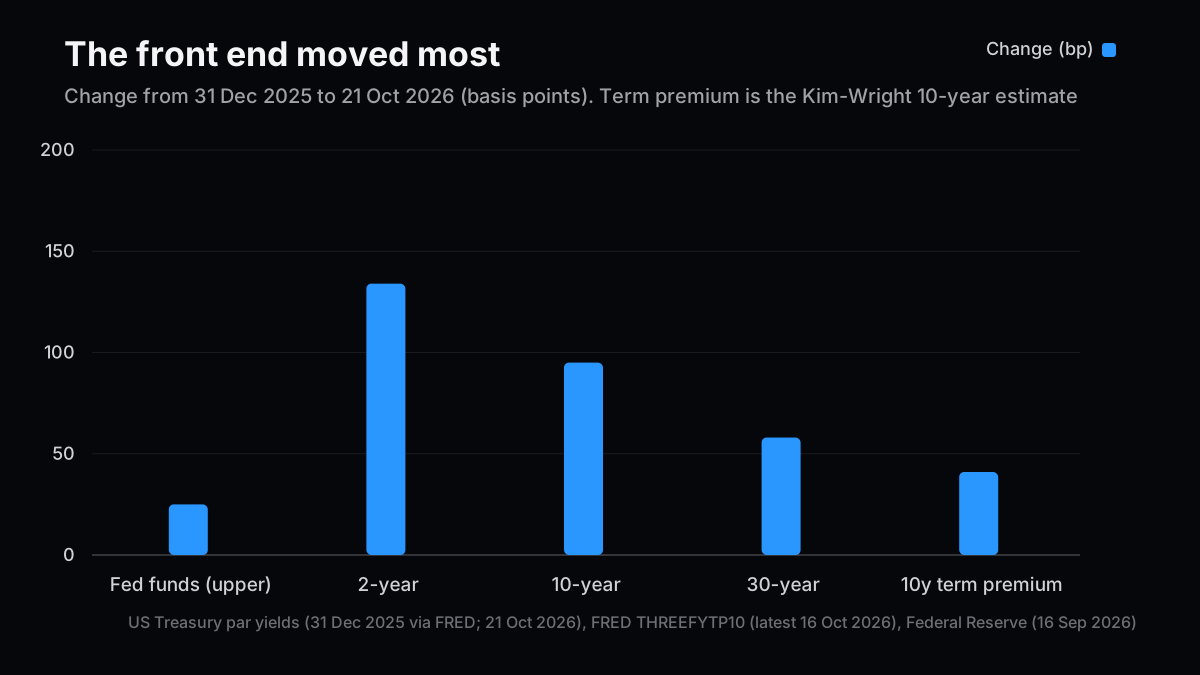
The 2-year mostly reflects where the market thinks the policy rate will go over the next couple of years. It rose 134 basis points, more than the 10-year's 95. My read is that most of the rise in long yields comes from the hike and the expectation of more.
The term premium rose 41 basis points. That is the extra pay for holding long-dated debt, and it absorbs heavy Treasury supply, selling of other governments' bonds, inflation uncertainty and, yes, the supply of long corporate bonds. If corporate issuance is moving Treasury yields, it lives somewhere inside those 41 basis points.
I also looked at the gaps between maturities.
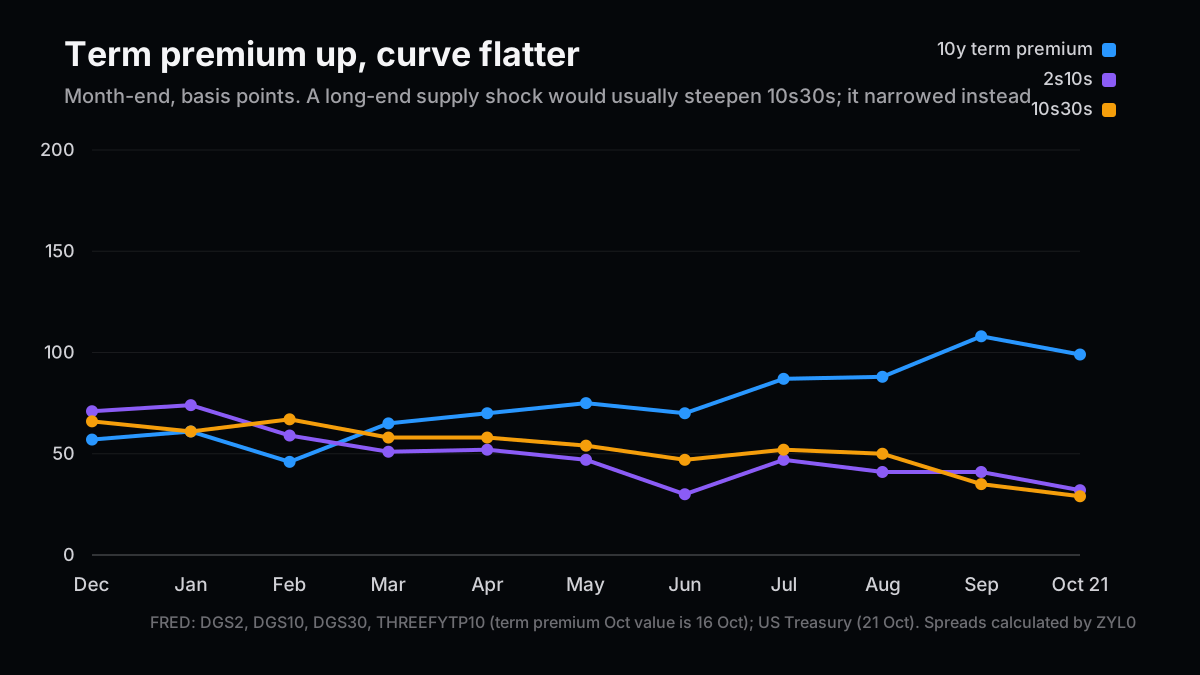
If long corporate bonds were crowding buyers out of long Treasuries, I would expect the 30-year to cheapen against the 10-year and the 10s30s spread to widen. It did the opposite, narrowing from 66 basis points at the start of the year to 29. The term premium went up, yet the curve got flatter. I stopped here for a while. It does not fit a picture where supply is weighing on the long end alone.
PIMCO reached a similar conclusion in June. Of the 51-basis-point rise in the 10-year from February 27, it attributed 38 to changing policy expectations and 13 to the term premium. Capital Economics has reportedly argued that AI bond issuance alone cannot explain the Treasury move. On the other side, J.P. Morgan wrote that long-end issuance "may also have contributed" to higher long yields, and the IMF flagged AI borrowing competing with sovereign bonds for investors. Opinion is split. What I could not find was anyone credible calling it the main driver.
How big is long-dated hyperscaler supply next to Treasury long-bond auctions?
The volume still deserves respect, so I compared it with long Treasury auctions from January through August 2026.
| Item | Amount | Assumption |
|---|---|---|
| 30-year auctions (Jan–Aug) | $185bn | $25bn in Feb, May, Aug; $22bn in other months |
| 20-year auctions (Jan–Aug) | $113bn | $16bn in Feb, May, Aug; $13bn in other months |
| Total long Treasury auctions | $298bn | — |
| Hyperscaler dollar bonds (to Aug 20) | $157bn | J.P. Morgan's $219bn minus $62bn in other currencies |
| Of which longer than 15 years | $47–64bn | Long share assumed at 30–41% |
| Share of long Treasury auctions | About 16–22% | — |
This assumes auction sizes stayed where the Treasury said they would, and it mixes data from different windows, so treat it as rough. Even so, roughly a fifth of long Treasury auction volume is not small. A tug-of-war for long-duration money would not surprise me.
How much of it reached Treasury yields is another matter. Judging by the shape of the curve, not much. The party taking the most strain is not the Treasury market. It is the issuers' own bonds. That is where I landed.
The Credit Ladder: Neocloud Bonds at 15%
Walk down the credit ladder one step at a time and the view changes.
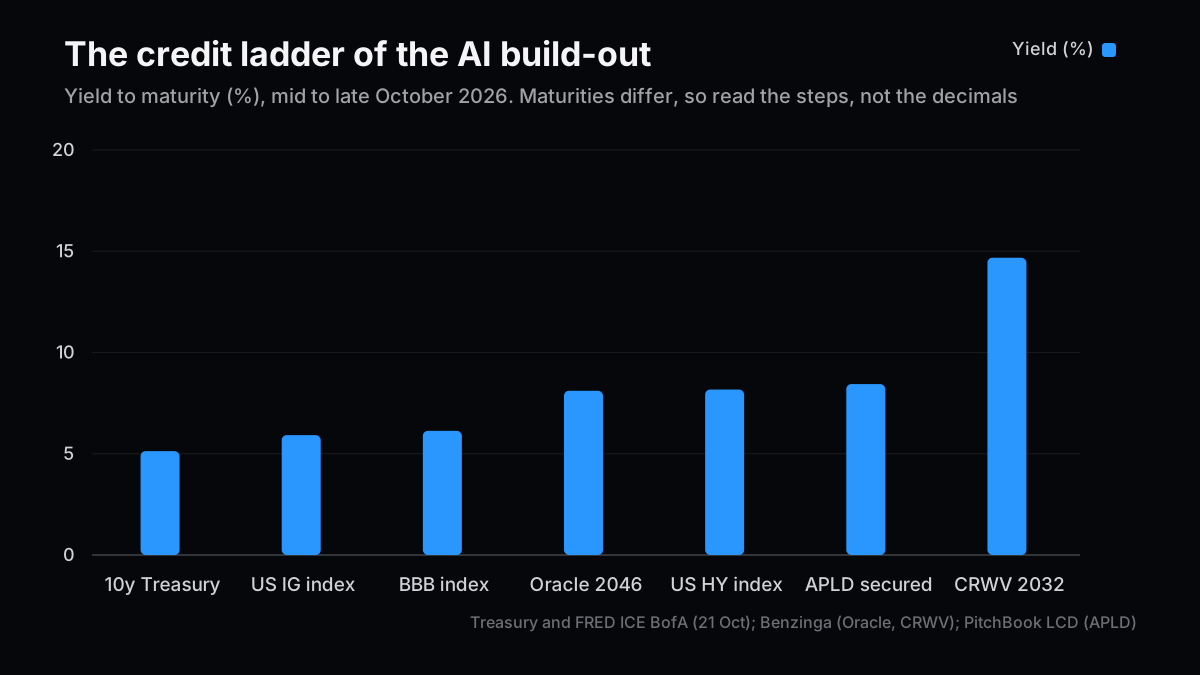
The 10-year Treasury sits at 5.13%, the investment-grade index at 5.92% and the BBB index at 6.13%. Those are gentle steps of 0.2 to 0.8 points. Then comes Oracle's 2046 bond at 8.11%. S&P cut Oracle to BBB− on July 9, the bottom rung of investment grade. The maturities differ, so the comparison is loose, but that yield is almost identical to the high-yield index at 8.17%. Oracle is still investment grade on paper and already priced close to junk.
Then CoreWeave's 2032 bond, at 14.68% on October 21. Here the ladder stops being a ladder and turns into a wall.

One correction to the way this is often described. CoreWeave's bonds did not "fall to junk." They were sold as high-yield bonds from the start, rated below investment grade. What happened this month was not a downgrade but a price collapse. According to PitchBook LCD, the 9.75% notes due 2031 traded as low as 78 on October 14 for a 16.39% yield, down from about 85 at the start of the month. Bloomberg reported that five-year credit default swaps hit a record 1,194.5 basis points intraday on October 15, pricing more than a 60% chance of default within five years. By October 19 they had eased to around 1,090.
How the neoclouds are raising money
Lay the neoclouds and their data-center developers side by side and their funding styles split clearly.
| Company | Main funding, 2025–26 | Market signal, mid-October |
|---|---|---|
| CoreWeave (CRWV) | Unsecured high-yield bonds (9.75% 2031, 9.625% 2032 and others). Over $10bn of unsecured and convertible debt plus a $3.1bn term loan in Q2 | 2031s at 78–82, yields in the mid-teens; five-year CDS above 1,000bp |
| Nebius (NBIS) | Convertibles: $4bn in March (1.25% 2031, 2.625% 2033) and $5.75bn in August (0.50% 2030, 4.50% 2034) | Still able to issue at low coupons, funding on equity upside |
| Applied Digital (APLD) | Secured project bonds ($2.35bn of 9.25% 2030s; $1.59bn of 7% five-year notes in June). Main tenant is CoreWeave | 7% notes at 94.5, about 8.44%; J.P. Morgan analysts cut them to Neutral |
| TeraWulf (WULF) | Secured notes ($3.2bn of 7.75% 2030s, October 2025). Google backstops part of its tenant's lease | I could not confirm a current price |
Two things jumped out when I built this table.
First, the same AI infrastructure prices very differently depending on how the debt is structured. Applied Digital's secured bonds yield around 8%, and its tenant is CoreWeave, whose own unsecured bonds yield around 15%. The market treats bonds backed by a physical data center and a long lease as safer than the tenant's general credit.
Second, Nebius has leaned on convertibles. A 0.50% coupon is what you pay when buyers get the right to swap into shares if the stock rises. If the stock falls, a cheap loan is all that is left. It turns a credit question into an equity question.
What happens when you refinance at 15%
CoreWeave's second-quarter results show that revenue is not the problem. Revenue more than doubled from a year earlier to $2.575 billion, and the backlog reached about $104 billion, with more than $25 billion of new commitments added early in the third quarter.
Interest is the problem. Net interest expense was $640 million in the quarter, more than double the $267 million a year earlier. Adjusted EBITDA of $1.51 billion covers that 2.4 times. Adjusted operating income, after depreciation, was $128 million, which covers only about a fifth of it. Debt and lease obligations together are reported at about $51 billion.
So I did a simple calculation. Say the company borrows another $10 billion. At a 9.75% coupon that costs $975 million a year in interest. At 15% it costs $1.5 billion. The gap, $525 million a year, is about the same as four quarters of second-quarter adjusted operating income (roughly $510 million). Capex plans for 2026 have been reported at $35–39 billion. To keep growing it has to keep borrowing, and every new loan hands more of its operating profit to lenders.
Having made more than 20 deep-tech investments, I have watched again and again how the value of a capital-heavy company turns on the terms of its next raise. On one follow-on round I spotted that the valuation was overstated, argued against it with data, and led the renegotiation. However good the business plan looks, if the price of the money needed to run it changes, the plan is worth something different. I think that is what CoreWeave's share price is reacting to: not revenue, but the price of money.
What this means for the hyperscalers
For the hyperscalers, the neoclouds are suppliers of compute and also counterparties they prop up with equity and contracts. The IMF reportedly reviewed 14 publicly disclosed AI deals since 2023 in which hyperscalers put in about $300 billion of equity and about $650 billion of debt in exchange for roughly $1.4 trillion of future spending commitments. When revenue dries up, those investments lose value at the same moment. The IMF called this wrong-way risk.
For Oracle, S&P reportedly cited customer concentration as a reason for the downgrade, with OpenAI accounting for about half of a roughly $638 billion backlog. My read is that hyperscaler spreads have widened this year not just because of supply, but because counterparty credit is starting to show up in the price.
Scenarios and My Investment Call
Here is how I would frame the next six to twelve months. The probabilities are my own judgment.
| Scenario | Probability | What happens | Early signals |
|---|---|---|---|
| Base case | 50% | The policy rate holds near 4% and the 10-year stays around 5%. Hyperscalers keep issuing and spreads drift wider. Neoclouds keep funding through private deals and insurer money, at high rates | The Fed holds in October; CoreWeave bonds stay in a 13–16% yield range |
| Main scenario (upside) | 20% | Softer inflation revives rate-cut bets and long yields slip into the high 4s. Neoclouds can borrow below 12% and the credit ladder flattens | The 2-year breaks below 4.5%; new neocloud bonds sell smoothly |
| Tail risk | 30% | The funding window shuts for neoclouds and stress spreads to data-center high yield and Oracle. Hyperscalers trim capex, and Treasuries rally as a safe haven | CoreWeave CDS above 1,500bp; Oracle cut to high yield; new bond deals pulled |
I put the tail at 30% because prices already lean that way. A 60% implied default probability in the CDS tells me the market is taking it seriously.
One thing worth noticing: in the tail, Treasury yields fall. The "AI debt drives rates up" story fits best while AI investment is working. When it breaks, money runs to Treasuries.
Investment call
- Long Treasuries: neutral. This year's rise has been led by the Fed, not by issuance, and Treasuries become the refuge in the tail scenario
- High-grade hyperscaler bonds (Alphabet, Amazon, Meta, Microsoft): leaning long over the medium term. The spread widening this year is compensation for heavy supply, and I would take it
- Oracle bonds: wait and see. At BBB−, one more notch puts them in high yield, and the long bonds already yield about the same as the high-yield index
- Neocloud unsecured bonds and shares: negative in the short term. As long as CDS sits above 1,000 basis points, the shares will follow credit
- Secured data-center bonds: selective. Tenant credit and collateral quality make the difference; two 8% yields can hide very different risks
What would change my mind
Two things. First, if the 2-year falls while the 30-year rises and the 10s30s spread widens sharply, and if Treasuries sell off repeatedly on the days hyperscalers launch big deals, I will accept that supply is hitting Treasury yields directly and revise this view.
Second, if CoreWeave or another neocloud completes a large raise at a yield below 12%, the funding window is open and my credit-stress read is wrong.
Watch points
- The Fed's decision and statement on October 27–28
- Whether the Treasury's quarterly refunding announcement in early November raises long-bond auction sizes
- Interest costs, funding plans and backlog in the neoclouds' third-quarter results in November
- Oracle's ratings (BBB− at S&P; Baa2 with a negative outlook at Moody's)
- Whether the next big hyperscaler deal has to pay a wider new-issue premium
One doubt stays with me after writing this. I still cannot split the 41-basis-point rise in the term premium into a corporate-supply piece and everything else. Until I can, I hold this conclusion provisionally.
Related Posts
- The Warsh Shock — Part 2: How Far Rate Risk Reaches Into Tech Capex — the rates-to-capex analysis this post builds on
- The Warsh Shock — Part 1: How Jackson Hole Rewired the Rate and Dollar-Yen Outlook — the rate outlook that led to the September hike
- Big Tech AI Capex Is Not Comparable As Reported — how far each company's capex runs ahead of operating cash flow
- Certification Gates for 800V DC Data Centers — the same data centers, read from the permits inside the building
References
- Federal Reserve issues FOMC statement (Federal Reserve, September 16, 2026)
- Daily Treasury Par Yield Curve Rates, October 2026 (US Treasury)
- Hyperscalers: Now also a credit story (J.P. Morgan Asset Management, August 20, 2026)
- AI financing needs do not override cyclical drivers of yield (PIMCO, June 1, 2026)
- How hyperscaler issuance is reshaping the Treasury curve (TwentyFour Asset Management, September 3, 2026)
- CoreWeave Reports Strong Second Quarter 2026 Results (CoreWeave, August 11, 2026)
Next Issue Ideas
- Idea 1: Counting the borrowing that never shows up as bonds — J.P. Morgan estimates about $1.4 trillion of data-center lease obligations, roughly $1.1 trillion of them off balance sheet. Building that number up from company filings would show how much leverage sits outside the bond tallies.
- Idea 2: Will insurers become the lender of last resort for AI infrastructure? — Compare the yields and collateral terms of the insurer and private-credit money that neoclouds have started to court, and find where the tail risk would actually start.
- Idea 3: Will November's refunding raise long-bond auction sizes? — Follow the link between Treasury's issuance plan and the term premium as a sequel to this breakdown. The question is whether the expected 2027 increase in auction sizes gets pulled forward.
This post is not investment advice. The author may hold securities of the companies mentioned. Generative AI was used in preparing it. Please read the disclaimer before making any investment decision.