How to Build a Mid-Size Company AI Operations Package Before Selling It for $3K a Month
For solo creators moving into corporate work in the AI era, sell "running operations" — not "tool deliveries." Designing a ¥300k / month AI operations package for mid-sized companies: the contents, pricing, and the proposal template, all in one place.

For solo creators moving into corporate work in the AI era, sell "running operations" — not "tool deliveries." Designing a ¥300k / month AI operations package for mid-sized companies: the contents, pricing, and the proposal template, all in one place.


How to Build a Mid-Size Company AI Operations Package Before Selling It for $3K a Month
In the previous article, I wrote that OpenAI- and Anthropic-style forward-deployed engineering could eat into the work solo creators do for clients. So what should an individual creator do? My answer is very concrete: become the mini-FDE for the mid-size companies the AI giants will not reach.
But the product is not a "how to use ChatGPT" workshop. The product is an AI operation that runs every month. Think of packaging the same flow I use for ZYL0 — topic planning, Skills, review, Markdown, publishing checks — into something a company can actually keep using.
Sell Less "AI Adoption" and More "Annoying Work Disappears"
If you tell a small business owner, "Let's deploy AI agents," the reaction is often lukewarm. What lands is much more ordinary:
- The company blog stops going stale.
- Recruiting articles can be drafted from internal interviews.
- Sales decks can get a first draft in a day.
- Social posts no longer depend on one tired employee.
- The founder's thoughts become articles, decks, and FAQ pages.
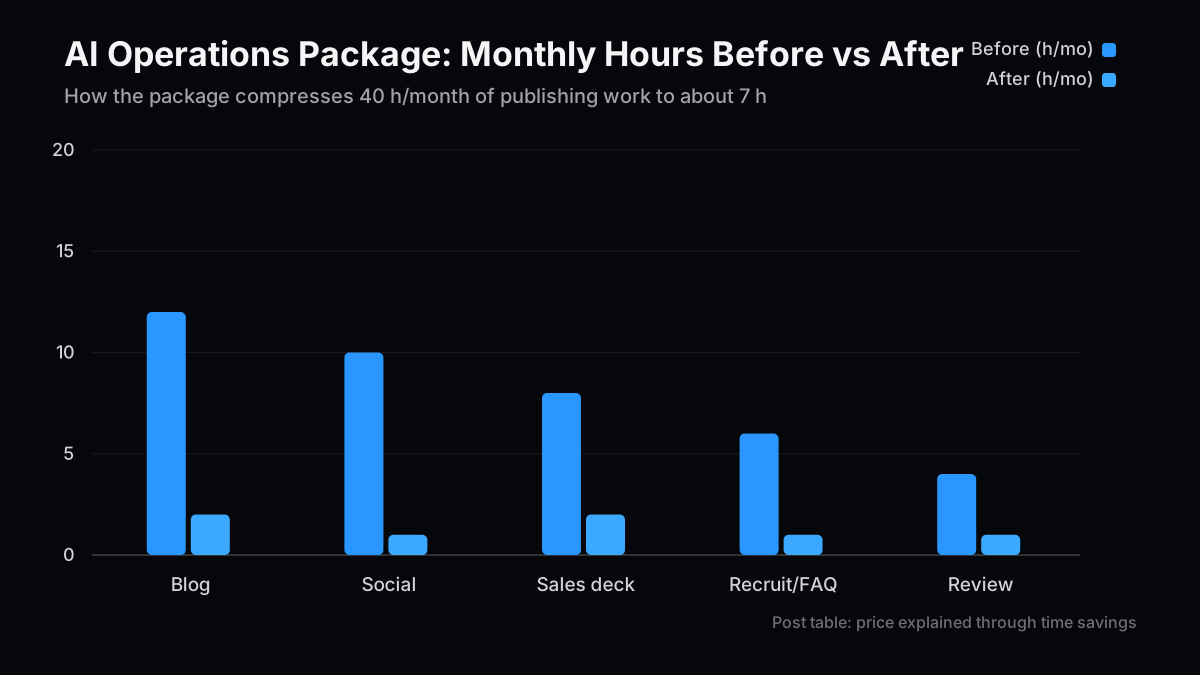
If I were naming the offer, I would not call it "AI implementation support." I would call it "an operations package that compresses 40 hours of monthly publishing work into 7 hours." Now the buyer can evaluate time, not hype.
That reframing matters. Creators naturally want to talk about tools: Claude, ChatGPT, Canva, Notion, MCP. Buyers purchase the feeling that the messy work is finally under control.
Five Pieces Are Enough for the First Package
For a $3K/month minimum package, do not sell everything at once. I would keep it to five pieces.
| Piece | Purpose | Deliverable |
|---|---|---|
| Workflow breakdown | Decide what should be AI-assisted | Workflow map and estimated time savings |
| Knowledge capture | Turn internal context into reusable material | FAQ, voice guide, product notes |
| Generation flow | Produce repeatable quality | Skills/prompts and review checklists |
| Monthly content operation | Actually run the work | Two blog posts, 12 social posts, one sales deck, etc. |
| Improvement meeting | Make the next month better | 30-minute monthly review and change log |
The key is: do not end at tool delivery. If you hand over a prompt and say "good luck," it will probably be abandoned by next month. Mid-size companies do not need a perfect AI tool. They need a slightly messy but reliable operation.
My own blog works the same way. I pick topics, inspect previous Next Issue Ideas, call the right Skill, write Markdown, generate images, and check the design. That chain is why articles accumulate. A one-off prompt does not create cadence.
Explain Price Through Time Savings, Not Deliverables
Creators often struggle with pricing corporate work. If you price by blog post or social post, you fall into commodity pricing immediately.
I would explain $3K/month like this:
| Work | Before | After | Value |
|---|---|---|---|
| Blog planning and draft | 12 hours/month | 2 hours/month | Drafts from founder interviews |
| Social posts | 10 hours/month | 1 hour/month | Repurposing from long-form content |
| Sales deck | 8 hours/month | 2 hours/month | Reusing product notes and examples |
| Recruiting / FAQ | 6 hours/month | 1 hour/month | Turning internal questions into knowledge |
| Review | 4 hours/month | 1 hour/month | Fewer mistakes through checklists |
That turns 40 hours into roughly 7. You are not selling "articles." You are selling a monthly operating system that removes a recurring bottleneck.
I would still keep the first contract testable: $3K/month, three-month minimum, monthly review of outputs and time saved. Do not underprice. But make it short enough that the buyer can try it without feeling trapped.
The Proposal Can Be Seven Pages
Long proposals do not get read. For mid-size companies, seven pages is enough.
- Current pain: updates stop, knowledge sits in one person's head, output depends on one employee.
- Target: compress 40 hours/month into 7.
- Scope: blog, social, sales deck, recruiting FAQ.
- Operating flow: interview -> AI draft -> human review -> publish -> improve.
- Month-one plan: audit, templates, first delivery.
- Price: $3K/month, three-month contract.
- Risk controls: fact-checking, confidential information, approval, copyright review.
The trap is overexplaining the future of AI. Buyers want to know what becomes easier next month. I made that mistake early too. I wanted to talk about models and architecture. In client work, operating design usually lands harder than technical explanation.
What the Contract Must Define
AI operations work can get messy fast. At minimum, define these items in the contract or order form:
- Final approver before publishing
- Responsibility for fact-checking
- What confidential information may enter AI tools
- Copyright and reuse rights
- Monthly output limits
- Number of revision rounds
- The work is operations support, not a guaranteed business outcome
The output limit is especially important. At $3K/month, you cannot create unlimited articles and decks. I would set a baseline: two blog posts, 12 social posts, one sales deck, and one monthly meeting. Anything beyond that is a separate estimate.
If this is vague, the creator burns out. The faster AI makes the work, the more likely the client says, "Great, can we have more?" That is exactly why the scope needs to be small from day one.
The Order I Would Build It In
If I were starting today, I would do this:
- Draw my own publishing workflow on one page.
- Remove anything that is too personal to sell.
- Build a "40 hours to 7 hours" hypothesis for one target company.
- Write the seven-page proposal.
- For the first client, track improvement logs more carefully than the outputs themselves.
For solo creators, surviving the AI era is not only about posting more. It is about turning your own operating system into a product. Not for giant enterprises, but for companies small enough to need help and large enough to pay for it. That middle layer still has a lot of space.
Start by writing down ten annoying tasks you do every month. The one that other companies probably struggle with too is the seed of your AI operations package.
Revisit Checklist: Before Selling This at per Month
- Convert internal hours saved into a monetary value using the client's realistic staff cost.
- Explain scope by reduced operating load, not only by the number of articles, posts, FAQs, or support replies produced.
- If a client skips review meetings for two straight months, move back to a smaller validation project before promising a retainer. Next Issue Ideas
- Idea 1: A reusable proposal template for AI operations packages — the seven-page structure, pricing table, and risk-control language.
- Idea 2: Creator pricing in the AI era — how to price writing, social posts, video, and monthly operations support.
- Idea 3: Turning a founder interview into articles, social posts, and FAQ — a practical 30-minute workflow.
Related Posts
- The AI Operations Proposal Template, Fully Filled In — 7 Pages, Price Table, and Scope-Creep Language You Can Paste — A fully filled-in seven-page AI operations proposal template covering tiered pricing, revision caps, and scope-creep c…
- The Shortest Path to Connecting Internal Knowledge over MCP: Wiring Research Notes, Past Proposals, and Meeting Minutes into Claude Code in 30 Minutes — A 30-minute build log: a minimal MCP server that lets Claude Code search research notes, past proposals, and meeting minutes.
- Running AI Agents as an Organization: A 12-Subagent, Neon-Backed Postgres Task Board Architecture for a One-Person Company — The era of letting one AI do everything is over.
References
The factual and numerical assumptions in this article are anchored to primary or public materials that readers can revisit during AdSense review and future updates.
This article is for informational purposes only and does not constitute investment advice or a recommendation of any specific stock, service, or contract structure. The author may hold positions or interests related to companies or services mentioned. Generative AI was used for parts of research, translation, and proofreading, with final review by ZYL0. See the disclaimer for details.