Physical AI Series ③: Hardware Is the Last Bottleneck — Actuators, Hands and Sensors
Part 3 covers the hardware that still caps physical AI: actuators worth over half of humanoid BOM, dexterous hands and touch, lidar and depth cameras, and the rare-earth magnet deadline, through Westmag, XELA, Clone, Hesai and more.
Part 3 covers the hardware that still caps physical AI: actuators worth over half of humanoid BOM, dexterous hands and touch, lidar and depth cameras, and the rare-earth magnet deadline, through Westmag, XELA, Clone, Hesai and more.


Physical AI Series ③: Hardware Is the Last Bottleneck — Actuators, Hands and Sensors
When I worked on automotive EEPROM in mass production, I learned that between "the prototype works" and "we can build millions of identical parts at the same yield" lies a whole branch of engineering that design alone does not cover. This series has moved through data and operations and the robot brain. What is left is the layer governed by that mass-production engineering: hardware.
As of October 3, 2026. Market forecasts come from Bank of America Institute's March 2026 report; company figures come from company disclosures. Some shares and growth rates are my own calculations.
More Than Half the Cost Is Muscle
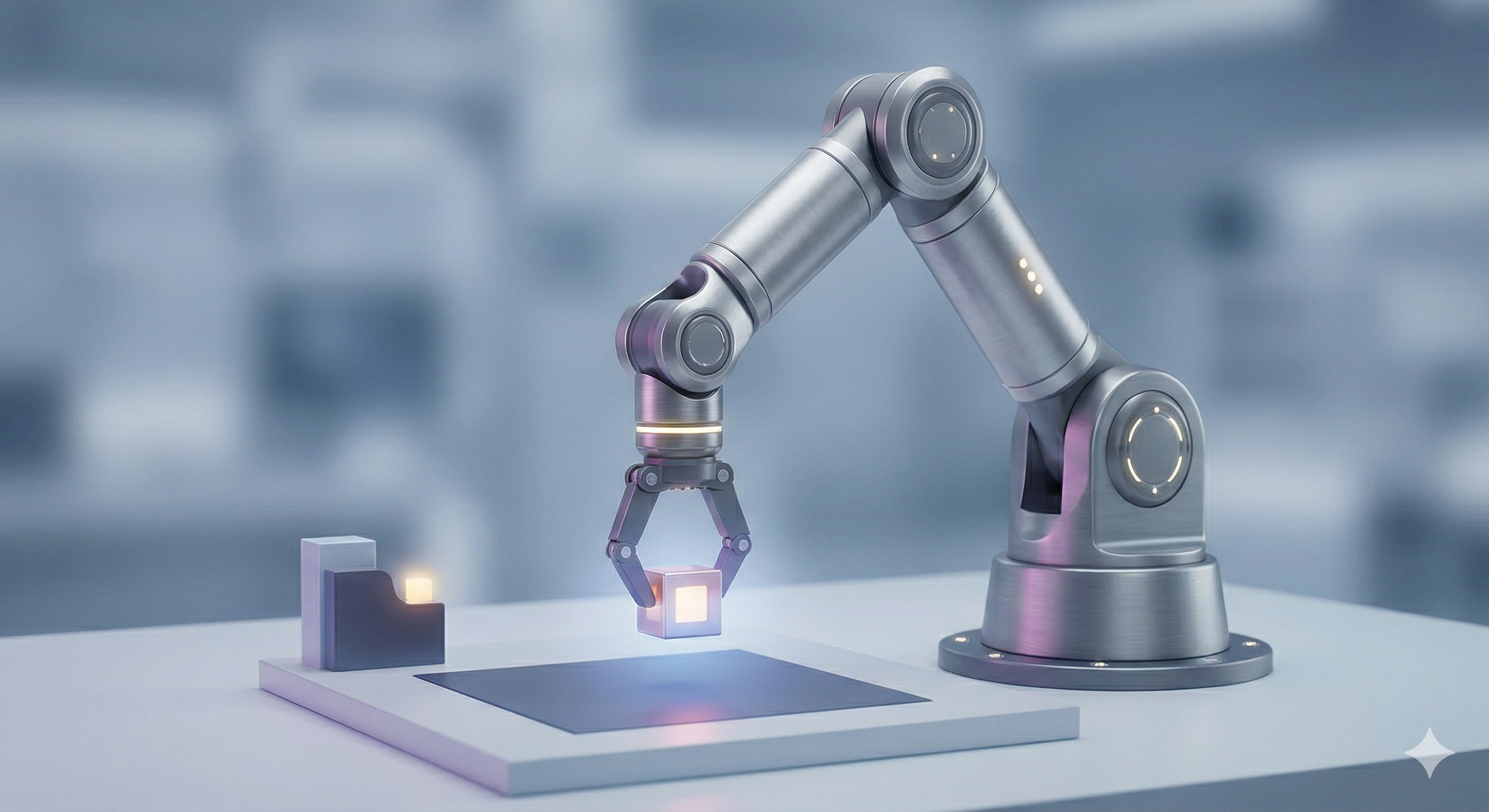
Let me lead with the conclusion: what sets the price of a humanoid is not its brain but its muscle.
Sapphire Ventures' Physical AI map gives hardware three boxes: sensors, actuators and components. The names look different from the other layers. Many are listed companies — Hesai, Ouster, Nabtesco, Moog — and startups are in the minority. Sapphire notes that actuator, sensor and compute costs have fallen by an order of magnitude, but also that onboard power budgets cap the size of model a robot can run in real time, and that hardware development cycles are long and capital-hungry.
Bank of America Institute's March 2026 report puts concrete numbers on the cost structure. Here is its projected 2030 breakdown.
| Part | Share of 2030 BOM | Role |
|---|---|---|
| Linear actuators | 27% | Extension in knees, ankles, elbows |
| Rotary actuators | 24% | Rotation in shoulders, hips, wrists |
| Dexterous hands | 19% | Grasping and manipulation |
| Control system | 10% | Compute and motion control |
| Vision and other sensors | 4% | Cameras, touch and more |
| Energy system | 4% | Battery and power |
| Other | 12% | Structure and the rest |
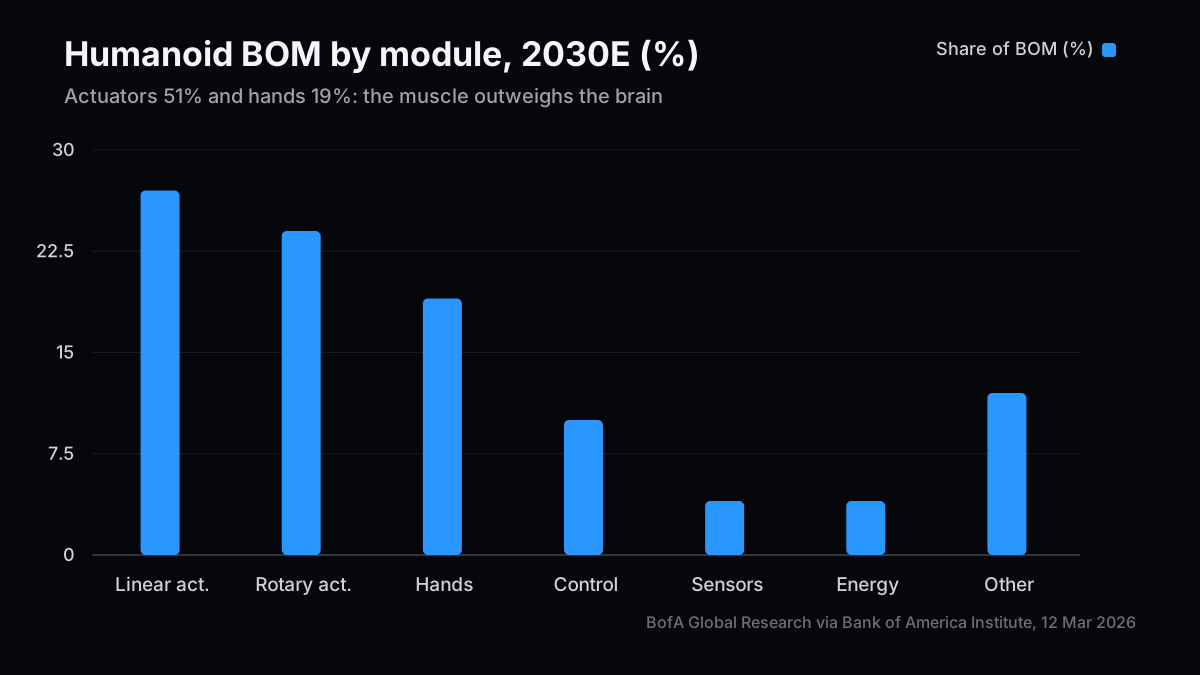
Actuators alone come to 51%. Add the hands and you reach 70% (my calculation). The control system — the "brain" from Part 2 — is just 10%. BofA estimates a China-built humanoid's BOM at about $35,000 in 2025 and expects it to roughly halve to about $17,000 by 2030. Pilot-stage units still cost $90,000 to $100,000 each.
The volume forecast is just as large. BofA expects annual humanoid shipments to grow from about 20,000 units in 2025 to 1.2 million in 2030 and 10 million in 2035 — an 86% compound annual growth rate from 2025 to 2035. Investment in humanoid development rose from $0.7 billion in 2018 to $4.3 billion in 2025.
| Year | BofA shipment forecast (thousand units) |
|---|---|
| 2025 | 20 |
| 2026E | 90 |
| 2028E | 500 |
| 2030E | 1,200 |
| 2035E | 10,000 |
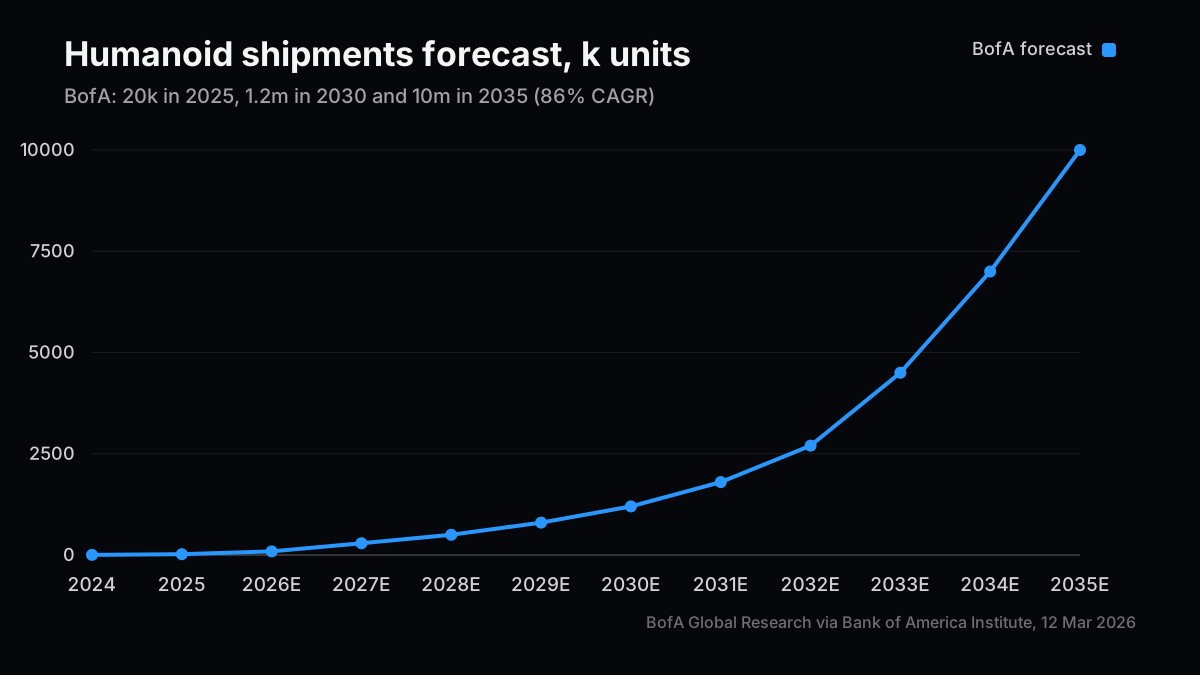
Honestly, I have not decided whether I believe this forecast. The 2026 figure of 90,000 units is 4.5 times 2025. But whichever number you pick, the weight of the muscle does not change.
Breaking Down the Hardware Bottlenecks
Listing the problems brought back several of my own old lessons.
When I built a new business around our power-management ICs and energy harvesters, I kept designing backward from the power ceiling — cutting features to fit the energy available. Robots work the same way. As Sapphire points out, the onboard power budget decides how large a model the robot can run. The battery is only 4% of BOM, but its constraint lands on every other part.
When I did structural analysis in ANSYS and Fusion 360, most of my time went into estimating the life of parts that carry heat and stress at the same time. A humanoid joint is exactly that kind of part, multiplied. Pack big torque into a small volume and the heat has nowhere to go.
Here are the bottlenecks that caught my attention. There turned out to be seven.
| Bottleneck | What it means | Why it binds | Companies on the map |
|---|---|---|---|
| Torque density and heat | Packing large forces into small joints | Trade-off between heat and lifetime | maxon, Kollmorgen, Moog, Westmag |
| Reducers | High torque, stiffness, minimal backlash | Precision machining at volume | Nabtesco |
| Dexterous hands | Degrees of freedom, durability, cost | Many parts, easily broken | Clone, Sanctuary AI, Wonik Robotics, Origami Robotics |
| Touch | Sensing force and slip at the fingertip | Miniaturization, wiring, noise | XELA, ATI Industrial Automation |
| Perception cost | Price and reliability of lidar and depth cameras | Needs automotive-scale volume | Hesai, Ouster, Aeva, Innoviz, RealSense |
| Power and thermal budget | Onboard power limits models and runtime | Battery energy density | (Cuts across parts) |
| Magnet supply | Rare-earth magnets in motors | Concentration in China | Westmag |
BofA's 19% for hands says a lot. Sapphire also covers the debate over five-fingered hands versus simple grippers. My view is that grippers are enough for many factory jobs. But if robots are headed into homes and restaurants, there is no getting around the hand.
The supply-chain problem comes with a concrete date. According to CSIS, China controls about 90% of global rare-earth separation and processing and about 93% of magnet manufacturing. On October 9, 2025, China announced controls requiring export licenses even for magnets containing 0.1% or more of Chinese-origin heavy rare earths. After the US–China summit on October 30, it suspended implementation for one year, until November 10, 2026 — about five weeks from now. The separate licensing regime on seven rare earths that began in April 2025 is not covered by that suspension.
Who Is Attacking the Problem: Muscle, Hands and Senses
What surprised me reading the map is that many hardware startups compete not on a part, but on how and where the part is made.
Muscle: Westmag, Nabtesco and the motor makers
Westmag (Western Magnetics Company) came out of stealth on June 2, 2026 with an $11 million seed led by a16z, with Founders Fund, Lux and Menlo participating. It builds drone motors and robot actuators in the US, at a headquarters and plant called "Factory 01" in South San Francisco. It runs design, winding and final validation on a single production platform and says it holds orders for hundreds of thousands of units. The backdrop is the US FCC's December 2025 ban on certifying new foreign-made drone motors. Its value is less a technology than a location.
In reducers, Japan's Nabtesco matters. It estimates its own global share at about 60% for the RV reducers used in the base, shoulder and elbow joints of medium and large industrial robots. Its cycloidal design is prized for stiffness and shock tolerance. How much of that design carries over to humanoids is still open. maxon (Switzerland), Kollmorgen and Moog are long-established makers of precision motors and drives, listed in the map's actuator box.
Hands: Clone, Sanctuary AI, Wonik Robotics, Origami Robotics
Clone Robotics has the boldest approach. It stretches water-pressure artificial muscles, called Myofiber, over a polymer skeleton with 206 bone analogues, driven by a 500-watt pump. As of March 2026, its CEO said it had raised about $17 million and was raising a $50 million round.
Sanctuary AI is best read as a lesson. Known for hydraulic hands with more than 20 degrees of freedom, it saw its founding CEO depart in November 2024 and in 2026 shifted toward selling AI software for existing industrial robots. The hands are now described as a product in development. It is a direct illustration of how long hardware cycles and fundraising pressure collide.
South Korea's Wonik Robotics makes the Allegro Hand, a standard research hand, and released new V5 and V6 versions in 2026. Origami Robotics is a young company that raised a $500,000 pre-seed from Y Combinator and others in March 2026. It builds infrastructure to capture human hand motion and replay it on robot hands — a position that straddles hand hardware and data.
Senses: XELA, Hesai, RealSense and others
XELA Robotics is a Japan-born tactile-sensor company. Its magnetic "uSkin" sensors measure three-axis force at the fingertip across a fine grid. In 2026 it shrank each sensing point from about 4 mm to 2.5 mm square and pushed integration into five-fingered hands; in April it took an investment from Plug and Play. For force sensing, the map also lists ATI Industrial Automation, part of Novanta and known for six-axis force/torque sensors.
In perception, listed companies give the clearest numbers. Hesai shipped 628,275 lidar units in Q2 2026, up 78.4% year on year, of which 142,371 went to robotics, up 193.4%. Its compact JT series, used in robot lawn mowers and similar machines, has passed 200,000 cumulative units.
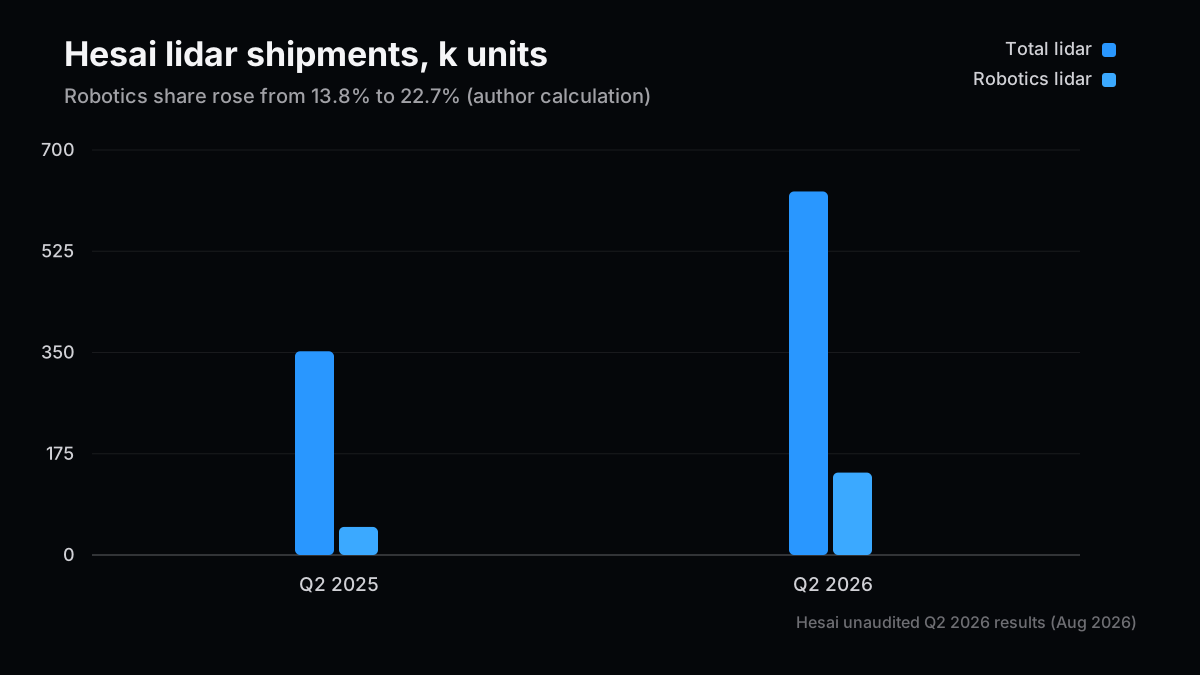
By my calculation, robotics rose from 13.8% of Hesai's shipments in Q2 2025 to 22.7% in Q2 2026. Lidar earned its scale economies in cars and is now flowing into robots. RealSense spun out of Intel in July 2025 with $50 million from Intel Capital and MediaTek, and claims its depth cameras sit in 60% of the world's AMRs and 80% of humanoids. Listed lidar makers Ouster, Aeva and Innoviz round out the box.
| Company | Category | Listing / funding | Product / approach |
|---|---|---|---|
| Westmag | Actuators | $11M seed (Jun 2026, led by a16z) | US-made drone motors and robot actuators |
| Nabtesco | Reducers | Listed in Tokyo (6268) | RV reducers; ~60% global share in medium/large robots (company estimate) |
| Clone Robotics | Hands / artificial muscle | ~$17M raised; raising $50M (as of Mar 2026) | Water-pressure Myofiber muscles |
| Sanctuary AI | Hands | ~$150M raised in total | Hydraulic hands; pivoted to software in 2026 |
| XELA Robotics | Touch | Investment from Plug and Play (Apr 2026) | Magnetic uSkin tactile sensors |
| Hesai | Lidar | Listed in the US (HSAI) | 142,000 robotics units shipped in Q2 2026 |
| RealSense | Depth cameras | $50M (Jul 2025) | Depth cameras; next product due to ship in Q1 2027 |
In my post on protection boundaries in 800V racks, I argued against putting component ratings and system tests in the same evidence column. Actuators deserve the same care. Catalog torque and lifetime are single-part numbers; the lifetime inside a humanoid, under heat and shock, has to be verified separately. For joint drive circuits, there is also discussion of using the GaN I covered in my 800V data-center post to shrink the electronics.
The Investment Call and Scenarios
The conclusion first: of the three layers, this is the easiest to access through listed stocks.
In March I wrote that I would pick up robot makers on a dip in 2027. For components, I now think they move before the finished robots. The winning robot maker is hard to call, but every winner has to buy actuators, reducers and sensors.
Concretely, I would hold listed precision-component makers medium-term long: Nabtesco in reducers; Harmonic Drive Systems (6324), which is not on Sapphire's map but works in the same space; and Hesai, whose robotics lidar is growing fast. But I stay short-term neutral. BofA's forecast of a halving BOM means falling component prices. Volume can grow while profits stall if prices fall fast enough.
Among startups, companies like Westmag that create value from where they manufacture have a policy tailwind. Hands and touch are the most technically interesting, but as Sanctuary AI's pivot shows, the biggest risk is whether the funding lasts.
| Scenario | Condition | Evidence to watch | Implication |
|---|---|---|---|
| Base | BOM falls as BofA expects, with China leading on volume | Chinese makers' shipments; actual BOM prices | Precision parts earn on volume while unit prices fall |
| Main | China-built robots drive prices down fast; non-China players move to high-value parts | Reducer and sensor pricing; non-China order books | Japanese precision suppliers squeezed between volume and price |
| Tail | China's magnet controls resume after November 10, delaying non-China production | Whether the suspension is extended; motor makers' sourcing | Tailwind for non-China magnet and motor makers; finished robots delayed |
What would change my mind: if non-China humanoids reach the same BOM level as Chinese ones by 2027, my "volume in China, profit in precision parts" view is wrong. In that case value has most likely shifted from components to the robot makers.
Watch Points
- Whether China extends its rare-earth suspension on November 10, 2026
- How high robotics climbs as a share of Hesai's shipments
- Whether Westmag's production ramps in line with its orders
- Clone Robotics' $50 million round, and what becomes of Sanctuary AI's hands
Across the three parts, one pattern stood out: value in physical AI is gathering in the brain, while the constraints on cash and mass production remain in the plumbing and the muscle. Next, I want to put all three layers in one table and decide where to place capital.
Related Posts
- Physical AI Series ①: The Startups Building the Data, Simulation and Ops Stack — The data and operations layer
- Physical AI Series ②: The Race to Build the Robot Brain — Foundation model strategies and valuations
- 800V in AI Data Centers: The Roles of GaN and SiC — Power semiconductor basics and the miniaturization angle
- Protecting 800V AI Racks — Keeping component ratings and system tests apart
- Buttons Without Holes — Reading a finger through metal with ultrasound, in AI glasses and foldables
References
- Sapphire Ventures: Physical AI: The Countdown to Robotics' ChatGPT Moment (Aug 27, 2026)
- Bank of America Institute: Physical AI, part 2: Humanoid robots (Mar 12, 2026)
- Hesai: Second Quarter 2026 Results
- CSIS: China's New Rare Earth and Magnet Restrictions (Oct 9, 2025)
- Westmag: $11M seed led by a16z (Jun 2026)
- Carta: State of Private Markets: Q1 2026
Next Issue Ideas
- Idea 1: A capital-allocation table for physical AI's three layers — Put every company from this series into "plumbing, brain, muscle" and lay out listed and private exposure in a single table.
- Idea 2: Reading the November 10 rare-earth deadline — How an extension or a resumption would change 2027 production plans for motor, magnet and humanoid makers.
- Idea 3: Harmonic versus RV reducers in humanoids — Split joint-by-joint requirements and compare order books and valuations among Japan's precision-component makers.
This article is for informational purposes only and is not investment advice or a recommendation to buy or sell any security. The author may hold securities of companies mentioned. Generative AI was used in parts of the research, writing and translation. Market forecasts are third-party projections, and summed shares and ratios are the author's calculations. See the disclaimer for details.