The Warsh Shock — Part 1: How Jackson Hole Rewired the Rate and Dollar-Yen Outlook
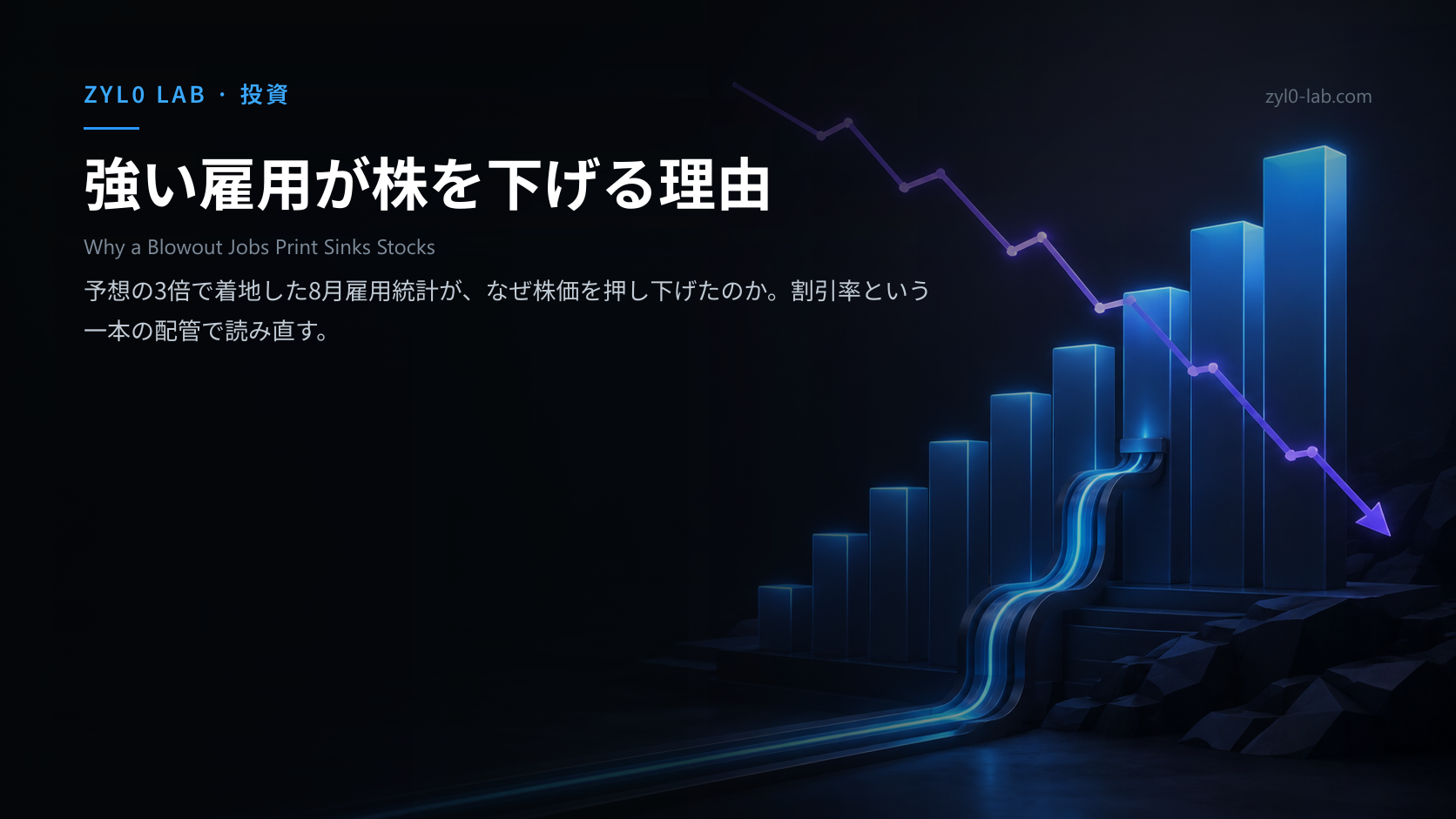
On his 100th day as Fed Chair, Kevin Warsh used Jackson Hole to flag inflation concern, pushing September hike odds from about 35% to near 60%. Part 1 reads the dollar-yen positioning risk hiding behind a narrowing rate gap.
On his 100th day as Fed Chair, Kevin Warsh used Jackson Hole to flag inflation concern, pushing September hike odds from about 35% to near 60%. Part 1 reads the dollar-yen positioning risk hiding behind a narrowing rate gap.


The Warsh Shock — Part 1: How Jackson Hole Rewired the Rate and Dollar-Yen Outlook
Over the last two pieces I worked through six months of the Iran conflict and landed on concrete plays in tanker stocks and marine war-risk insurance. But something kept nagging at me after I finished Part 2 of that series: both articles quietly assumed rates would keep drifting along roughly where they already were. Reading Kevin Warsh's August 28 Jackson Hole speech, I think that assumption itself is now worth questioning. This time the subject isn't oil or geopolitics — it's the rate backdrop that discounts every position in a portfolio, and the dollar-yen picture that flows from it.
Day 100, and Warsh Chose Discipline Over Silence
Kevin Warsh, who served on the Fed's Board of Governors from 2006 to 2011, was nominated by President Trump as the next Fed Chair on January 30, 2026. The Senate confirmation vote came in at 54-45 — reportedly the most partisan Fed Chair confirmation vote in history. He was confirmed on May 13 and sworn in on May 22, taking over monetary policy from outgoing Chair Jerome Powell.
His keynote at the Jackson Hole Economic Policy Symposium on August 28 landed exactly 100 days into his term. What struck me first was how deliberately he avoided previewing the next meeting or laying out a clear reaction function. He said, "I stand here today committed to a discipline, not to a decision," and went further: "We should not indulge a regime in which market participants are looking primarily to the Fed for their next trade." That's about as close as a sitting chair gets to declaring, on day 100, that he doesn't intend to lean on forward guidance.
His read on inflation was more pointed than I expected. PCE inflation is running at 3.7% year over year, and Warsh called that "concerning." He allowed that the summer's inflation prints came in better than forecast, while insisting the underlying trend hasn't meaningfully improved.
The market reaction was fast enough that I barely had time to brace for it. Here's the scoreboard.
| Indicator | Before the speech | After the speech | Change |
|---|---|---|---|
| 2-year Treasury yield | — | 4.31% | +8bp |
| 10-year Treasury yield | — | 4.72% | +4bp |
| 30-year Treasury yield | — | 5.21% | +2bp |
| Dollar index (DXY) | — | 99.66 | +0.6% |
| September hike odds priced (CME) | ~35% | ~57-60% | +22-25pt |
Watching September hike odds jump from 35% to nearly 60% in a single session is a genuinely large move by my own read. Going into the speech, markets had all but priced in "another hold" as the base case, so this rattled that assumption at the root. Equities sold off the same day — the textbook reaction to a hawkish surprise.
The Countdown to September: What Changed After Five Straight Holds
The Fed funds target sits at 3.50-3.75% today, held for a fifth consecutive meeting at the July 29 FOMC. The next meeting is September 15-16, and it's one of the quarterly meetings that comes with an updated Summary of Economic Projections and dot plot — in other words, Warsh's first real opportunity to put numbers behind the word "discipline."
Worth pausing here for a 2024 comparison. Back when the yen carry trade was at its most crowded, in mid-2024, the Fed funds rate sat at 5.25-5.50% against a Bank of Japan rate of 0-0.1% — a 5.15-5.25 point gap. As of August 2026, that's Fed 3.50-3.75% against BOJ 1.00%, a gap that has compressed to roughly 2.50-2.75 points.
| Point in time | Fed funds upper bound | BOJ policy rate | US-Japan differential |
|---|---|---|---|
| Mid-2024 (peak carry-trade crowding) | 5.50% | 0.10% | 5.15-5.25pt |
| August 2026 (now) | 3.75% | 1.00% | 2.50-2.75pt |
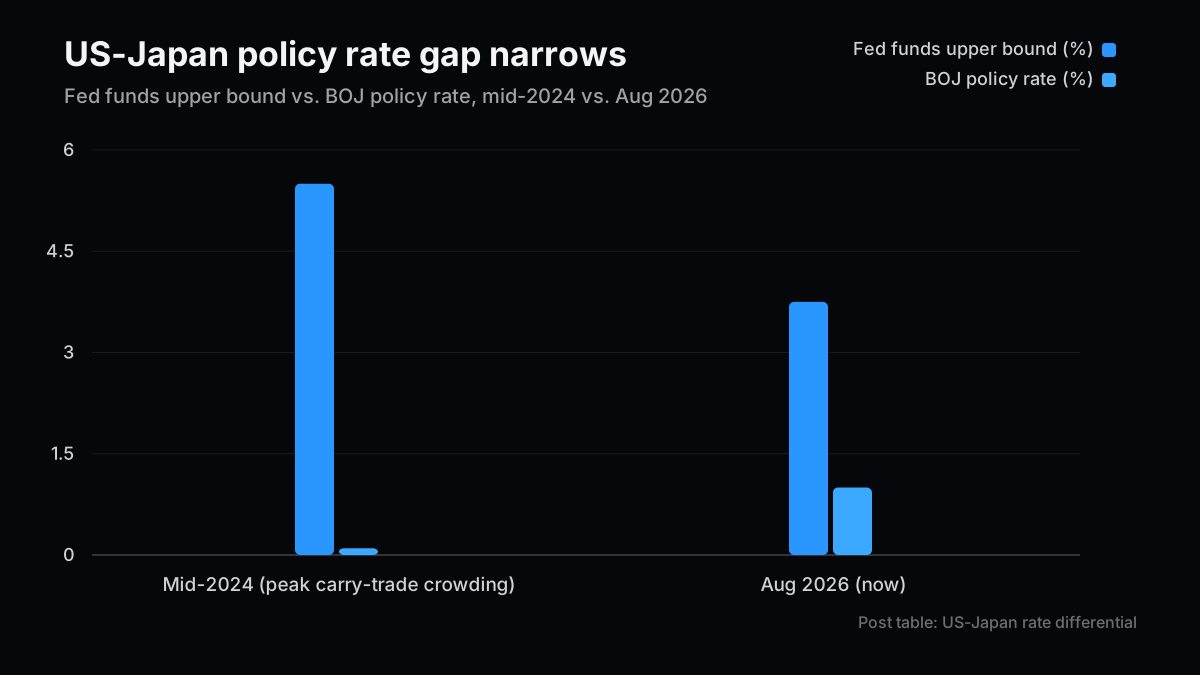
Taken at face value, this reads as "the gap has narrowed, so the yen should find buyers more easily." But — and this is worth stressing — if Warsh's speech does end up pushing the Fed toward a September hike, that narrowed gap swings back the other way. The BOJ is widely expected to deliver one more hike this year, to 1.25% (the July meeting held at 1.00% on an 8-1 vote, with board member Hajime Takata dissenting in favor of 1.25%), but a Fed hike could easily outrun the BOJ's own tightening pace. The direction of the rate gap, I'd argue, is a harder variable to read than its level.
A Narrower Rate Gap, a Dollar-Yen That Still Isn't Settled
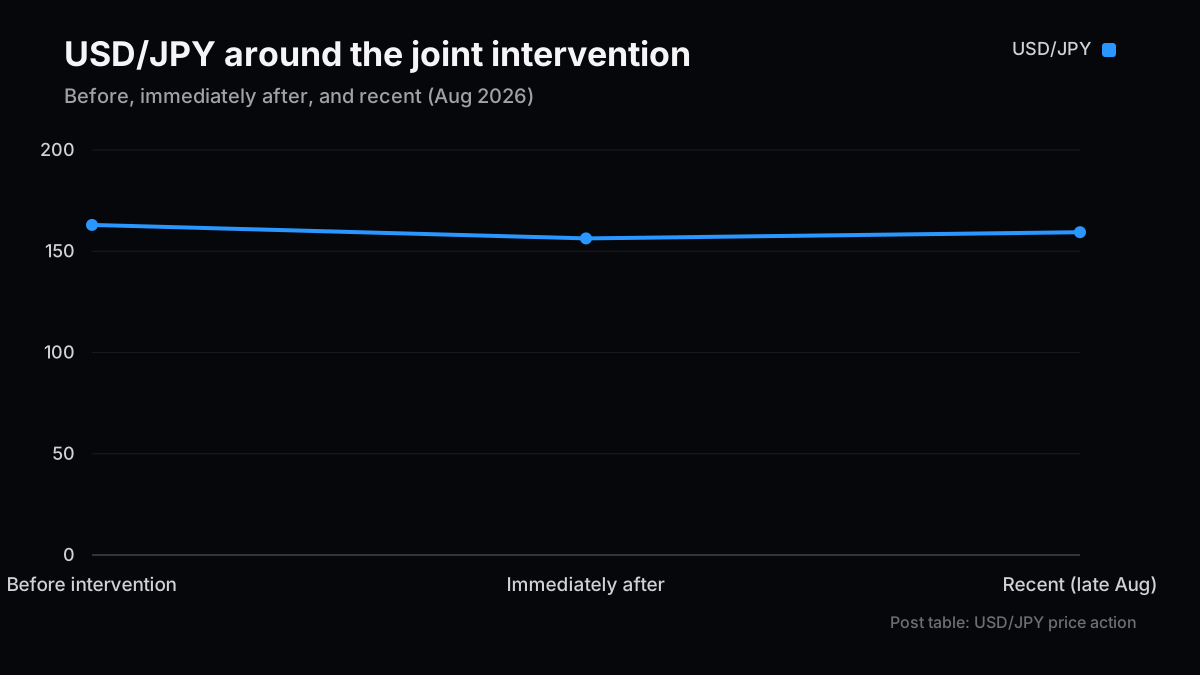
Looking back at dollar-yen price action, the single biggest event of the past six months was the joint US-Japan intervention. Before it, dollar-yen had sold off to the 163 handle — a genuine 40-year high. Right after both governments confirmed the coordinated intervention, it dropped sharply to the 156 handle, and has since climbed back to around 159 by late August.
| Point in time | USD/JPY | Context |
|---|---|---|
| Before the joint intervention | 163 handle | A genuine 40-year high |
| Immediately after | 156.34 | US and Japan officially confirm intervention |
| Recent (late August) | ~159.4 | A partial rebound off the intervention low |
Behind that price action sits a real shift in CFTC positioning. Speculative net-short yen positions stood at roughly 138,000 contracts at the end of June, and shrank to about 59,500 by August 11 on intervention risk. That's a drop of more than half, and honestly, it's a large enough move that I'd call the intervention effective.
But here's where the real story starts. Shorts shrinking doesn't mean shorts are gone. Positioning had built up to record levels earlier in the year, and there's clearly room left to rebuild. I keep coming back to the July-August 2024 carry-trade unwind — dollar-yen collapsed from 162 to the 140s in a matter of weeks — and my honest read is that a thin positioning backdrop is often harder to forecast than a crowded one, not easier. I structured a portfolio company's dollar-denominated financing plan while posted in North America, and the lesson that stuck was that FX P&L doesn't get quieter just because positioning looks thin.
Here are the two directional scenarios I'm weighing for dollar-yen specifically:
- Rate-gap re-widening: if the Fed hikes in September while the BOJ stays on hold, the gap that just narrowed reopens. Yen shorts would likely rebuild, putting the upper-160s back in play.
- BOJ hike plus intervention caution: if the BOJ delivers its 1.25% hike this year while lingering intervention risk keeps speculative funds from rebuilding shorts too aggressively, the thin-positioning setup stays vulnerable to a squeeze.
Which one plays out depends heavily on the September FOMC outcome. Rather than a single directional call, I think the practical approach here is tracking two axes — how crowded positioning is, and which way the rate gap is moving. Rising rates generally also weigh on rate-sensitive sectors — high dividend payers, REITs, small caps — but that thread connects directly to Part 2's tech-capex theme, so I'll leave it there for now.
Scenarios and What Would Change My Mind
Pulling this together into a base/main/tail framework:
| Scenario | September FOMC | USD/JPY | Implication |
|---|---|---|---|
| Base: another hold | Held at 3.50-3.75% | 155-160 range | Rate-gap direction unchanged; positioning drifts back |
| Main: a hike | 25bp hike to 3.75-4.00% | Back up to 160-165 | Yen shorts rebuild; intervention risk resurfaces |
| Tail: BOJ moves first, Fed stays put | Fed holds, but the BOJ hikes to 1.25% | Break below 150 possible | A squeeze against thin positioning |
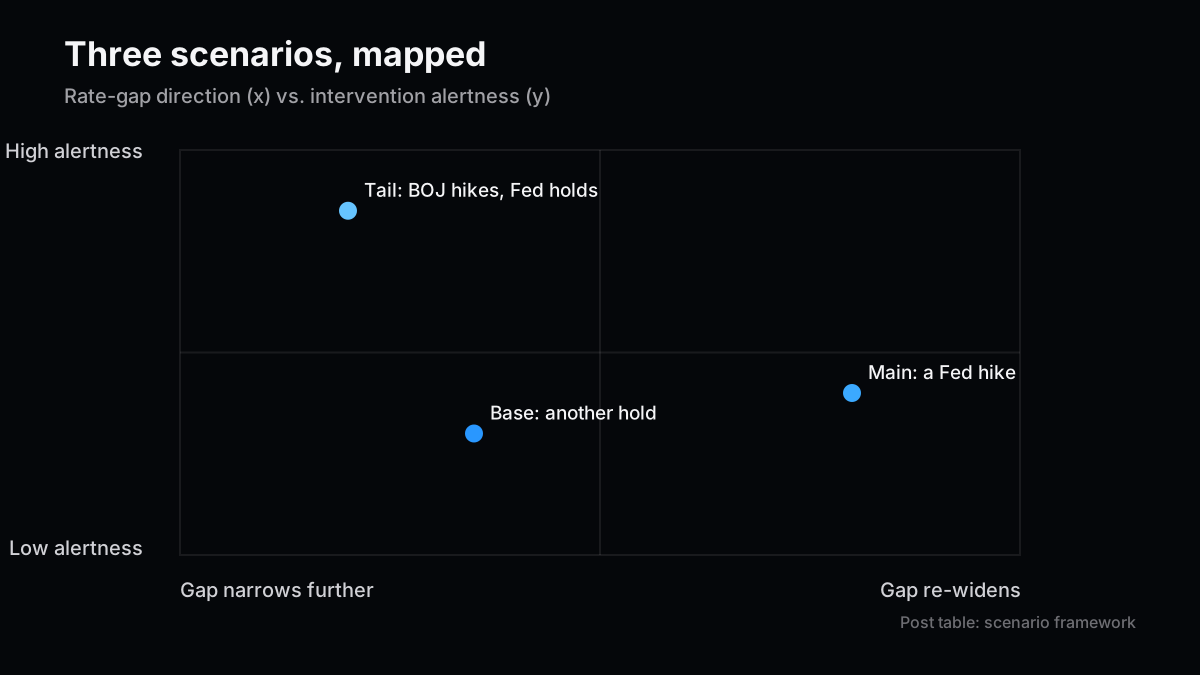
My own take: given that Warsh deliberately chose the word "discipline," I don't think he forces a hike through in September purely on optics — if anything, I'd lean slightly toward another hold rather than a coin flip. But here's the condition that would change my mind: if September's core PCE accelerates above 3.5% year over year, the hold scenario loses ground fast and the odds of a hike rise materially.
The next question is where this rate pressure actually lands in the real economy. In Part 2, I'll dig into whether the roughly $725 billion in combined 2026 capex from the four hyperscalers can hold up under a higher-rate environment.
Next Issue Ideas
- Idea 1: How Far Rate Risk Reaches Into Tech Capex (Part 2) — Building on this piece's rate scenarios, a look at how Microsoft, Amazon, Alphabet, and Meta fund their buildouts, and what would actually trigger a capex slowdown.
- Idea 2: Grading the September FOMC — Checking the actual hike decision and the SEP/dot plot against this article's base/main/tail scenarios.
- Idea 3: Revisiting the yen carry unwind — Tracking monthly CFTC positioning updates against the July-August 2024 unwind as a comparison case.
Related Posts
- US Stock Market Outlook: Iran-US Tensions — Flagged dollar-yen as a risk-off indicator before the war started; this piece's positioning analysis extends that thread.
- Iran War Sparks a Reversal in Coal Stocks — An earlier articulation of the "higher for longer" rate view.
- The Warsh Shock — Part 2: How Far Rate Risk Reaches Into Tech Capex — Part 2, tracing this piece's rate scenarios through to capex spending.
- Tightening by Pressure: Bessent, a Firmer Yen, and the Choice Facing Japanese Equities — The Japan-side counterpart to this piece's US rate story.
References
The factual and numerical assumptions in this article are anchored to primary or public materials readers can verify.
- Keynote remarks by Chairman Warsh at the 2026 Jackson Hole Economic Policy Symposium (Federal Reserve Board, official)
- Kevin Warsh confirmed as Fed chair, succeeding Jerome Powell (CNN Business)
- Federal Funds Target Range - Upper Limit (FRED, St. Louis Fed)
- CFTC Data Show Speculators Extend Yen Net Shorts as Carry Trade Crowding Intensifies (VT Markets)
- U.S.-Japan yen intervention, Bank of Japan: carry trade (CNBC)
This article is for informational purposes only and does not constitute investment advice or a recommendation of any specific security, currency pair, or trade structure. The author may hold positions or interests related to the asset classes discussed. Generative AI was used for parts of research, translation, and proofreading, with final review by ZYL0. See the disclaimer for details.