Buttons Without Holes: Input Design for Metal-Frame AI Glasses and Ultra-Thin Foldables
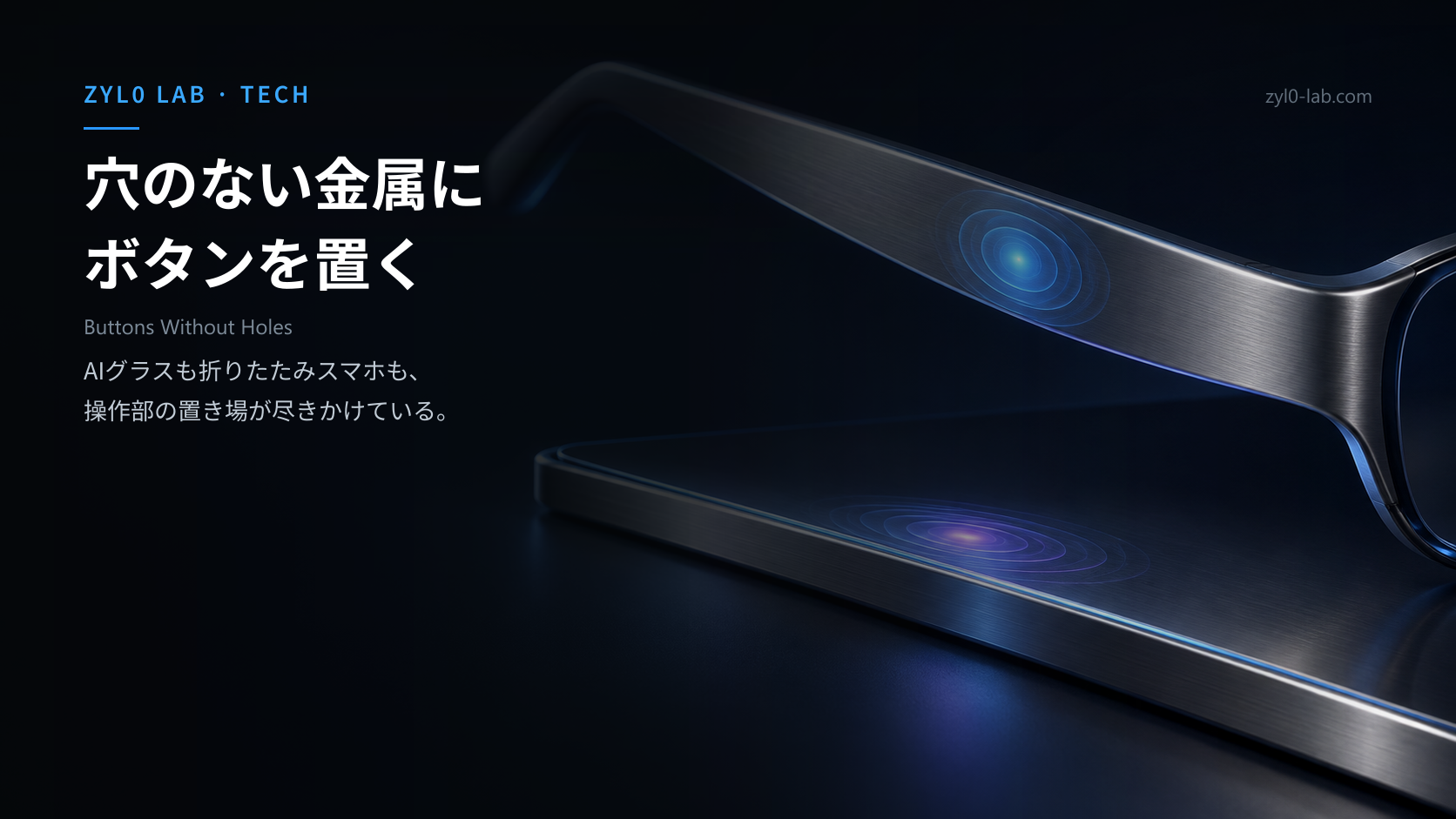
Metal-frame AI glasses and foldables that are about 4 mm thick when open are running out of room for buttons. This post maps current designs and their problems, then compares capacitive, inductive, strain, piezo and ultrasound sensing by whether they work through solid metal.
Metal-frame AI glasses and foldables that are about 4 mm thick when open are running out of room for buttons. This post maps current designs and their problems, then compares capacitive, inductive, strain, piezo and ultrasound sensing by whether they work through solid metal.


Buttons Without Holes: Input Design for Metal-Frame AI Glasses and Ultra-Thin Foldables
This is an outside-in read based solely on public information. No company interviews or non-public materials were used. Performance figures are manufacturer claims unless noted otherwise.
The iPhone Duo goes on sale on October 23, and it is 5.2 mm thick when open. Apple calls it the thinnest iPhone ever. Three months earlier, Samsung shipped the Galaxy Z Fold8 Ultra at 4.1 mm unfolded, and back in March Honor had already put the Magic V6 out at 4.0 mm. On the eyewear side, Even Realities got its G2 down to 36 g on a titanium and magnesium frame.
Read only the spec sheets and this looks like steady progress. What caught my attention was something else. On an enclosure this thin and this metallic, where is a finger supposed to go?
Back when I ran structural simulations, I kept seeing the same picture: punch a hole in a thin plate and the stress piles up around its edge. For a round hole in a wide plate, the textbook answer is roughly three times the nominal stress. A button opening is a weak point in a thin frame before you even add the waterproof seal and the stack of parts behind it.
In my last post on 800 VDC certification gates, I separated component certification from permission to run a facility. Before that, in the piece on advanced-substrate ramps, I split technology demos from production evidence. Buttons without holes need the same discipline. A sensor announcement and a production win inside a thin metal phone are different events. When I worked on bringing automotive parts into volume production, passing component qualification was where the real work started, not where it ended. That memory stayed with me through this whole piece.
The plan: first the current product designs and their problems, then five ways to read a finger without cutting the metal, and finally the companies and scenarios.
Where metal-frame glasses have been hiding their controls
The short version: metal-frame AI glasses have been pushing their controls onto whatever part of the frame is not metal.
The reason is simple. A capacitive touch sensor, the same kind used in phone screens, reads changes in the electric field between a finger and an electrode. Put metal in between and the field is blocked, so the finger disappears. Anywhere you want touch input has to be plastic, or you have to cut an opening and fill it with a plastic or glass window.
Here are the main products I could check against public information.
| Product | Announced | Frame | Weight | Where the controls are | Visible trade-off |
|---|---|---|---|---|---|
| Even Realities G1 | 2024 | Magnesium alloy front, titanium alloy temples | 44 g | TouchBar at the temple tips behind the ears | The bulging tips give it away, and you reach behind your ear to use them |
| Even Realities G2 | 2025 | Titanium and magnesium alloy | 36 g | TouchPads on both temples (tap, double tap, hold, scroll) | Temples are 53% thinner than G1, but electronics still sit in small end pods |
| Meta Ray-Ban Display | Sep 2025 | Injection-molded plastic, titanium hinges | 69 g | Touchpad and button on the right temple, plus an EMG wristband | The main input moved to the wrist. The band weighs 42 g; the set is $799 |
| Samsung smart glasses | Jul 2026 | Not disclosed (Gentle Monster and Warby Parker designs) | Not disclosed | Touch on the frame; gestures only through a Galaxy Watch9 | I could not find a price or ship date when I checked |
| Even Realities R1 (ring) | 2025 | Stainless steel with a zirconia ceramic coating | — | The ring itself is a controller for the G2 | Sold separately at $249; it moves glasses input to the finger |
What stands out is that the products aimed at mass retail lean toward plastic frames, and the ones that commit to metal struggle to find a home for the controls. Even's G1 packed the battery, antenna and TouchBar into the tips behind the ears. The G2 shrank those tips, but they are still there.
The other trend is to move input off the frame entirely. Meta bundles an EMG wristband that reads finger movement at the wrist. Even sells a ring, and Samsung hands gestures to the watch. If you cannot put controls on the frame, put them on another device.
That only works if people are willing to wear a second device, though. For anyone who wants the glasses to stand alone, it is a detour.
Metal is not just about looks, either. Waveguide displays shift their image when the frame flexes even slightly, and titanium or magnesium is what lets a thin temple stay stiff. Rings are heading the same way, with titanium and ceramic shells becoming the default. The material requirements and the sensor's needs are pulling in opposite directions.
Four millimeters open: what is left on a foldable's edge
Phones give us harder numbers than glasses do.
A foldable stacks two slabs when closed and becomes a single slab when open. The power key (usually with the fingerprint sensor built in) and the volume keys sit on the edge of one of those halves. So the height available for a button is set, more or less, by the unfolded thickness.
| Model | Announced | Unfolded | Folded | Weight |
|---|---|---|---|---|
| Honor Magic V6 | Mar 2026 | 4.0 mm | 8.75 mm | 219 g |
| Galaxy Z Fold8 Ultra | Jul 2026 | 4.1 mm | 8.9 mm | 215 g |
| Galaxy Z Fold7 | Jul 2025 | 4.2 mm | 8.9 mm | 215 g |
| Galaxy Z Fold8 | Jul 2026 | 4.5 mm | 9.7 mm | 201 g |
| iPhone Duo | Sep 2026 | 5.2 mm | 11.3 mm | 254 g |
| Reference: iPhone Air | Sep 2025 | 5.64 mm (one slab) | — | 165 g |
Plotted side by side, the gap is easy to see.
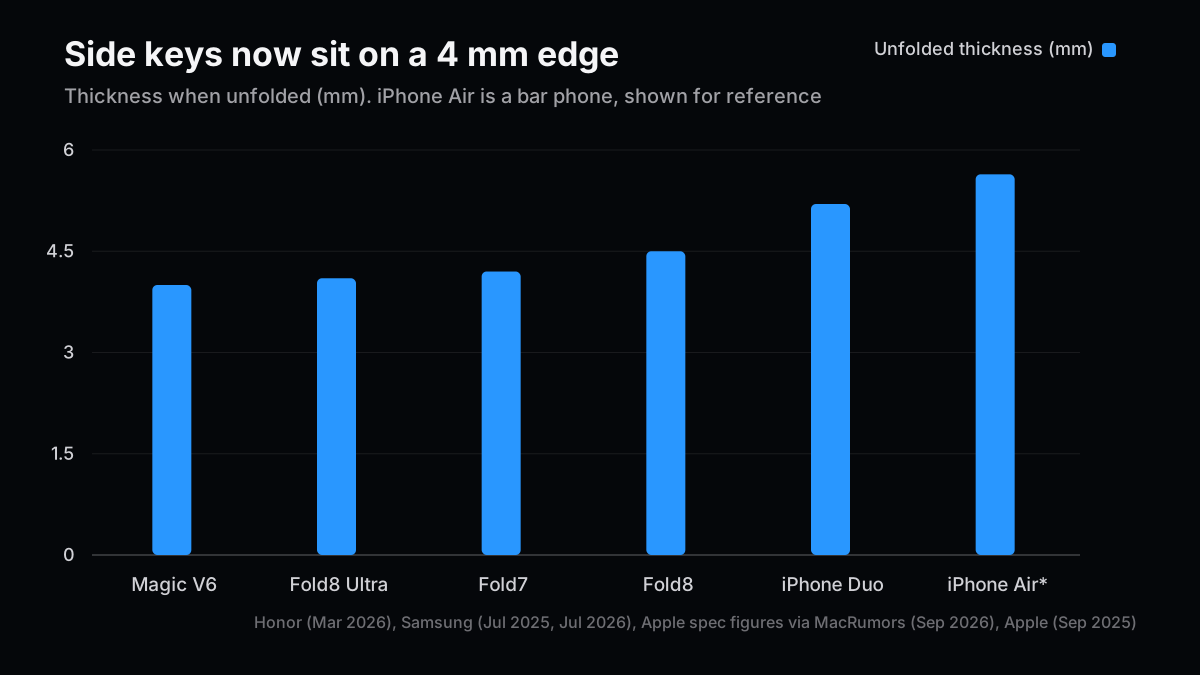
That 4 mm includes the display panel, the cover glass and the frame wall. The height left for a button is smaller still. A mechanical button is a vertical stack: keycap, switch, waterproof seal and the ledge in the frame that holds it all. My read is that 4.1 mm is already close to the floor for a conventional key.
Actually, the tighter limit may be the number of holes rather than the height. Every opening for power, volume up and volume down in a thin titanium or aluminum rail adds another stiffness problem and another sealing step. Apple says the iPhone Duo's Grade 5 titanium frame uses antenna splits with ceramic fiber inserts and internal support ribs. The cuts in that frame clearly took real engineering effort.
What Camera Control showed about the cost of cutting a window
The biggest example of cutting a window in a metal frame to add touch is Camera Control, which arrived with the iPhone 16.
By Apple's description, the surface is sapphire crystal ringed by stainless steel trim. Under the sapphire sit a multi-pixel capacitive sensor and a signal processor, and below those a tactile switch for the click plus a force sensor that works with the Taptic Engine. Apple says the sapphire height is set individually on each unit and then micro-welded in place.
That gave users press, light press and swipe. The price was a lot of parts and a lot of process steps.
In daily use, reports of accidental triggers in pockets and bags piled up. With iOS 18.2 Apple added an option to make the control respond only when the screen is on, alongside settings for double-click launch and for turning off light press and swipe. Software can cut down the mistakes. But this sensor stack has little ability, at the sensing stage, to tell fabric pressure from a finger.
The iPhone 18 Pro, released in September 2026, kept both press and swipe. For the standard iPhone 18, expected in spring 2027, reports say Apple will drop the capacitive layer and rely on pressure alone. That answers both cost and false triggers, but it also gives up the swipe.
Which leaves an obvious question: is there a way to keep the swipe without cutting a hole?
Five ways to read a finger through metal
This is the core of the piece, and the comparison table below is where I spent the most time.
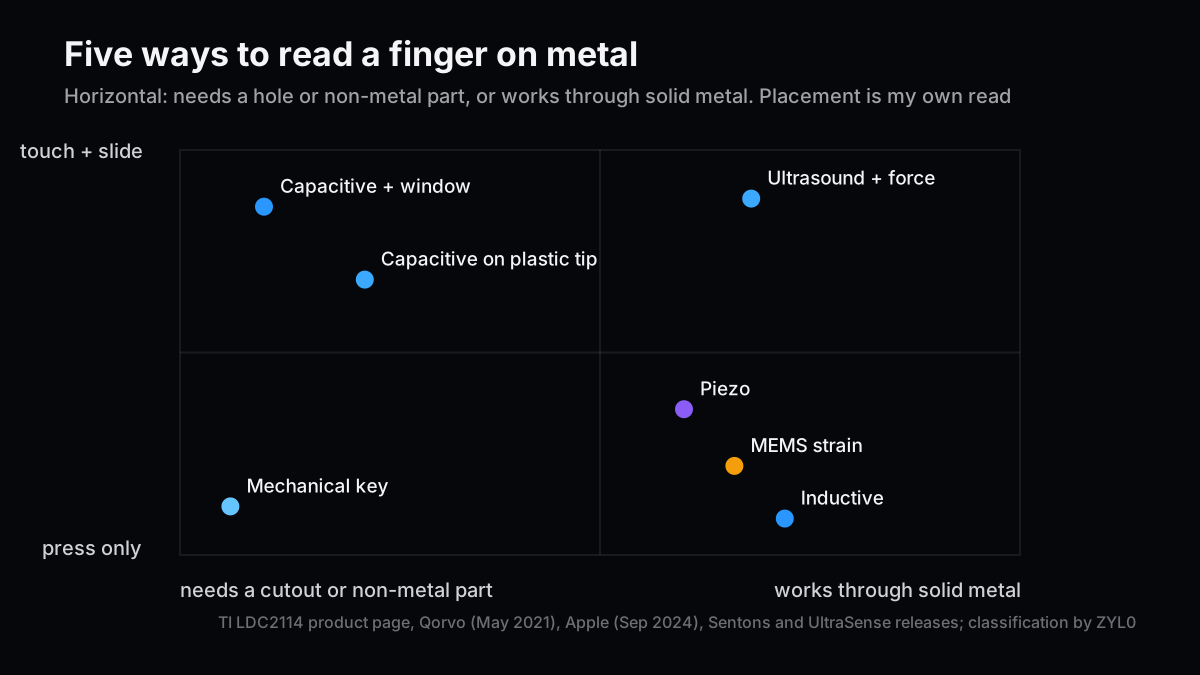
There are five broad ways to pick up input on a metal surface: capacitive sensing behind a window, inductive sensing, MEMS strain gauges, piezoelectric sensing, and ultrasound combined with force sensing.
| Approach | Example companies and parts | Hole in metal | Light touch | Slide | Press | Main weakness |
|---|---|---|---|---|---|---|
| Capacitive + window | Apple Camera Control | Required | Yes | Yes | Yes (with a force sensor) | Many parts and steps; false triggers through fabric |
| Inductive | Texas Instruments LDC2114 | Not needed | No | No | Yes | Needs room for the metal to flex, plus coil area |
| MEMS strain gauge | Qorvo (bought NextInput in 2021) | Not needed | No | No | Yes | Temperature drift and frame twist must be compensated |
| Piezoelectric | Various element makers | Not needed | No | Partly | Partly (best at sudden changes) | Hard to detect a sustained hold |
| Ultrasound + force | Sentons, UltraSense Systems | Not needed | Yes | Yes | Yes | Volume track record is mostly cars and gaming phones |
On paper, only the ultrasound-plus-force approach covers touch, slide and press without a hole. That is a statement about physics, though. How much each approach has proven in volume production is a separate question.
On a simple map, only one approach lands in the top-right corner.
Inductive, strain and piezo: they feel a push, not a touch
Inductive sensing puts a coil behind the metal and reads the change in inductance when a press moves the metal closer. TI says its LDC2114 reliably detects deflections of less than 200 nm, and it ignores oil, dirt and humidity, which is a real strength.
Its current draw is 6 µA for one button at 0.625 samples per second and 72 µA for two buttons at 20 samples per second. Do the arithmetic and 0.625 SPS means one reading every 1.6 seconds, far too slow for a button. At 20 SPS the interval drops to 50 ms, which is usable, but the current goes up twelvefold. Low power and fast response do not come together for free.
The deeper limit is that nothing happens unless the metal bends. A light touch or a slide leaves the inductance unchanged.
MEMS strain gauges follow the same pattern. They are very sensitive to pressing force and blind to anything that does not load the frame. According to Qorvo, NextInput had shipped tens of millions of sensors into phones, wearables and cars by the time of the acquisition. The track record is real, but the coverage stops at pressing.
Ultrasound: listening to sound bounce inside the metal
Ultrasound flips the idea around. Instead of moving the metal, it sends sound through it.
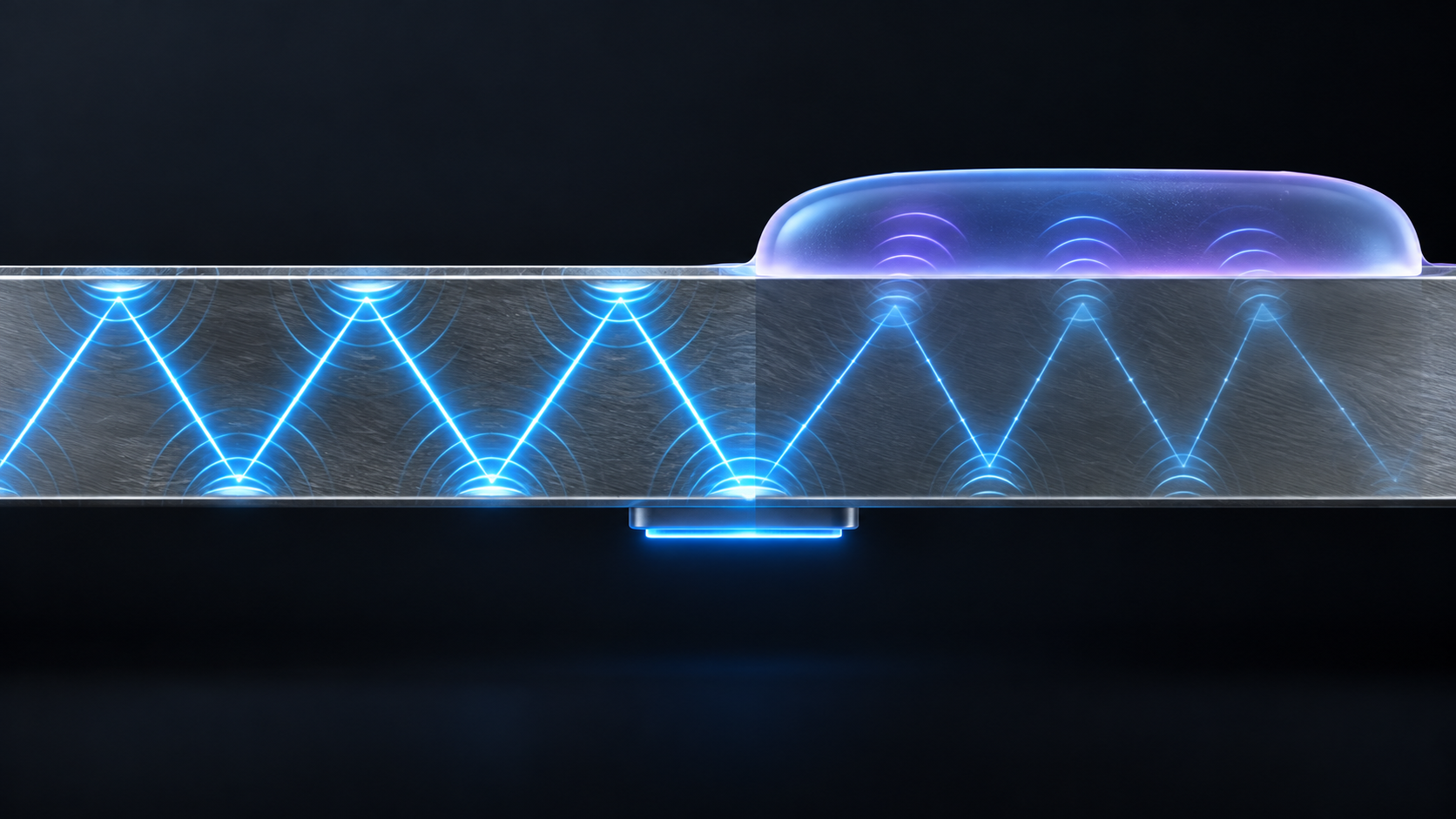
A small transducer is bonded to the inside of the metal and fires high-frequency pulses. Each pulse travels through the metal, reflects off the outer surface and comes back. When the outside surface is touching air, almost all of it bounces back. When a finger is on the surface, some of the energy leaks into the finger and the returning echo gets weaker. The sensor reads that difference.
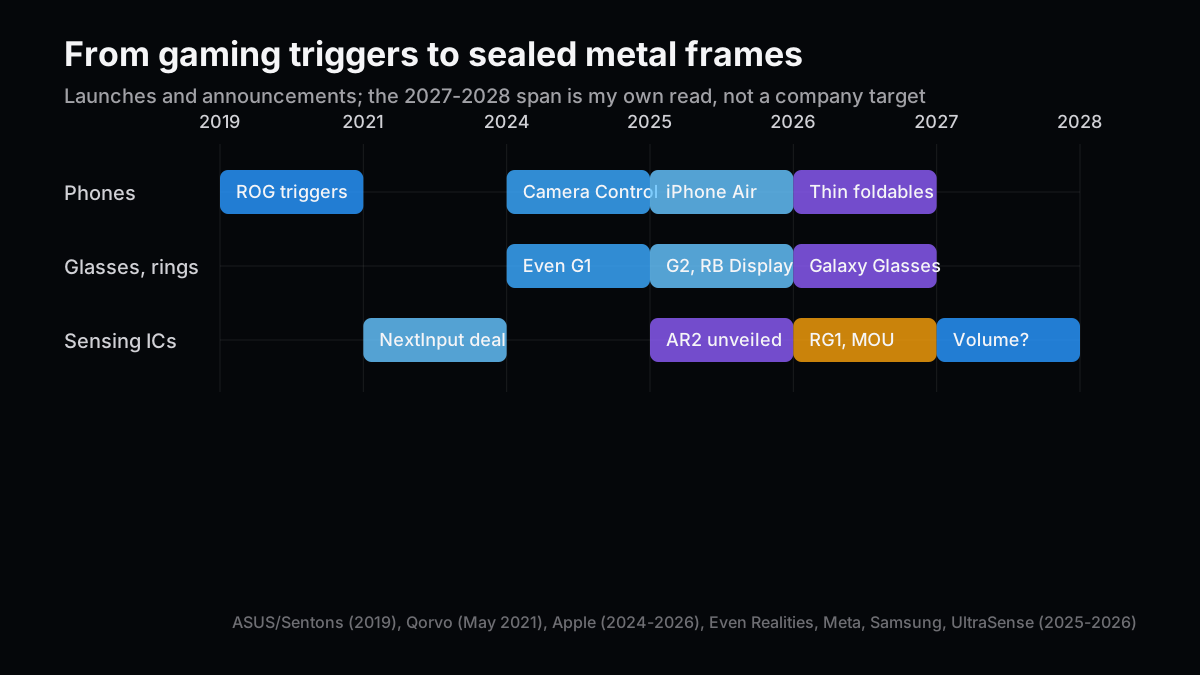
As far as I can tell, the first mass-market product to show this was Sentons' AirTrigger in the ASUS ROG Phone 2 in 2019, where ultrasonic sensors on the side stood in for a game controller's shoulder buttons. Sentons pairs ultrasonic touch detection with strain-gauge force sensing.
UltraSense Systems integrates a PMUT (piezoelectric micromachined ultrasonic transducer), signal-processing circuitry and a microcontroller on a single chip. In January 2026 it said it had shipped more than 3 million units of its AEC-Q100 qualified automotive controller. Its UltraTouch AR2 for AI glasses is pitched as working on magnesium, titanium and plastic frames, and the CEO had said production would come in the second half of 2026. In February it launched UltraTouch RG1 for metal and ceramic rings, and on September 21 it signed a memorandum of understanding with Korean component maker Partron covering AI wearables and smartphones.
The MOU is a framework for joint development and production support, not a binding order. On the evidence ladder I used in the advanced-substrate piece, it sits roughly on the second rung from the bottom.
I ran the numbers: the metal changes how a finger looks
At this point I did a small calculation of my own.
How much ultrasound reflects at a boundary depends on the difference in acoustic impedance (density times sound speed) on each side. Using a simple normal-incidence model, I worked out how much energy leaves the metal into a finger (soft tissue, 1.63 MRayl) or into water (1.48 MRayl) for a few common frame materials.
| Metal | Acoustic impedance (MRayl) | Energy into a finger | Energy into water | Echo left after 3 reflections (finger) |
|---|---|---|---|---|
| Stainless steel | 45.7 | 13.3% | 12.2% | 65% |
| Titanium | 27.3 | 21.3% | 19.5% | 49% |
| Aluminum | 17.3 | 31.5% | 29.0% | 32% |
| Magnesium | 10.0 | 48.2% | 44.9% | 14% |
The formula is transmitted share = 4 × Z1 × Z2 ÷ (Z1 + Z2)². Against air, every one of these metals reflects more than 99.99%. The model ignores the bonding layer, angled incidence and shear waves.
Two things surprised me.
The first is how much the material matters. With stainless steel, a finger pulls only 13% of the energy out per reflection. With magnesium it pulls 48%. Even's choice of magnesium for the G2's front happens to be a friendly one for ultrasound, while a stainless frame is on the hard side.
The second is how little separates a finger from water. On titanium the numbers are 21.3% versus 19.5%. My conclusion from the arithmetic is that echo strength alone cannot reliably tell sweat or a water droplet from a finger. Vendors say they can distinguish the two, so that discrimination must come from combining echo strength with contact area, how the signal changes over time and the force channel. I would not take a spec sheet's "no false triggers" at face value.
Dry fabric, on the other hand, is mostly trapped air, so cloth pressing on the frame barely weakens the echo. Against the in-pocket triggers that dogged Camera Control, ultrasound starts from a strong position on physics alone.
Companies, scenarios and my investment call
Here is the same analysis restated as a map of who sits where.
| Company | Listing | Role in this theme | Where things stand, from public information |
|---|---|---|---|
| Apple | AAPL | Owns the problem; largest user of the cut-a-window design | iPhone 18 Pro kept press and swipe; standard iPhone 18 reportedly goes pressure-only |
| Samsung Electronics | 005930.KS | Has both the thinnest-class foldable and smart glasses | Fold8 Ultra is 4.1 mm open; glasses use frame touch plus the watch |
| Meta | META | Moving input off the frame | Ray-Ban Display ships with an EMG band for $799 |
| Texas Instruments | TXN | Inductive sensing ICs | LDC2114 detects sub-200 nm deflection; press only |
| Qorvo | QRVO | MEMS strain gauges | Bought NextInput in May 2021 |
| Partron | 091700 (KOSDAQ) | Sensor module design and manufacturing | Signed an MOU with UltraSense in September 2026 |
| Sentons | Private | Early mover in ultrasound plus strain | Supplied AirTriggers for the ROG Phone 2 and 3 |
| UltraSense Systems | Private | Ultrasound-plus-force SoC | Over 3 million automotive units (Jan 2026); expanding into glasses and rings |
What bothers me about this table is how few clean public-market plays it contains. For TI or Qorvo, these sensors are a sliver of revenue, nowhere near enough to move the stock. The direct beneficiaries are module makers like Partron and the private sensor companies.
Scenarios
I split the outlook for solid-state buttons on metal frames in 2027–2028 into three cases. The probabilities are my own judgment.
| Scenario | Probability | What happens | Early signals |
|---|---|---|---|
| Base case | 50% | Solid-state buttons stay in a slice of the premium end (foldables, metal-frame AI glasses); mass-market glasses keep plastic temples | 2027 launches still carry mechanical keys and plastic temples |
| Main scenario (upside) | 30% | Ultrasound or pressure-only solid-state buttons win volume slots in foldables and AI glasses, and a module supply chain forms | AR2 volume shipments announced, module makers disclose production orders, teardowns confirm parts |
| Tail risk | 20% | Input moves off the frame to EMG bands, rings, watches or voice, and controls on the frame shrink | EMG bands spread beyond Meta; watch-based gestures become standard |
Laid out on a timeline, the story moves from a small experiment in gaming phones to sealed metal frames.
What would change my mind
My read assumes there is lasting demand for keeping slide gestures without cutting holes. Either of two developments would break that assumption.
The first is the standard iPhone 18 arriving in spring 2027 with a pressure-only Camera Control and getting good reviews. If people turn out not to need the swipe and a press is enough, cheap and proven options like inductive sensing or strain gauges will do the job, and ultrasound's edge shrinks.
The second is input leaving the frame. If Meta's EMG band, Even's R1 or Samsung's watch gestures become the norm, the case for putting an expensive sensor in a temple gets much weaker.
My investment call
Neutral in the near term, leaning long for 2027–2028, conditional on confirmed production wins.
In listed equities, I would treat this theme less as a catalyst for any one stock and more as an indicator of where device design is heading. Apple's weight and cost (the Duo is 254 g), Samsung's thinness race and Meta's move to the wrist will decide which parts the demand flows toward.
Watch points
- What sensing approach the standard iPhone 18's Camera Control uses in spring 2027 teardowns
- Whether UltraSense announces AR2 volume shipments (it had pointed to the second half of 2026)
- What temple material and controls Samsung's smart glasses use at retail launch
- Whether Partron's disclosures start to show solid-state button module orders
- Whether the next generation of foldables goes below 4 mm unfolded
To be honest, even now that the piece is finished, I wonder whether 20% is too low for the tail risk. I have not figured out how fast a wristband could take input away from the glasses.
Related Posts
- Physical AI Series ③: Hardware Is the Last Bottleneck — Robot hands and tactile sensors
- Reading Advanced-Substrate Startups From the Outside — An evidence ladder that separates announcements from production
- Certification Gates for 800V DC Data Centers — Keeping component approval and system operation apart
References
- Apple unveils iPhone Duo (Apple Newsroom, September 2026)
- A First Look at Galaxy Z Fold8 Ultra, Galaxy Z Fold8 and Galaxy Z Flip8 (Samsung Newsroom, July 2026)
- Inside iPhone Camera Control (TechRadar, September 2024)
- LDC2114 product page (Texas Instruments)
- Qorvo Acquires Leading MEMS-based Sensor Solution Provider NextInput (Qorvo, May 2021)
- UltraSense Systems and Partron Sign MOU (PR Newswire, 21 September 2026)
Next Issue Ideas
- Idea 1: Reading a robot fingertip from under its skin — Compare ultrasound, magnetic and vision-based tactile sensors on wear resistance and resolution, going one level deeper into the touch questions from Physical AI Series ③.
- Idea 2: Will glasses input move to the wrist? — Compare EMG bands, rings and watch gestures on added cost, battery and installed base, and test this post's tail-risk scenario.
- Idea 3: Where the gap between 254 g and 201 g comes from — Break down the weight of the iPhone Duo and Galaxy Z Fold8 across hinge, battery and titanium, ahead of the next generation's weight targets in 2027.
This article is not investment advice. The author may hold securities of companies discussed. Generative AI assisted its preparation. Review the disclaimer before making investment decisions.