AI Valuation 2: Four Market Channels If an AI IPO Slips Six Months
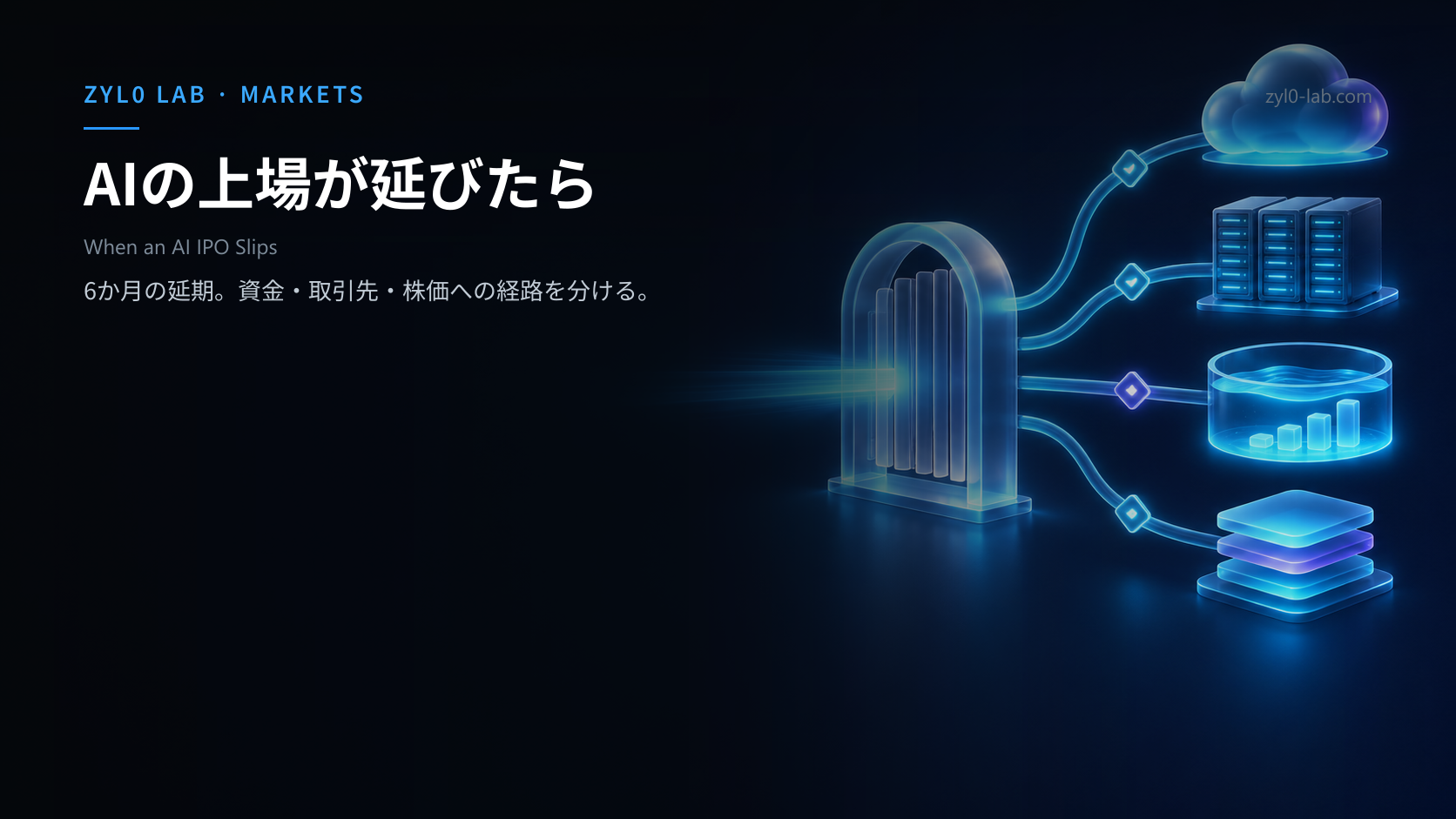
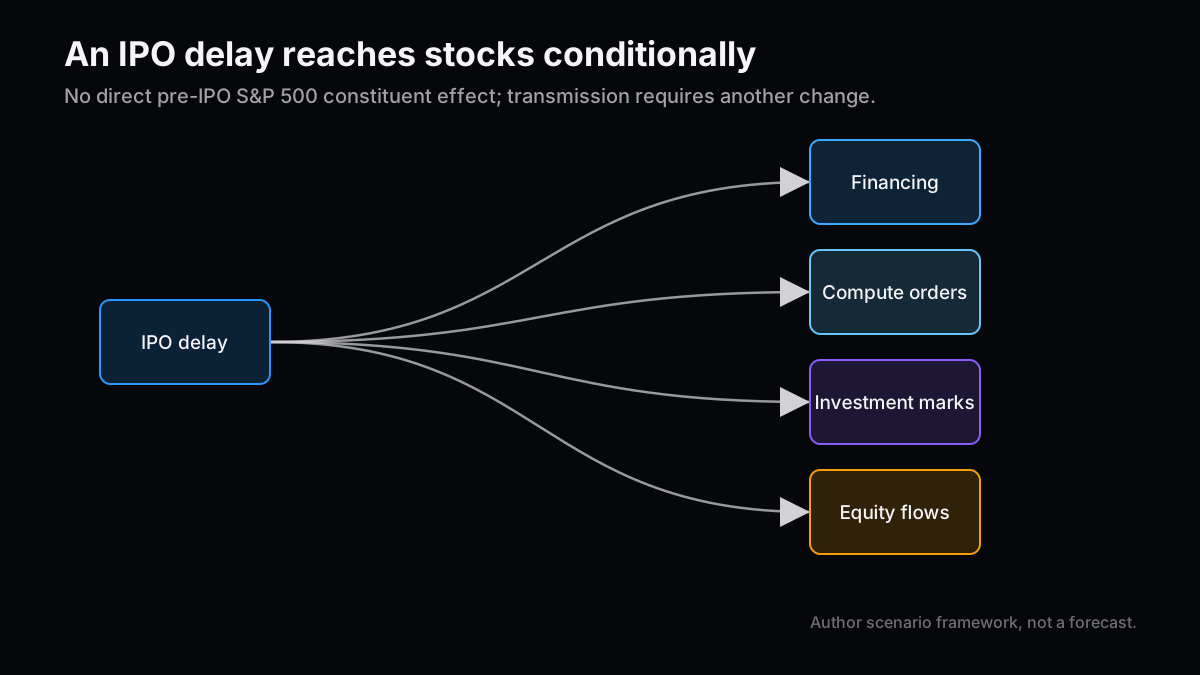
Trace a hypothetical AI IPO delay through financing, compute orders, investment marks and equity flows, using liquidity and contractual obligations to test the transmission mechanisms.
Trace a hypothetical AI IPO delay through financing, compute orders, investment marks and equity flows, using liquidity and contractual obligations to test the transmission mechanisms.

A six-month delay in Anthropic's IPO would not automatically stop compute orders. September-end cash, cash equivalents and short-term investments of $131.845 billion need to be read separately from approximately $69.8 billion of commitments payable over the following twelve months. The reason for delay and continuity of financing determine the market transmission.
This is a public-information conditional scenario, checked on November 7, 2026. Anthropic publicly filed its S-1 on October 26 and its S-1/A on November 2. This research did not establish a fixed listing date, offering price or a new official postponement decision. Six months means a hypothetical delay in expected IPO funding, not an event reported as having occurred.
Post 76 separated headlines from their channels into stocks. Listing dates, customer usage, server delivery and cash collection operate on different clocks here too.
Start With Three Different Reasons for Delay
A filing update carries different information from an offering unable to attract buyers at its desired price.
| Type of delay | What changed | First evidence to inspect | Hypothesized market meaning |
|---|---|---|---|
| Process and preparation | Timing, disclosure or readiness | Amendments and company statements | Primarily a timing issue |
| Pricing adjustment | Demand at the proposed valuation | Offering terms and pricing changes | Potential reassessment of AI multiples |
| Business or financing constraint | Usage, cost or funding availability | Liquidity, contract changes and orders | Stronger transmission into real demand |
The final row is the most consequential. The word delay does not establish that row. Having accompanied a portfolio company's IPO, I learned to distinguish a transaction timetable from business progress. That experience does not provide non-public knowledge about the companies discussed here.

Channel One: The Financing Mix Changes First
The filing provides the following starting points, in billions of US dollars.
| Disclosure | Amount | Interpretation |
|---|---|---|
| Cash, cash equivalents and short-term investments, September-end | 131.845 | Existing resources |
| January–September operating cash flow | About +6.6 | Historical operating inflow |
| Commitments payable over the next twelve months | About 69.8 | Gross payments, not net cash burn |
| Aggregate committed spending including longer terms | About 895.4 | Multi-year obligations, not all immediately payable |
| Arrangements subject to termination rights or pre-commencement conditions | About 213.8 | Not every commitment is equally fixed |
Large net losses cannot simply be substituted for cash burn because financing-related fair-value movements are included. Positive historical operating cash flow, however, also does not prove that future infrastructure spending is fully self-funded.
The next table spreads $69.8 billion evenly over twelve months. It excludes customer receipts, payroll, other capital spending, financing and payment timing differences. It is a gross-payment sensitivity, not a runway estimate.
| Hypothetical delay | Evenly spread commitments, USD billions | Balance after subtracting only that amount from 131.845 |
|---|---|---|
| Three months | 17.45 | About 114.40 |
| Six months | 34.90 | About 96.95 |
| Twelve months | 69.80 | About 62.05 |
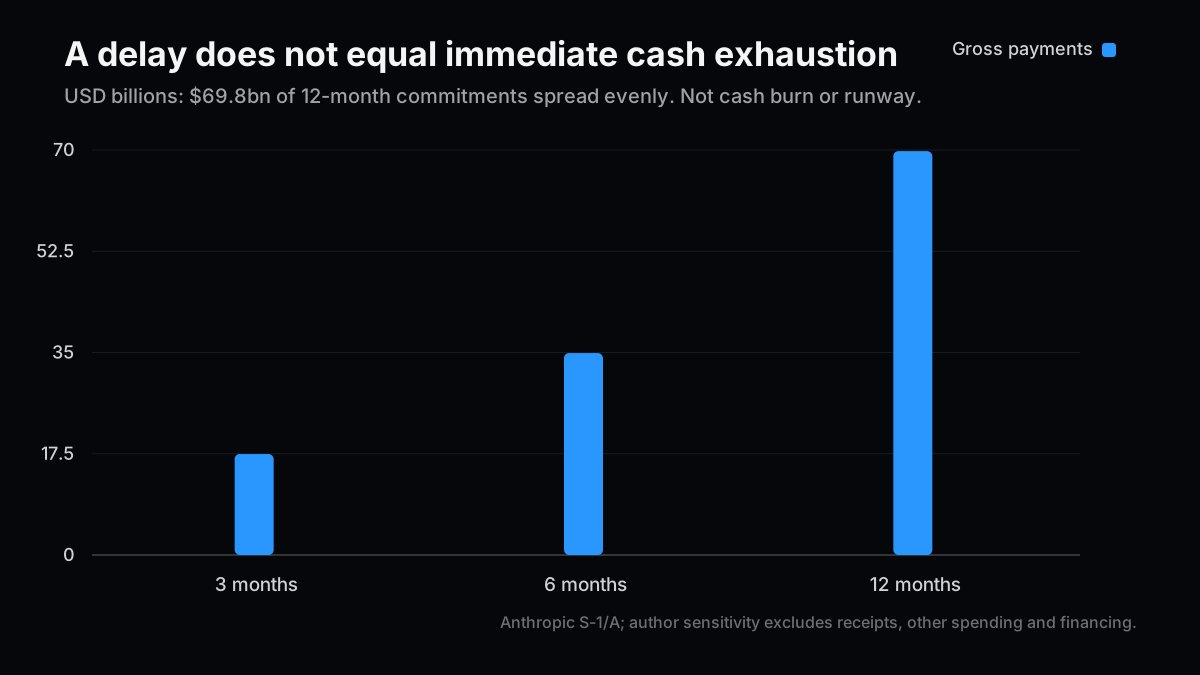
These starting resources do not support assuming immediate cash exhaustion after six months. Risk rises if weaker collection, new spending and unavailable replacement financing occur together. Undrawn facilities and conditional investment promises should not be added to cash without examining their conditions.
Channel Two: Orders Must Change Before Suppliers Lose Revenue
Compute purchasing is the obvious market concern. An IPO delay is not a contract cancellation. Minimum purchases, commencement dates and supplier delivery conditions determine when payments and revenue occur.
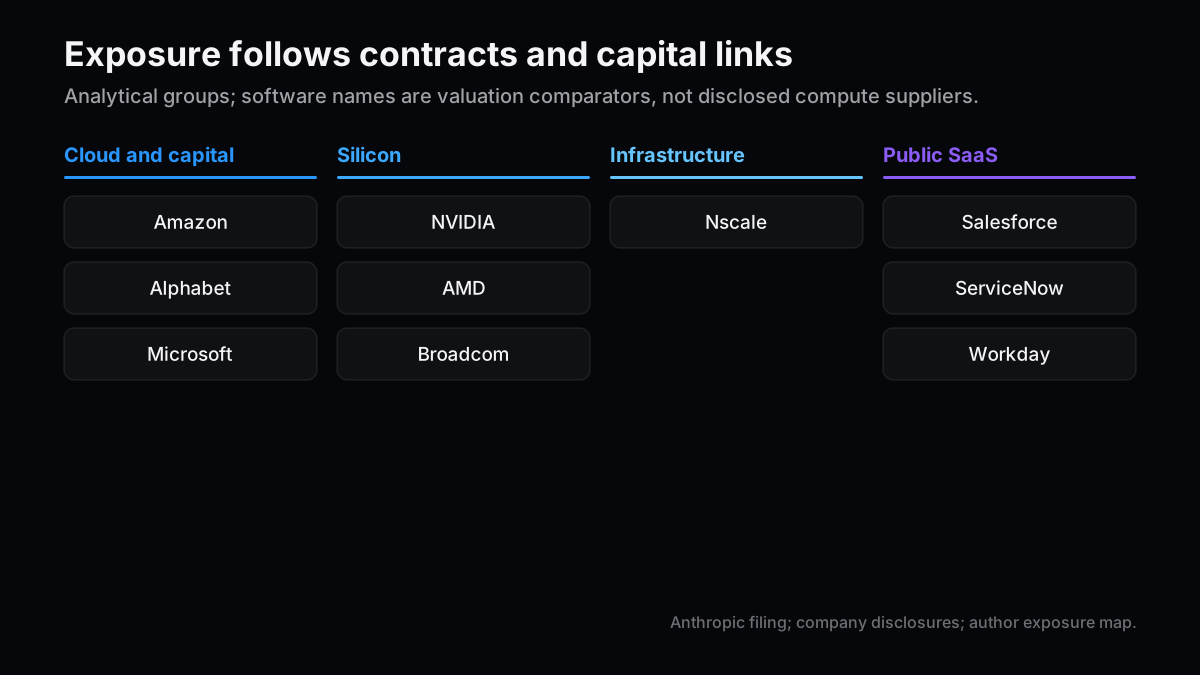
The S-1/A describes a multi-chip architecture spanning AWS Trainium, Google TPUs, NVIDIA GPUs and AMD GPUs. A reduction at one supplier could reflect workload migration rather than lower total compute demand. The analysis needs both allocation and aggregate usage.
| Counterparties | Transmission route | Evidence of deterioration | What a delay alone cannot establish |
|---|---|---|---|
| Amazon, Alphabet, Microsoft | Cloud usage and financial relationships | Lower usage, changed contracts or late payment | Earnings impact on the entire parent |
| NVIDIA, AMD, Broadcom | Equipment, components and financial arrangements | Delivery deferrals or reduced purchasing | Final revenue loss at each supplier |
| Infrastructure operators and financiers | Commissioning and repayment assumptions | Refinancing difficulty, collateral pressure or unused capacity | Ability to redeploy to other customers |
Amazon's latest release describes a widening Bedrock model selection. If one AI customer's demand weakens, the ability to redirect capacity matters. My hypothesis is that highly specialized assets and concentrated customer exposure make that substitution harder. It remains a contract- and asset-specific question.

Channel Three: Investment Marks Are Not Equivalent Cash Losses
A lower IPO valuation may affect existing investors' holdings. Accounting treatment depends on the security, observable transactions and conversion terms. A 25% valuation reduction does not mechanically produce an identical percentage reduction in a parent's earnings.
Nor must the parent's market value fall dollar for dollar with an investment mark. Its share price reflects operating profits, financing needs and expectations across the whole business.
If investment gains had previously lifted reported earnings, repricing could nevertheless prompt investors to separate core operations from those gains. Accounting recognition and public-market interpretation deserve different analyses. Combining them into a single loss figure would exaggerate certainty.
Channel Four: Relative Valuations and Waiting Capital Move
A pricing-driven delay can trigger reassessment of listed AI and SaaS multiples. The direction is not uniform. Weaker AI expectations can hurt exposed shares, while capital previously reserved for an IPO may remain available to existing stocks.

The May Series H, co-led by Sequoia and others, raised $65 billion. Carta reports that approximately 57% of Series B-and-later funding in 2026 went to AI businesses on its platform. Interrupted price discovery in a large deal could challenge concentrated expectations. Venture commitments and public-equity allocations are still different pools of capital and cannot simply be netted together.
An unlisted company has no direct constituent weight in the S&P 500. Delaying its IPO therefore cannot trigger an index sale of that company's shares. S&P DJI's June 2026 consultation also rejected eligibility exceptions based solely on megacap size. Listing and immediate mechanical index buying should not be treated as the same event.
For a purely illustrative index calculation, assume exposed stocks represent 20% of an index, fall 10% together and everything else remains unchanged. The first-order index effect is roughly minus 2%. Neither input is a measured current weight or a forecast. A real prediction requires actual weights and company-specific earnings effects.

Read Contracts and Collection Before Trading the Headline
My base case for a procedural delay with funding intact is primarily a disruption to price discovery and near-term flows, not an automatic collapse in compute demand. Confidence in forecasting a broad-index decline from one IPO timetable would be low.
| Scenario | Assumptions | Hypothesized equity transmission | Assessment |
|---|---|---|---|
| Base case | Six-month delay with usage and funding intact | Volatility without a necessary demand shock | Neutral; inspect contracts |
| Main deterioration | Lower pricing and worse replacement financing | Reassessment of AI multiples and equipment finance | Reduce sensitivity to demanding expectations |
| Tail risk | Funding interruption plus weaker orders or payment | Real losses spread through cloud, chips and finance | Prioritize concentration and funding exposure |
What would change my mind: confirmed reductions in major compute contracts or payment delays accompanying postponement. That would turn a timing interpretation into a demand and credit problem. If usage, collection and financing remain intact, I would not cut operating forecasts solely because the listing moved.
The evidence sequence is company statements, liquidity, offering terms, compute contracts and counterparty disclosures. Prices may move before those documents arrive. The analysis should still leave a verifiable explanation of which channel eventually carried the shock.
Related Posts
- AI Valuation 1: The Eleven-Company SaaS Comparison — Starting multiples that might be reassessed.
- Post 76: Channels From Policy Into Stocks — Separating headlines from earnings effects.
- AI Chip Investments 2: Conditional Customer Funding — Capital support linked to deployment milestones.
References
- Anthropic S-1/A: liquidity, obligations and counterparties, November 2, 2026
- Anthropic public S-1 announcement, October 26, 2026
- S&P DJI megacap consultation results, June 4, 2026
- Amazon 2026 Q3 results and Bedrock model selection
- Anthropic Series H announcement, May 28, 2026
- Carta State of Private Markets Q3 2026
Next Issue Ideas
- Idea 1: Where AI Customer Receivables Concentrate — Compare collection assumptions across chips, cloud and infrastructure operations.
- Idea 2: IPO Investment Gains Versus Cash — Compare investment income and operating cash flow at three or more public companies.
- Idea 3: Can Idle Compute Move to Another Customer? — Assess two-year equipment-finance exposure through asset flexibility and customer concentration.
This article is not investment advice. The author may hold securities mentioned. Generative AI assisted its preparation. Please read the disclaimer before making an investment decision.