A 72% Chance Democrats Take Congress, Yet Few Laws Will Change: Midterm Winners and Losers, Read by How Policy Actually Moves
Prediction markets give Democrats a 72% chance of winning both chambers and 23% for a split Congress. The veto stays either way, yet budgets, probes, confirmations and local votes still move stocks. Five likely winners and three likely losers, read by evidence and by what is already priced.

Prediction markets give Democrats a 72% chance of winning both chambers and 23% for a split Congress. The veto stays either way, yet budgets, probes, confirmations and local votes still move stocks. Five likely winners and three likely losers, read by evidence and by what is already priced.

This is an outside-in read based only on public information. I did not interview any company or use non-public material. Data checked on November 2, 2026 (Asia time), before any results. The probabilities come from prediction markets and forecast models and are not outcomes.
Ahead of the November 3 midterms, Polymarket gives Democrats a 72% chance of winning both the House and the Senate, and a 23% chance of a split Congress with a Democratic House only (figures reported by Reuters on November 2). Either way, President Trump keeps his veto. There is almost no path for legislation to reverse policy.
Stocks will still move, in my view. What moves them is not new law but four other channels: budgets, investigations, confirmations, and decisions made by states and towns.
In my last post on Big Tech's July-September earnings, I found that four companies' capex had reached 115% of their operating cash flow. For companies already filling the gap with bonds and equity, even a small change in who pays for power changes the math. So this time I wanted to read the election not by which party wins, but by which channels open.
Here is the conclusion up front. Most of the areas expected to gain from a Democratic win have already moved. Oil and gas, at the top of the likely losers, is this year's best-performing sector, and the AI hyperscalers have already been sold. On election night, the biggest swings are more likely to come from that positioning than from what policy can actually do.
Prediction Markets Put a Democratic Sweep at 72%
First, how much is the market already assuming?
| Source | Type | Democratic sweep | Split Congress | Democratic Senate | Democratic House |
|---|---|---|---|---|---|
| Polymarket | Prediction market (11/2) | 72% | 23% | — | — |
| Kalshi | Prediction market (11/1) | About 70% | About 26% | 72% | — |
| Decision Desk HQ | Forecast model | — | — | 64% | 84% |
| Poliwave | Forecast model (11/2) | — | — | 78% | 89% |
Polymarket puts the chance of Republicans holding both chambers at just 6%.
The House looks settled. The contest is the Senate. Republicans hold it 53-47 today, so Democrats need a net gain of four seats, and a 50-50 split goes to Vice President Vance. Close races in Texas, Michigan, Maine, Ohio and Iowa decide whether this ends as a sweep or a split.
History deserves a quick look. BNY counts an average S&P 500 gain of 16.6% in the 12 months after midterms since 1950. Morgan Stanley finds an average of 23% in the following year when a Republican president faced a split Congress, and 16% when Democrats held both chambers.
Morgan Stanley's own head of US public policy research, Ariana Salvatore, says "we don't think that blueprint holds up this time around." I agree, and I would not size positions off those averages. There are fewer than 20 observations, and this year's gaps between sectors are too wide. Energy is up 59.7% year to date and communication services is down 14.4%. The reshuffling inside the index could easily outweigh anything the average says.
The Veto Stops Laws. Four Other Channels Move Stocks
Even with both chambers, Democrats still face a Republican president. Bills die by veto, and overriding takes two-thirds of both chambers. In the Senate, breaking a filibuster alone takes 60 votes. Undoing the Medicaid cuts, reviving clean-energy tax credits or taxing oil windfalls will almost certainly not become law.
So what does move? Here are the four channels, with legislation alongside for contrast.
| Channel | Democratic sweep | Split Congress | Where it bites |
|---|---|---|---|
| Legislation | Bills can pass but die by veto | House bills stall in the Senate | Headlines only (oil and gas, renewables) |
| Budgets | Control of House appropriations; leverage in funding deals | Same (the House alone is enough) | Hospitals, public-plan insurers, research tools |
| Investigations | Subpoenas from committees in both chambers | House only | Crypto, AI and data centers, oil |
| Confirmations | The Senate can stall Fed, SEC, CFTC and FERC nominees | No effect | Crypto, financials, power |
| States and localities | Proceeds regardless of Congress | Same | AI and data centers, the grid |
Building this table showed me that nearly all the difference between a sweep and a split sits in two rows: confirmations and Senate investigations. The budget channel opens with the House alone, so a split Congress takes away little from the health care case. The areas where the Senate result really matters are crypto and financial appointments, the Fed included.

The calendar is already set
The dates matter too.
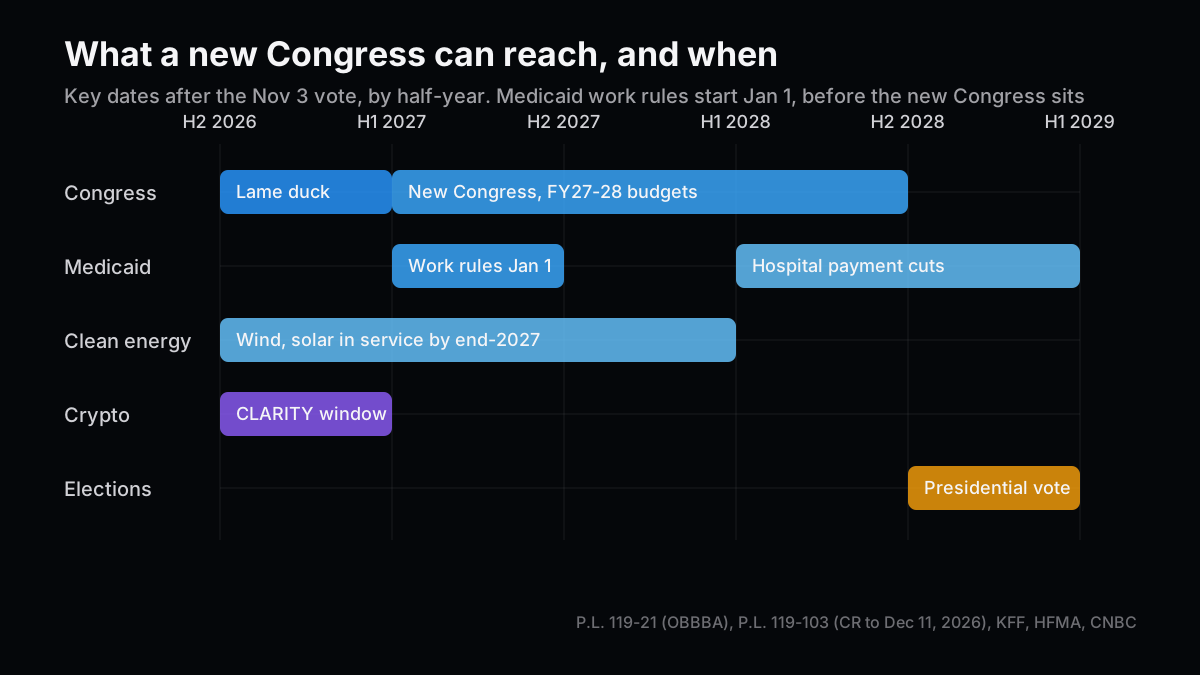
The current stopgap funding runs out on December 11. House Appropriations Chairman Tom Cole has reportedly said there is not enough time to finish all 12 bills by then. Holland & Knight lists another stopgap among the options, and a second extension into early 2027 looks like the likely path. If that happens, full-year fiscal 2027 funding gets written by the new Congress that sits on January 3. With the House, that is where Democrats get their first real negotiation.
Medicaid work requirements, meanwhile, start on January 1, 2027, two days before the new Congress. KFF says they begin on or before that date in 44 states and Washington, DC. Neither outcome stops the start. What Democrats can do is fight for delays or softer enforcement in the budget talks that follow.
The heavier blow for hospitals comes later. State-directed payments, the extra Medicaid money states route to hospitals, start falling by 10 percentage points a year from January 2028. HFMA projects cuts to hospitals in at least 37 states, $8.7 billion in the first year alone. Caps on provider taxes, which states levy on hospitals and others to draw federal matching funds, also start stepping down from October 2027 (2028 in some states). That leaves more than a year to bargain.

Five Areas Likely to Gain From a Democratic Win
Now to the areas in question, one at a time, with the evidence and the channel each one depends on.
Hospitals: the schedule of the cuts becomes the bargaining chip
The 2025 tax and spending law, the One Big Beautiful Bill Act, cuts federal Medicaid spending by $911 billion over 2025-2034 (CBO, as compiled by KFF). It adds 7.5 million uninsured people, more than 5 million of them because of the work requirements. More uninsured patients means more unpaid hospital bills.
On July 28, House Democratic Leader Hakeem Jeffries promised that a Democratic House would reverse the Medicaid cuts and restore ACA subsidies. A reversal dies by veto. The realistic version is delaying the cuts through budget talks. Jefferies analyst Brian Tanquilut made the same point: if Democrats win either chamber, the schedule of Medicaid payment cuts to hospitals could slip. He named HCA, Tenet, Community Health and Acadia, and his firm sees a delay as more likely than a return of the expanded ACA subsidies.
The stocks have already moved. By Becker's Hospital Review's count, Tenet rose 42.9% between June 30 and October 16, Universal Health Services 24.5% and HCA 17.7%. The S&P 500 gained 2.1% over the same stretch.
Public-plan insurers: not every health insurer points the same way
Medicaid made up 75% of Molina's 2025 premium revenue, or $32.2 billion. Centene is also heavy in Medicaid and the ACA exchanges, the public marketplaces for individual coverage. Oscar is mostly exchanges.
The enhanced ACA subsidies expired at the end of 2025, and paying enrollment fell from 21.8 million in 2025 to 19.2 million in 2026. Insurers are asking for a median premium increase of about 15% for 2027. If Democrats win back even part of the subsidies in budget talks, enrollment losses would slow.
Not every insurer gains, though. Reuters also noted that closer scrutiny of Medicaid and Medicare Advantage could weigh on insurers. Companies with large Medicare Advantage books could face pressure on pricing and profits. That is why I separate insurers that lean on public plans from those that lean on Medicare Advantage.
This group has moved early too. Centene is up more than 50% this year. Molina has gained only around 10%, held back by rising medical costs and its planned 2027 exit from Medicare Advantage drug plans.
Life-science tools: NIH money is set by the House
The president's fiscal 2027 budget asks for $41.2 billion for the National Institutes of Health, $3.5 billion less than fiscal 2026 (HHS budget in brief). On June 9, the House Appropriations Committee went the other way, approving a bill that raises NIH funding by $100 million, on a party-line 34-28 vote. Under the stopgap, NIH can issue continuing grants below their previous level (NIH notice NOT-OD-26-131). Until a budget is settled, university labs tend to hold off on instruments and reagents.
A Democratic House would hand the appropriations gavel to a Democrat. NIH also has plenty of Republican supporters in the Senate, which makes more funding one of the easier bipartisan calls. Of all five areas, this is probably where the budget channel works most cleanly.
The effect varies by company. In 2025, Bank of America analysts named Bruker, Illumina and 10x Genomics among the names with the highest academic and government exposure. Thermo Fisher, Danaher and Agilent sell mostly to pharma and biotech, which dilutes the NIH effect. Thermo Fisher is up about 17% this year (AAII, as of October 16), but I read that mostly as recovering pharma demand, with little of the election in it yet.
Renewables: no new tailwind, but the next rollback goes away
To be honest, this is the thinnest channel of the five. Under the wind and solar credits (45Y and 48E), projects that did not start construction by July 4, 2026 must be in service by the end of 2027. That deadline has passed. Extending the credits needs a law, and a law needs the president's signature.
So what does a Democratic Congress change? It closes the door on a second budget reconciliation bill that could cut the credits further. The credits that remain, such as the 45X manufacturing credit and the storage credit, are protected at least until the 2028 presidential election. UBS sees room for bipartisan bills on faster permitting and on nuclear power even with a split Congress.
I set EV-battery reuse for stationary storage as an investment theme and invested in a North American startup in that space. Storage is a business where you cannot plan without assuming power prices and the expiry dates of incentives. Seen that way, this election does not raise the ceiling for renewables. It makes the floor harder to fall through.
Renewables differ in how they depend on policy. First Solar uses 45X for its US manufacturing. NextEra says its wind and solar projects through 2030 qualify for the credits. Enphase and Sunrun serve households, where the homeowner credit ended with 2025, so they now rely on the credits businesses claim through leases and power purchase agreements. Solar ETFs were up more than 30% for the year in May and were back near where they started by early September. I see little sign of pre-election buying.
Part of the grid: once someone is told to pay, builders can build
Household electricity prices are up more than 10% since 2024 (Reuters). In Ohio, the average household power bill reportedly rose more than 53% between June 2021 and June 2026.
On September 16, the House voted 417-3 for the Ratepayer Protection Act, which asks state regulators to "consider" standards making large data centers pay for the grid upgrades they require. On September 30, a procedural vote in the Senate failed 57-43, short of 60. Senate Democratic Leader Chuck Schumer and others opposed it as voluntary and too weak. Senator Richard Blumenthal has his own bill, the GRID Act, that would make the payments mandatory.
A Democratic Senate would put something closer to a mandate on the agenda. The 60-vote bar still means working with some Republicans. But candidates in both parties are campaigning on power bills, and I think this is one of the rare areas the veto is unlikely to stop.
Once the cost rule is settled, regulated utilities that own transmission and distribution can keep investing in the grid with less fear of a rate backlash. Transmission contractors and equipment such as transformers keep their demand no matter who pays. The independent power producers that rallied on high-priced contracts with data centers, such as Vistra, Constellation and Talen, end up on the side facing closer scrutiny of prices. That line is why I say "part of the grid."
Here are the five areas side by side.
| Area | Key evidence | Channel | Representative companies | Pre-election move |
|---|---|---|---|---|
| Hospitals | $911bn of Medicaid cuts; 5m+ uninsured via work rules | Budgets (House) | HCA, Tenet, Universal Health Services | Tenet +42.9% (6/30-10/16) |
| Public-plan insurers | 75% of Molina's premiums come from Medicaid | Budgets (House) | Molina, Centene, Oscar | Centene +50%+ YTD |
| Life-science tools | President's budget cuts NIH $3.5bn; House bill adds $100m | Budgets (House) | Bruker, Illumina, 10x Genomics | Thermo Fisher about +17% YTD |
| Renewables | July 4 start deadline passed; next rollback blocked | Blocking legislation | First Solar, NextEra, Enphase, Sunrun | Gave back the May rally |
| Part of the grid | Power prices up 10%+ since 2024; ratepayer bill stalled | States, Senate agenda | Exelon, American Electric Power, Quanta Services | Utilities +3.9% YTD |
On the winning side, only the grid and renewables have yet to move. Of the two, the grid has the stronger channel.

Three Areas Likely to Lose
The likely losers overlap with this year's winners.
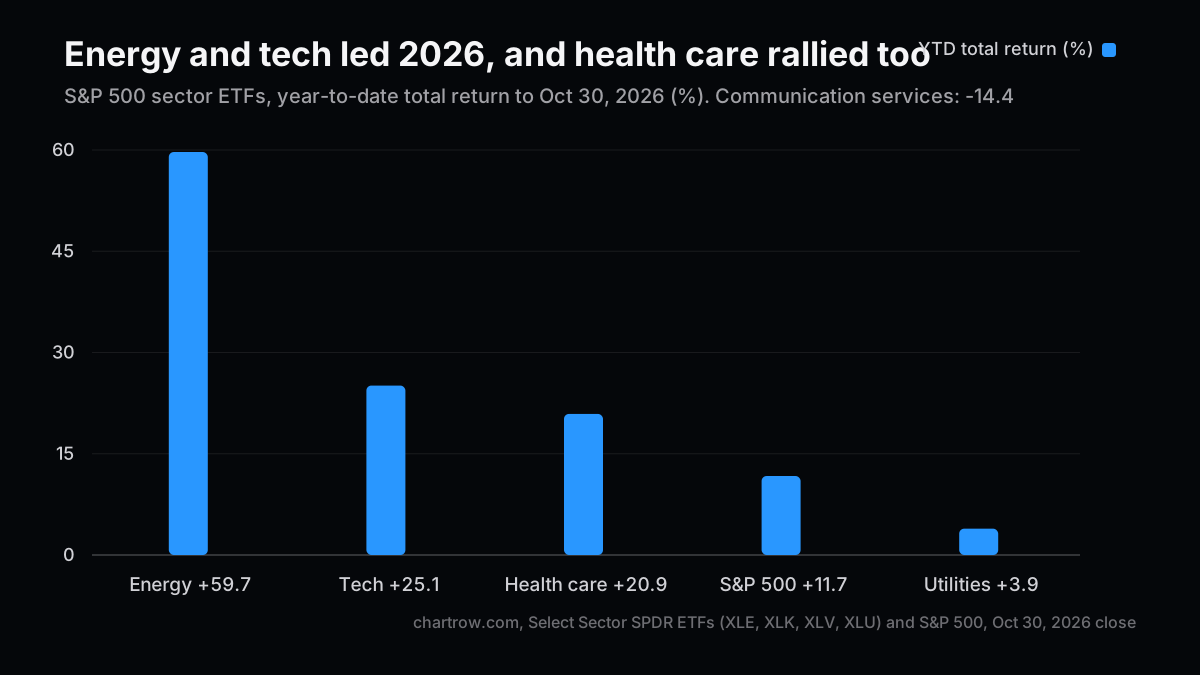
Energy leads at +59.7% and tech is second at +25.1%. Health care is third at +20.9%. Both the likely winners and the likely losers have already run. The most important number may be the one that does not fit on the chart: communication services, home to Alphabet and Meta, is down 14.4%. The hyperscalers have already been sold.
AI, data centers and hyperscalers: the action is local, not in Congress
The headwinds are real. In CNBC's October survey, 63% of registered voters opposed a data center within 10 miles of their home, against 13% in favor. Ballotpedia, as reported by Axios, counts 41 data-center ballot measures in 10 states on November 3, 21 of them in Ohio. All six measures already decided this year went against development.
In Congress there is the ratepayer bill, and also export controls. Senators Elizabeth Warren, a Democrat, and Jim Banks, a Republican, have proposed a bill that would halt sales of NVIDIA's Blackwell chips to China for two years. Investigations are coming too. On October 21, Senator Blumenthal, the top Democrat on the Senate Permanent Subcommittee on Investigations, asked donors to the White House ballroom project for records. Apple and NVIDIA reportedly pledged $25 million each.
Reuters listed memory and storage (Micron, Sandisk, Seagate), chip equipment makers, power providers and data-center builders as exposed. Bank of America's Michael Hartnett has reportedly warned that stocks could fall more than 10% if a Democratic sweep comes with a Democratic win for Texas governor. Societe Generale, on the other hand, expects the AI trade to hold, since Democrats will not have a veto-proof majority.
I land in between. As my last post showed, three of the four already cannot fund capex on their own. Paying for grid upgrades would push that ratio higher, so the pressure lands on costs. But the strongest channel is the ballot measures and state utility commissions, and those move regardless of who controls Congress. The point I made in my post on AI's power bottleneck, that power and not compute is the binding constraint, has now become a political point too. On election night, I will be watching the Ohio ballot results more closely than the Senate count.
Crypto: the lame duck is the last window
The CLARITY Act, which would set market rules for crypto, failed a Senate procedural vote 49-50 on September 15, short of the 60 needed. Democrats wanted ethics rules covering crypto profits made by the Trump family and said the Republicans' revisions fell short. During the vote, Coinbase fell 8%, Circle 10% and bitcoin 3%.
Democrats are reportedly preparing investigations into Trump-linked crypto companies. In the new Congress the bill would have to be reintroduced and passed by both chambers again. A Democratic House can block it in a split. With a sweep it also drops off the Senate agenda, and CFTC and SEC nominations could stall. Either way, the November-December lame duck, while Republicans still control both chambers, is the last window.
The stocks, though, have priced a lot of this in. Coinbase was down 30.5% for the year on October 23, while bitcoin was down just 3.5% as of October 21 (Reuters). The shares are already carrying more of the bad headlines than the coin is.
Oil and gas: the laws will not pass, but the headlines will hurt
Brent traded above $115 on October 28. Exxon earned $15.4 billion in the July-September quarter, about double a year earlier, and Chevron earned $9.9 billion. AAA says diesel is up 71% in a year and gasoline 38%. Record profits days before an election are uncomfortable for both parties.
Democrats have three windfall bills on the table: a clawback from Senator Sheldon Whitehouse and Representative Ro Khanna, a 100% tax on crude prices above $75 a barrel from Representative Brad Sherman, and a plan from Senators Ron Wyden, Chuck Schumer and Michael Bennet to raise the buyback excise tax on large oil companies from 1% to 25%. All of them die by veto. What will bite is hearings and headlines, and a crowded trade that is up 59.7% this year could use them as a reason to unwind.
Still, Congress does not set the oil price. As I traced in my piece on oil routes six months into the Iran war, shipping routes and stockpiles do. The medium-term view depends on the Strait of Hormuz.
| Area | Key evidence | Channel | Representative companies | Pre-election move |
|---|---|---|---|---|
| AI, data centers and hyperscalers | 41 ballot measures in 10 states; 63% oppose nearby sites | States, investigations, Senate agenda | Microsoft, Alphabet, Amazon, Meta | Comm. services -14.4%, tech +25.1% |
| Crypto | CLARITY Act stalled 49-50; probes of Trump family ventures | Blocking legislation, probes, confirmations | Coinbase, Circle, Strategy | Coinbase -30.5% YTD |
| Oil and gas | Exxon $15.4bn and Chevron $9.9bn profits; three windfall bills | Investigations and headlines | Exxon Mobil, Chevron, ConocoPhillips | Energy +59.7% YTD |

How Much Is Already Priced In?
I placed all eight areas on two axes: how directly a Democratic Congress can act on them, and how far they ran before the vote.
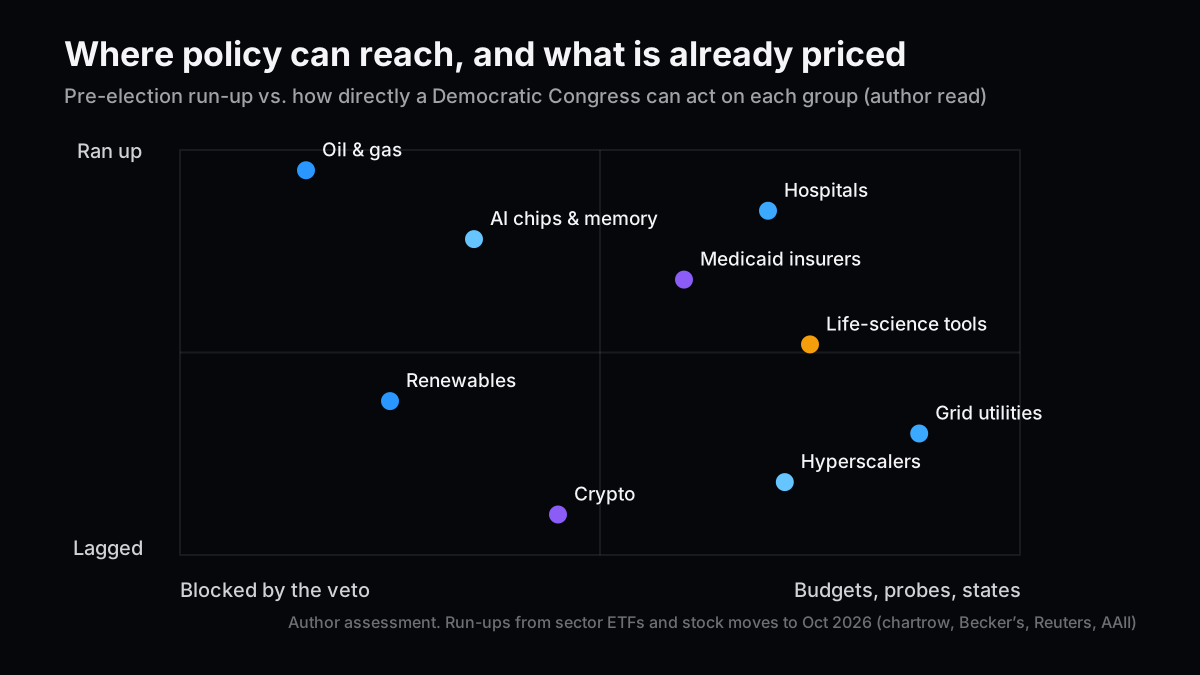
Hospitals and public-plan insurers sit top right: strong channel, already up. Oil and gas sits top left, up sharply despite a weak channel, and I think that is where election night swings hardest. The grid sits bottom right, with a strong channel and no move yet. The hyperscalers are also bottom right, but on the losing side, after the selling has happened.
I worked through one more thing. At 72%, a good part of the hospital rally already assumes a sweep, so confirming it leaves limited upside. Which outcome hurts most, then? As the channel table shows, the budget channel opens with the House alone, so a split does not take away much of the health care case. The real danger for hospital stocks is not the 23% split but the 6% chance that Republicans hold both chambers. Crypto is the opposite: it is the area where the gap between a split and a sweep is widest.
So my conclusion is this: on the winning side, the laggard is part of the grid; on the losing side, the most fragile is the crowded oil and gas trade.
Scenarios and My Investment Call
Here is how I would frame the next six to twelve months, with the market's probabilities next to mine. I think the Senate is a little closer than the markets do.
| Scenario | Market | My view | What happens | Early signals |
|---|---|---|---|---|
| Base case: Democratic sweep | 72% | 65% | Budget deals delay part of the Medicaid cuts and hold NIH flat or higher. The Senate stalls nominees; CLARITY stays stuck in 2027. Grid costs move toward a mandate | December's stopgap pushes into 2027; Medicaid timing enters the January-March talks |
| Main scenario: split Congress | 23% | 28% | The health care budget case survives. Nominations and Senate probes stay Republican. CLARITY could return in revised form; the ratepayer bill settles as a voluntary version | Results in close Senate races such as Texas, Maine and Ohio |
| Tail risk: Republicans hold both | 6% | 7% | The health care rally unwinds. AI infrastructure, oil and crypto get bought back. Bigger deficits push long yields up | A tight House count |
Higher long yields in the tail case point the same way as the rate picture in my post on the AI bond rush. The Fed held on October 28, but two members dissented in favor of a hike.
Investment call
- Hospitals: neutral in the short term. Even a sweep leaves limited upside. The real risk is a Republican hold, which could erase much of the rally since June. If holding, favor operators less dependent on the state-directed payments that start shrinking in 2028
- Public-plan insurers: neutral, leaning slightly long. The direction helps, but Centene has already run and Molina carries its own problems
- Life-science tools: leaning long over the medium term. Only for names with high academic and government exposure. The NIH number set in January-March is the catalyst
- Part of the grid (regulated wires utilities, grid contractors and equipment): leaning long over the medium term. It is the only winner that has not moved yet
- Renewables: neutral. The floor gets firmer, but this is not a source of upside
- Hyperscalers: keeping last post's calls. The election adds weight on the cost side, but after the selling already done, this is not the point to sell on the election. AI chips and memory lean negative in the short term after their run
- Crypto-linked stocks: negative in the short term if Democrats sweep. Still, the shares have already priced in a lot of bad news
- Oil and gas: leaning negative in the short term, neutral over the medium term. The election could trigger an unwind of a crowded trade. The oil price itself depends on Hormuz
What would change my mind
If Democrats win both chambers but fail to win any delay in the Medicaid cuts during the January-March budget talks, I will accept that the health care rally was hope and nothing more. In the other direction, if a split Congress still passes a ratepayer bill that makes grid payments mandatory, I will treat the headwind for AI infrastructure as running regardless of who controls Congress, and mark down my view of the hyperscalers a notch.
Watch points
- Election night, November 3 (November 4 in Asia): close Senate races such as Texas, Maine and Ohio; Ohio's 21 data-center measures; 19 utility commissioners elected in nine states
- The November-December lame duck: whether CLARITY gets another vote
- December 11: the funding deadline, and whether it is pushed into 2027
- January 1: Medicaid work requirements begin. January 3: the new Congress sits
- January-March: the fiscal 2027 NIH number and the schedule of the Medicaid cuts
One doubt stays with me after writing this. How partisan is the fight over AI's power bill, really? As the House's 417-3 vote shows, Republican candidates are campaigning on power prices too. If costs get shifted onto data centers even without a sweep, the election result may matter less to the hyperscalers than it seems.
Related Posts
- Cloud Revenue Doubled at the Top, Yet Three of Four Can No Longer Fund Their Capex — how heavy the four companies' cash needs were before any grid costs
- Did the AI Bond Rush Push Up Long-Term US Yields? — the rate picture that matters in the tail scenario
- Power, Not Compute: Mapping the AI Electricity Bottleneck Across Power Semiconductors and the Grid — a map of who invests in the grid
- Oil's New Map, Six Months Into the Iran War — Part 1: How Routes and Stockpiles Actually Shifted — what actually sets the oil price, rather than Congress
References
- Sectors bracing for a pivot as US midterm elections loom (Reuters via Investing.com, November 2, 2026)
- Defense, healthcare, crypto and AI: How the midterm election could affect stocks (CNBC, November 2, 2026)
- Midterm Election Update: Medicaid Changes (KFF, October 21, 2026)
- NOT-OD-26-131: NIH Operates Under a Continuing Resolution (NIH)
- Senate cloture vote on Clarity Act fails (CNBC, September 15, 2026)
- Voluntary ratepayer protection bill blocked in Senate again (Roll Call, September 30, 2026)
Next Issue Ideas
- Idea 1: Election scorecard, did the eight areas actually move? — Check the price moves from November 4 against where each area sat on this post's quadrant chart, and see whether the read on what was priced in held up.
- Idea 2: Hospital funding starts shrinking in 2028 — Compare at least three hospital operators on their exposure to state-directed payment and provider-tax cuts, built up from filings, to see which state mix hurts most.
- Idea 3: After 41 ballot measures, who pays for data-center power? — Follow the vote results and state utility commission decisions, and compare the knock-on effects for regulated utilities, independent power producers and hyperscalers.
This post is not investment advice. The author may hold securities of the companies mentioned. Generative AI was used in preparing it. Please read the disclaimer before making any investment decision.