Physical AI: Three Patent Families and the Economics of Robot Hands
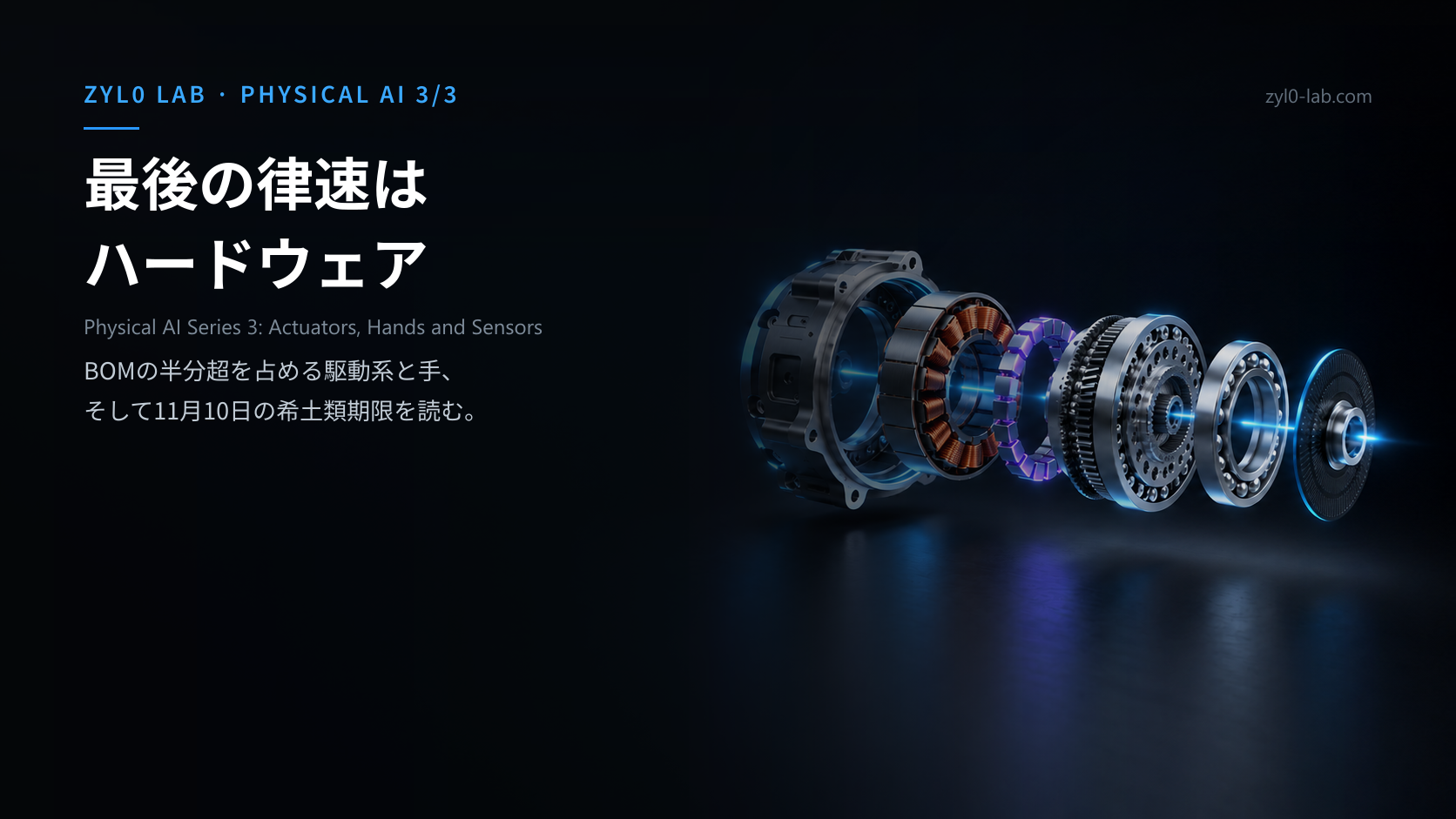
Read published hand and forearm patent claims alongside three robotics strategies, connecting cable routing, tactile manufacturing and direct actuation to service costs and useful operating hours.
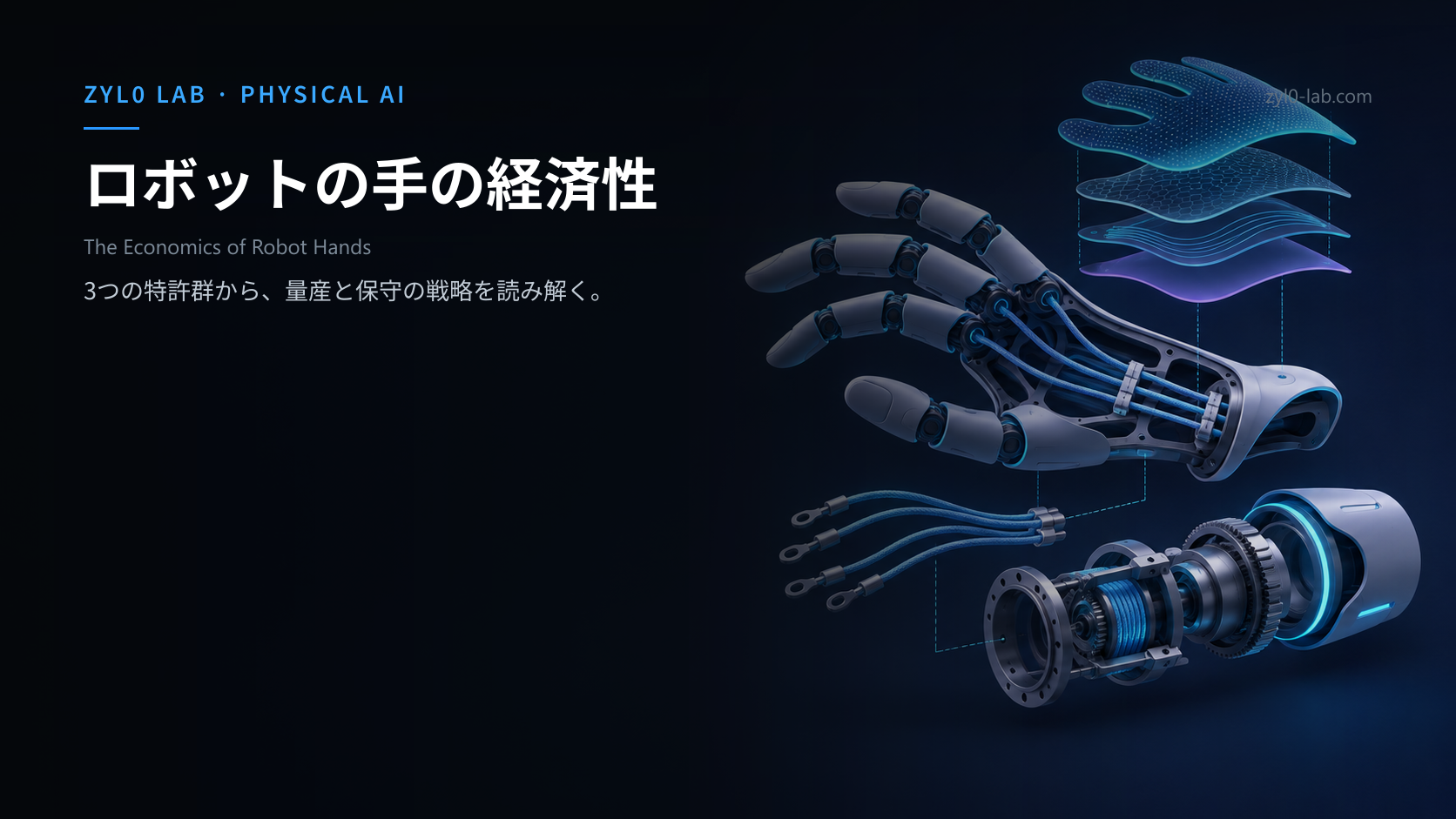
Read published hand and forearm patent claims alongside three robotics strategies, connecting cable routing, tactile manufacturing and direct actuation to service costs and useful operating hours.

Robot businesses should be assessed by the cost of a useful working hour, not merely by patent counts. Three Tesla hand and forearm patent families address actuation, cable routing and tactile-sensor manufacturing. My strategic inference is an effort to make manipulation manufacturable and serviceable as well as humanlike.
This public-information technical and business assessment was checked on November 7, 2026. It examines three selected hand and forearm patent families alongside Figure and Boston Dynamics disclosures. Publication text is read through Google Patents and Justia reproductions. A1 denotes a published application, not proof of a granted enforceable right, production adoption, validity or infringement.
Post 76 discussed constraints outside compute. Physical AI has an analogous issue at the contact surface. Better models cannot create more billable work if the hand spends too much time stopped, adjusted or repaired.
Separate Publication Dates From Priority Dates
The selected families address different business questions. This is a claim-focused case selection, not an exhaustive count of a patent portfolio.
| Representative publication | Priority date | Publication date | Reading focus |
|---|---|---|---|
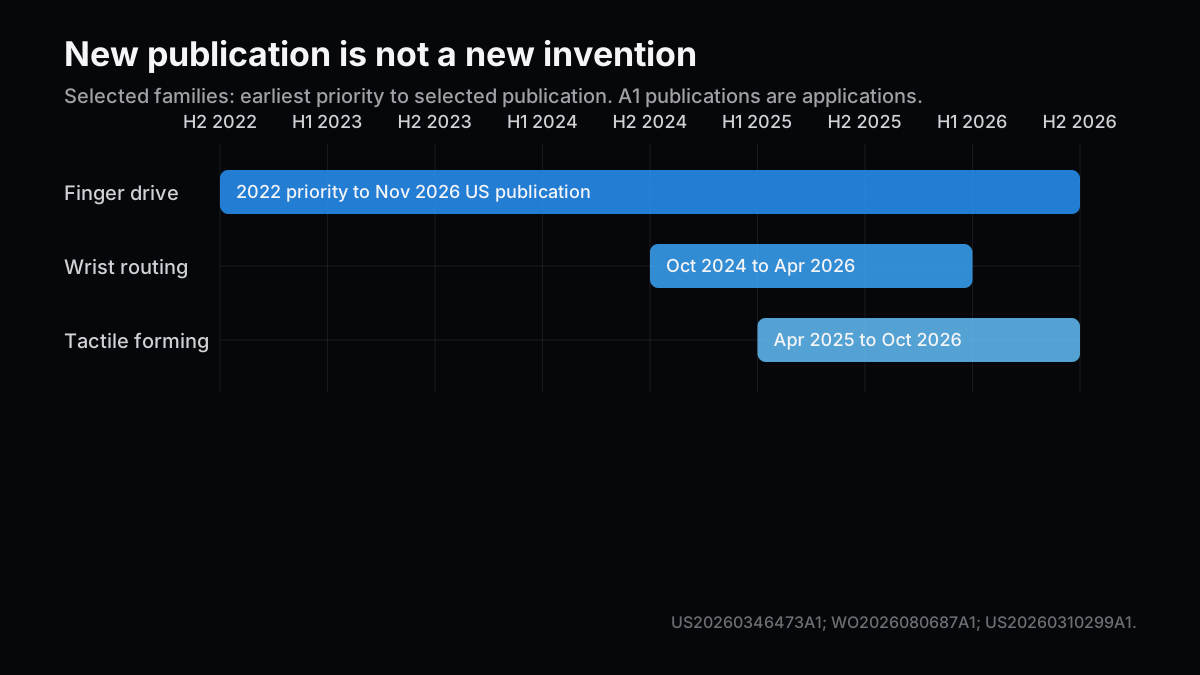
| US20260346473A1 | September 30, 2022 | November 5, 2026 | Cable-driven fingers; claims 1, 11 and others |
| WO2026080687A1 | October 10, 2024 | April 16, 2026 | Forearm-to-hand cable routing; claim 1 and others |
| US20260310299A1 | April 4, 2025 | October 8, 2026 | Forming three-dimensional tactile sensors; claim 1 and others |
The November publication is newest, but its family includes WO2024073138A1, published in 2024. It is not evidence of an invention suddenly appearing in 2026. Counting national and international publications separately can overstate the pace of invention.
A priority date also does not establish a completed product on that date. Publication lags limit what a portfolio reveals about present hardware. These documents do not allow reconstruction of a current internal product roadmap.

Finger and Wrist Claims Focus on Transmission and Routing
Claim 11 of US20260346473A1 describes proximal and distal members, two pivots, a cable routed away from those pivots and an enlarged cable end engaging the distal member when pulled. The description discusses driving two finger joints with one actuator. That differs from independently powering every joint.
The design suggests a route toward compact packaging and adaptive grasping with fewer drive components. The publication does not establish achieved part-count savings or measured service life. Cable wear, stretch, friction and tension adjustment still require operational evidence.
Claim 1 of WO2026080687A1 includes different cable configurations on the forearm and hand sides of the wrist. Dependent claims specify arrangements such as lateral and vertical stacks. The focus is a particular routing structure, rather than a blanket description of every cable-driven hand.
| Structural hypothesis | Potential business benefit | Evidence still needed |
|---|---|---|
| Fewer drive sources control multiple joints | Compactness and reduced assembly burden | Part count, assembly time and repeatability |
| Organize routing across the wrist | Lower interference and adjustment burden | Force and friction across wrist postures |
| Make contact components serviceable | Potentially shorter downtime | Replacement steps, recalibration and post-repair success |
The final row is my economic evaluation criterion, not a repair-time result established by the publication. Intent and demonstrated field performance must remain separate.
Using ANSYS and Fusion 360 for structural work taught me to distinguish understanding geometry and stress from demonstrating actual fatigue life. A convincing drawing is not evidence that volume production will be easy. That boundary matters when translating patent disclosure into investment expectations.
The Tactile Application Also Concerns How Sensors Are Made
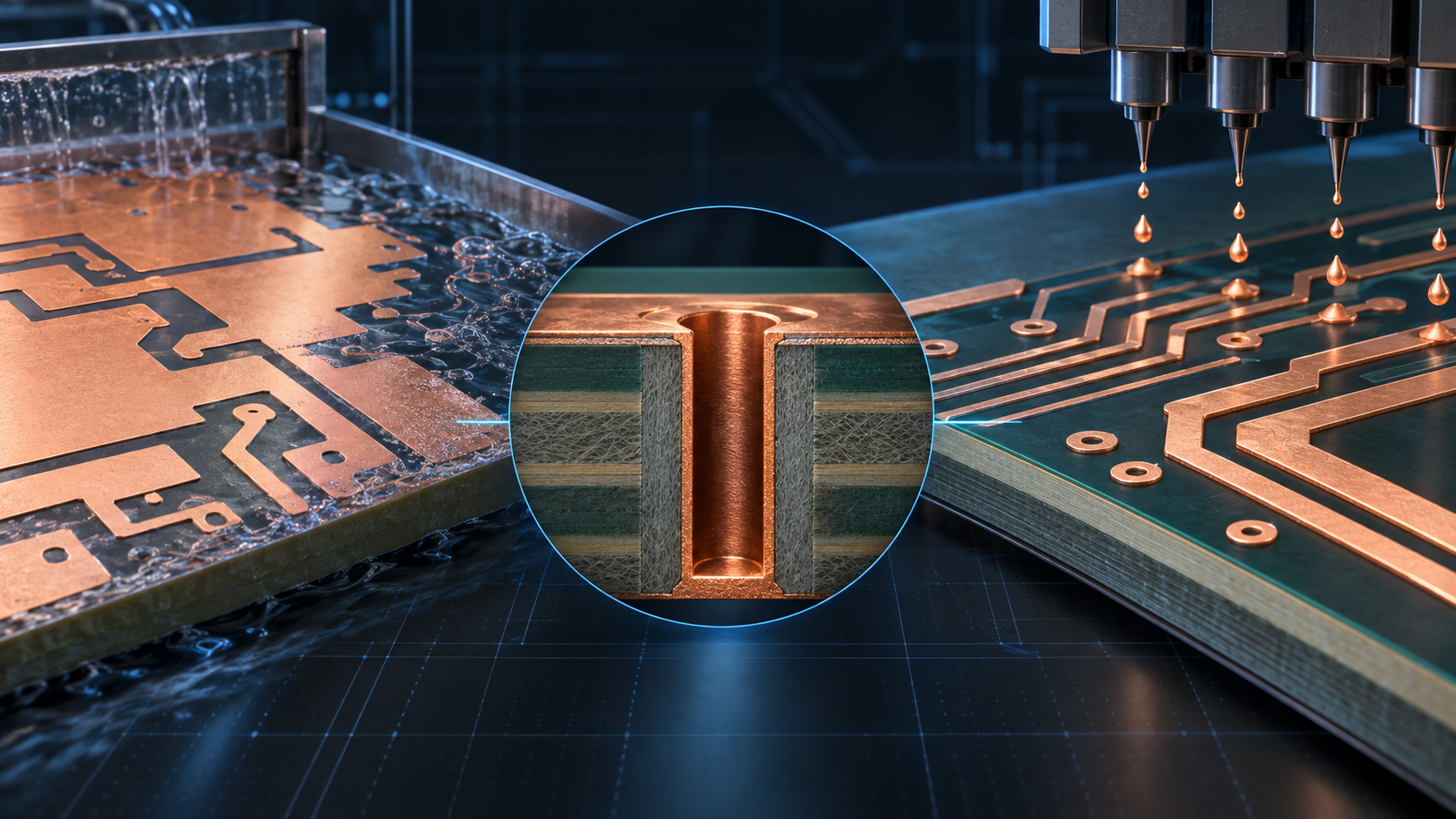
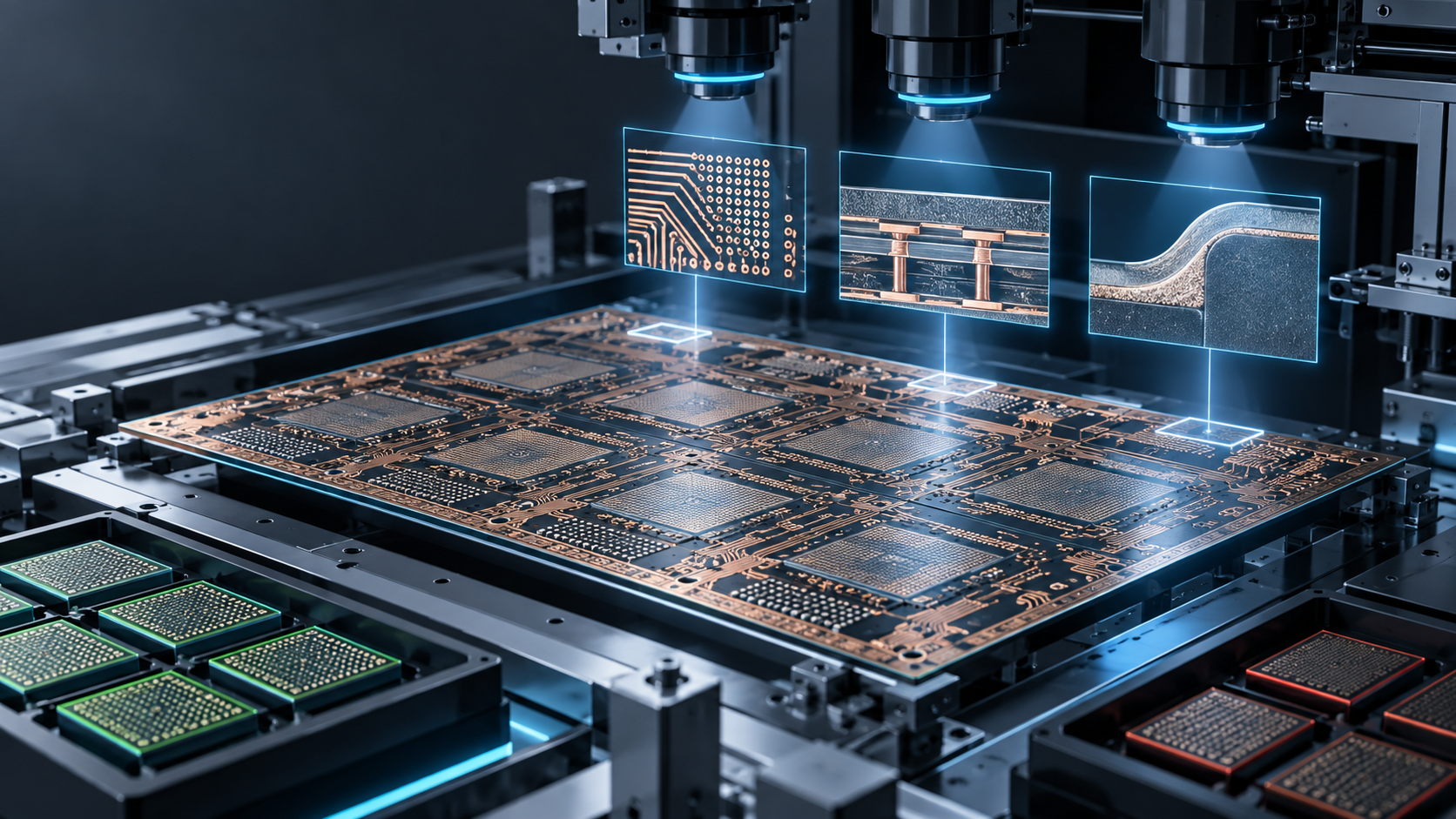
Claim 1 of US20260310299A1 describes forming a stack from conductive regions, substrate materials and a separator layer, then shaping it into a target three-dimensional structure. The description includes printing and forming approaches. The issue is how to produce a conformal component, not simply how to place a flat sensing element on a hand.
I read this as a manufacturing clue. Including fabrication methods can be strategically useful without establishing yield, cost or durability. Tactile sensing alone also does not prove successful slip detection or delicate-object handling in production.
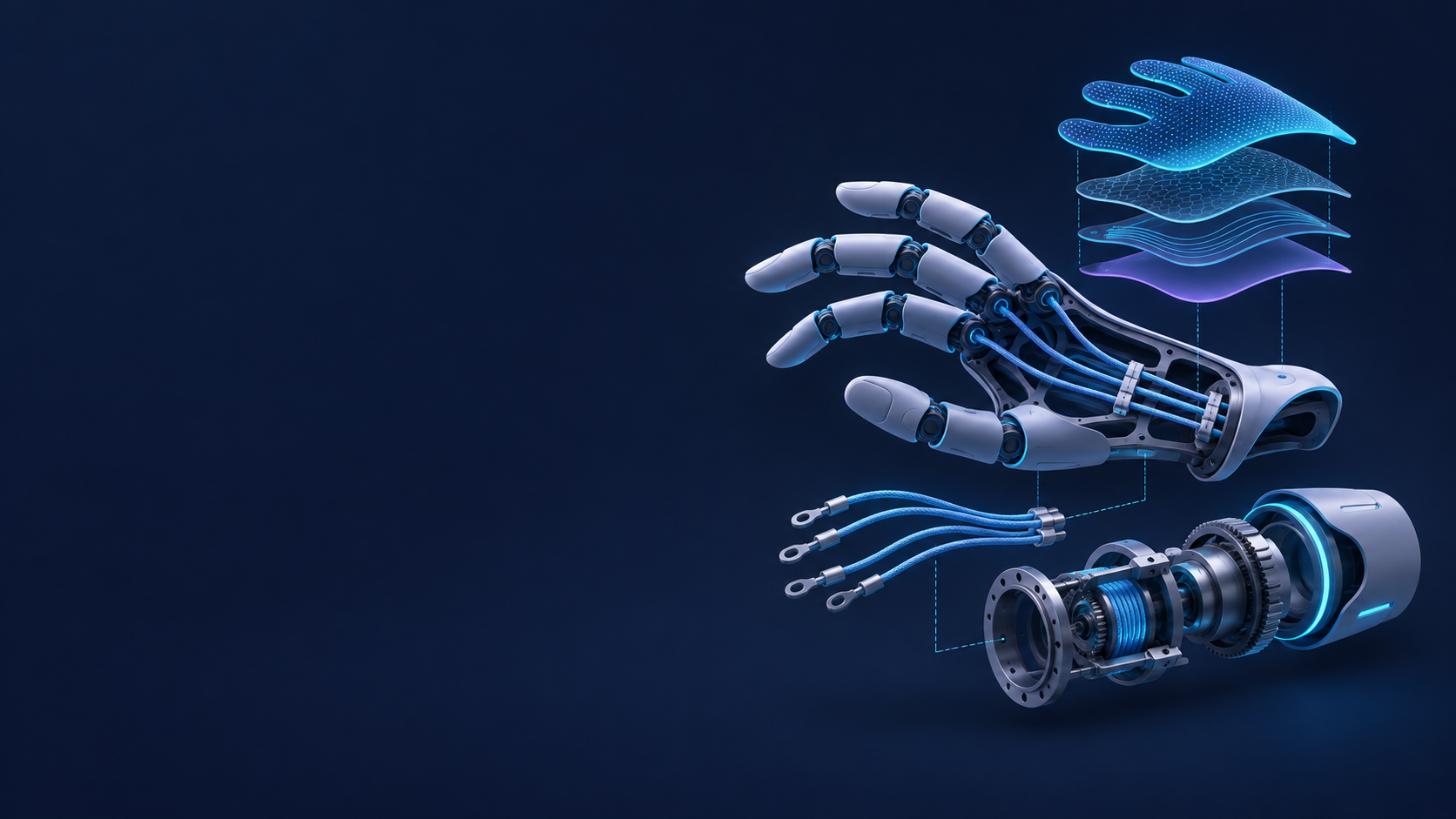
An economic assessment also needs to know whether a replaced sensing surface behaves consistently. Changed sensitivity may require recalibration. Manufacturing, maintenance and training data meet at this boundary; a single sensor specification cannot answer the whole question.
Three Companies Make Different Architectural Choices
The evidence types differ. Tesla is represented by selected applications, Figure by a company experiment and Boston Dynamics by product-design documentation. These are not controlled competitive benchmarks.
| Company and evidence | Visible choice | Strategic interpretation | Tradeoff to investigate |
|---|---|---|---|
| Tesla, three publication families | Cable actuation, routing and tactile forming | Compact mechanisms and manufacturing design | Wear, tension, calibration and servicing |
| Figure, Helix 2.5 | Whole-body learning and unseen environments | Less environment-specific setup | Full-task success and recovery |
| Boston Dynamics, Atlas hand | Four fingers, 13 DOF, direct actuation | Strength, simulation and serviceability | Weight, cost and task fit |
Atlas documentation describes encapsulated actuators without fragile cables crossing joints. That is a different choice from optimizing cable paths. Which arrangement wins depends on tasks and maintenance conditions, rather than appearance alone.
Figure's September 2026 evaluation reports 56% complete-task success with pretraining versus 9% in its comparison condition across 30 unseen homes. These are company-reported experimental results, not comparisons with Tesla or Atlas. The 56% figure is not a factory utilization rate.
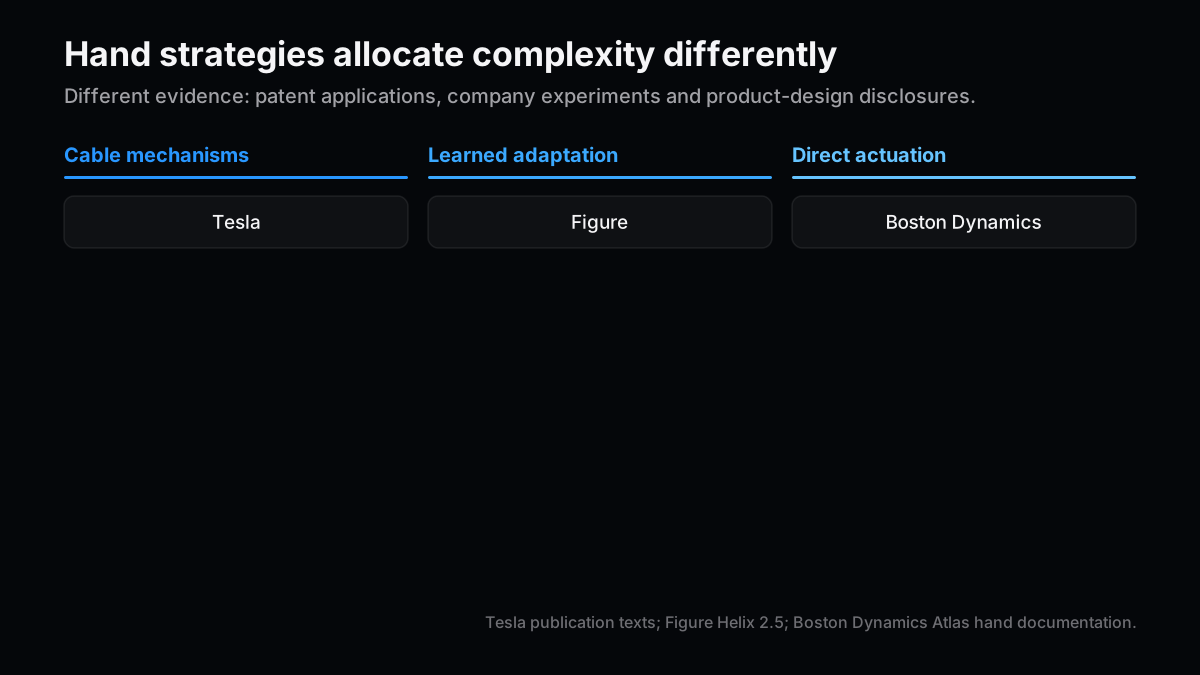
My interpretation is that the competitive question concerns where contact and failure are handled: mechanical design, learned adaptation or operational recovery. Every system eventually needs all three. The location of complexity and cost nevertheless differs across architectures.

Translate the Strategy Into Cost Per Useful Hour
Instead of inventing product prices or lifetimes, use explicitly hypothetical inputs: $100,000 acquisition cost, five-year straight-line allocation, $10,000 annual maintenance and 2,000 scheduled hours. These are calculation assumptions, not any real robot's price, warranty or service life.
Annual acquisition allocation is $20,000. Add $10,000 maintenance and divide the $30,000 total by useful hours.
| Useful-work share of scheduled time | Useful annual hours | Acquisition and maintenance per useful hour |
|---|---|---|
| 40% | 800 | $37.50 |
| 70% | 1,400 | $21.43 |
| 90% | 1,800 | $16.67 |
Electricity, integration, supervision, insurance and damaged output are excluded. This is not a labor-replacement break-even estimate. It shows how different amounts of completed useful work change the economics of the same assumed machine price.
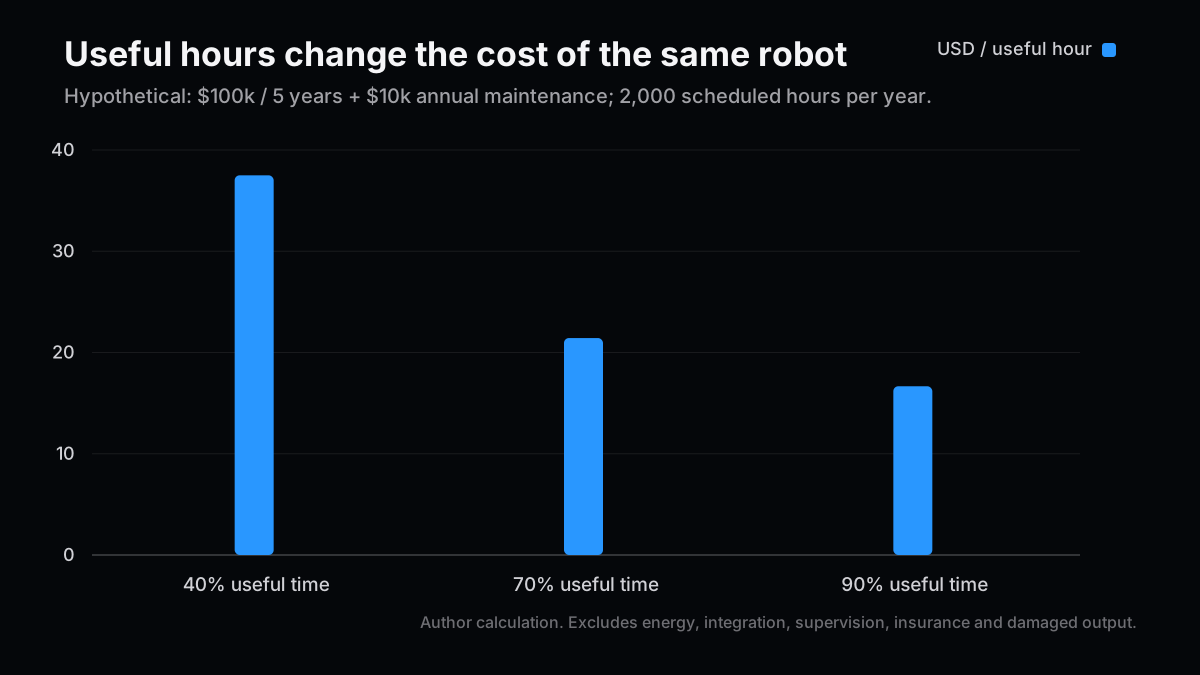
Useful time depends on more than mechanical availability. Autonomous success, waiting and recovery also matter. An inexpensive cable system can become costly if adjustment is frequent. A more expensive component can improve total economics if replacement is fast and completed work increases.
That is why I would connect patent analysis to operating evidence before assigning revenue potential. A design can reduce bill-of-material costs while shifting expense into service. Another can raise upfront cost while reducing field intervention. Neither outcome can be determined by the number of disclosed joints.

Patents Generate a Hypothesis, Not Proof of Production Value
The selected families suggest attention to contact mechanisms and manufacturing. I am interested in the medium-term supply chain for tactile materials, wear components, calibration and replacement systems. These publications alone do not justify building Tesla earnings or equity value from assumed robot shipments.
| Scenario | Required evidence | Economic implication | Assessment |
|---|---|---|---|
| Base case | Limited tasks operate with repeatable servicing | Useful hours improve gradually | Verify production and operations |
| Main upside | High success coincides with low service burden | Cost falls across more tasks | Reassess components and operating platforms |
| Tail risk | Wear, recalibration and recovery remain costly | Low machine price still yields expensive work | Reduce adoption and profit assumptions |
What would change my mind: component durability improves but task success and recovery costs do not, leaving cost per useful hour unchanged. Conversely, repeated multi-site disclosure of useful hours and maintenance costs would strengthen the production thesis.
The next useful evidence is cycles before replacement, repair time, recalibration requirements and complete-task success across all attempts. A hand's architecture can reveal strategic priorities. Working hours and recovered cash establish whether those priorities became shareholder value.
Related Posts
- AI Chip Investments 2: Integrating Models and Hardware — Capital and compute behind physical AI.
- AI Chip Earnings 2: Production Growth and Cash — The funding burden of scaling technology.
- Post 76: How Constraints Reach Stocks — Reading businesses through constraints outside compute.
References
- US20260346473A1, published finger application text, November 5, 2026
- WO2024073138A1, the same finger family's 2024 publication
- WO2026080687A1, hand and forearm cable routing, April 16, 2026
- US20260310299A1, published 3D tactile-sensor application text, October 8, 2026
- Figure, Helix 2.5 company evaluation, September 17, 2026
- Boston Dynamics, Robot Hands for Modern AI and Real Work
Next Issue Ideas
- Idea 1: The Price of One Hour of Robot Downtime — Compare service, recovery and useful hours across three or more operating disclosures.
- Idea 2: Where Tactile Manufacturing Earns a Return — Map materials, printing, forming and calibration against three-to-five-year adoption conditions.
- Idea 3: Humanoids and Dedicated Machines on the Same Task — Compare integration costs and completed work rather than acquisition price alone.
This article is not investment advice. The author may hold securities mentioned. Generative AI assisted its preparation. Please read the disclaimer before making an investment decision.