A 1% Stock Option Thins to 0.63% After Three Funding Rounds: Even Founders Shrink to 16%
What is the 1% stock option in your job offer worth by IPO? Even founders shrink to 16%. Here is how the thinning works, a rough take-home figure, and what to ask before you join.
What is the 1% stock option in your job offer worth by IPO? Even founders shrink to 16%. Here is how the thinning works, a rough take-home figure, and what to ask before you join.

The amounts here combine public data into an example and are not any company's numbers. The data on how ownership thins out is Carta's and largely US, so it may not fit Japanese companies. The tax notes are general and use Japanese rules, so please check with a tax adviser for your own case. Checked as of October 31, 2026 (Asia time).
Your startup job offer says "1% in stock options." By the time the company lists, what is that 1% worth?
The short answer: with three funding rounds before listing, the medians put your stake at about 0.63%. That is an example, and the number of rounds and the amounts sold vary by company. But nobody escapes dilution, not even founders. In Carta's US data, the median founding team holds 56% after seed, 36% after Series A, and 16.1% after Series C.
Being diluted is not necessarily bad news, though. This post walks through the math, a rough take-home figure, and what to ask before you join.
In the last post, the ramen shop math had a line saying new shareholders thin your share by 20%. This time I open up that one line from the point of view of someone working there.
Your Slice Gets Thinner, but the Pizza Gets Bigger
Think of a company's shares as a pizza.
Each time the company raises money, new shareholders get slices. Your slice stays the same size in shares, but it becomes a smaller share of the whole. That is what "dilution" means.
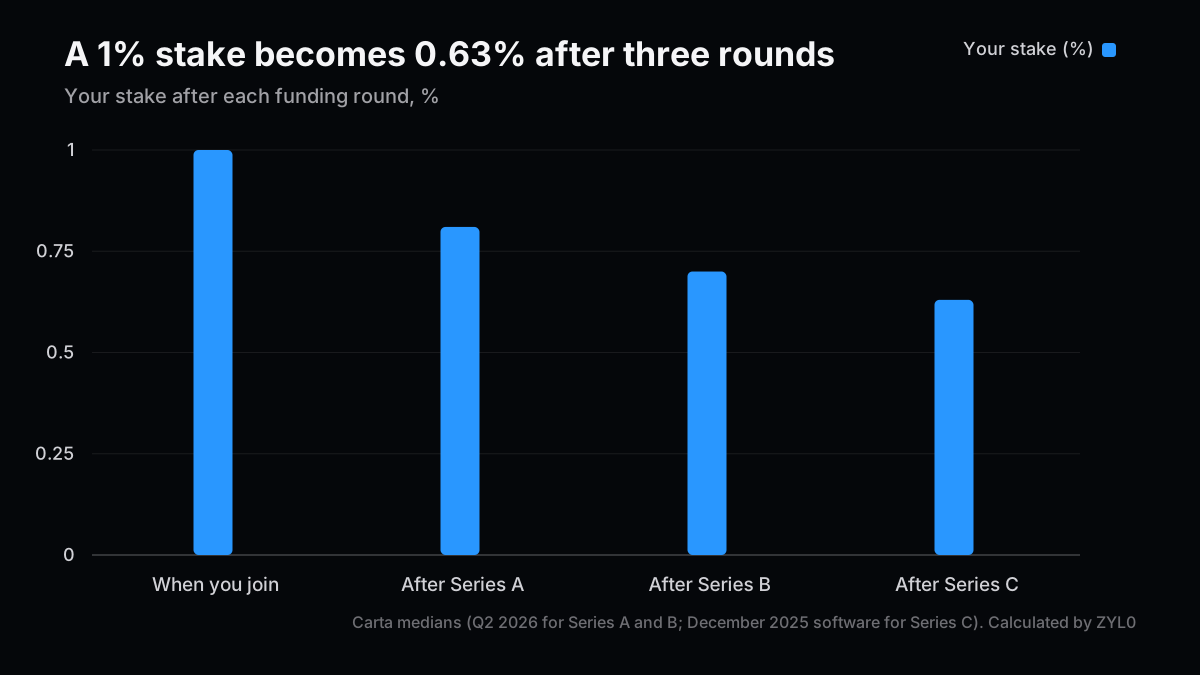
How much? Carta's Q2 2026 medians show 18.7% sold in a Series A and 13.4% in a Series B. I could not find a Series C figure at the same level of detail, so I use 10%, the December 2025 median for software companies, as a placeholder.
It is plain multiplication, so a calculator is enough.
| Point | Share new holders get that round | Your stake |
|---|---|---|
| When you join | — | 1.00% |
| After Series A | 18.7% | 0.81% |
| After Series B | 13.4% | 0.70% |
| After Series C | 10% | 0.63% |
The founders' numbers show this is nothing unusual.
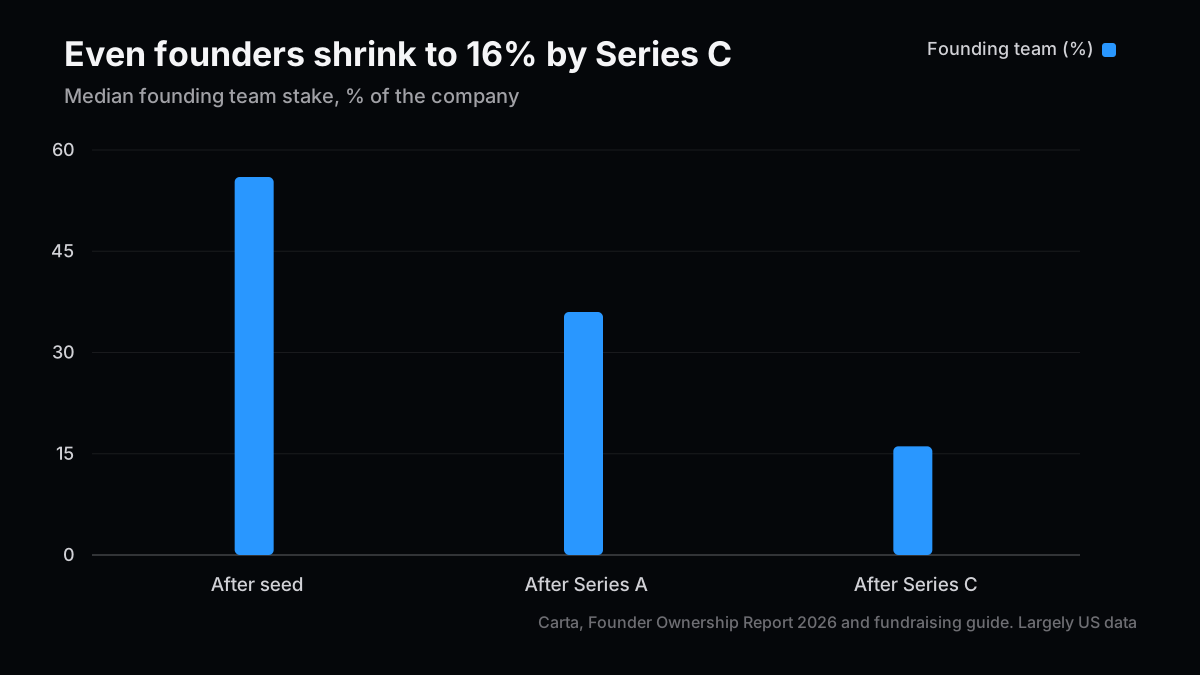
By Series C, the employee pool (16.8%) is bigger than the founders' stake (16.1%). More is set aside for the people working there than the people who started it still hold. Seeing that number changed how I look at this a little.
So is dilution a loss?
Not necessarily. Your percentage falls, but if the company's price rises faster, your slice is worth more. Say the company was worth ¥1bn when you joined, so 1% is ¥10M. If it is worth ¥11.3bn at listing, 0.63% is about ¥71.6M. Your share fell by nearly 40%, and its value rose sevenfold.
¥11.3bn is not an arbitrary figure. According to INITIAL, it was the median first-day market value of Japanese startups listing in the first half of 2025.


What Do You Actually Take Home?
This is probably what you most want to know.
A stock option is a right to buy shares at a fixed price. If the company was worth ¥1bn when you joined, think of 1% as the right to buy that 1% for ¥10M. Sell after listing, and the difference is your profit.
Under Japan's tax-qualified option rules, buying the shares triggers no tax, and the profit is taxed at about 20% (20.315%) when you sell, the same rate the National Tax Agency describes for shares. Without that status, the gain is generally taxed as income when you exercise, and you keep a lot less.
With the same assumptions (¥1bn on joining, ¥11.3bn at listing, three rounds), it looks like this.
| Granted when you join | Stake at listing | Value at listing | Cost to buy | Take-home after tax |
|---|---|---|---|---|
| 0.1% | 0.063% | ¥7.2M | ¥1M | about ¥4.9M |
| 0.5% | 0.317% | ¥35.8M | ¥5M | about ¥24.5M |
| 1% | 0.634% | ¥71.6M | ¥10M | about ¥49.1M |
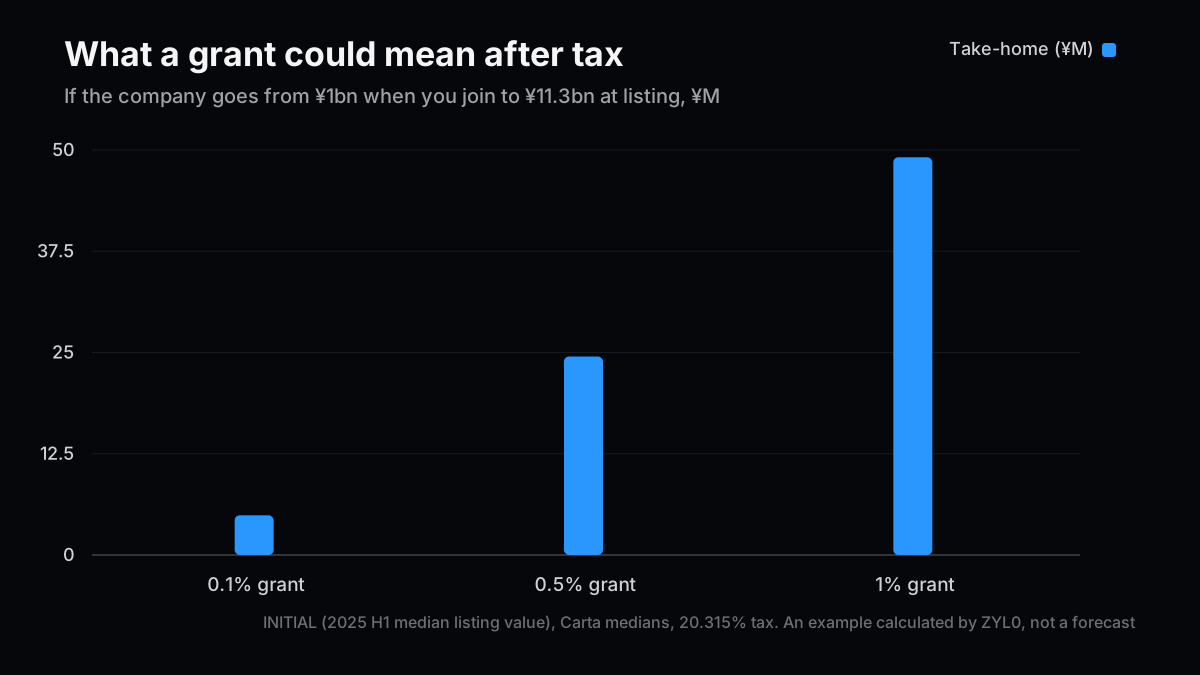
Treat 1% as a big number. One study puts stock options at new listings at a median of 9.4% of the whole company (2022), and that is split among everyone, so most employees get far less. A Money Forward guide suggests designing for about 0.5 to 1 times annual salary for regular staff. On a ¥6M salary that is ¥3M to ¥6M, close to the 0.1% row above.

Why It Rarely Goes to Plan
So far this is the version where things work out. Honestly, here is why they often do not.
Most companies never list. INITIAL counts 14 startups listing in Japan in the first half of 2026. In that same half-year, STARTUP DB counts 1,061 companies raising money. The sources differ, so this is no clean ratio, but the gap is two orders of magnitude. Without a listing, options often stay on paper.
You may lose them when you leave. Some contracts only let you use the right after a set number of years, or cancel it when you quit. This varies by company.
You may not be able to sell right away. There is often a period after listing when you cannot sell, and the price can fall meanwhile. The ¥11.3bn above is a median first-day value, and nothing guarantees you can sell at it.
Dilution varies. Among this year's large rounds, ElevenLabs sold 4.5% for $500M, Harvey 1.8% for $200M, and Valar Atomics 16.7% for $1bn (each as amount raised over valuation). The higher the price, the less gets sold each time. Join later and fewer rounds remain, and some companies raise four times or more. The 0.63% is only the three-round example.
So I do not think stock options can stand in for salary. If you are taking a pay cut to join, first make sure your life still works if they end up worth nothing. They are a poor fit if you need a lump sum soon.

What to Ask Before You Join
When someone says "1%", here is what to check. It may feel awkward to ask, but a serious company should be able to answer.
| What to ask | Why it matters |
|---|---|
| What percent of all shares, including planned ones? | "X shares" alone tells you nothing |
| What is the price per share to exercise? | Your take-home depends on the gap from this price |
| When can I use it (vesting)? | Terms like "gradually over four years" are common |
| What happens if I leave? | It may lapse, or you may keep a window to use it |
| Is it tax-qualified? | It changes how much tax you pay, by a lot |
| Current valuation, and the next funding plan? | Your starting price, and how much dilution to expect |
Japan's tax-qualified options also cap how much you can exercise in a year. The limit was ¥12M, and for options granted from April 2024 it rose to as much as ¥36M depending on how long ago the company was founded. The 1% row above is ¥10M, so it usually fits, but check if you are getting a large grant.
If you want to run your own numbers, get a feel for company prices with the calculator from the last post, then follow the multiplication in the tables above.
What struck me while writing this is how strong the word "1%" is. A percentage is easy to grasp, but on its own it settles nothing. Only once you ask how the denominator will change does it become a conversation about money.
Related Posts
- Who Decides a Startup Is Worth a Trillion Yen? — How a company gets its price, worked on a ramen shop
- Cloud Revenue Doubled at the Top, Yet Three of Four Can't Fund Their Capex — Which also touches on what happens to shareholders when listed companies raise equity
References
- Founder Ownership Report 2026 (Carta)
- Startup Funding: A Guide (Carta)
- Series A Funding: Round benchmarks, Q2 2026 (Carta)
- How Much Equity Founders Sell in Each Venture Round (Carta, December 2025)
- Japan Startup Finance 2025 H1 (INITIAL)
- Japan Startup Finance 2026 H1 (INITIAL)
- Domestic Startup Investment Report, H1 2026 (STARTUP DB)
- Stock Option Grants at Hiring (Startup Class)
- A Guide to Stock Options (Money Forward)
- 2024 Tax Reform for Stock Options in Japan (EY)
- No.1463 Tax on Share Transfers (National Tax Agency, Japan)
Next Issue Ideas
- Idea 1: Did You Grow, or Did the Yen Just Fall? — Where a home-made investment spreadsheet quietly goes wrong.
- Idea 2: Why Do Prices Fall Right After Listing? — Reading the gap between private valuations and post-IPO share prices from public information.
- Idea 3: Five Numbers to Check Before Joining a Startup — Cash left, sales growth, the gap between rounds, and other figures you can check from outside.
This post is not investment or tax advice. The author may hold securities of the companies mentioned. Generative AI was used in preparing it. Please read the disclaimer before making any investment decision.