A $10 Billion Moon Contract Is Not a Backlog: Reading NASA's Lunar Awards Through Three Companies' Backlog Rules
NASA's CLPS 2 is a $10 billion ceiling shared by eight vendors; the money actually ordered that day was about $1.3 billion under VADR. Three lunar companies' 10-Q backlog rules show how ceilings, firm orders and options get counted.

NASA's CLPS 2 is a $10 billion ceiling shared by eight vendors; the money actually ordered that day was about $1.3 billion under VADR. Three lunar companies' 10-Q backlog rules show how ceilings, firm orders and options get counted.

The $10 billion attached to NASA's CLPS 2 on November 7, 2026 is a ceiling that eight companies will compete under for ten years. It is nobody's order. The money NASA actually ordered in the same announcement was about $1.3 billion across six VADR task orders. And when you open the 10-Qs of the three listed CLPS 2 vendors, the ratio of accounting remaining performance obligations (RPO) to company-reported backlog runs from 33% at Firefly to 46% at Intuitive Machines and 82% at Voyager. Same word, very different contents.
This is an outside-in read based only on public information: NASA's release and the companies' SEC filings, all checked on November 11, 2026. Intuitive Machines figures come from its latest available 10-Q, as of June 30, 2026.
In Post 72 I put four Big Tech companies on one capex definition before comparing them. The same discipline applies here. Space-company earnings releases lead with "record backlog," but the release itself rarely says what went into the number. The answer sits in the 10-Q, in management's discussion and in the revenue note.
Ceiling, Firm Order, Option: Three Words Behind Every IDIQ
Government space buying often runs through IDIQ contracts (indefinite-delivery/indefinite-quantity). The agency sets a frame first, then orders specific work later, one task order at a time. That gives every headline dollar figure at least three layers.
| Term | What it means | Distance from company revenue |
|---|---|---|
| Ceiling (maximum value) | The most that could ever be paid under the contract; for multiple-award vehicles, the total across all vendors | Far. The vendor has only qualified to compete |
| Firm amount (task order, base award) | Work with a defined price and scope that has actually been ordered | Close, though the government can still terminate for convenience |
| Option | Value added only if the customer chooses to exercise it | Uncertain until exercised |
CLPS 2's $10 billion sits in the first row. Eight vendors were selected, which does not mean $1.25 billion each. Who gets work will be decided task order by task order.
A ceiling is the most that can be paid, not a promise to pay. Voyager's 10-Q offers a useful split for how far the money has actually arrived. In the wording of its table footnotes, funded backlog covers projects with a written contract or purchase order, while unfunded backlog holds contract value not yet funded, unexercised options and potential bookings under IDIQ contracts (how this differs from the MD&A text is covered in "The Three Backlogs Do Not Count the Same Things"). In this piece I read the funded side as the one closer to revenue.
Splitting NASA's November 7 Release Into Layers
NASA's RELEASE26-095 bundled several Moon Base awards. The dollar figures in it belong to different layers.
| Contract | How NASA describes it | Layer |
|---|---|---|
| CLPS 2 | Ten-year, multiple-award IDIQ with a combined maximum value of $10 billion; eight companies are "eligible to compete" for future deliveries | Ceiling only; no task orders named that day |
| CLPS 1.0 | Contract value raised from $2.6 billion to $4.2 billion | A raised ceiling |
| VADR | Six task orders worth about $1.3 billion combined; VADR's maximum is $5 billion across all contracts | Firm (awarded to Arrow Science and Technology, Blue Origin and Impulse Space) |
| PROMISE | Blue Origin: $94 million base contract plus a $140 million option period based on performance | Firm plus option |
A "$234 million maximum" for PROMISE is not NASA's wording. It is my sum of $94 million and $140 million, and the option depends on performance.
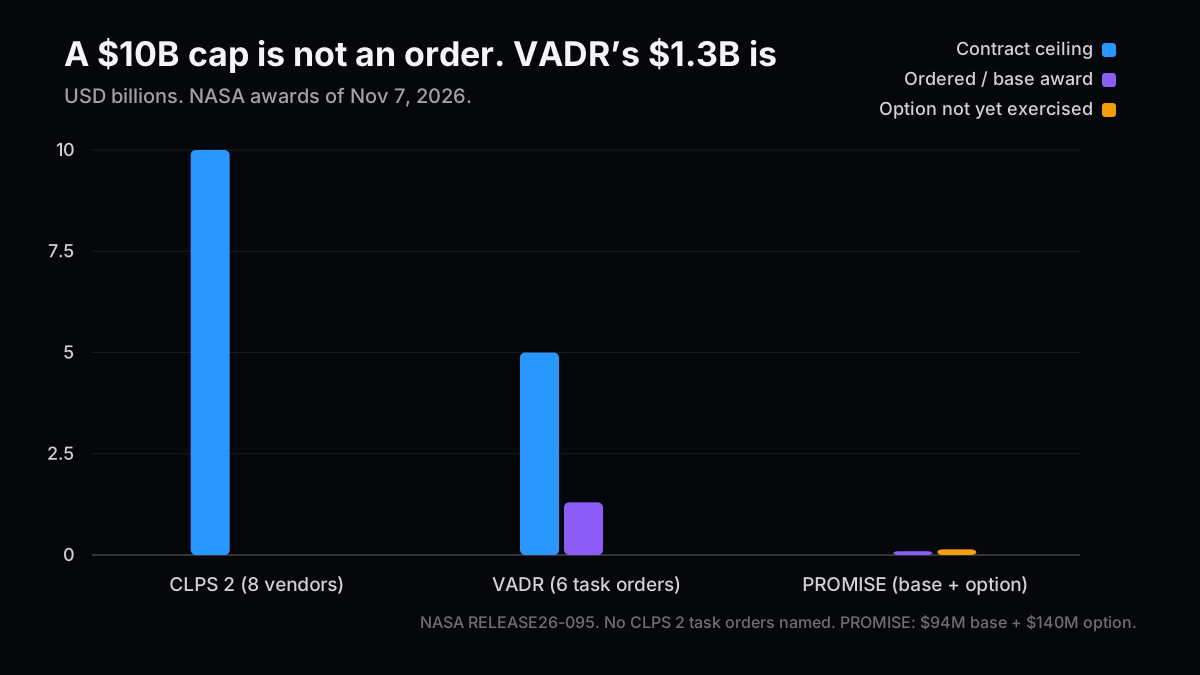
The tallest bar is a ceiling nothing has been ordered against.
NASA lists Firefly Aerospace, alongside Blue Origin, Impulse Space and Quantum Space, among the providers of in-space transportation spacecraft for the VADR missions. Firefly is not, however, one of the three companies awarded the six task orders. How much of the $1.3 billion might reach Firefly as a subcontractor is not stated.

The Three Backlogs Do Not Count the Same Things
Of the eight CLPS 2 vendors, three are themselves US-listed companies: Firefly Aerospace, Intuitive Machines and Voyager Technologies. Lockheed Martin Space and Northrop Grumman Space Systems are units of US-listed groups (LMT, NOC), and I leave them out because they are parts of much larger parents. I read the backlog definition in each of the three companies' latest 10-Q.
| Firefly (Sep 30, 2026) | Intuitive Machines (Jun 30, 2026) | Voyager (Sep 30, 2026) | |
|---|---|---|---|
| Backlog | $1,674.3M | $1,762.0M | $742.1M |
| When it is added | On execution of a legally binding agreement | When management judges the customer has made a substantive commitment to a defined scope | Funded plus unfunded |
| Future IDIQ orders | Not addressed | Excluded, explicitly | Unfunded backlog includes IDIQ bookings |
| Unexercised options | Not addressed in the backlog definition | Excluded, explicitly | Included in unfunded; at Sep 30 unfunded was mainly unexercised options |
| Other notes | Includes $400.3M of multi-launch agreements with missions not yet scheduled | Includes a multi-satellite program booked at an estimated value above $600M | Includes $347M added with the Astrobotic acquisition (earnings release) |
Voyager's filing describes unfunded backlog two ways. The MD&A text says "bookings under IDIQ contracts that has been definitized," while the table footnote says "potential bookings under IDIQ contracts." Whether a CLPS 2-style selection with no task order would be counted cannot be settled from that wording.
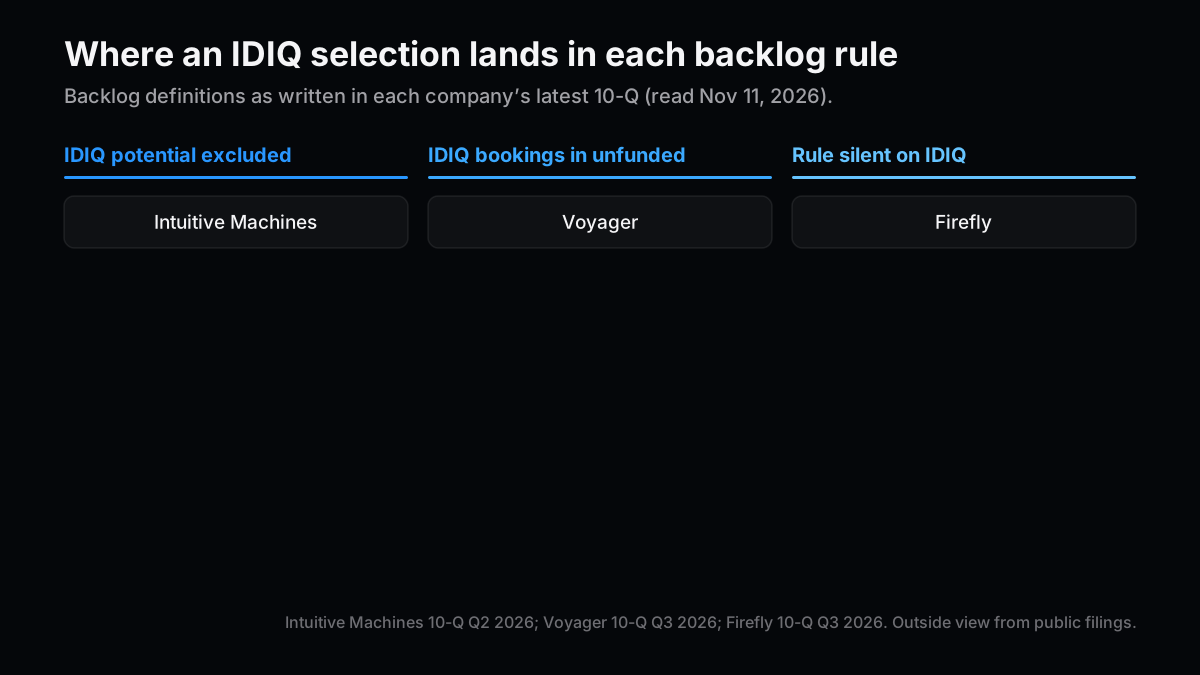
At a VC firm, I found that evaluation standards varied from person to person, and I standardized them. Assessments built on mismatched standards look comparable and are not. Backlog works the same way. If all three won identical task orders, the timing and size of what appears in backlog could still differ. Ranking the companies by backlog size ranks their counting rules.
Measuring the Gap Between Backlog and RPO
The definitions diverge because backlog is not a number the accounting standards define. Firefly calls it "our estimate," Intuitive Machines says "we define backlog," and Voyager lists it among the key performance metrics its management monitors. RPO, by contrast, is an item in the notes to the financial statements. So to put the three on one yardstick, I use RPO from the revenue note. RPO follows the accounting standard and captures the transaction price of contracted work not yet performed. Intuitive Machines states explicitly that it excludes unexercised options. Firefly's accounting policy, which does not treat options as performance obligations until exercised, implies the same. Voyager's 10-Q does not address the point.
| Backlog | RPO | RPO ÷ backlog (author calculation) | Expected conversion | |
|---|---|---|---|---|
| Firefly (Sep 30, 2026) | $1.674B | $0.549B | 33% | 37.4% of RPO within 12 months |
| Intuitive Machines (Jun 30, 2026) | $1.762B | $0.815B | 46% | 25–30% of backlog in the rest of 2026, 35–40% in 2027 |
| Voyager (Sep 30, 2026) | $0.742B | $0.608B | 82% | $93.8M of RPO in the rest of 2026, $335.3M in 2027 |
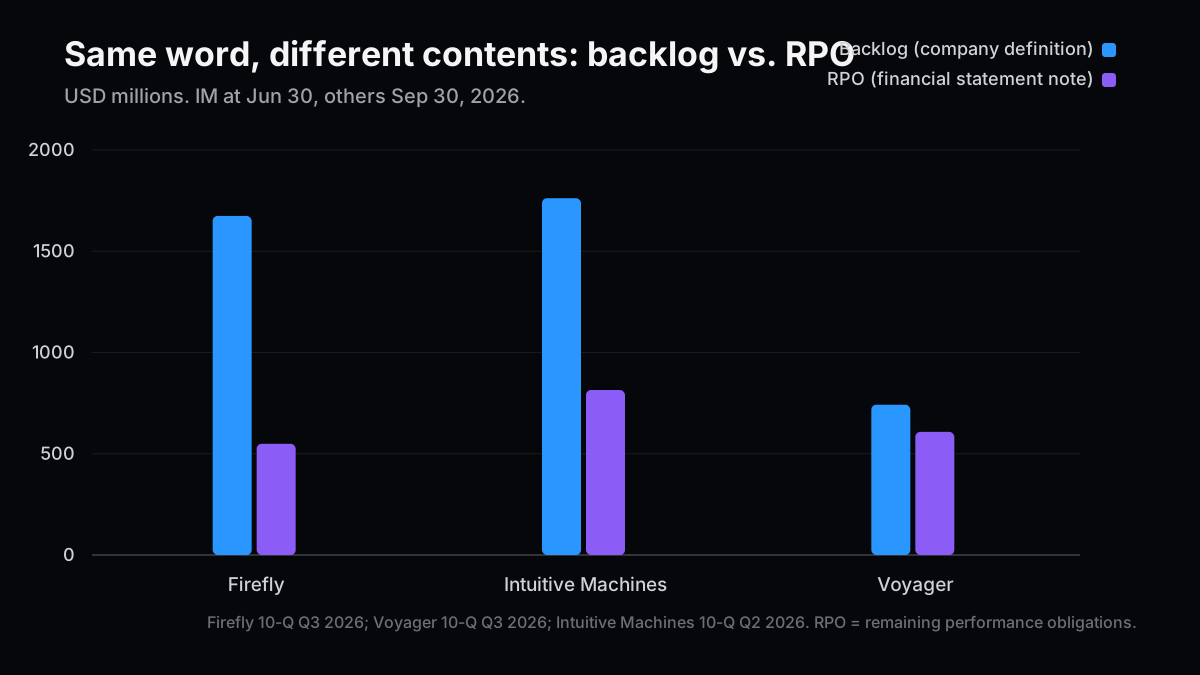
Firefly does not have the largest backlog — Intuitive Machines does ($1.762B vs $1.674B) — but Firefly has the largest backlog-to-RPO gap, about $1.13 billion. Part of it is plausibly the $400.3 million of multi-launch agreements with unscheduled missions. The rest is not itemized in the 10-Q.
Intuitive Machines decomposes its own $947.3 million gap: about $587.0 million for the multi-satellite program, $316.0 million of funded value on contracts billed as work is performed, and $44.3 million of constrained variable consideration. Whether a company explains the gap is one more thing to compare.
RPO is still not a pure "firm amount." Intuitive Machines' RPO covers fixed-price obligations only; time-and-materials and cost-reimbursable work drops out under a practical expedient. Firefly's 10-Q says its time-and-materials obligations qualify for the same "right to invoice" expedient, and Voyager's accounting policy in its fiscal 2025 10-K applies the right-to-invoice method mainly to cost-plus and time-and-materials contracts. How that affects either company's RPO figure cannot be read from the notes. Voyager's RPO ($608.0 million) also exceeds its funded backlog ($390.3 million), and one sentence in its MD&A calls the $608.0 million "funded backlog," which does not match its own table.
A firm order is not locked-in profit either. Voyager recorded a current accrued contract loss provision of $23.1 million, up from $0.6 million at year-end, mainly tied to fixed-price contracts assumed from Astrobotic. Winning work does not protect margins once costs rise.

When, and in Which Number, CLPS 2 Will Show Up
All three backlog figures are dated September 30, 2026 or earlier. The November 7, 2026 CLPS 2 award cannot be in any of them.
Firefly's November 10 earnings release leads with "record backlog of $1.7 billion" and, further down under "Additional Recent Highlights," says it was "onboarded as a vendor to NASA's $10 billion CLPS 2 initiative, to compete for and deliver task orders for large cargo landers." The same release says Firefly was onboarded to the $981 million Space Force NITE-STAR IDIQ "to compete for task orders." The wording is accurate and never calls a ceiling an order. Readers just should not add the $10 billion to the $1.7 billion.
Voyager reported on November 2, before NASA's announcement, and does not mention CLPS 2.
I could open neither the original nor a reprint of Intuitive Machines' CLPS 2 announcement, so this piece does not use its contents. Its September-quarter 10-Q was not on EDGAR as of November 11. Under the rules in its June 10-Q, a CLPS 2 selection alone stays out of backlog until a task order arrives.

What to look for differs by company. The test applies to filings covering periods that include dates after November 7, 2026. Intuitive Machines' 10-Q as of September 30, 2026 cannot contain CLPS 2, given its date. Each test assumes the company explains what moved its backlog; without that explanation, none of them can be applied.
- Firefly: backlog is added on execution of a legally binding agreement. If backlog rises on account of CLPS 2 before any CLPS 2 task order exists, the master contract itself has been counted.
- Voyager: watch how unfunded backlog moves. If CLPS 2 lifts only unfunded backlog while funded backlog stays flat, potential IDIQ bookings have been counted.
- Intuitive Machines: under its stated rule, backlog should not change until a task order arrives. If it does, check how the rule was applied.
So CLPS 2 becomes a valid explanation for a share price only when task orders arrive one by one and land in backlog and RPO, where each company's rule decides how they are counted.
Four Checks for Any Space Contract Headline
When I read a space-company award announcement, I work through these in order.
| Check | Where to look | This case |
|---|---|---|
| Ceiling or firm? | Words like "maximum value," "eligible to compete," "onboarded" | CLPS 2 is a ceiling; VADR's ~$1.3B is firm |
| Option conditions | "Option," "based on performance" | PROMISE's $140M depends on performance |
| Backlog definition | The Backlog section of the 10-Q MD&A | IM excludes IDIQ potential; Voyager includes it in unfunded |
| Revenue timing | The RPO note's "percent within 12 months" | Firefly 37.4%; Voyager $93.8M in the rest of 2026 |
By the fourth check, you have a rough sense of what the headline means for revenue over the 12 months from October 2026. For Firefly, 37.4% of $549.3 million in RPO is about $205 million (my calculation), a very different picture from a $1.7 billion headline.

Investment Call: Don't Explain a Stock With a Ceiling
CLPS 2 confirmed three companies' eligibility. It does not change their revenue outlook today. A share price that moved on the $10 billion was likely treating a ceiling as an order. Through November 2027, the things to track are task-order count and size, and growth in RPO.
| Scenario | What happens | Markers visible within 12 months (by November 2027) | How to read it |
|---|---|---|---|
| Most likely | CLPS 2 task orders arrive a few at a time through November 2027 | Timing and count of the first task orders; backlog and RPO at the three companies edge up quarter by quarter | Check each order's value and revenue timing |
| Upside | NASA needs lunar deliveries sooner and pulls orders forward | Several vendors win task orders in the same quarter; RPO rises at all three, but the near-term portion does not jump | Who wins matters more than policy differences |
| Tail risk | Budget cuts or shifting priorities thin the orders | Few task orders by November 2027; backlog moves only for reasons other than CLPS 2 | Only the headline number survives |
Firefly itself, in its earnings release, lists delays or reductions in US appropriations and changes in government budgetary priorities among the factors that could make actual results differ from its expectations.
What would change my mind: either of two things by November 2027. First, the near-term portion of RPO in the three companies' revenue notes rises sharply because of CLPS 2 task orders. That would break the call that the revenue outlook does not change soon.
Second, task orders arrive and RPO grows, yet share prices do not react and move only on ceiling announcements. What fails here is the premise that firm amounts, not ceilings, explain share prices.
What would make this method unnecessary: the three companies align their backlog definitions and the RPO-to-backlog gap (33%, 46%, 82%) narrows. Backlog could then be compared as reported. At that point, this piece's reading would no longer be needed.
The limits deserve stating too. This comparison relies on the wording of three companies' filings, not their contracts. Intuitive Machines' figures are as of June 30, a quarter behind the other two. Backlog is a management estimate, and each company notes that customers may be able to terminate contracts before completion.
Related Posts
- Cloud Revenue Doubled at the Top, Yet Three of Four Can No Longer Fund Their Capex — Putting four companies on one definition before comparing.
- Space Business Series 1: The Startups Turning Microgravity Into an R&D Platform — Space business seen from station and research demand.
- Physical AI: Three Patent Families and the Economics of Robot Hands — Separating announced designs from hours actually worked.
References
- NASA, RELEASE26-095, "NASA Awards Moon Base Transportation, Technology, Science Projects," November 7, 2026
- Firefly Aerospace, Q3 2026 earnings release (8-K, Exhibit 99.1), November 10, 2026
- Firefly Aerospace, Q3 2026 Form 10-Q (Backlog; revenue note), November 10, 2026
- Voyager Technologies, Q3 2026 earnings release (8-K, Exhibit 99.1), November 2, 2026
- Voyager Technologies, Q3 2026 Form 10-Q (Backlog; revenue note), November 3, 2026
- Intuitive Machines, Q2 2026 Form 10-Q (Backlog; revenue note), August 13, 2026
- Voyager Technologies, fiscal 2025 Form 10-K (significant accounting policies; revenue recognition)
Next Issue Ideas
- Idea 1: Who Gets the First CLPS 2 Task Orders, and for How Much — Once orders arrive, track backlog and RPO for three or more vendors in one table.
- Idea 2: Can Fixed-Price Lunar Landers Keep a Margin? — Compare loss provisions and cost-estimate changes across three or more lunar transport companies' notes.
- Idea 3: Defense IDIQs vs. Space IDIQs, Orders Against Ceilings — Count how much of the contracts companies called "onboarded" turned into orders one to two years later.
This article is not investment advice. The author may hold securities mentioned. Generative AI assisted its preparation. Please read the disclaimer before making an investment decision.