October CPI Came Without a 12-Month Number: Which Inflation Gauges Are Fed Officials Using to Weigh a Hike?
October's CPI came with no 12-month change, only a 0.3% monthly core print. Waller keys on that monthly number, Bowman on an estimated 3.3% core PCE and wages, Hammack on broad PCE pressure; for Cook there is only her vote. December, read gauge by gauge.

October's CPI came with no 12-month change, only a 0.3% monthly core print. Waller keys on that monthly number, Bowman on an estimated 3.3% core PCE and wages, Hammack on broad PCE pressure; for Cook there is only her vote. December, read gauge by gauge.

The October consumer price index released on November 10, 2026 has no year-over-year change. The October 2025 index was never produced, because of the 2025 lapse in federal appropriations. What is left is one month of data, a 0.3% monthly rise in core prices, and the Fed officials debating a hike are filling the missing month with different yardsticks.
This is an outside-in read based only on public material from the BLS, the Federal Reserve Board, the Cleveland Fed, the BEA and the US Treasury, checked on November 12, 2026 (Asia time). Officials' views are quoted from the texts of their speeches, the FOMC statement and the press conference transcript; except where I flag something as my reading, I do not guess at intentions they did not state. CPI index levels and changes were checked against BLS time-series data (series codes are listed in the References).
In Post 84, three listed companies used the same word, backlog, to count different things. Inflation has the same problem. When an indicator goes missing or disagrees, read what the people deciding use in its place. Two officials voted for a hike at the October 28 FOMC meeting; two voted to hold and then spoke on November 10. Adding the Chair to those four, here are the numbers each used in public.
What the October CPI Is Missing
Open the October 2025 cell in the BLS time series and there is no value for all items, core, food, energy or shelter, only the note "Data unavailable due to the 2025 lapse in appropriations." A year-over-year change divides this month's index by the index twelve months earlier. With no denominator, there is no number.
There are exceptions. The table in the BLS release does show October 12-month changes for gasoline (+37.4%), new vehicles (+0.7%) and used cars and trucks (−3.3%). Why these items have an October 2025 index is not explained in the release, and I have not confirmed it.
The November 2025 index does exist, so the 12-month change returns for headline and core with the November data. The hole does not go away, though. Any change that starts or ends in October 2025 stays missing in the series. A chart of 12-month rates will have gaps at October 2025 and October 2026, the October-to-November 2025 monthly change cannot be computed, and two-year comparisons will hit the same hole again in October 2027.
What the 12-month number used to do
Losing the year-over-year change makes three things harder to read. First, the direct comparison with the 2% goal: the FOMC's statement on longer-run goals defines 2% as "the annual change in the price index for personal consumption expenditures." Second, the trend: a 12-month figure smooths out month-to-month noise. Third, base effects: a 12-month figure moves with what happened a year ago, not only with this month. A single month has no base effect, but it has no smoothing either.
The officials fill these roles with substitutes: the comparison with the target through a PCE estimate, the trend through consecutive monthly prints and the breadth of price increases.
Why PCE still has a 12-month number
What disappeared is a CPI number. The FOMC's target gauge, the personal consumption expenditures (PCE) price index, still comes with a 12-month rate, and PCE prices are built largely from CPI components. The BEA's NIPA Handbook (Chapter 5) says that for most PCE categories the closest matching price index is a CPI, and it uses producer price indexes (PPI) for items such as physician and hospital services.
For that reason, in its January 22, 2026 release the BEA explained that it filled the missing October 2025 CPIs with the geometric mean of the September and November CPIs. That is why an October 2026 PCE 12-month rate can be computed. Its October 2025 denominator, however, contains prices the BEA imputed. If those imputed values miss the true prices, the error lands only in the October 12-month rate and drops out of November's, whose denominator is real data again. The size of any error is not published, and I cannot tell it. So October's PCE 12-month rate is best checked alongside November's. By the BEA's schedule, though, November's PCE comes out on December 23, after the meeting, so the November 25 number has to be read with the uncertainty of the imputed denominator built in.
Why CPI and PCE give different answers
By September the two gauges were already disagreeing.
| 12-month change, September 2026 | All items | Core (ex food and energy) |
|---|---|---|
| CPI (not seasonally adjusted) | 3.7% | 2.6% |
| PCE (BEA) | 3.6% | 3.1% |
The CPI figures are my calculation from BLS indexes; the PCE figures are the BEA's, released October 29. On core, PCE runs 0.5 percentage point above CPI.
The BEA groups the sources of the gap into four effects: formula (PCE uses a Fisher-Ideal formula, CPI a modified Laspeyres), weight (the same item carries a different share of spending), scope (CPI covers households' out-of-pocket spending, PCE also covers spending on their behalf) and "other" (seasonal adjustment and the like). In the BEA's own example, the third quarter of 2006, CPI ran 0.7 point above PCE, with the biggest contribution from the weight of owners' imputed rent. On scope, hospital and nursing home services stood out in that example. Shelter is heavy in CPI; the October release says shelter accounted for over thirty percent of the monthly all-items increase.
This time core PCE sits above core CPI. A year earlier, in November 2025, core PCE at 2.8% (BEA) was also above core CPI at 2.6% (my calculation from BLS indexes). Which gauge usually runs higher over long periods is something I have not checked here.
On headline the order flips: CPI all items at 3.7% sits 1.1 points above core at 2.6%. Energy CPI was up 20.4% over twelve months in September (not seasonally adjusted, my calculation), and gasoline was still up 37.4% in October. Bowman says pressure from higher energy prices and AI-related demand continues to flow through to core goods and services, and she attributes about a quarter of above-target core PCE inflation to energy.


Reading It Month to Month: Headline +0.4%, Core +0.3%
With no 12-month figure, the October CPI can only speak in monthly changes. Here are the seasonally adjusted numbers next to September.
| Monthly change, seasonally adjusted | Sep 2026 | Oct 2026 |
|---|---|---|
| All items | +0.6% | +0.4% |
| Core | +0.3% | +0.3% |
| Food | +0.0% | +0.5% |
| Energy | +5.2% | +0.7% |
| Shelter | +0.4% | +0.3% |
Headline slowed from 0.6% to 0.4% almost entirely because energy cooled, from +5.2% to +0.7%. Food went the other way, from 0.0% to 0.5%.
Core did not move. It printed +0.3% in August, September and October.
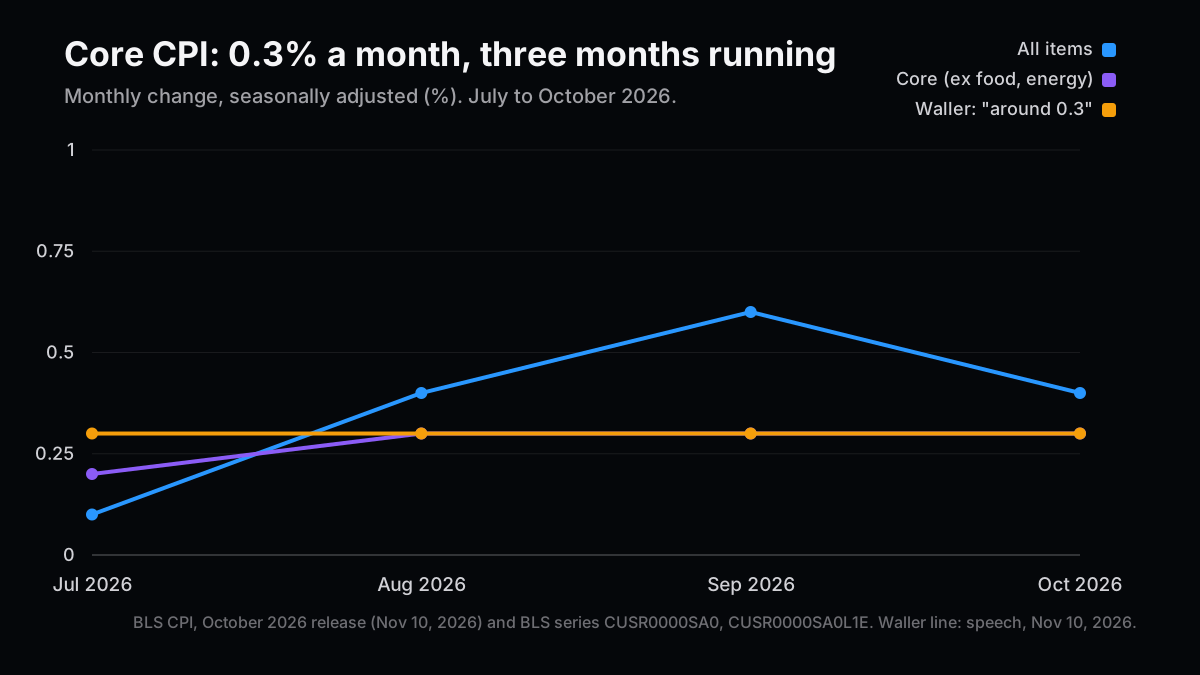
Twelve months of 0.3% would come to roughly 3.6% a year. That is a CPI pace, though, not the same yardstick as the 2% goal, which is defined in PCE terms. Comparing CPI with CPI, core was up 2.6% over the twelve months to September. A monthly pace running above the 12-month figure is itself a sign of acceleration.
Monthly and 12-month numbers trade off against each other. The monthly number arrives early but is noisy, and the published figure is rounded to one decimal. October's +0.3% core works out to about 0.296% from the seasonally adjusted indexes; "0.3%" covers anything from 0.25% up to just under 0.35%. The 12-month number is smoothed and stable, but it is slow to show a change in pace.
And on the morning of November 10, one official had set exactly that 0.3% as his trigger.

The Officials' Evidence in One Table
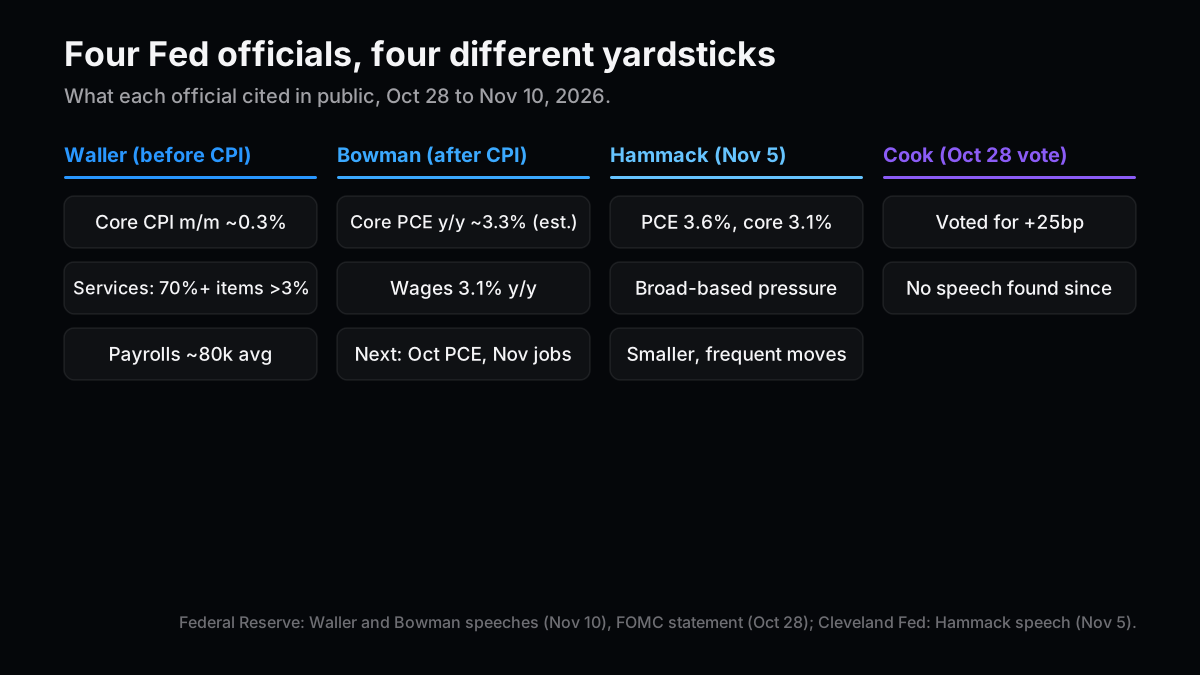
On October 28 the FOMC held the federal funds target range at 3.75% to 4.00%. The vote was 10 to 2; the statement says the two dissenters, Governor Lisa Cook and Cleveland Fed President Beth Hammack, preferred a 25 basis point hike. Governor Christopher Waller and Vice Chair for Supervision Michelle Bowman voted to hold, and each spoke on November 10. As a reference point, the table also includes Chair Kevin Warsh's press conference the same day.
| Official | Oct 28 vote | Numbers used in public | Direction | Source |
|---|---|---|---|---|
| Governor Waller | Hold | Monthly core CPI (if around 0.3% or more), September PCE, breadth of services prices | Supports a 25bp hike in December; 50bp to be considered on conditions | Nov 10 speech (before the CPI) |
| Vice Chair for Supervision Bowman | Hold | Estimated October core PCE at 3.3% year over year; wages at 3.1% | "Still work to do"; further tightening weighed against its costs | Nov 10 speech (after the CPI) |
| Cleveland Fed President Hammack | Hike 25bp | September PCE 3.6%, core PCE 3.1%, breadth of pressure | Move to a restrictive stance, in smaller and more frequent steps | Nov 5 speech |
| Governor Cook | Hike 25bp | Not found | Not found | Vote in the Oct 28 statement only |
| Chair Warsh (reference) | Hold | Target: 2% as measured by PCE. Signposts: inflation compensation in swaps and inflation expectations. Policy works through financial conditions | Price stability is "not about some isolated data point" | Oct 28 press conference (before CPI) |
Waller: a trigger set on the monthly print
Speaking in London, Waller noted that the CPI was due "in a few hours" and then spelled out his conditions. Even if October improved on September, he would support a 25 basis point hike in December. But if October looked like the previous two months, "with core CPI inflation around 0.3 percent or even higher," a 50 basis point hike should be considered, and hiking only 25 would put the Fed's credibility at risk.
Core came in at +0.3%. Taken at his word, the print meets the condition for considering 50. I could not find, as of November 12, any text showing that Waller backed 50 after seeing the data.
His second yardstick is breadth. Breadth is how you tell a one-off price jump in a few items from a rise that has spread across prices and is likely to persist. In September, more than 70% of the components of core PCE services prices rose more than 3% over twelve months. Waller writes that earlier this year excess inflation came from nonmarket prices that are estimated rather than observed, while now the components more relevant to future inflation, core goods and core market-based services excluding housing, are elevated. On jobs, he cited October's 165,000 gain but put the six- and twelve-month averages closer to 80,000 a month, which he reads as a labor market in rough balance.
Waller put September headline PCE at 3.7% over twelve months. The BEA release says 3.6% (both put core at 3.1%).
Bowman: translating CPI into PCE
Bowman spoke after the CPI came out. She did not discuss it as a monthly number at all. She translated it: "Today's consumer price index suggests that 12-month core PCE inflation likely moved up further to 3.3 percent in October."
Wages are part of her yardstick. Wage growth minus productivity growth gives the growth of labor cost per unit of output. The wages and salaries component of the employment cost index (September) and average hourly earnings (October) were both up 3.1% from a year earlier. Bowman gives no productivity figure, but citing strong productivity gains in recent years, she says that pace is in line with or even below what 2% inflation would imply, so she does not see the labor market pushing prices up. She attributes the above-target core PCE inflation of the twelve months to September roughly a quarter each to tariffs, energy and AI-related pressure, with the last quarter reflecting lingering effects of earlier shocks.
Her bottom line is that there is "still work to do," but she also writes that the benefit of additional tightening has to be carefully weighed against its costs for interest-rate-sensitive sectors, and that financial conditions have already tightened a bit with lower equity prices and wider corporate spreads. She adds that monetary policy cannot offset the direct effects of tariffs and energy costs, has limited influence on AI-related price pressures, and plays its central role in containing second-round effects. Of the four, Bowman attaches the most conditions to a hike, and I read the reason in that breakdown.
Hammack: 12-month PCE and breadth
Hammack spoke in Zurich on November 5, eight days after her dissent. Her topic was the dollar's reserve status and stablecoins, and she did not mention her vote. She did, however, put her inflation evidence on the record. September headline PCE was 3.6% and core 3.1%, both higher than at the start of the year. Inflation has been above goal for nearly six years, and the pressure she sees is "relatively broad based," coming from both supply and demand.
From there she says policy needs to move to a restrictive stance to bring inflation back to 2%, and that she would prefer to get there "through more frequent smaller adjustments when possible." That, she says, would be less disruptive to households, businesses and financial markets, and would reduce the risk of policy falling behind and an inflationary mindset taking hold.
My reading is that the difference between Waller and Hammack is how each handles the trade-off between monthly and 12-month numbers. Waller treats consecutive monthly prints as a sign of acceleration and holds out a 50 basis point step on conditions. Hammack looks at 12-month PCE and breadth and prefers a run of small steps. Neither of them frames it in these terms.
Cook: only a vote on record
For Governor Cook, I checked the Federal Reserve Board's speech list and press releases on November 12 and found no speech since October 28 and no explanation of her dissent. So this piece treats Cook only as having voted for a 25 basis point hike. I do not fill in which inflation gauge she watches.
At a VC firm, I once realized that a follow-on round was priced too high and argued against it in the investment committee with data. The objection only moved to a negotiation of terms once the numbers behind it were on the table. Dissents work the same way: what someone dissented on tells you more about the next decision than the vote count. Hammack put her numbers out eight days later. Cook had not as of November 12. If she speaks before December, that is when the fourth yardstick becomes visible.
Chair Warsh: expectations and financial conditions over any single data point
At his October 28 press conference, the Chair said the target is "2 percent as measured by PCE" and that price stability is "not about some isolated data point." As signposts for whether his strategy is working, the package he calls "new monetary medicine" (recommitting to the 2% target as the Fed's own responsibility, laying out a framework, and removing "a dose of accommodation" in September), he pointed to two things: inflation compensation as measured by swaps prices, which is read from market prices and carries risk premiums as well as expected inflation, and inflation expectations. Policy, he said, works mainly by tightening financial conditions; they had tightened a bit since the previous meeting, and that was not something the Committee was uncomfortable with. The press conference came thirteen days before the October CPI, so how he read that print is unknown.
Yields Rose the Same Day. The Reason Is Not on Record
In the Treasury's daily table, the 2-, 10- and 30-year yields all rose on November 10.
| Treasury par yield (%) | Oct 28 | Nov 6 | Nov 9 | Nov 10 | Nov 9 to 10 |
|---|---|---|---|---|---|
| 2-year | 4.67 | 4.51 | 4.56 | 4.73 | +0.17 |
| 10-year | 5.05 | 4.86 | 4.88 | 4.98 | +0.10 |
| 30-year | 5.37 | 5.26 | 5.26 | 5.35 | +0.09 |
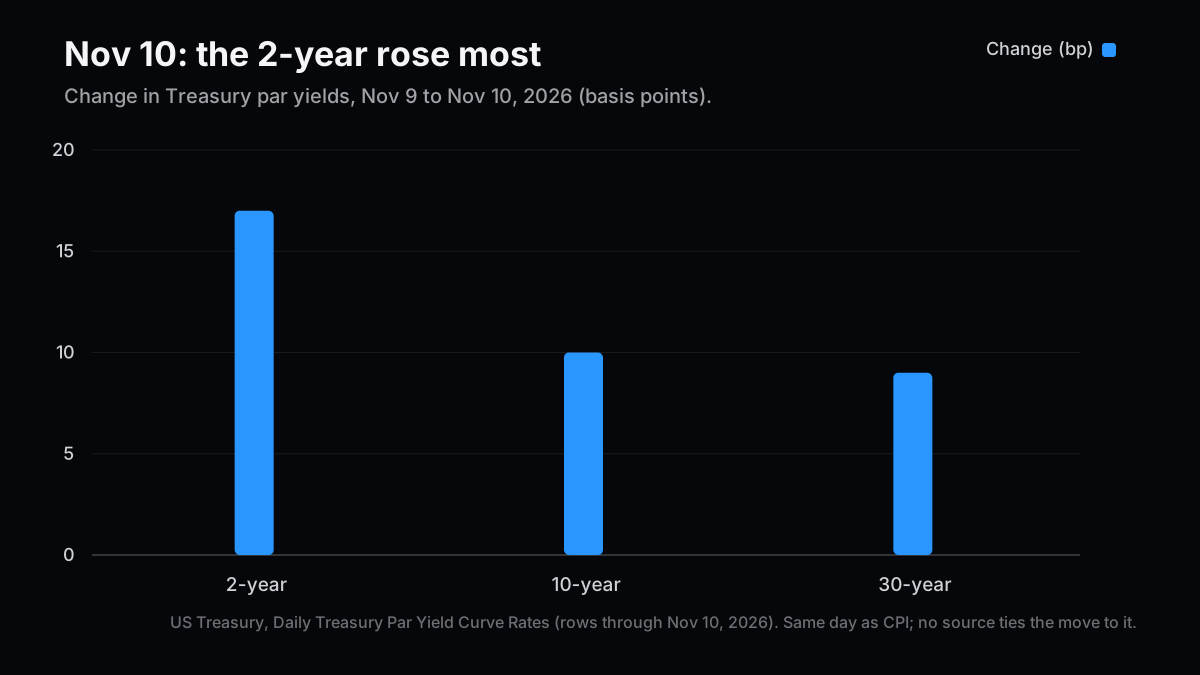
In Post 71 I broke the rise in long-term yields apart by maturity to find the main driver. I will not go that far here. November 10 brought the CPI and two speeches on the same day, and no source separates which of them moved yields. What can be said is that they happened on the same day and that the 2-year rose most.
The 2-year yield is commonly read as a gauge of where the policy rate is expected to go over roughly the next two years. At 4.73%, it sits 0.73 percentage point above the 4.00% top of the policy range. Waller said in his speech that he was comfortable holding in October because the Committee's signals had already led markets to price in some tightening. That explains the October meeting, though, not the November 10 move.
What Arrives Before the December 8-9 Meeting
The December FOMC meets on the 8th and 9th, with a Summary of Economic Projections.
| When | What | Whose yardstick it tests |
|---|---|---|
| November 25 (BEA) | October PCE | Checks Bowman's 3.3% estimate; feeds Hammack's PCE and Waller's breadth |
| Before the December meeting (per Bowman) | November employment report | Waller's roughly 80,000 average; Bowman's 3.1% wage growth |
| December 8-9 | FOMC statement and projections | The votes of all four and the Chair, Cook included |
Bowman named two things the Committee will receive before December: the October PCE report and the November employment report. The November CPI is not among them. The BLS release puts the November CPI on December 10, after the meeting.
My Stock Analyzer economic indicators page tabulates CPI, unemployment and policy rates for major economies (each indicator updates on its own schedule, so it may not yet show the October 2026 figures used here). Treasury yields are on the Treasury yields page, which lists the 13-week, 5-, 10- and 30-year but not the 2-year; for that, use the Treasury's table.

Investment Call: Don't Settle December on the October CPI
Only Waller's yardstick was triggered by the October CPI. All three officials whose numbers can be checked (Waller, Bowman, Hammack) cite 12-month PCE, and Bowman and Hammack use it as their main gauge. The Chair measures the target in PCE but takes his signposts from expectations and financial conditions. Cook's gauge is unknown. So the next number that matters for December is the October PCE on November 25. For anyone weighing stocks against bonds on the rate outlook, that date carries more weight than the CPI headline. Through the Chair's lens, what to follow through November 25 and December 8 is not a release but swaps-based inflation compensation and the moves in stocks and corporate bonds, which are the markers in case D.
When the yardsticks split, give the most weight to the next release of the gauge most voters use. A monthly number only moves the people who set their trigger on a monthly number. The exception is anyone whose yardstick is a market price: there is no release date.
| Case | What happens | Markers visible by December 8 | How to read it |
|---|---|---|---|
| A: reference | October core PCE lands at 3.2% to 3.4% (near Bowman's 3.3%) | November payrolls grow by 50,000 to 110,000 | Debate centers on a 25bp hike |
| B: upside | Core PCE at 3.5% or above | November payrolls grow by more than 110,000, and officials who voted to hold start talking about the size of a hike | Waller's 50bp option becomes a real choice |
| C: downside | Core PCE at 3.1% or below | Bowman gives more weight to the costs of a hike | Whether to hike 25bp at all becomes the debate |
| D: financial conditions lead | Inflation stays high, but equity losses and wider credit spreads deepen | The tightening in financial conditions Bowman flagged shows up in other officials' speeches | Officials weigh financial conditions over prices in deciding December |
The core PCE cut-offs (3.2% to 3.4%, 3.5% or above, 3.1% or below) and the 0.2-point line are lines I drew around Bowman's 3.3% estimate, and the payroll band (50,000 to 110,000 a month) is my own rule of thumb centered on the roughly 80,000 six- and twelve-month average Waller cited. Neither is a sourced threshold.
I attach no probabilities to A through D. Public information does not support them.
What would change my mind: three things. First, if November 25 core PCE lands 0.2 point or more away from Bowman's 3.3% (at 3.1% or below, or 3.5% or above) and officials do not shift their tone. Then reading the decision gauge by gauge fails, and officials are deciding December on something outside these price yardsticks, such as energy prices or financial conditions.
Second, if Cook speaks before the meeting and cites the monthly CPI as her main reason. Two officials would then have their trigger on the monthly number, and the October CPI carries more weight than I gave it.
Third, wages. Bowman does not count 3.1% wage growth as inflationary because she assumes strong productivity growth. If productivity growth slows, the same 3.1% means faster growth in labor cost per unit, and wages move to the inflationary side. The gauges to watch are the BLS's nonfarm business labor productivity and unit labor costs; the preliminary July-September 2026 figures came out on November 5, with productivity up 3.6% and unit labor costs down 0.7% at annual rates from the prior quarter (BLS time series). The revised figures are due on the morning of December 8, the first day of the meeting (BLS release schedule).
What would make this method unnecessary: the 12-month change returns to CPI with the November data; that much is already set. So the condition narrows to the gap between core CPI and core PCE (0.5 point in September) closing. The BEA splits the gap into formula, weight, scope and other effects. Going by the weight and scope effects that were large in its 2006 example, the gap could narrow if shelter, heavy in CPI, speeds up, or if medical services, large in PCE's scope, cool. If the gap shrinks to within 0.2 point, there is less need to read the gauges separately.
This piece reads speech texts, the statement and the press conference transcript, not post-speech question-and-answer sessions or media interviews. The Chair's press conference came before the October CPI. FOMC policy is set by twelve voters, and the five here are only part of that group.
Related Posts
- Did the AI Bond Rush Push Up Long-Term US Yields? — Breaking the rise in long yields apart by maturity.
- Cloud Revenue Doubled at the Top, Yet Three of Four Can No Longer Fund Their Capex — Four companies' results on one definition, right after the October 28 hold.
- The Warsh Shock — Part 2: How Far Rate Risk Reaches Into Tech Capex — The rates-to-capex analysis.
- A $10 Billion Moon Contract Is Not a Backlog — Another case of one word counting different things, in space-company backlogs.
References
- BLS, "Consumer Price Index – October 2026," November 10, 2026
- BLS, CPI time-series data (series used: CUSR0000SA0, CUSR0000SA0L1E, CUSR0000SAF1, CUSR0000SA0E, CUSR0000SAH1, CUUR0000SA0, CUUR0000SA0L1E, CUUR0000SA0E, CUUR0000SETB01; productivity: PRS85006092, PRS85006112)
- Federal Reserve Board, Governor Waller, "The Economic Outlook and Some Thoughts on Labor Market Dynamism," November 10, 2026
- Federal Reserve Board, Vice Chair for Supervision Bowman, "The U.S. Economy and Considerations for Monetary Policy," November 10, 2026
- Federal Reserve Bank of Cleveland, President Hammack, "Reserve Currencies and Stablecoins," November 5, 2026
- Federal Reserve Board, FOMC statement, October 28, 2026
- Federal Reserve Board, transcript of Chair Warsh's press conference, October 28, 2026
- BLS, Schedule of Releases for Productivity and Costs
- Federal Reserve Board, FOMC meeting calendars (2026)
- FOMC, "Statement on Longer-Run Goals and Monetary Policy Strategy" (reaffirmed January 27, 2026)
- BEA, "Personal Income and Outlays, September 2026," October 29, 2026
- BEA, "Personal Income and Outlays, October and November 2025" (Technical Notes: October Prices), January 22, 2026
- BEA, FAQ, "What accounts for the differences in the PCE price index and the Consumer Price Index?"
- BEA, NIPA Handbook, Chapter 5, "Personal Consumption Expenditures" (updated December 2024)
- US Treasury, Daily Treasury Par Yield Curve Rates (November 2026)
Next Issue Ideas
- Idea 1: Did October Core PCE Come In at 3.3%? — Use the BEA's November 25 release to check Bowman's estimate and Waller's breadth gauge, then redraw where the officials stand before December.
- Idea 2: Splitting the 0.5-Point Core CPI-PCE Gap by Item — Use the BEA's reconciliation table (Table 9.1U) to see which weight and scope items create the gap, as CPI regains its 12-month change with the November data.
- Idea 3: AI Capex and Corporate Bonds in a Hiking Cycle — Test the tightening in financial conditions Bowman described against credit spreads at three or more hyperscalers that keep issuing debt.
This article is not investment advice. The author may hold assets mentioned. Generative AI assisted its preparation. Please read the disclaimer before making an investment decision.