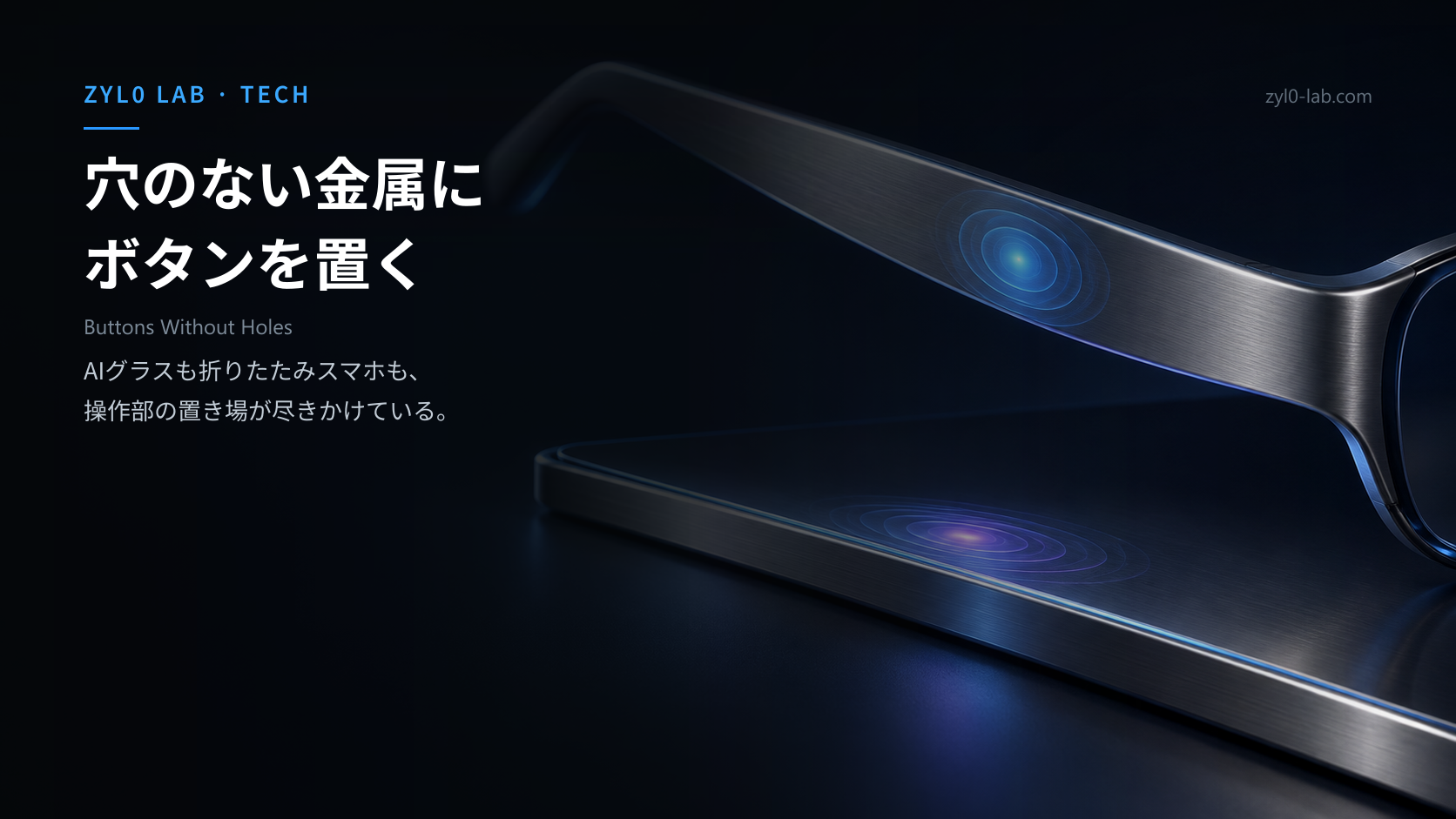
穴のない金属フレームにボタンを置く:AIグラスと薄型・折りたたみスマホの入力設計
本稿は公開情報のみに基づく外部からの読み方であり、各社への取材や非公開資料は使っていない。性能値は、特記のない限りメーカーの公表値である。
10月23日に発売されるiPhone Duoは、開くと厚さ5.2mmになる。Appleはこれを「史上最も薄いiPhone」と呼ぶ。その3か月前、SamsungはGalaxy Z Fold8 Ultraを開いて4.1mmで出した。Honorは3月に、Magic V6を4.0mmで出している。眼鏡の側では、Even Realities G2がチタンとマグネシウムのフレームで36gまで軽くなった。
数字だけを追うと、話は順調に見える。私が引っかかったのは別のところだ。これだけ薄く、これだけ金属になった筐体の、どこに指で触る場所を残すのか。
構造シミュレーションを回していた頃、薄い板に穴を開けると、穴の縁に応力が集まる絵を何度も見た。無限に広い板に丸い穴を開けると、縁の応力は教科書どおり約3倍になる。ボタンの穴は、それだけで薄い枠の弱点になる。そこへ防水のシールと、部品の積み重ねが加わる。
前回の800V DCの認証ゲートの記事では、部品の認証と施設の稼働許可を分けて読んだ。その前の先端基板の量産立ち上げの記事では、技術デモと量産の証拠を階層に分けた。今回の「穴のないボタン」にも、同じ読み方が要る。センサーの発表と、薄い金属筐体での量産採用は別の話だ。車載製品の量産に関わったとき、部品の認定を通ってからが本番だった。その感覚が、今回もずっと頭にあった。
本稿では、まず既存製品の設計と課題を並べる。次に、穴を開けずに指を読む5つの方式を比べる。最後に企業群とシナリオを置く。
先に結論を書くと、金属フレームのAIグラスは、操作部を「金属でない場所」へ逃がしてきた。
理由は単純だ。スマホの画面と同じ静電容量方式のタッチセンサーは、指と電極の間の電界の変化を読む。間に金属があると電界がさえぎられ、指が見えなくなる。だからタッチ操作を持たせたい場所は、樹脂にするか、穴を開けて樹脂やガラスの窓を入れるしかない。
公開情報で確認できた主な製品を並べると、次のようになる。
| 製品 | 発表 | フレーム | 重さ | 操作部の位置 | 見えている課題 |
|---|
| Even Realities G1 | 2024年 | 前面はマグネシウム合金、テンプルはチタン合金 | 44g | 耳の後ろのテンプル先端にTouchBar | 先端の膨らみが目立つ。耳の後ろへ手を回す操作になる |
| Even Realities G2 | 2025年 | チタンとマグネシウム合金 | 36g | 両テンプルのTouchPad(タップ、ダブルタップ、長押し、スクロール) | テンプルはG1より53%薄いが、電子部品はテンプル端の小さな筐体に残る |
| Meta Ray-Ban Display | 2025年9月 | 樹脂の射出成形(ヒンジはチタン) | 69g | 右テンプルのタッチパッドとボタン、付属の筋電(EMG)リストバンド | 主な操作は手首へ移った。バンドは42gで、セット価格は$799 |
| Samsungのスマートグラス | 2026年7月 | 非公表(Gentle Monster、Warby Parkerのデザイン) | 非公表 | フレームのタッチ操作。ジェスチャーはGalaxy Watch9経由のみ | 価格と発売日は、本稿の確認時点で見つけられなかった |
| Even Realities R1(リング) | 2025年 | ステンレス鋼にジルコニアセラミックのコーティング | — | 指輪そのものがG2のコントローラになる | $249の別売り。眼鏡の操作を指へ移す発想 |
表を見て気づくのは、量販を狙う製品ほど樹脂フレームに寄り、金属フレームの製品ほど操作部の置き場で苦労していることだ。Even G1は、電池・アンテナ・TouchBarを耳の後ろの先端部にまとめた。G2で先端部は小さくなったが、消えてはいない。
もう一つの流れは、操作部をフレームの外へ出す方向だ。MetaはEMGリストバンドを同梱し、指の動きを手首で読む。Evenはリングを用意し、Samsungはジェスチャーをウォッチに任せた。フレームに操作を置けないなら別のデバイスに置けばいい、という割り切りに見える。
ただ、これは追加のデバイスを身につけることが前提になる。眼鏡だけで完結させたい人には、遠回りだ。
眼鏡で金属が好まれる理由は、見た目だけではない。導波路ディスプレイは、フレームがわずかに歪むと像がずれる。細いテンプルで剛性を出すには、チタンやマグネシウムが向く。指輪も同じで、チタンやセラミックの外装が当たり前になりつつある。素材の要求と、センサーの都合が正面からぶつかっている。
スマホの側は、眼鏡よりも数字がはっきりしている。
折りたたみスマホは、閉じると2枚の板が重なり、開くと1枚になる。電源キー(多くは指紋センサーと一体)と音量キーは、そのうち片側の縁に載る。つまり、ボタンを置ける縁の高さは、ほぼ「開いたときの厚さ」で決まる。
| 機種 | 発表 | 開いた厚さ | 閉じた厚さ | 重さ |
|---|
| Honor Magic V6 | 2026年3月 | 4.0mm | 8.75mm | 219g |
| Galaxy Z Fold8 Ultra | 2026年7月 | 4.1mm | 8.9mm | 215g |
| Galaxy Z Fold7 | 2025年7月 | 4.2mm | 8.9mm | 215g |
| Galaxy Z Fold8 | 2026年7月 | 4.5mm | 9.7mm | 201g |
| iPhone Duo | 2026年9月 | 5.2mm | 11.3mm | 254g |
| 参考:iPhone Air | 2025年9月 | 5.64mm(1枚の板) | — | 165g |
厚さの差を図にすると、こうなる。
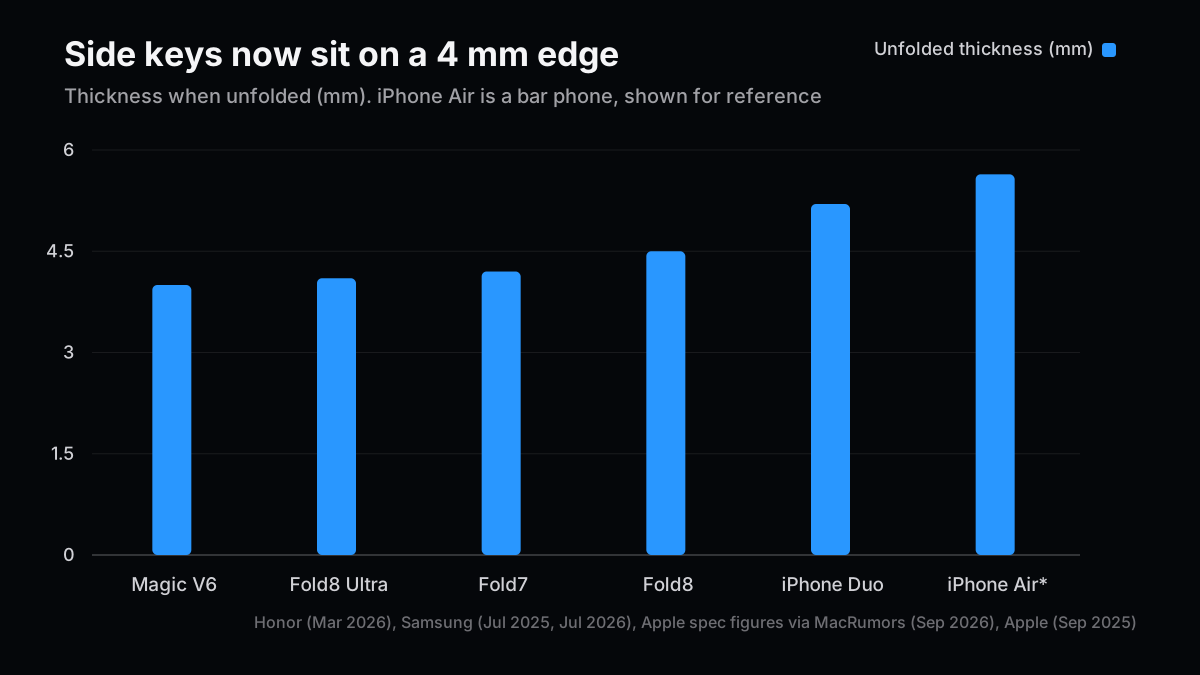
4mmという厚さには、表示パネル、カバーガラス、フレームの肉厚がすべて含まれる。ボタンに使える高さは、そこからさらに削られる。機械式ボタンは、キートップ、スイッチ、防水のシール、それを受ける枠の段差を縦に積む部品だ。私の見立てでは、4.1mmは機械式ボタンを置ける下限にかなり近い。
──いや、正確に言えば、限界に近いのは高さよりも穴の数かもしれない。チタンやアルミの薄い枠に電源・音量上・音量下の穴を開けるたびに、剛性の確保とシールの工程が一つずつ増える。iPhone DuoはGrade 5チタンの枠に、セラミックファイバーを入れたアンテナの切れ目と、内側の補強リブを持たせたとAppleは説明している。穴と切れ目をどう扱うかに、設計の手間がかかっていることがうかがえる。
金属フレームに窓を開けてタッチ操作を載せた最大の例が、iPhone 16から入ったCamera Controlだ。
Appleの説明では、表面はサファイアクリスタルで、周りをステンレスの縁取りが囲む。サファイアの下には多点の静電容量センサーと信号処理チップがあり、さらにその下に、クリック用のタクトスイッチと、Taptic Engineと連動するフォースセンサーがある。サファイアの高さは1台ずつ合わせてから、マイクロ溶接で固定するという。
これで「押す」「軽く押す」「なぞる」の3つの操作ができるようになった。その代わり、部品と工程が多い。
使い勝手の面では、ポケットやバッグの中での誤作動の報告が相次いだ。AppleはiOS 18.2で、画面がオンのときだけ反応する設定を加えた。ダブルクリックで起動する設定や、軽く押す操作とスワイプを切る設定も用意されている。ソフトで誤作動は減らせる。ただ、布越しの圧力と指をセンサーの段階で見分ける力は、この構成にはあまりない。
2026年9月のiPhone 18 Proでは、押す操作とスワイプがそのまま残った。一方、2027年春に出るとされる標準のiPhone 18については、静電容量の層をなくして感圧だけにする計画が報じられている。コストと誤作動の両方への答えに見えるが、スワイプは使えなくなる。
ここで問いが一つ立つ。「なぞる」操作を捨てずに、穴も開けない方法はあるのか。
ここからが本題だ。この比較表を作るのに、本稿で一番時間を使った。
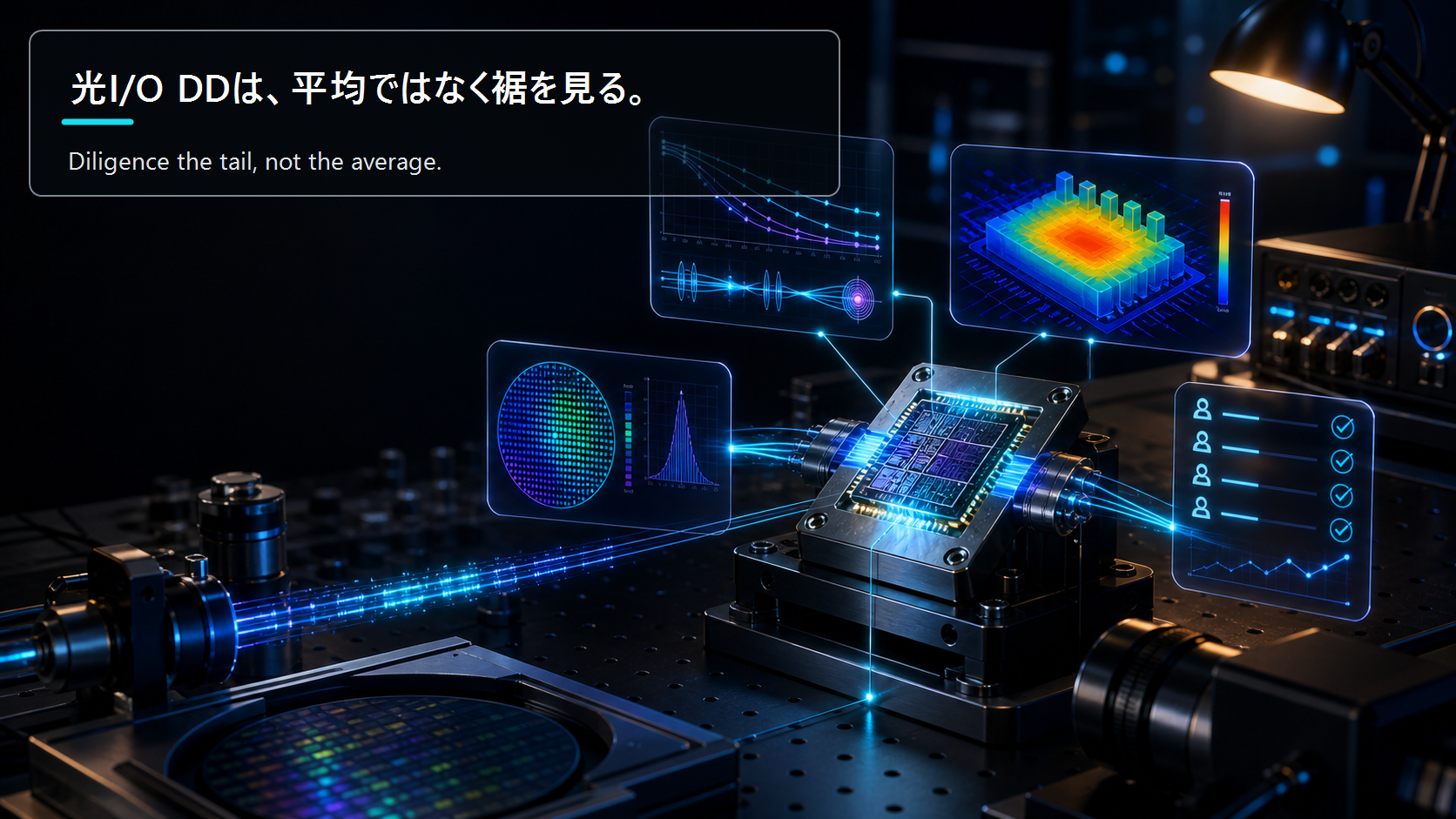
金属の表面で操作を拾う方法は、大きく5つある。静電容量に窓を組み合わせる方式、誘導方式、MEMSひずみゲージ、圧電(ピエゾ)、そして超音波とフォースを組み合わせる方式だ。
| 方式 | 主な企業・製品 | 金属に穴 | 軽く触れる | なぞる | 押し込む | 主な弱点 |
|---|
| 静電容量+窓 | Apple Camera Control | 必要 | ○ | ○ | ○(フォースセンサー併用) | 部品点数と工程が多い。布越しの誤作動 |
| 誘導(インダクティブ) | Texas Instruments LDC2114 | 不要 | × | × | ○ | 金属がたわむ空間とコイルの面積が要る |
| MEMSひずみゲージ | Qorvo(2021年にNextInputを買収) | 不要 | × | × | ○ | 温度ドリフトと筐体のねじれを補正する必要がある |
| 圧電(ピエゾ) | 素子メーカー各社 | 不要 | × | △ | △(変化の瞬間に強い) | 押し続けている状態を判定しにくい |
| 超音波+フォース | Sentons、UltraSense Systems | 不要 | ○ | ○ | ○ | 量産実績は車載とゲーミングスマホが中心 |
表のとおり、穴を開けずに「触れる」「なぞる」「押す」の3つをそろえられるのは、原理の上では超音波とフォースを組み合わせる方式だけだ。ただ、これはあくまで原理の話で、方式ごとに量産での実績の厚みはまだ違う。
位置関係を図にすると、右上に入るのは一つしかない。
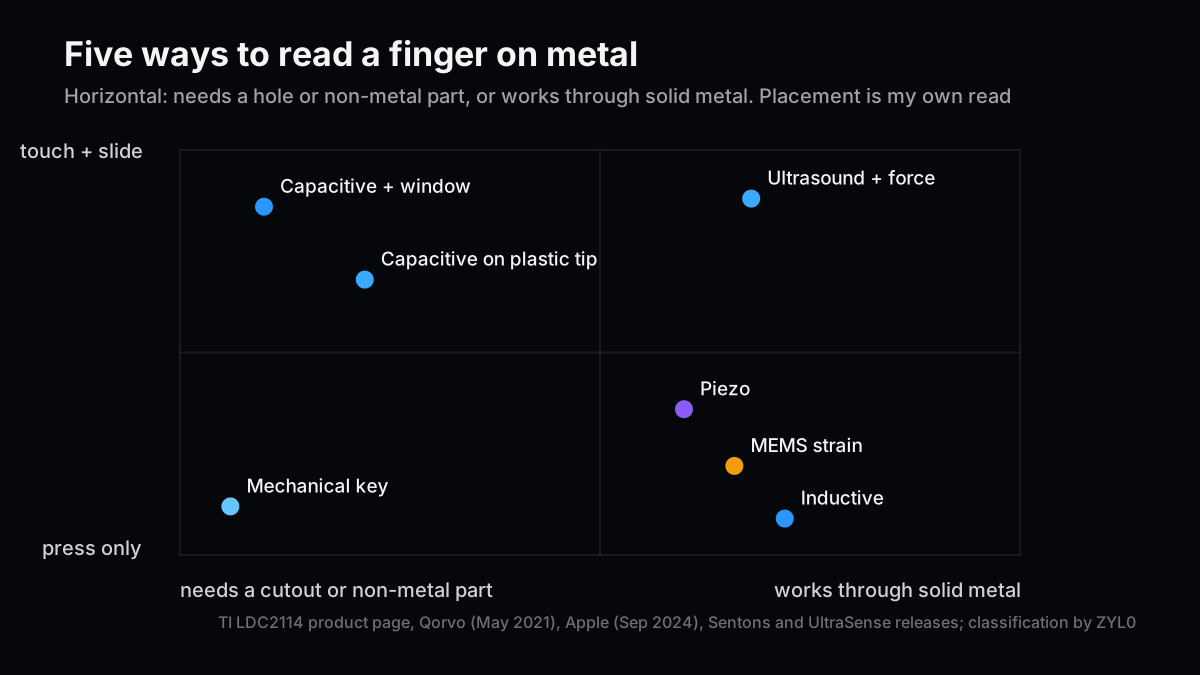
誘導方式は、金属の裏にコイルを置き、押された金属が近づいてインダクタンスが変わるのを読む。TIのLDC2114は、200nm未満のたわみを検出できるとしている。油や汚れ、湿気に影響されないのは大きな長所だ。
消費電流は、1ボタンを0.625SPSで読むと6µA、2ボタンを20SPSで読むと72µA。計算すると、0.625SPSの読み取り間隔は1.6秒になり、ボタンとしては遅すぎる。20SPSなら間隔は50msで実用になるが、電流は12倍になる。低い電流と速い反応は、そのままでは両立しない。
もっと根本的な制約もある。金属がたわまない限り、何も起きないことだ。指先で軽く触れても、なぞっても、インダクタンスは変わらない。
MEMSひずみゲージも同じ構図にある。押し込む力には敏感だが、力のかからない操作は見えない。Qorvoによれば、NextInputは買収の時点で、スマホ・ウェアラブル・車載向けに数千万個のセンサーを出荷していた。実績はある。ただ、守備範囲は「押す」に限られる。
超音波方式は、発想が逆になる。金属を動かすのではなく、金属の中に音を通す。
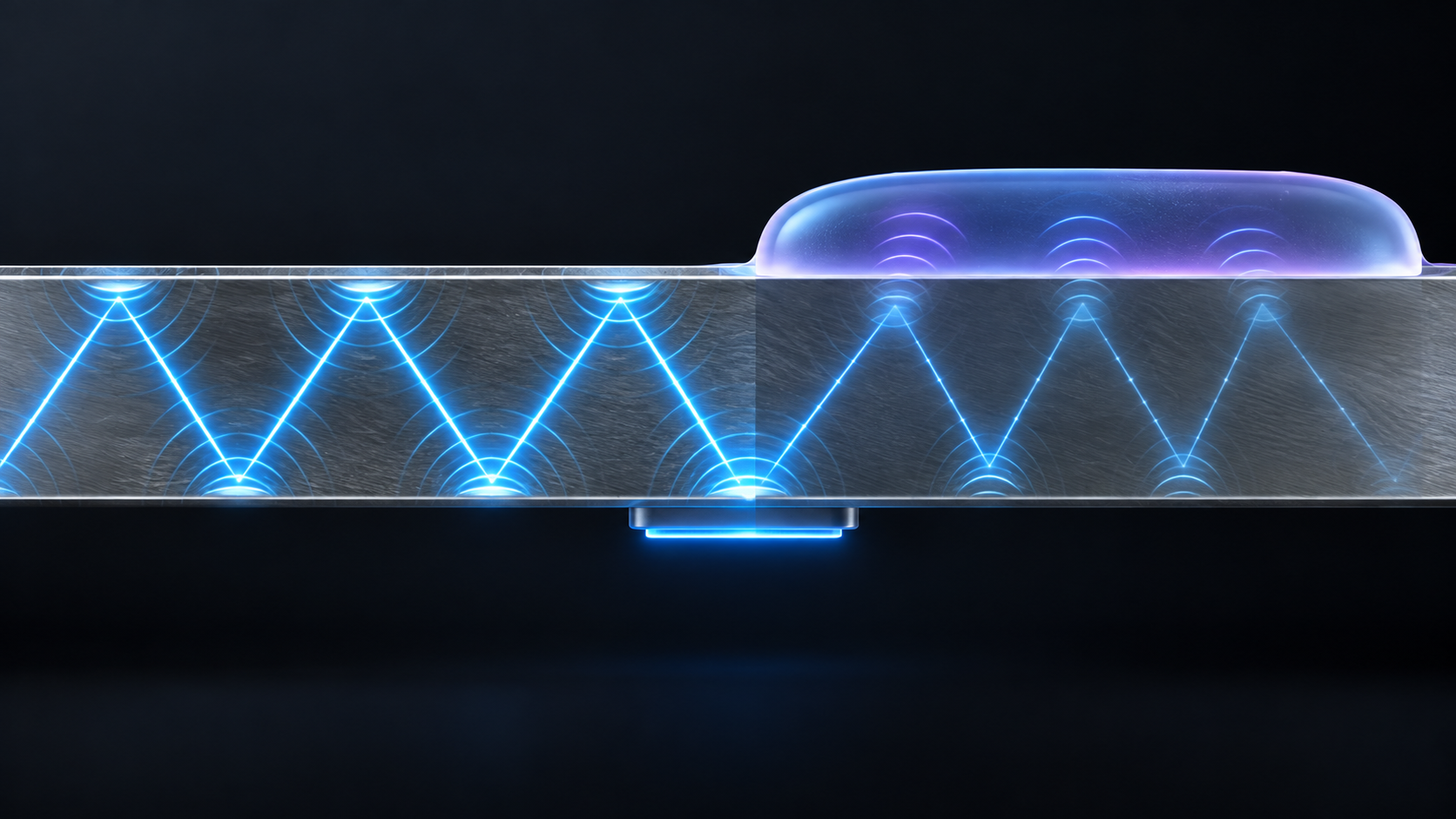
金属の裏に小さなトランスデューサーを貼り、高い周波数のパルスを出す。パルスは金属の中を進み、外側の表面で跳ね返って戻ってくる。表面が空気に触れているときは、ほぼすべてが跳ね返る。指が触れると、エネルギーの一部が指の側へ抜け、戻ってくるエコーが弱くなる。この差を読む。
この方式を量産品で最初に見せたのは、SentonsのAirTriggerだと私は理解している。2019年のASUS ROG Phone 2で、側面に超音波センサーを入れ、ゲーム機のショルダーボタンの代わりにした。Sentonsは、超音波のタッチ検出とひずみゲージ式のフォースセンサーを組み合わせる方式をとる。
UltraSense Systemsは、PMUT(圧電マイクロマシン超音波トランスデューサー)、信号処理回路、マイコンを1チップにまとめる。2026年1月には、車載向けのAEC-Q100準拠コントローラで累計300万個の出荷を発表した。AIグラス向けのUltraTouch AR2は、マグネシウム・チタン・樹脂のどのフレームでも使えるとしており、CEOは量産を2026年後半と述べていた。2月には金属とセラミックのリング向けにUltraTouch RG1を出し、9月21日には韓国の部品メーカーPartronと、AIウェアラブルとスマホ向けの覚書を結んだ。
ただし、この覚書は共同開発と量産支援の枠組みで、拘束力のある受注ではない。先端基板の記事で使った証拠の階層でいえば、まだ下から2段目あたりにいる。
ここで一つ、自分で計算してみた。
超音波が境界で跳ね返る割合は、両側の音響インピーダンス(密度×音速)の差で決まる。垂直に入射する単純なモデルで、指(軟組織、1.63MRayl)または水(1.48MRayl)が触れたとき、金属から相手の側へ抜けるエネルギーの割合を、代表的な素材について出した。
| 金属 | 音響インピーダンス(MRayl) | 指へ抜ける割合 | 水へ抜ける割合 | 3回反射した後に残るエコー(指) |
|---|
| ステンレス鋼 | 45.7 | 13.3% | 12.2% | 65% |
| チタン | 27.3 | 21.3% | 19.5% | 49% |
| アルミニウム | 17.3 | 31.5% | 29.0% | 32% |
| マグネシウム | 10.0 | 48.2% | 44.9% | 14% |
計算式は、抜ける割合=4×Z1×Z2÷(Z1+Z2)²。空気が相手なら、どの金属でも99.99%以上が跳ね返る。接着層、斜めの入射、横波は無視した簡易モデルだ。
表を作ってみて、意外だったことが2つある。
1つ目は、素材による差の大きさだ。ステンレスでは、指が触れても1回の反射で13%しかエネルギーが抜けない。マグネシウムなら48%抜ける。EvenがG2の前面にマグネシウムを使っているのは、超音波から見ると都合のいい組み合わせになる。逆に、ステンレスの枠は信号が取りにくい側に入る。
2つ目は、指と水の差がほとんどないことだ。チタンなら指で21.3%、水で19.5%しか違わない。エコーの強さだけで汗や水滴と指を見分けるのは難しい、というのが私の計算の結論だ。メーカーは指と水滴を見分けられると説明しているが、その識別はエコーの強さだけでなく、接触面積、時間の変化、押し込む力の組み合わせで成り立っているはずだ。スペック表の「誤検知なし」を、そのまま受け取らないほうがいい。
一方で、乾いた布は空気を多く含むので、布越しの接触はエコーをあまり弱めない。Camera Controlで問題になったポケットの中の誤作動に対しては、原理の上で強い側に立てる。
ここまでの整理を、企業群の位置に置き直す。
| 企業 | 上場 | このテーマでの立ち位置 | 公開情報で見える現在地 |
|---|
| Apple | AAPL | 問題を抱える側。窓を開ける方式の最大の実装者 | iPhone 18 Proは押す操作とスワイプを維持。標準のiPhone 18は感圧だけと報道 |
| Samsung Electronics | 005930.KS | 最薄クラスの折りたたみとスマートグラスの両方を持つ | Fold8 Ultraは開いて4.1mm。グラスはフレームのタッチとウォッチ連携 |
| Meta | META | 入力をフレームの外へ出す側 | Ray-Ban DisplayにEMGバンドを同梱、$799 |
| Texas Instruments | TXN | 誘導方式のIC | LDC2114は200nm未満のたわみを検出。押し込み専用 |
| Qorvo | QRVO | MEMSひずみゲージ | 2021年5月にNextInputを買収 |
| Partron | 091700(KOSDAQ) | センサーモジュールの設計と量産 | 2026年9月にUltraSenseと覚書 |
| Sentons | 非上場 | 超音波とひずみの先行者 | ROG Phone 2・3のAirTriggerに採用 |
| UltraSense Systems | 非上場 | 超音波とフォースのSoC | 車載で累計300万個超(2026年1月)。グラスとリング向けを展開 |
この表で私が気になるのは、純粋な受け皿が上場株にほとんどないことだ。TIやQorvoにとって、このセンサーは売上のごく一部でしかなく、株価を動かす規模ではない。直接の恩恵が見えるのは、Partronのようなモジュールメーカーと、非上場のセンサー企業になる。
2027〜28年に、金属筐体の固体ボタンがどこまで広がるかを3つに分けた。確率は私の主観だ。
| シナリオ | 確率 | 何が起きるか | 先に出る兆候 |
|---|
| ベースケース | 50% | 高価格帯の一部(折りたたみ、金属フレームのAIグラス)に限って固体ボタンが入る。量販のグラスは樹脂テンプルのまま | 2027年の新機種で、機械式ボタンと樹脂テンプルが残る |
| メインシナリオ(上振れ) | 30% | 超音波か感圧の固体ボタンが、折りたたみとAIグラスで量産採用される。モジュールの供給網ができる | AR2の量産出荷の発表、モジュールメーカーの量産受注の開示、分解での搭載確認 |
| テールリスク | 20% | 入力がフレームの外(EMGバンド、リング、ウォッチ)や音声へ移り、フレーム上の操作部そのものが小さくなる | EMGバンドの他社への広がり、ウォッチ連携の標準化 |
ここまでの動きを時系列に並べると、ゲーミングスマホの小さな実験から、密閉した金属フレームへと舞台が移ってきたことが分かる。
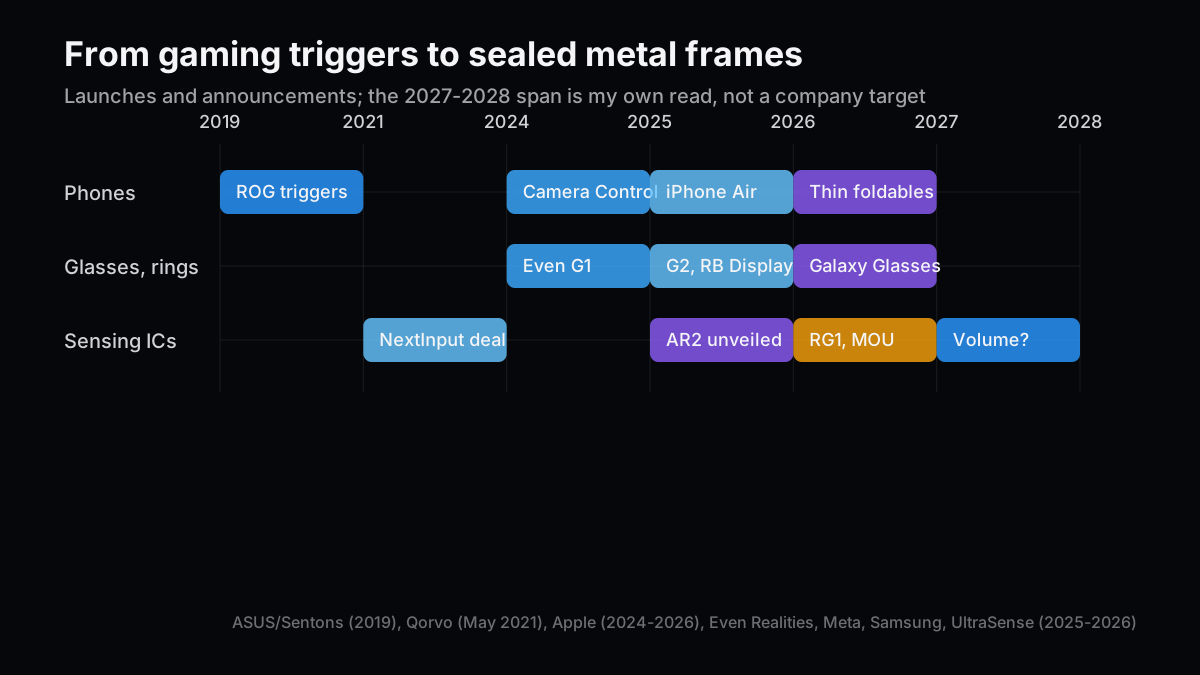
私の見立ては、「穴を開けずに、なぞる操作まで残したい」という需要が続くことを前提にしている。次の2つのどちらかが起きれば、この前提は崩れる。
1つ目は、感圧だけのCamera Controlを載せた標準のiPhone 18が2027年春に出て、評判がよかった場合だ。なぞる操作はいらず、押すだけで十分だと分かれば、誘導やひずみゲージのような安くて実績のある方式で足りる。超音波の強みは小さくなる。
2つ目は、入力がフレームの外へ移る場合だ。MetaのEMGバンド、EvenのR1、Samsungのウォッチ連携が当たり前になれば、テンプルに高価なセンサーを載せる理由は薄れる。
短期はニュートラル、2027〜28年はロング寄り。ただし量産採用の確認が条件、というのが今の見立てだ。
上場株で見るなら、このテーマは個別銘柄の材料というより、デバイスの設計がどちらへ動くかを読む指標として使う。Appleの重量とコスト(Duoは254g)、Samsungの薄さ競争、Metaの手首への移行。この3つの向きが、どの部品に需要が集まるかを決める。
- 2027年春の標準iPhone 18の分解で、Camera Controlがどの方式になったか
- UltraSenseのAR2の量産出荷の発表(同社は2026年後半を予定としていた)
- Samsungのスマートグラスの発売モデルで、テンプルの素材と操作部がどうなるか
- Partronの開示に、固体ボタンのモジュール受注が出てくるか
- 次の世代の折りたたみで、開いた厚さが4mmを割るか
正直に書くと、書き終えた今も、テールリスクの20%は低すぎるかもしれないと迷っている。手首のバンドが眼鏡の入力を奪う速さを、私はまだ読み切れていない。
次号の記事案
- 案1:ロボットの指先を「保護層の下」で読む — 超音波・磁気・視触覚の触覚センサーを、摩耗への強さと分解能で比べる。連載③で扱った触覚の論点を一段掘る回。
- 案2:AIグラスの入力は手首へ移るか — EMGバンド、リング、ウォッチ連携を、追加コスト・電池・普及台数で比べる。本稿のテールリスクを確かめる。
- 案3:254gと201gの差はどこから来るか — iPhone DuoとGalaxy Z Fold8の重さを、ヒンジ・電池・チタンの配分から読む。2027年の次の世代の重量が見どころ。
本稿は投資助言ではありません。記載した企業の有価証券を筆者が保有している可能性があります。作成には生成AIを利用しています。投資判断の前に免責事項をご確認ください。
This is an outside-in read based solely on public information. No company interviews or non-public materials were used. Performance figures are manufacturer claims unless noted otherwise.
The iPhone Duo goes on sale on October 23, and it is 5.2 mm thick when open. Apple calls it the thinnest iPhone ever. Three months earlier, Samsung shipped the Galaxy Z Fold8 Ultra at 4.1 mm unfolded, and back in March Honor had already put the Magic V6 out at 4.0 mm. On the eyewear side, Even Realities got its G2 down to 36 g on a titanium and magnesium frame.
Read only the spec sheets and this looks like steady progress. What caught my attention was something else. On an enclosure this thin and this metallic, where is a finger supposed to go?
Back when I ran structural simulations, I kept seeing the same picture: punch a hole in a thin plate and the stress piles up around its edge. For a round hole in a wide plate, the textbook answer is roughly three times the nominal stress. A button opening is a weak point in a thin frame before you even add the waterproof seal and the stack of parts behind it.
In my last post on 800 VDC certification gates, I separated component certification from permission to run a facility. Before that, in the piece on advanced-substrate ramps, I split technology demos from production evidence. Buttons without holes need the same discipline. A sensor announcement and a production win inside a thin metal phone are different events. When I worked on bringing automotive parts into volume production, passing component qualification was where the real work started, not where it ended. That memory stayed with me through this whole piece.
The plan: first the current product designs and their problems, then five ways to read a finger without cutting the metal, and finally the companies and scenarios.
The short version: metal-frame AI glasses have been pushing their controls onto whatever part of the frame is not metal.
The reason is simple. A capacitive touch sensor, the same kind used in phone screens, reads changes in the electric field between a finger and an electrode. Put metal in between and the field is blocked, so the finger disappears. Anywhere you want touch input has to be plastic, or you have to cut an opening and fill it with a plastic or glass window.
Here are the main products I could check against public information.
| Product | Announced | Frame | Weight | Where the controls are | Visible trade-off |
|---|
| Even Realities G1 | 2024 | Magnesium alloy front, titanium alloy temples | 44 g | TouchBar at the temple tips behind the ears | The bulging tips give it away, and you reach behind your ear to use them |
| Even Realities G2 | 2025 | Titanium and magnesium alloy | 36 g | TouchPads on both temples (tap, double tap, hold, scroll) | Temples are 53% thinner than G1, but electronics still sit in small end pods |
| Meta Ray-Ban Display | Sep 2025 | Injection-molded plastic, titanium hinges | 69 g | Touchpad and button on the right temple, plus an EMG wristband | The main input moved to the wrist. The band weighs 42 g; the set is $799 |
| Samsung smart glasses | Jul 2026 | Not disclosed (Gentle Monster and Warby Parker designs) | Not disclosed | Touch on the frame; gestures only through a Galaxy Watch9 | I could not find a price or ship date when I checked |
| Even Realities R1 (ring) | 2025 | Stainless steel with a zirconia ceramic coating | — | The ring itself is a controller for the G2 | Sold separately at $249; it moves glasses input to the finger |
What stands out is that the products aimed at mass retail lean toward plastic frames, and the ones that commit to metal struggle to find a home for the controls. Even's G1 packed the battery, antenna and TouchBar into the tips behind the ears. The G2 shrank those tips, but they are still there.
The other trend is to move input off the frame entirely. Meta bundles an EMG wristband that reads finger movement at the wrist. Even sells a ring, and Samsung hands gestures to the watch. If you cannot put controls on the frame, put them on another device.
That only works if people are willing to wear a second device, though. For anyone who wants the glasses to stand alone, it is a detour.
Metal is not just about looks, either. Waveguide displays shift their image when the frame flexes even slightly, and titanium or magnesium is what lets a thin temple stay stiff. Rings are heading the same way, with titanium and ceramic shells becoming the default. The material requirements and the sensor's needs are pulling in opposite directions.
Phones give us harder numbers than glasses do.
A foldable stacks two slabs when closed and becomes a single slab when open. The power key (usually with the fingerprint sensor built in) and the volume keys sit on the edge of one of those halves. So the height available for a button is set, more or less, by the unfolded thickness.
| Model | Announced | Unfolded | Folded | Weight |
|---|
| Honor Magic V6 | Mar 2026 | 4.0 mm | 8.75 mm | 219 g |
| Galaxy Z Fold8 Ultra | Jul 2026 | 4.1 mm | 8.9 mm | 215 g |
| Galaxy Z Fold7 | Jul 2025 | 4.2 mm | 8.9 mm | 215 g |
| Galaxy Z Fold8 | Jul 2026 | 4.5 mm | 9.7 mm | 201 g |
| iPhone Duo | Sep 2026 | 5.2 mm | 11.3 mm | 254 g |
| Reference: iPhone Air | Sep 2025 | 5.64 mm (one slab) | — | 165 g |
Plotted side by side, the gap is easy to see.
That 4 mm includes the display panel, the cover glass and the frame wall. The height left for a button is smaller still. A mechanical button is a vertical stack: keycap, switch, waterproof seal and the ledge in the frame that holds it all. My read is that 4.1 mm is already close to the floor for a conventional key.
Actually, the tighter limit may be the number of holes rather than the height. Every opening for power, volume up and volume down in a thin titanium or aluminum rail adds another stiffness problem and another sealing step. Apple says the iPhone Duo's Grade 5 titanium frame uses antenna splits with ceramic fiber inserts and internal support ribs. The cuts in that frame clearly took real engineering effort.
The biggest example of cutting a window in a metal frame to add touch is Camera Control, which arrived with the iPhone 16.
By Apple's description, the surface is sapphire crystal ringed by stainless steel trim. Under the sapphire sit a multi-pixel capacitive sensor and a signal processor, and below those a tactile switch for the click plus a force sensor that works with the Taptic Engine. Apple says the sapphire height is set individually on each unit and then micro-welded in place.
That gave users press, light press and swipe. The price was a lot of parts and a lot of process steps.
In daily use, reports of accidental triggers in pockets and bags piled up. With iOS 18.2 Apple added an option to make the control respond only when the screen is on, alongside settings for double-click launch and for turning off light press and swipe. Software can cut down the mistakes. But this sensor stack has little ability, at the sensing stage, to tell fabric pressure from a finger.
The iPhone 18 Pro, released in September 2026, kept both press and swipe. For the standard iPhone 18, expected in spring 2027, reports say Apple will drop the capacitive layer and rely on pressure alone. That answers both cost and false triggers, but it also gives up the swipe.
Which leaves an obvious question: is there a way to keep the swipe without cutting a hole?
This is the core of the piece, and the comparison table below is where I spent the most time.
There are five broad ways to pick up input on a metal surface: capacitive sensing behind a window, inductive sensing, MEMS strain gauges, piezoelectric sensing, and ultrasound combined with force sensing.
| Approach | Example companies and parts | Hole in metal | Light touch | Slide | Press | Main weakness |
|---|
| Capacitive + window | Apple Camera Control | Required | Yes | Yes | Yes (with a force sensor) | Many parts and steps; false triggers through fabric |
| Inductive | Texas Instruments LDC2114 | Not needed | No | No | Yes | Needs room for the metal to flex, plus coil area |
| MEMS strain gauge | Qorvo (bought NextInput in 2021) | Not needed | No | No | Yes | Temperature drift and frame twist must be compensated |
| Piezoelectric | Various element makers | Not needed | No | Partly | Partly (best at sudden changes) | Hard to detect a sustained hold |
| Ultrasound + force | Sentons, UltraSense Systems | Not needed | Yes | Yes | Yes | Volume track record is mostly cars and gaming phones |
On paper, only the ultrasound-plus-force approach covers touch, slide and press without a hole. That is a statement about physics, though. How much each approach has proven in volume production is a separate question.
On a simple map, only one approach lands in the top-right corner.
Inductive sensing puts a coil behind the metal and reads the change in inductance when a press moves the metal closer. TI says its LDC2114 reliably detects deflections of less than 200 nm, and it ignores oil, dirt and humidity, which is a real strength.
Its current draw is 6 µA for one button at 0.625 samples per second and 72 µA for two buttons at 20 samples per second. Do the arithmetic and 0.625 SPS means one reading every 1.6 seconds, far too slow for a button. At 20 SPS the interval drops to 50 ms, which is usable, but the current goes up twelvefold. Low power and fast response do not come together for free.
The deeper limit is that nothing happens unless the metal bends. A light touch or a slide leaves the inductance unchanged.
MEMS strain gauges follow the same pattern. They are very sensitive to pressing force and blind to anything that does not load the frame. According to Qorvo, NextInput had shipped tens of millions of sensors into phones, wearables and cars by the time of the acquisition. The track record is real, but the coverage stops at pressing.
Ultrasound flips the idea around. Instead of moving the metal, it sends sound through it.
A small transducer is bonded to the inside of the metal and fires high-frequency pulses. Each pulse travels through the metal, reflects off the outer surface and comes back. When the outside surface is touching air, almost all of it bounces back. When a finger is on the surface, some of the energy leaks into the finger and the returning echo gets weaker. The sensor reads that difference.
As far as I can tell, the first mass-market product to show this was Sentons' AirTrigger in the ASUS ROG Phone 2 in 2019, where ultrasonic sensors on the side stood in for a game controller's shoulder buttons. Sentons pairs ultrasonic touch detection with strain-gauge force sensing.
UltraSense Systems integrates a PMUT (piezoelectric micromachined ultrasonic transducer), signal-processing circuitry and a microcontroller on a single chip. In January 2026 it said it had shipped more than 3 million units of its AEC-Q100 qualified automotive controller. Its UltraTouch AR2 for AI glasses is pitched as working on magnesium, titanium and plastic frames, and the CEO had said production would come in the second half of 2026. In February it launched UltraTouch RG1 for metal and ceramic rings, and on September 21 it signed a memorandum of understanding with Korean component maker Partron covering AI wearables and smartphones.
The MOU is a framework for joint development and production support, not a binding order. On the evidence ladder I used in the advanced-substrate piece, it sits roughly on the second rung from the bottom.
At this point I did a small calculation of my own.
How much ultrasound reflects at a boundary depends on the difference in acoustic impedance (density times sound speed) on each side. Using a simple normal-incidence model, I worked out how much energy leaves the metal into a finger (soft tissue, 1.63 MRayl) or into water (1.48 MRayl) for a few common frame materials.
| Metal | Acoustic impedance (MRayl) | Energy into a finger | Energy into water | Echo left after 3 reflections (finger) |
|---|
| Stainless steel | 45.7 | 13.3% | 12.2% | 65% |
| Titanium | 27.3 | 21.3% | 19.5% | 49% |
| Aluminum | 17.3 | 31.5% | 29.0% | 32% |
| Magnesium | 10.0 | 48.2% | 44.9% | 14% |
The formula is transmitted share = 4 × Z1 × Z2 ÷ (Z1 + Z2)². Against air, every one of these metals reflects more than 99.99%. The model ignores the bonding layer, angled incidence and shear waves.
Two things surprised me.
The first is how much the material matters. With stainless steel, a finger pulls only 13% of the energy out per reflection. With magnesium it pulls 48%. Even's choice of magnesium for the G2's front happens to be a friendly one for ultrasound, while a stainless frame is on the hard side.
The second is how little separates a finger from water. On titanium the numbers are 21.3% versus 19.5%. My conclusion from the arithmetic is that echo strength alone cannot reliably tell sweat or a water droplet from a finger. Vendors say they can distinguish the two, so that discrimination must come from combining echo strength with contact area, how the signal changes over time and the force channel. I would not take a spec sheet's "no false triggers" at face value.
Dry fabric, on the other hand, is mostly trapped air, so cloth pressing on the frame barely weakens the echo. Against the in-pocket triggers that dogged Camera Control, ultrasound starts from a strong position on physics alone.
Here is the same analysis restated as a map of who sits where.
| Company | Listing | Role in this theme | Where things stand, from public information |
|---|
| Apple | AAPL | Owns the problem; largest user of the cut-a-window design | iPhone 18 Pro kept press and swipe; standard iPhone 18 reportedly goes pressure-only |
| Samsung Electronics | 005930.KS | Has both the thinnest-class foldable and smart glasses | Fold8 Ultra is 4.1 mm open; glasses use frame touch plus the watch |
| Meta | META | Moving input off the frame | Ray-Ban Display ships with an EMG band for $799 |
| Texas Instruments | TXN | Inductive sensing ICs | LDC2114 detects sub-200 nm deflection; press only |
| Qorvo | QRVO | MEMS strain gauges | Bought NextInput in May 2021 |
| Partron | 091700 (KOSDAQ) | Sensor module design and manufacturing | Signed an MOU with UltraSense in September 2026 |
| Sentons | Private | Early mover in ultrasound plus strain | Supplied AirTriggers for the ROG Phone 2 and 3 |
| UltraSense Systems | Private | Ultrasound-plus-force SoC | Over 3 million automotive units (Jan 2026); expanding into glasses and rings |
What bothers me about this table is how few clean public-market plays it contains. For TI or Qorvo, these sensors are a sliver of revenue, nowhere near enough to move the stock. The direct beneficiaries are module makers like Partron and the private sensor companies.
I split the outlook for solid-state buttons on metal frames in 2027–2028 into three cases. The probabilities are my own judgment.
| Scenario | Probability | What happens | Early signals |
|---|
| Base case | 50% | Solid-state buttons stay in a slice of the premium end (foldables, metal-frame AI glasses); mass-market glasses keep plastic temples | 2027 launches still carry mechanical keys and plastic temples |
| Main scenario (upside) | 30% | Ultrasound or pressure-only solid-state buttons win volume slots in foldables and AI glasses, and a module supply chain forms | AR2 volume shipments announced, module makers disclose production orders, teardowns confirm parts |
| Tail risk | 20% | Input moves off the frame to EMG bands, rings, watches or voice, and controls on the frame shrink | EMG bands spread beyond Meta; watch-based gestures become standard |
Laid out on a timeline, the story moves from a small experiment in gaming phones to sealed metal frames.
My read assumes there is lasting demand for keeping slide gestures without cutting holes. Either of two developments would break that assumption.
The first is the standard iPhone 18 arriving in spring 2027 with a pressure-only Camera Control and getting good reviews. If people turn out not to need the swipe and a press is enough, cheap and proven options like inductive sensing or strain gauges will do the job, and ultrasound's edge shrinks.
The second is input leaving the frame. If Meta's EMG band, Even's R1 or Samsung's watch gestures become the norm, the case for putting an expensive sensor in a temple gets much weaker.
Neutral in the near term, leaning long for 2027–2028, conditional on confirmed production wins.
In listed equities, I would treat this theme less as a catalyst for any one stock and more as an indicator of where device design is heading. Apple's weight and cost (the Duo is 254 g), Samsung's thinness race and Meta's move to the wrist will decide which parts the demand flows toward.
- What sensing approach the standard iPhone 18's Camera Control uses in spring 2027 teardowns
- Whether UltraSense announces AR2 volume shipments (it had pointed to the second half of 2026)
- What temple material and controls Samsung's smart glasses use at retail launch
- Whether Partron's disclosures start to show solid-state button module orders
- Whether the next generation of foldables goes below 4 mm unfolded
To be honest, even now that the piece is finished, I wonder whether 20% is too low for the tail risk. I have not figured out how fast a wristband could take input away from the glasses.
Next Issue Ideas
- Idea 1: Reading a robot fingertip from under its skin — Compare ultrasound, magnetic and vision-based tactile sensors on wear resistance and resolution, going one level deeper into the touch questions from Physical AI Series ③.
- Idea 2: Will glasses input move to the wrist? — Compare EMG bands, rings and watch gestures on added cost, battery and installed base, and test this post's tail-risk scenario.
- Idea 3: Where the gap between 254 g and 201 g comes from — Break down the weight of the iPhone Duo and Galaxy Z Fold8 across hinge, battery and titanium, ahead of the next generation's weight targets in 2027.
This article is not investment advice. The author may hold securities of companies discussed. Generative AI assisted its preparation. Review the disclaimer before making investment decisions.