AI時代のクリエイター価格設定|記事・SNS・動画・月次オペの値付けの考え方
前回、中小企業向けAI運用パッケージを30万円/月で設計する話を書きました。読んでくれた方から一番多かった反応は、提案書の中身でも契約条項でもなく、価格でした。「30万円って、どう正当化するんですか」。今回はその続きで、ソロクリエイターと小規模スタジオのための、AI時代の値付けの考え方を整理します。
結論から先に言うと、2026年に「記事1本いくら、動画1本いくら」で売っているクリエイターは、いちばんAIに削られる位置にいます。納品物単価という土俵そのものを、降りる時期に来ています。
正直に言うと、私自身もこの罠に何度か落ちました。記事1本3万円で受けて、AIで初稿が30分で出るようになった瞬間に、自分の時給が跳ね上がって嬉しい——ところまでが半年。次の相見積もりで、別のクリエイターが「同じ品質、1本1万円」と書いて出してきます。
ここで起きていることは、技術的にはシンプルです。AIが初稿コストをほぼゼロにした結果、納品物の市場価格は限界費用に向かって落ちていく。これは2024年から2025年にかけて、ライティング、サムネ、SNS投稿、ショート動画の順で実際に起きました。
問題は、買う側もそれを学習し終わったことです。「ChatGPTで自分でもできますよね?」というセリフは、もう挨拶です。クリエイター側が「いやAIだけだとここが甘くて…」と説明するたびに、相手の脳内では「やっぱり自分でやれる作業だな」と上書きされていきます。
ここを抜けるには、土俵を変えるしかない。私には、現時点で有効に見える出口が3つあります。
ここからは、私が自分のZYL0ブログ運用と、副業相談で見ている案件に当てはめて整理します。完璧な答えではなく、現実的に通る言い方として読んでください。
| レンズ | 売っているもの | 相手が払う理由 | 向いている案件 |
|---|
| 削減時間 | 相手の社内工数の削減 | 担当者・社長の時間が空く | 中小企業の発信、採用、営業資料 |
| アウトカム | リード、応募、継続率などの結果 | 数字に直接効く | EC、SaaS、採用ブランディング |
| リテイナー / 月次オペ | 毎月回るワークフロー | 止まらない安心感と社内に残らない属人化 | ブログ、SNS、ニュースレターの継続運用 |
3つとも「納品物いくら」を言っていません。ここがポイントです。
私の感覚では、ソロクリエイターはまず削減時間レンズとリテイナーの組み合わせが現実的です。アウトカム連動は、ECや採用のように数字が測れる案件以外では、トラブルになります。「コンバージョン上がってない=報酬払えない」を一度経験すると、二度と組みたくなくなる。
ここは聞かれることが多いので、具体的な数字で出します。為替や案件難易度で上下しますが、私が見ている範囲ではこのあたりに収束しています。
| 階層 | 月額レンジ | 想定スコープ | 想定クライアント |
|---|
| ソロクリエイター(自分1人) | 15〜40万円/月 | ブログ2本、SNS 8〜12本、簡易レビュー | 個人事業主、地方の中小企業 |
| 小規模スタジオ(2〜4人) | 60〜150万円/月 | ブログ4本、SNS 30本、ショート動画4本、月次MTG | 都市部の中堅企業、上場準備企業 |
| エージェンシー代替(5人〜) | 250〜600万円/月 | 全チャネル運用、ブランド設計、撮影、広告連動 | 上場企業の事業部、海外展開ブランド |
ここで重要なのは、階層を飛び越えて値付けしないことです。ソロなのに80万円/月を提案すると、相手はエージェンシー水準の体制を期待します。AIで作業が速くなっても、レビュー責任や障害対応の人手は減りません。私は、ここを甘く見て炎上したスタジオを今年だけで3つ知っています。
単発案件もまだ受けるなら、最低単価は決めておいた方がいいです。私の場合は、ブログ初稿1本 5万円以下は受けない、ショート動画は1本3万円以下は受けない、と決めています。これより安い相場の人と価格で戦っても、AIが両者の差を消してしまうからです。
ここはイメージしにくいと思うので、私が実際に組むなら、という前提で1案件分歩いてみます。
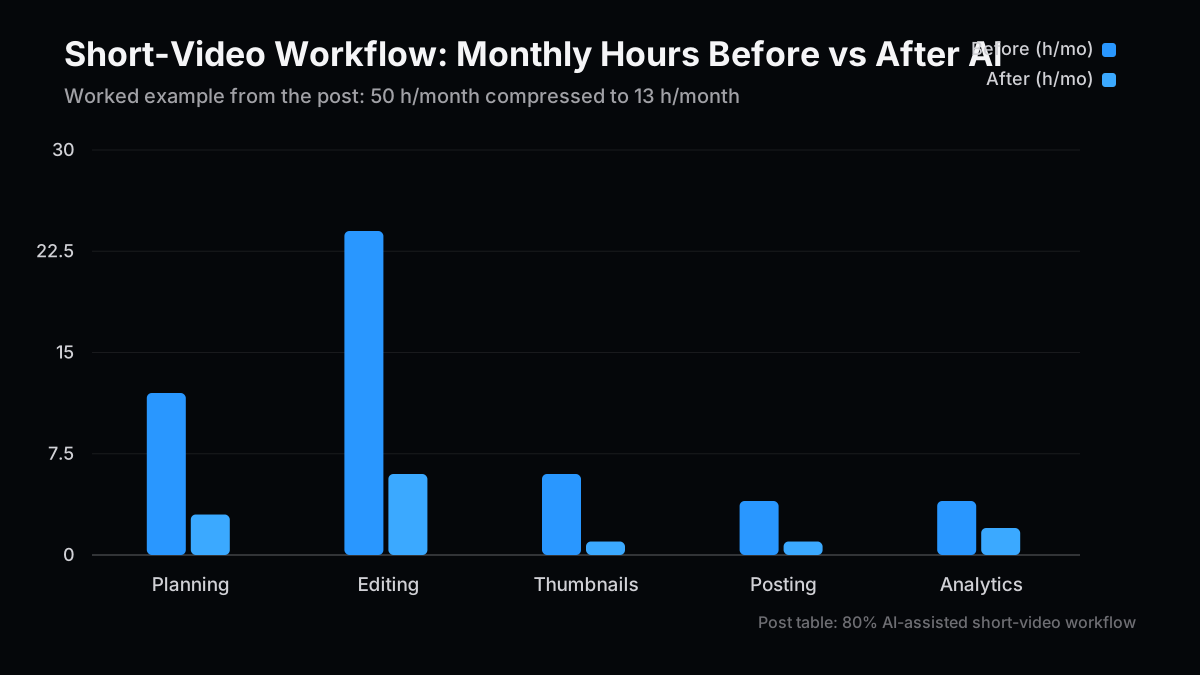
前提:地方のD2Cブランド。Instagram Reelsを週2本、TikTokを週1本、6ヶ月運用したい。撮影は先方が iPhone で。編集、テロップ、構成、サムネ、分析は全部こちら。AIで初稿が出る前提で、人間レビューは私。
| 工程 | 月間工数(Before) | 月間工数(After) | 担当 |
|---|
| 企画・構成 | 12時間 | 3時間 | 私 + Claude |
| 編集・テロップ | 24時間 | 6時間 | CapCut + AIテロップ + 私 |
| サムネ・カバー | 6時間 | 1時間 | Canva + Claude Design |
| 投稿・スケジューリング | 4時間 | 1時間 | 私 |
| 分析・改善メモ | 4時間 | 2時間 | 私 |
合計、月50時間が月13時間。差し引き37時間が浮きます。
これを「動画1本1万円×12本=12万円」で売ったら、終わりです。私なら、月45万円/月、6ヶ月契約で出します。理由は3つ。
- 相手の社内採用なら、SNS担当者の人件費は最低でも月35〜45万円かかる
- 私の側は、月13時間 + 月次MTG2時間で回る(時給換算 約3万円)
- AIツール代と外注テロップ補助で月3万円程度のコストが乗る
この説明を最初の30分で出せると、価格交渉は「12万円か45万円か」ではなく「45万円か社内採用か」になります。土俵が変わる。
これは、AI時代のクリエイターが必ず一度は言われるセリフです。私も言われます。ここで「いえ、プロでないと品質が…」と返すと、ほぼ負けます。相手はもう自分で試した上で聞いているからです。
私が今使っている返し方は、だいたいこの3つです。
- 「はい、できます。1本目までは。問題は、毎週それを30本続けられるかどうかです。」
- 「ツールを使うのは誰でもできます。毎週同じ品質で出すには、自分の声・商品・顧客を入れたSkillと、レビュー基準のセットが必要です。私はそれを作って運用する役です。」
- 「社長や担当者の時給で、月40時間それに使うのが安いか、月45万円で外に出すのが安いか、で考えてください。」
3つとも、AIの否定ではなく運用継続コストの話に変えています。AIが上手くなればなるほど、この返し方は強くなる。なぜなら、AIが上手くなるほど「1本目」と「30本目」の差が、ツールではなく運用設計の差になっていくからです。
価格設計と同じくらい大事なのが、受けない判断です。私が最近、自分用にメモしているサインを共有します。
- 「まずは1本だけお試しで安く」と言ってくる(リテイナーに移行する文化がない)
- 「成果が出たら本契約」と言う(成果定義を出さない時点で危険)
- 「AIで作るんだから安くなりますよね」と言う(価値の見方がツール側)
- 既存ベンダーを「使えなかった」と悪口で説明する(次は自分が言われる側)
- 月次MTGを断る(運用ではなく単発納品として扱う気しかない)
- 修正回数の上限を入れさせない(無限修正地獄の入り口)
私の経験上、このサインが2つ以上重なる案件は、ほぼ確実に揉めます。AIで作業速度が上がった分だけ、相手の要求も速度を増します。スコープクリープは、AI時代にむしろ悪化しました。
最後に、価格を守る一番現実的な道具を1つ。月次レビューを1枚にまとめて、必ず毎月送ることです。私はZYL0の運用でも、副業の相談でもこれを使っています。
中身は7項目で十分です。
- 今月の納品物リスト(記事、SNS、動画、資料の本数)
- 削減できた相手側工数の見積もり(時間)
- 数字の変化(PV、フォロワー、問い合わせ、応募など)
- 今月うまくいったこと(1〜2個)
- 今月の課題・改善点(1〜2個)
- 来月のテーマと優先順位
- スコープ追加の相談事項
これを毎月送るだけで、解約率がはっきり下がります。理由は単純で、相手の社内で「このクリエイターを切る理由を説明する文書」を、こちらが先に作っているからです。社長や上長に「払う価値があるか」を聞かれた担当者は、このレビューをそのまま転送できる。
逆に言うと、月次レビューを出していないクリエイターは、解約の判断材料を相手の記憶だけに委ねています。これは2026年の市場では、かなり危ない位置です。
ソロクリエイターが2026年にやるべきことは、増産ではなく、売り方の作り直しだと私は見ています。AIで本数を増やしても、相手の脳内では「ツールでできる作業」のままです。値付けのレンズを、納品物から、削減時間と月次オペに切り替える。ここに数年単位の余白がある。
具体的な一歩としては、今月の請求書を1枚開いて、「これは何時間を相手から消した対価か」を書き加えてみてください。書けない請求書があれば、それが次に作り直す案件です。
- 1納品あたりではなく、月次で何時間の顧客作業を消しているかを記録する。
- 修正回数、確認待ち日数、追加依頼数を見て、価格ではなくスコープ設計の問題を切り分ける。
- AI利用で作業時間が短くなった分は値下げではなく、継続運用、品質保証、レポート作成へ再配分する。
次号の記事案
- 案1:AI運用パッケージの提案書テンプレを公開する — 前回・今回で扱った価格と運用設計を、そのまま使える7ページ提案書の形に落とす。見出し・価格表・リスク管理文言まで具体化する。
- 案2:社長ヒアリング30分から、記事・SNS・FAQを同時生成する実践ワークフロー — Claude SkillとMCPで、1回の会話を3チャネル分の素材に変換する手順を、私のZYL0運用の実例で公開する。
- 案3:AI時代の単発案件サバイバル|リテイナーに乗らない案件の最低単価と捨て方 — 月額に乗らない案件を完全には切れない現実の中で、最低単価と断る言い回しを整理する。
本文の事実関係と数値前提は、再審査時にも読者が確認できる一次情報・公的資料を優先して見直しています。
本記事は情報提供を目的としたものであり、特定の銘柄、サービス、契約条件の推奨や投資助言ではありません。執筆者は記事内で触れた銘柄やサービスにポジションまたは利害関係を持つ可能性があります。調査、翻訳、校正の一部に生成AIを利用していますが、最終的な内容はZYL0が確認しています。詳細は免責事項をご確認ください。
Creator Pricing in the AI Era — How to Price Writing, Social, Video, and Monthly Operations Support
In the previous post, I walked through how I would design a $3K/month AI operations package for mid-size companies. The most common reply was not about the proposal or the contract clauses. It was about price. "How do you actually justify $3K?" This post is the follow-up — pricing for solo creators and small studios in the AI era.
The short version: in 2026, creators still pricing "per article" or "per video" are sitting in the exact spot AI is eating fastest. The deliverable-unit playing field itself is the thing to step off.
I fell into this trap a few times myself. You take a $300 article, AI makes the first draft come out in 30 minutes, your hourly rate jumps, you feel great — for about six months. Then the next RFP comes in and a different creator writes "same quality, $100 per article" on the line below yours.
What is happening, technically, is simple. Once AI drives the first-draft cost close to zero, deliverable prices fall toward marginal cost. Writing, thumbnails, social posts, and short-form video all moved through that compression between 2024 and 2025, more or less in that order.
The harder part is that buyers finished learning this too. "Couldn't I just do this with ChatGPT myself?" is no longer a question. It is a greeting. Every time a creator answers, "Well, AI alone has these weak spots…" the buyer's brain is silently overwriting it as "so this is actually something I can do." The only way out is to change the playing field. There are three exits that look workable to me right now.
These are the lenses I use on my own ZYL0 blog work and on the projects I see in advisory calls. None of them is the perfect answer. Treat them as wordings that actually land in real conversations.
| Lens | What you are selling | Why the buyer pays | Best fit |
|---|
| Hours saved | Reduction in their internal hours | Their staff and founder get their time back | Mid-size company publishing, recruiting, sales decks |
| Outcome | Leads, applications, retention, recruiting results | Tied directly to a number | E-commerce, SaaS, employer brand |
| Retainer / monthly ops | A workflow that keeps running every month | Cadence and freedom from single-person dependency | Ongoing blog, social, newsletter operations |
Notice that none of them say "per deliverable." That is the point.
For solo creators, the most realistic combination at this point looks like hours saved + retainer. Outcome-linked pricing is dangerous outside cases where the number is genuinely measurable. Once you hit one "conversions didn't move, so we can't pay" conversation, you do not want to repeat it.
I get asked this a lot, so here are specific numbers. They move with FX and project complexity, but in what I see, the ranges converge around this.
| Tier | Monthly range | Scope assumption | Typical client |
|---|
| Solo creator (you alone) | $1.5K – $4K / month | 2 blog posts, 8–12 social posts, light review | Sole proprietors, regional small businesses |
| Small studio (2–4 people) | $6K – $15K / month | 4 blog posts, 30 social posts, 4 short videos, monthly meeting | Urban mid-market, IPO-prep companies |
| Agency replacement (5+ people) | $25K – $60K / month | Full channel ops, brand design, production, paid integration | Enterprise BU, brands going cross-border |
The important rule here is: do not skip tiers when you quote. If a solo creator quotes $8K/month, the buyer expects agency-grade staffing. AI speeds up the work, but review responsibility and incident response still need humans. I personally know three studios that got burned this year by ignoring that line.
If you still take one-off projects, set a minimum. I will not take a blog draft under about $500. I will not take a short video under about $300. Trying to win below that, against creators using the same AI tools you use, just lets the AI erase the difference between you.
This one is hard to picture abstractly, so let me walk through a project as if I were quoting it today.
The setup: a regional D2C brand. They want two Instagram Reels per week and one TikTok per week, for six months. They film on iPhone in-house. Editing, captions, structure, thumbnails, and analytics all sit with us. AI does first drafts; I do human review.
| Stage | Before (monthly hours) | After (monthly hours) | Owner |
|---|
| Planning and structure | 12 | 3 | Me + Claude |
| Editing and captions | 24 | 6 | CapCut + AI captions + me |
| Thumbnails and covers | 6 | 1 | Canva + Claude Design |
| Posting and scheduling | 4 | 1 | Me |
| Analytics and improvement notes | 4 | 2 | Me |
Total goes from 50 hours/month to 13. About 37 hours disappear from the client side.
Pricing this as "$100 per video x 12 = $1.2K" is how you lose. I would quote $4.5K/month, six-month minimum. Three reasons.
- Hiring an in-house social person would cost them at least $3.5K–$4.5K/month all-in.
- On my side, the workflow runs in 13 hours plus a 2-hour monthly meeting (effective rate around $300/hour).
- AI tooling and supplemental caption help cost roughly $300/month on my side.
If you can explain this in the first 30 minutes of the call, the negotiation reframes from "$1.2K vs $4.5K" to "$4.5K vs an internal hire." Different playing field.
Every creator in 2026 hears this line. I hear it too. If you answer "well, you really need a pro for the quality…" you have basically lost. They are asking the question after already trying it themselves.
Three lines I actually use, depending on the room:
- "Yes, you can. For the first one. The question is whether you can do it 30 times in a row, every week."
- "Anyone can use the tools. The work is building a Skill loaded with your voice, your product, and your customer, plus a review standard that keeps it consistent. That's the part I run."
- "Compare your founder's or staff member's hourly rate times 40 hours per month, against my retainer. Decide on that ratio, not on the tool."
All three pivot away from defending AI quality and toward the ongoing cost of running it well. The better AI gets, the stronger this framing becomes, because the gap between "post one" and "post thirty" stops being about tools and starts being about operating design.
Pricing is half the work. Knowing which projects to refuse is the other half. The pattern I keep in my own notes:
- "Let's just try one cheap piece first" (no culture of moving to retainer)
- "If it works, we'll sign a real contract" (refusing to define what "works" means is the warning)
- "Since you're using AI, it should be cheaper, right?" (they see value through the tool, not the operation)
- They explain a previous vendor with insults rather than facts (you will be next)
- They refuse the monthly meeting (they want piecework, not operations)
- They will not put a cap on revision rounds (the doorway to infinite-revision hell)
In my experience, when two or more of these show up in the same conversation, the project almost always blows up. AI made the work faster, and clients raised their pace of asks just as much. Scope creep got worse in the AI era, not better.
One last tool, and probably the most practical thing in this post. Write a one-page monthly review and send it every single month. I use this on ZYL0 operations and recommend it to every solo creator I advise.
Seven items are enough.
- This month's deliverables (counts of articles, social posts, videos, decks)
- Estimated client-side hours saved this month
- Number movement (page views, followers, inquiries, applications)
- What worked this month (one or two items)
- What needs improvement (one or two items)
- Next month's themes and priorities
- Any scope-change conversation needed
Sending this every month visibly lowers churn. The reason is mundane: you are pre-writing the document the client's internal team would need to defend keeping you. When the founder or a manager asks "are we still getting value?" the answer is one forward of your review away.
Creators who do not send this leave the renewal decision to the client's memory. In the 2026 market, that is a much riskier place to sit than most people realize.
For solo creators, the right move in 2026 is not more output. It is rebuilding how you sell. Producing more units does not change the buyer's mental category — it stays in "things a tool can do." Switching the pricing lens from deliverables to hours saved and monthly operations changes that category. There is several years of space here before it closes.
Concrete first step: open the last invoice you sent and add one line — "this was the price for removing X hours from the client." If there is an invoice you cannot fill that line in for, that is the project to redesign next.
- Track how many client-side hours you remove each month, not only what you deliver per unit.
- Watch revision rounds, waiting days, and extra requests to separate pricing problems from scope-design problems.
- Treat AI time savings as capacity for operations, quality control, and reporting, not as an automatic discount.
Next Issue Ideas
- Idea 1: A reusable AI operations proposal template, fully filled in — Turning the pricing and operating design from this post and the previous one into a seven-page proposal anyone can adapt, complete with headings, price tables, and risk-control language.
- Idea 2: From a 30-minute founder interview to articles, social posts, and FAQ in one pass — A practical Claude Skill plus MCP workflow that converts one conversation into material for three channels, shown with real examples from my ZYL0 setup.
- Idea 3: Surviving one-off projects in the AI era — Minimum unit prices and graceful refusal lines for the projects that will never move to retainer, because in reality you cannot reject all of them.
The factual and numerical assumptions in this article are anchored to primary or public materials that readers can revisit during AdSense review and future updates.
This article is for informational purposes only and does not constitute investment advice or a recommendation of any specific stock, service, or contract structure. The author may hold positions or interests related to companies or services mentioned. Generative AI was used for parts of research, translation, and proofreading, with final review by ZYL0. See the disclaimer for details.