宇宙スタートアップ投資が示す8つのメガトレンド
私はCVCで自社技術の棚卸しとスタートアップ技術の系統分類・シナジーマップ作成を担当した経験があります。「テーマ単位ではなく、互いにレバレッジが効く塊として見る」——これが投資テーマを設計するときの基本姿勢でした。今回の宇宙スタートアップも、個別の8トレンドを並べるのではなく、どの組み合わせがバリューチェーンとして連動するかで読み解いてみたいと思っています。
最初に、業界が今どこに立っているかをフラットに置きます。
宇宙産業は転換点にあります。SpaceXが打ち上げコストを劇的に引き下げ、NASAのArtemisプログラムが月面への有人帰還を準備し、民間資本が加速的に流入するなか、宇宙は「探検のフロンティア」から「産業化のプラットフォーム」へと変貌しつつあります。PwCの分析では、宇宙経済全体は2034年に$1.7兆、2064年には$6.1兆に達する見通し。
ここで重要なのは、伸びるのが「打ち上げや衛星通信といった従来型」ではなく、「宇宙空間そのものを生産・製造・資源調達の場として活用する産業化レイヤー」だという点です。宇宙特化VCの投資パターンを俯瞰すると、この産業化を構成する8つのメガトレンドが鮮明に浮かび上がります。
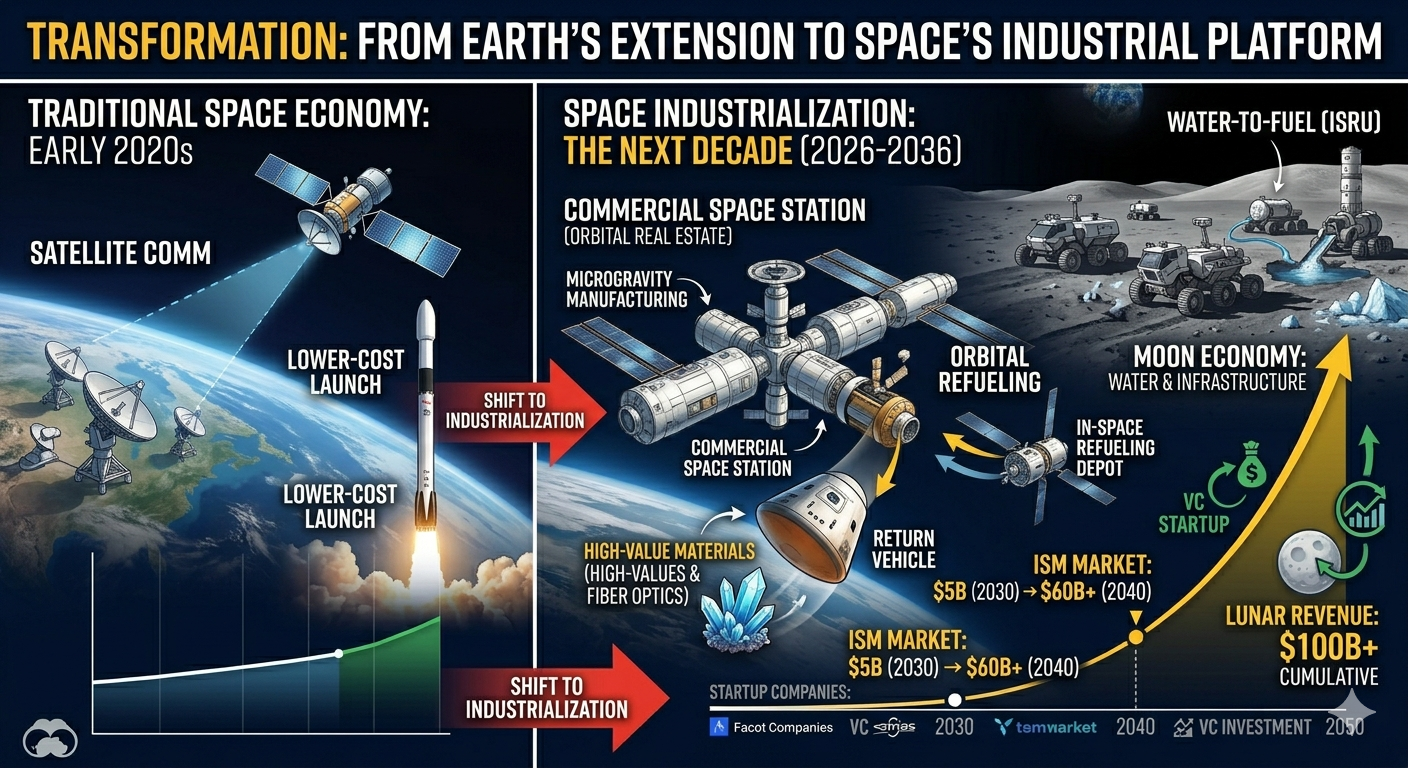
ISSは2030年代前半の運用終了が見込まれており、その後継として民間主導の商業宇宙ステーションの開発競争が激化しています。NASAはCommercial LEO Destinations(CLD)プログラムを通じて複数の企業に資金を投じ、「宇宙の不動産」を民間に移管する方針を明確にしています。
商業ステーションの用途はISS時代と根本的に違います。科学研究だけでなく、製造、バイオテク、メディア制作、宇宙観光など多目的な「軌道上プラットフォーム」としての活用が想定されている。建設には従来の航空宇宙の製造手法ではなく、造船所型の大規模モジュール製造技術が必要です。私が普段見ている海運脱炭素のサプライチェーンと、ここの製造プロセスは構造的にかなり似通っている、というのが個人的な発見でした。
宇宙空間での製造(In-Space Manufacturing, ISM)は、2025年時点で$2.2Bの市場規模を持ち、2030年に$5.2B、2040年には$62.8〜$135Bに成長すると予測されています(調査会社により幅あり)。CAGR 19〜30%の高成長セグメント。
| ISM市場予測 | 2025年 | 2030年 | 2040年 | CAGR |
|---|
| Allied Market Research | — | $21.3B(ISM+サービシング+輸送) | $135.3B | 20.3% |
| MarketsandMarkets | — | $4.6B | $62.8B | 29.7% |
| Research & Markets | $2.18B | $5.23B | — | 19.1% |
| 商業セクター比率 | 58.7% | — | — | — |
地球上では重力によって結晶構造が歪むタンパク質の結晶成長、対流の影響を受けない超高純度の光ファイバー製造、均質な合金の鋳造——これらは微小重力環境でのみ最適化できます。特に医薬品と先端半導体材料の分野で、地上では再現不可能な品質の製品を宇宙で生産し地球に帰還させるビジネスモデルが立ち上がりつつあります。
このビジネスの核心は、宇宙で製造した高付加価値材料を地球に安全に持ち帰る再突入能力にあります。打ち上げコストの低下と相まって「宇宙工場→地球への出荷」というサプライチェーンの経済性が現実味を帯びてきた、というのが現在地です。
月面経済はもはやSFではない、というのが私の基本的な見方です。PwCの推計では、月面活動からの累積収益は2026〜2050年で$93.9B〜$127.3Bに達する可能性。
月面経済の最大のドライバーは月極域の水氷です。電気分解して水素と酸素に分離すればロケット推進剤になるので、月面での燃料生産(ISRU: In-Situ Resource Utilization)が実現すれば、深宇宙探査の経済性が根本から変わる。月面ISRU水抽出市場は2024年に$1.1B、2033年に$6.5B(CAGR 18.7%)に成長すると予測されています。Artemis Accordsの署名国は2026年1月時点で61カ国に達し、月面資源利用の国際法的フレームワークも整備されつつあります。
月面ローバー市場は2025年に$3.8B、2034年に$12.6B(CAGR 14.2%)に成長見通し。NASAはLunar Terrain Vehicle Services(LTVS)契約に最大$4.6Bを投じ、2名の宇宙飛行士が14日間・1回の遠征で20km走行できる無加圧ローバーの開発を委託しています。
| 月面経済の主要市場 | 2025年 | 2030年代 | 備考 |
|---|
| 月面探査技術全体 | $11.4B | $18.9B (2029) | CAGR 13.4% |
| 月面ローバー | $3.8B | $12.6B (2034) | CAGR 14.2% |
| 月面ISRU水抽出 | $1.1B | $6.5B (2033) | CAGR 18.7% |
| 宇宙マイニング全体 | $3.07B (2026) | $7.4B (2031) | CAGR 19.2% |
| PwC月面累積収益 | — | $93.9〜$127.3B (2026-2050) | 5分野合計 |
衛星の寿命は燃料の枯渇によって制約されるケースが多い。軌道上で衛星に燃料を補給できれば、寿命を数年〜十年単位で延長できます。OSAM(On-orbit Servicing, Assembly, and Manufacturing)市場は急成長していて、衛星の寿命延長サービスだけでなく、デブリ除去、軌道上点検・修理、軌道間輸送といった多機能なサービスが商業化されつつあります。宇宙デブリ除去市場は単独で$750M規模と推定。
ビジネスモデルは石油産業のインフラに近い、というのが個人的な解釈です。燃料を宇宙空間にデポ(貯蔵庫)として配備し、必要に応じて顧客衛星にサービスを提供する。将来的には月面で生産した推進剤を軌道上デポに供給するという、月面ISRU→軌道上サービシングのバリューチェーン統合も視野に入る。
SpaceXのFalcon 9やStarshipが打ち上げコストを激減させましたが、次のパラダイムシフトは「飛行機のように離着陸するスペースプレーン」です。水平離着陸(HTHL)の宇宙機は、既存の空港インフラを活用でき、ターンアラウンドタイムの劇的な短縮が期待できます。
この技術が実現すれば、宇宙へのアクセスは「ロケット発射」から「フライト予約」へと変貌します。地球への再突入能力を持つ専用ビークルの開発も重要なサブテーマで、宇宙製造のバリューチェーンにおける「ラストワンマイル」を担います。
地上の通信インフラが届かない場所——海洋、砂漠、極地、農村部——にある何十億ものIoTデバイスを衛星経由で接続するというコンセプトが現実化しつつあります。最新の技術では既存のBluetoothチップを搭載した一般的なデバイスを、特別なハードウェア変更なしに衛星から直接接続できるようになってきた。
私はAWS IoTで河川洪水検知システムをゼロから組んだ経験があるのですが、カバレッジの空白地帯がIoTのボトルネックだったのは、この実装で痛感したことでした。衛星IoTがそこを潰す——というのは、ITインフラ側の人間としても投資する側としても腹落ちする話です。SATCOM on the moveが2026年に$42.8B(CAGR 19.3%)と予測されており、その中でもIoT特化の低軌道衛星コンステレーションは最速成長セグメントの一つです。
月面や深宇宙での長期滞在において、最大の技術的障壁の一つが宇宙放射線です。銀河宇宙線(GCR)や太陽粒子線(SPE)は、地磁気に守られた地球低軌道とは比較にならないレベルで人体や電子機器にダメージを与える。
従来の遮蔽手法——金属板や水タンクによる物理的シールド——では重量が課題でした。軽量かつ高性能な新素材による放射線シールドが切望されており、この分野は月面経済、商業ステーション、深宇宙探査のすべてに横断的に関わるイネーブリング・テクノロジー。市場浸透度が低い今こそ投資のタイミングだと見ています。
長期的な宇宙滞在を支えるためには、食料・医薬品・バイオマテリアルの現地生産が不可欠です。制御環境型バイオファームの技術は、宇宙ステーションや月面基地での食料生産に直結。応用範囲は宇宙に限らず、地球上でも気候変動に対応した垂直農業、希少植物由来の医薬品生産など、地球と宇宙の両方にまたがるデュアルユースのビジネスモデルが構築可能です。
微小重力環境を活用したバイオメディカル研究も有望で、「宇宙の病院から地球の家庭へ」というコンセプトで、宇宙環境での創薬研究や組織工学を地上医療にフィードバックするモデルが模索されています。
私の中ではここがいちばん大事なところです。8トレンドを並べて見せるだけでは投資判断にならないので、「相互依存性」と「政府アンカー需要」の2軸で整理します。
| トレンド | 市場成熟度 | 主な市場規模 | 投資ステージ |
|---|
| 商業宇宙ステーション | 開発期 | ISS後継需要$B規模 | Series A-C |
| 宇宙空間製造 | 実証→初期商業 | $2.2B→$5.2B (2030) | Seed-Series A |
| 月面経済 | 探査→商業準備 | $11.4B (探査技術, 2025) | Pre-seed-Series A |
| 軌道上サービシング | 初期商業 | $2.6B (2026) | Series A-B |
| 再利用型宇宙アクセス | 開発期 | 打ち上げ市場全体$10B+ | Seed-Series A |
| 衛星IoT | 商業化初期 | SATCOM全体$42.8B (2026) | Post-seed-Series A |
| 宇宙放射線シールド | 基礎研究→実証 | 横断的イネーブラー | Seed |
| 宇宙農業・バイオテック | 実証期 | デュアルユース | Seed-Series A |
| シナリオ | 宇宙経済規模(2035年) | 想定される展開 | 投資含意 |
|---|
| ベースケース | $600〜$800B | Artemis有人月面着陸が2027年に実現。商業ステーション1基が運用開始 | 月面関連・ISMが最初のスケーリングフェーズへ |
| メインシナリオ | $1.0〜$1.5T | 複数の商業ステーションが並行運用。月面ISRUが初の商業生産を達成 | 軌道上サービシング・月面インフラが本格的な収益化段階に |
| テールリスク(上振れ) | $2T超 | Starship完全運用+打ち上げコスト$100/kg以下。月面水の商業採掘開始 | 宇宙製造・月面経済が「新しいインターネット」級の市場創造 |
| テールリスク(下振れ) | $400B以下 | Artemis大幅遅延。商業ステーション開発中止。規制強化 | VC投資の冬。テーマ全体のバリュエーション調整 |
8つのトレンドに共通するのは、いずれも政府のアンカー需要(NASAのCLPS・LTVS・CLD契約等)が存在するという点です。純粋な民間需要だけに依存するのではなく、政府調達がリスクを引き下げ、商業市場を育てるという構図は、過去のGPS産業やインターネットの発展経路と重なります。
注目すべきは、これらのトレンドが互いに相互依存していることです。月面の水がなければ軌道上燃料デポは成立しない。商業ステーションがなければ宇宙製造はスケールしない。再突入技術がなければ宇宙で製造したものを地球に届けられない。宇宙放射線シールドがなければ長期滞在は困難。1つのテーマへの投資は、他のテーマの成功にもレバレッジが効く——というのが、私のシナジーマップ作成の経験から見たいちばん本質的な構造です。
- Artemis III(有人月面着陸)のスケジュール — 2027年目標。月面経済の投資テーマが一気に加速するトリガー
- Starshipの完全運用タイミング — 打ち上げコストの桁違いの低下は、宇宙産業全体のゲームチェンジャー
- FAAのBVLOS・再突入規制の進展 — 商業的な貨物再突入の規制枠組みが整備されれば、宇宙製造→地球帰還のビジネスモデルが本格化
- ISS退役の正式日程 — 2030年代前半。商業ステーション開発のデッドラインを設定
- 中国・インドの月面計画 — 国際競争の激化は市場全体のパイを拡大するが、地政学リスクも内包
結論として、宇宙は「次のインフラ投資」です。20世紀にインターネットが「通信のインフラ」から「経済のインフラ」へと進化したように、宇宙は「探査の場」から「産業のプラットフォーム」へと不可逆的に進化しています。8つのメガトレンドが相互に補強し合いながら形成される宇宙経済は、今後10〜20年で最も大きなα(超過リターン)を生み出すテーマの一つだと見ています。
- 案1:数字で追う続編 — 本記事の前提を最新データで更新し、何が強まり、何が崩れたかを再点検する。
- 案2:実務テンプレート編 — 読者が自分の投資判断、制作単価、または開発運用に転用できるチェックリストへ落とし込む。
- 案3:反対シナリオの検証 — 今回の見立てが外れる条件を先に定義し、次に見るべき指標と時間軸を整理する。
本文の事実関係と数値前提は、再審査時にも読者が確認できる一次情報・公的資料を優先して見直しています。
本記事は情報提供を目的としたものであり、特定の銘柄、サービス、契約条件の推奨や投資助言ではありません。執筆者は記事内で触れた銘柄やサービスにポジションまたは利害関係を持つ可能性があります。調査、翻訳、校正の一部に生成AIを利用していますが、最終的な内容はZYL0が確認しています。詳細は免責事項をご確認ください。
8 Megatrends in Space Startup Investing
I spent part of my CVC role mapping our parent company's tech stack and our portfolio's startup technologies into a synergy map. The biggest takeaway: don't think theme-by-theme; think in clusters where one bet leverages another. So with space startups, I want to read the eight trends not as a list but as a graph of mutual dependencies.
Let me put the picture down flat first.
The space industry is at an inflection point. SpaceX has dramatically lowered launch costs, NASA's Artemis is preparing for crewed lunar return, and private capital is flowing in at speed. Space is shifting from an "exploration frontier" into an "industrial platform". PwC projects the total space economy at $1.7T by 2034 and $6.1T by 2064.
The growth is not in the legacy "launch + comms" stack — it's in the industrialization layer that uses space itself as a place to produce, manufacture, and source materials. Looking across space VC portfolios, eight megatrends stand out clearly.
ISS retires in the early 2030s, and the race for privately-led commercial stations is intensifying. NASA's Commercial LEO Destinations (CLD) program is funding multiple companies and openly transferring "space real estate" to the private sector.
Use cases differ structurally from ISS-era research stations. These are multipurpose orbital platforms: manufacturing, biotech, media production, space tourism. Construction needs shipyard-scale modular manufacturing, not aerospace-style serial assembly. Coming from maritime work, the supply-chain shape here looks structurally familiar — that's actually one of my better personal anchors for understanding it.
ISM is $2.2B in 2025, projected at $5.2B by 2030 and $62.8–$135B by 2040 (forecasts vary), at 19–30% CAGR.
| ISM forecast | 2025 | 2030 | 2040 | CAGR |
|---|
| Allied Market Research | — | $21.3B (ISM + servicing + xport) | $135.3B | 20.3% |
| MarketsandMarkets | — | $4.6B | $62.8B | 29.7% |
| Research & Markets | $2.18B | $5.23B | — | 19.1% |
Microgravity enables products you cannot make on Earth: protein crystal growth without gravitational distortion, ultra-pure fiber optic without convection, homogeneous alloy castings. Pharmaceuticals and advanced semiconductor materials are where the "make-in-space, return-to-Earth" model is starting to pencil out economically.
The pivotal capability here is safe re-entry of high-value cargo. Combined with falling launch costs, the "space factory → Earth shipping" supply chain is finally crossing into commercial-economics territory.
The lunar economy is no longer science fiction — that's the framing I'd most defend. PwC estimates cumulative lunar revenue of $93.9B–$127.3B from 2026–2050.
The single biggest driver is water ice at the lunar poles. Electrolyze it and you get hydrogen + oxygen propellant. With Earth-launch fuel costing tens of thousands per kg, on-Moon fuel production (ISRU) fundamentally changes deep-space economics. The lunar ISRU water market is forecast at $1.1B in 2024 → $6.5B in 2033 (18.7% CAGR). Artemis Accord signatories reached 61 nations by January 2026.
The lunar rover market grows from $3.8B in 2025 → $12.6B by 2034 (14.2% CAGR). NASA's LTVS contract commits up to $4.6B for unpressurized rovers carrying 2 astronauts 20 km per sortie over 14 days.
| Lunar economy markets | 2025 | 2030s | Notes |
|---|
| Lunar exploration tech | $11.4B | $18.9B (2029) | 13.4% CAGR |
| Lunar rovers | $3.8B | $12.6B (2034) | 14.2% CAGR |
| Lunar ISRU water | $1.1B | $6.5B (2033) | 18.7% CAGR |
| Space mining | $3.07B (2026) | $7.4B (2031) | 19.2% CAGR |
| PwC cumulative lunar | — | $93.9–$127.3B (2026–2050) | 5 segments |
Satellite life is often capped by fuel depletion. Refueling on-orbit extends life by years, sometimes decades. OSAM (on-orbit servicing, assembly, and manufacturing) is expanding fast — life extension, debris removal, inspection and repair, orbit transfer. The debris-removal sub-market alone sits at ~$750M.
The business model rhymes with the oil industry. Pre-positioned propellant depots in orbit, on-demand service to client satellites — and longer-term, lunar-ISRU-to-orbit-depot value-chain integration is on the horizon.
Falcon 9 and Starship cut launch cost. The next paradigm shift is horizontal-takeoff-and-landing spaceplanes: existing airport infrastructure, dramatically shorter turnaround.
If realized, space access flips from "rocket launch" to "flight booking." A critical sub-theme is purpose-built re-entry vehicles — the "last mile" of the space-manufacturing supply chain that brings high-value goods home safely.
Billions of IoT devices in places that terrestrial networks don't reach — oceans, deserts, polar regions, rural — are about to become directly addressable from satellites. Recent tech allows off-the-shelf Bluetooth chips to connect to satellites without any hardware modification.
I built a flood-detection IoT system on AWS (IoT Core, Lambda, DynamoDB, API Gateway) from scratch, and the experience that stuck with me was that coverage gaps are the actual bottleneck, not silicon. Satellite IoT closes that gap. SATCOM on-the-move is forecast at $42.8B by 2026 (19.3% CAGR), with IoT-focused LEO constellations as the fastest-growing sub-segment.
For long-duration stays on the Moon and in deep space, the biggest single technical wall is radiation. Galactic cosmic rays (GCR) and solar particle events (SPE) damage humans and electronics at levels the magnetosphere-protected LEO simply doesn't see.
Traditional shielding (metal plates, water tanks) carries an unaffordable mass penalty. Lightweight high-performance materials are the missing piece. This is a horizontal enabler — it gates the lunar economy, commercial stations, and deep space exploration simultaneously. With low penetration today, the entry timing is, in my view, particularly interesting.
Long-duration missions need on-site production of food, medicine, and biomaterials. Controlled-environment biofarming maps directly onto stations and lunar bases — but the use cases are dual: climate-resilient vertical farming on Earth, rare-plant pharmaceutical production, specialized bioprocesses in simulated space conditions.
Microgravity biomedical research is parallel: protein crystal growth and organoid culture in space could accelerate drug development on Earth. The "from space hospital to Earth home" framing is being actively explored.
The most important section. Reading the eight trends as a list under-prices the structure — they need to be read on two axes: mutual dependency, and government anchor demand.
| Trend | Market maturity | Key market size | Investment stage |
|---|
| Commercial space stations | Development | Post-ISS demand, $B-scale | Series A–C |
| In-space manufacturing | Demo → early commercial | $2.2B → $5.2B (2030) | Seed–Series A |
| Lunar economy | Exploration → commercial prep | $11.4B (exp tech, 2025) | Pre-seed–Series A |
| On-orbit servicing | Early commercial | $2.6B (2026) | Series A–B |
| Reusable space access | Development | Launch market $10B+ total | Seed–Series A |
| Satellite IoT | Early commercial | SATCOM total $42.8B (2026) | Post-seed–Series A |
| Space radiation shielding | Basic research → demo | Cross-cutting enabler | Seed |
| Space agriculture & biotech | Demo | Dual-use | Seed–Series A |
| Scenario | Space economy (2035) | Development | Investment implication |
|---|
| Base | $600–$800B | Artemis crewed lunar landing in 2027; one commercial station operational | Lunar/ISM enter their first scaling phase |
| Main | $1.0–$1.5T | Multiple commercial stations operating; lunar ISRU achieves first commercial production | OSAM and lunar infrastructure reach full monetization |
| Upside tail | $2T+ | Full Starship ops + sub-$100/kg launch; commercial lunar water mining | Space manufacturing/lunar economy reach "new internet"-scale markets |
| Downside tail | <$400B | Major Artemis delay; commercial stations cancelled; regulatory tightening | Space VC winter; thematic valuation correction |
What unites all eight trends is government anchor demand — NASA CLPS, LTVS, CLD contracts, etc. The pattern of public procurement de-risking commercial scale-up rhymes with the early development of GPS and the internet. Pure private demand alone wouldn't carry the timeline.
The deeper structure is mutual dependency. No lunar water → no orbital fuel depot. No commercial stations → no space manufacturing scale. No re-entry tech → can't deliver what you make in space. No radiation shielding → no long-duration human presence. Investing in any one trend leverages the success of the others. From building synergy maps inside CVC, this is the kind of structure that compounds rather than substitutes.
- Artemis III (crewed lunar landing) schedule — currently 2027; the trigger that re-rates lunar startups
- Starship full operationalization — order-of-magnitude launch-cost drop is the industry-wide game changer
- FAA BVLOS and re-entry rules — commercial cargo re-entry frameworks unlock the full space-manufacturing return loop
- ISS retirement timeline — early 2030s; sets the deadline that pulls forward private investment
- China and India lunar programs — international competition expands the pie but layers in geopolitical risk
Bottom line: space is the next infrastructure investment. As the internet went from "communications infrastructure" to "economic infrastructure" in the 20th century, space is shifting from "a place to explore" to "a platform for industry" — and that move is now irreversible. The space economy, formed by these eight reinforcing megatrends, is, in my view, one of the largest sources of alpha for the next 10–20 years.
- Idea 1: A data-updated follow-up — Revisit the thesis with fresh numbers and separate what strengthened from what broke.
- Idea 2: A practical template edition — Turn the article into a checklist readers can reuse for investing, pricing, or technical operations.
- Idea 3: The bear-case test — Define the conditions that would invalidate this view and map the indicators to watch next.
The factual and numerical assumptions in this article are anchored to primary or public materials that readers can revisit during AdSense review and future updates.
This article is for informational purposes only and does not constitute investment advice or a recommendation of any specific stock, service, or contract structure. The author may hold positions or interests related to companies or services mentioned. Generative AI was used for parts of research, translation, and proofreading, with final review by ZYL0. See the disclaimer for details.