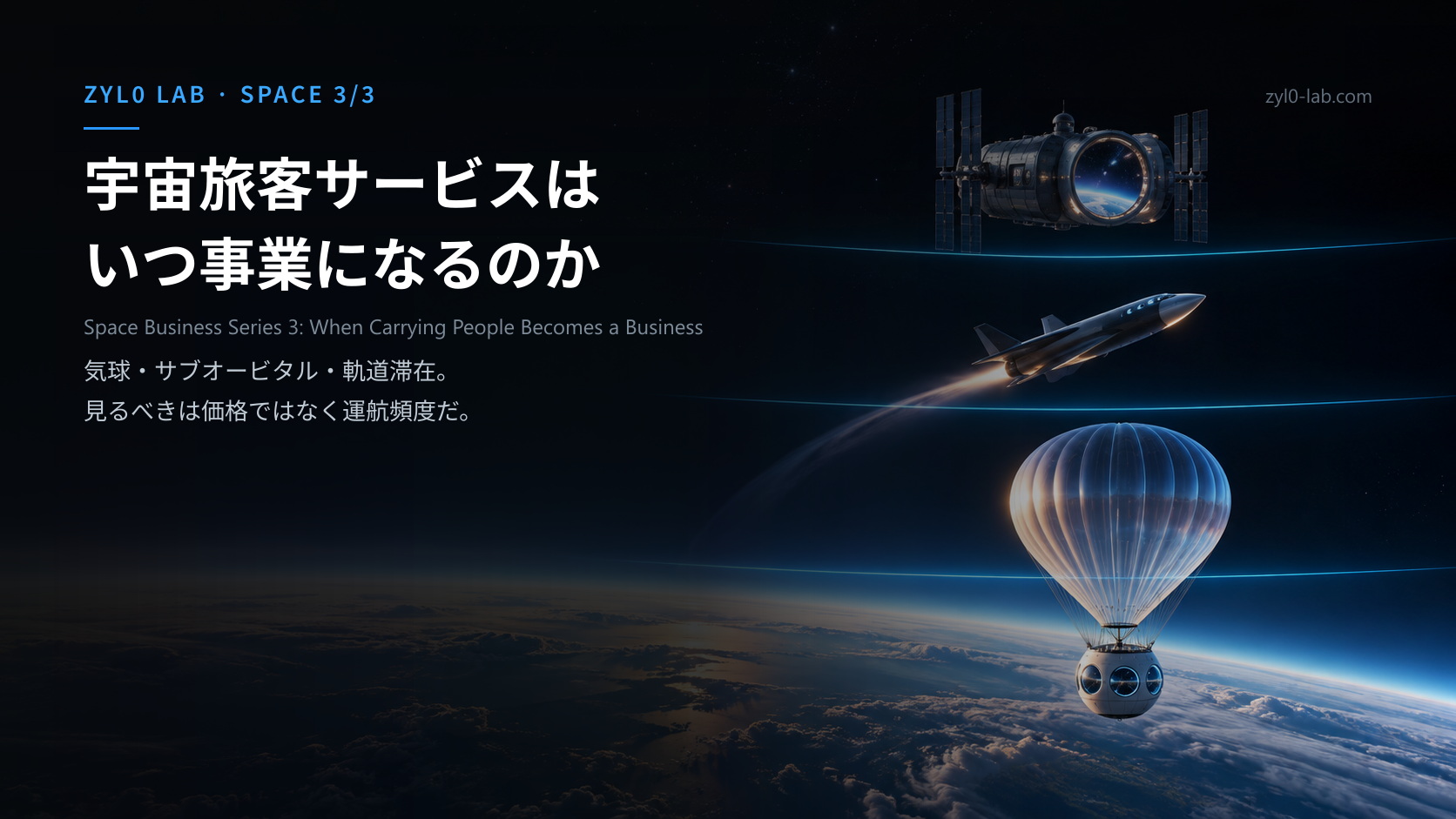
宇宙ビジネス連載③:宇宙旅客サービスはいつ事業になるのか
この連載でいちばん書くのをためらったのが今回だ。微小重力と通信には、少なくとも前へ進んでいる数字があった。旅客は違う。2026年、サブオービタルで客を運ぶ飛行は、1月の1回を最後に止まっている。
※本稿は各社の公開情報(発表資料・製品ページ・論文・報道)をもとにした、外部からの個人的な見立てです。
確認時点:2026年10月11日。 運航実績・調達額・日程は各社の発表と報道に基づく。座席の価格には報道や案内サイトの掲載値を含み、その旨を記した。円建ての金額のドル換算は1ドル=150円の概算で、倍率・合計・段階分けは筆者の計算と判断である。
最初に事実を置く。サブオービタルの2社が、同時に地上にいる。
Blue Originは2026年1月30日、New Shepardの飛行を少なくとも2年間止めると発表した。有人の月着陸機の開発に、人と資金を回すためだ。同社によれば、New Shepardは38回飛び、98人を高度100kmの上へ運んだ。最後の飛行は1月22日である。
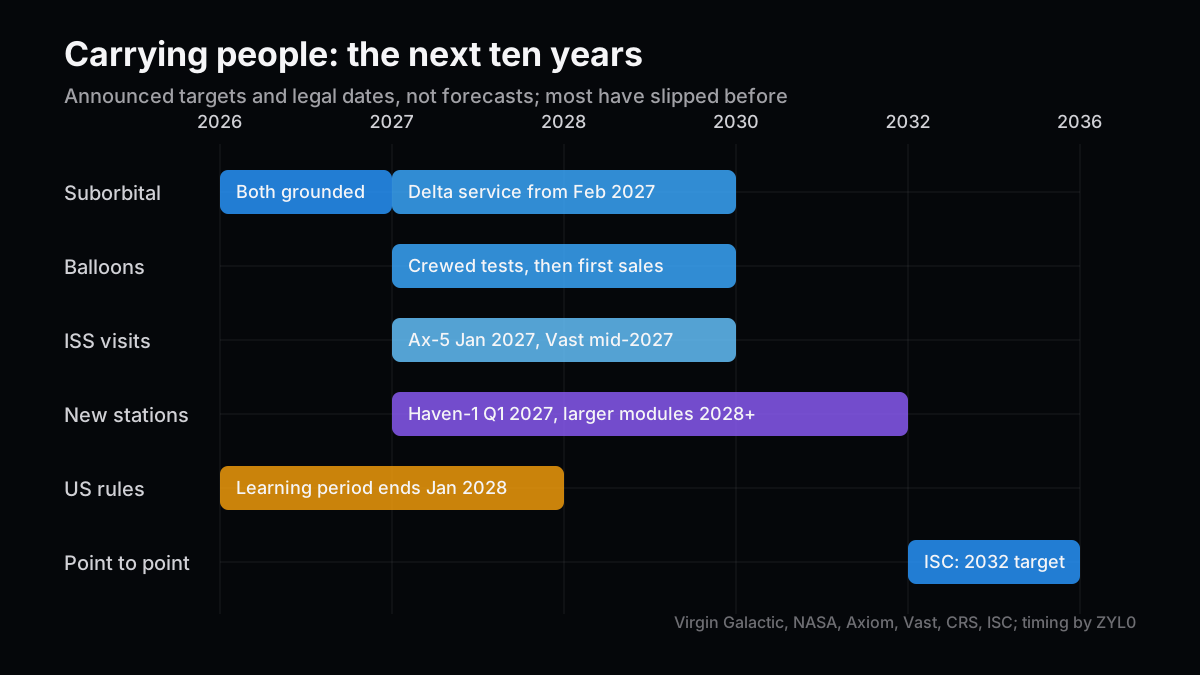
Virgin Galacticは、初代の機体VSS Unityで2023年6月から2024年6月までに商業飛行を7回行い、機体を退役させた。次世代のDeltaは開発中だ。8月12日の発表で、初の商業飛行の目標を2026年第4四半期から2027年2月以降へ延ばした。
サブオービタルで客を運べる機体は、いま1機も動いていない。
軌道はどうか。Axiom SpaceはISSへの民間ミッションを、2022年から2025年までに4回実施した。5回目は2027年1月以降の予定である。年に1回前後というのが、これまでの実力だ。
連載で使ってきた証拠の階段を、旅客に置き換える。
| 段階 | 見える証拠 | まだ言えないこと |
|---|
| 1. 有人試験 | 人を乗せて飛んだ | 代金を払う客を乗せられるか |
| 2. 初の商業飛行 | 代金を払った客が飛んだ | 繰り返せるか |
| 3. 反復 | 商業飛行を複数回こなした | 月単位の頻度で飛べるか |
| 4. 定期運航 | 月に数回の運航が続いている | 1回の飛行で黒字になるか |
| 5. 採算 | 運航の利益で機体を増やせる | 需要が何年続くか |
Blue OriginもVirgin Galacticも段階3まで進み、そこで地上へ戻った。段階4に届いた会社は、まだ1社もない。
価格と実績を、高度の順に並べる。
| 種類 | 体験 | 1席の価格 | 商業飛行の実績 | 次の節目 |
|---|
| 成層圏気球 | 高度20〜30km台、数時間、無重力なし | 5万〜19.5万ドル(報道・案内サイト) | なし | 各社が2027年に有人試験を目標 |
| サブオービタル | 高度80〜100km、数分間の無重力 | 75万ドル(Virgin Galactic) | Unityで7回、New Shepardで98人 | Deltaの商業飛行(2027年2月以降) |
| 軌道(ISS訪問) | 高度約400km、約2週間 | 推定で約5,500万ドル(報道) | Axiomが4回 | 5回目(2027年1月以降) |
| 商業ステーション滞在 | 専用の居住モジュール | 非開示 | なし | Haven-1(2027年第1四半期) |
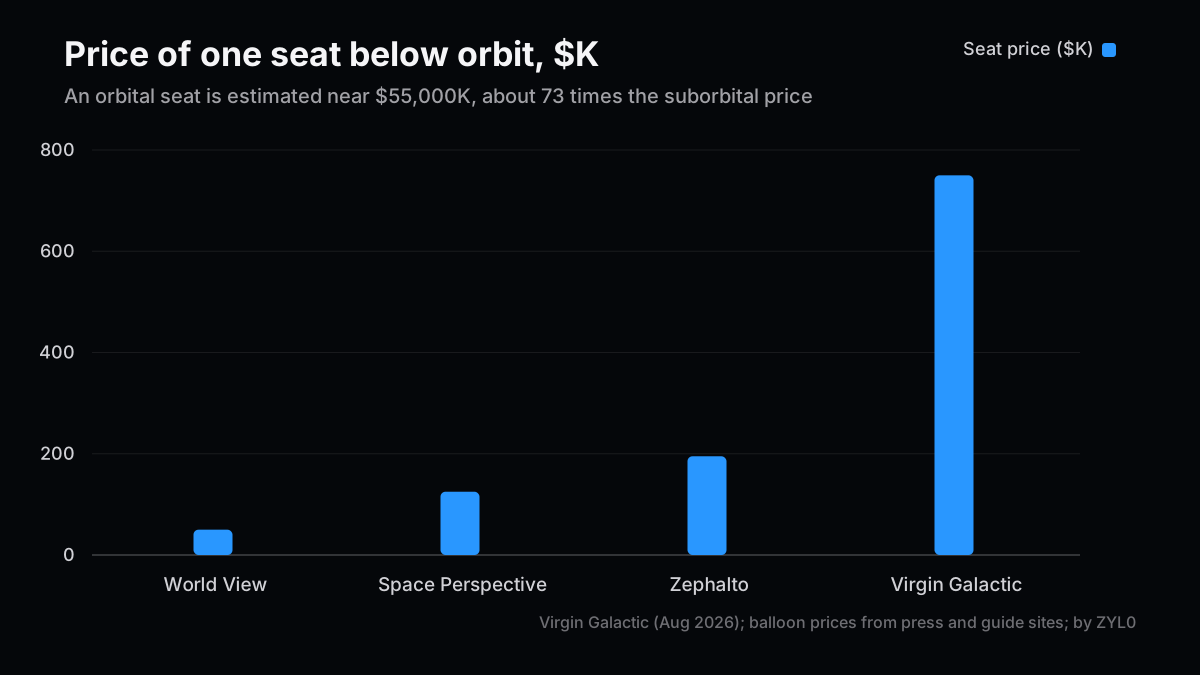
サブオービタルの75万ドルから軌道の約5,500万ドルまで、約73倍の開きがある(私の計算)。間を埋める商品はない。この階段は、段と段の間が広すぎる。
理由を並べていて、私は車載の量産を思い出した。
車載製品の量産では、設計や工程を一つ変えるたびに認定をやり直すのが普通だった。フィジカルAI連載③で、試作品が動くことと同じ品質のものを作り続けることの間には別の工学がある、と書いた。有人の機体も同じだ。機体を新しくすれば、実績は引き継げない。Unityの7回の商業飛行は、Deltaの実績にはならない。
Virgin Galacticが挙げた遅延の理由は示唆に富む。大きな不具合が一つあったのではない。同社の説明では、数百にのぼる小さな取り付け作業が残り、一部の部品は仕様より数千分の1インチ高かったり低かったりした。構造解析に関わっていた頃の感覚で言えば、怖いのは個々の部品より、公差の積み上がりのほうだ。1機目を組み上げる難しさは、設計の難しさとは別のところにある。
気になった詰まりを順に挙げる。数えたら6つあった。
| 課題 | 中身 | 2026年に起きたこと | 関わる企業 |
|---|
| 運航頻度 | 固定費を回収するには月単位の運航が要る | Virgin Galacticが2027年第2四半期末に月10回の運航を目標に掲げた | Virgin Galactic |
| 機体の作り直し | 新型機は試験と認定を一からやり直す | Deltaの初の商業飛行が2027年2月以降へ延びた | Virgin Galactic |
| 優先順位 | より大きな契約が来ると旅客は後回しになる | Blue Originが月着陸機を優先し、New Shepardを止めた | Blue Origin |
| 行き先 | 軌道の行き先は、いまISSしかない | Haven-1が2027年第1四半期へ延び、NASAの後継調達は未確定 | Vast、Axiom Space、Starlab |
| 規制 | 米国は搭乗者の安全規則の制定を法律で猶予中 | 猶予の期限は2028年1月1日のまま | 全社 |
| 安全の実証 | 気球は代金を取る有人飛行がまだ一度もない | 各社の有人試験の目標が2027年へ | World View、Zephalto、HALO Space、岩谷技研 |
3行目は、私がいちばん重く受け止めた点だ。Blue Originは、NASAから有人月着陸機の開発で34億ドルの契約を受けている。一方、Virgin Galacticが2026年3月から売り出した1席75万ドルの枠は、50席超、予約額で5,000万ドル超だった。後者は前者の約1.5%である(私の計算)。同じ技術者をどちらに回すかを問われれば、答えは決まっている。旅客事業は、技術に負けたのではなく、社内の資源配分で負けた。
規制も時計が動いている。米国は2004年以来、商業宇宙飛行の搭乗者の安全について、当局が規則を作ることを法律で猶予してきた。事故が起きるまでは業界に学ばせる、という考え方だ。現在の期限は2028年1月1日。米議会調査局の資料によれば、連邦航空局は2024年の時点で、延長がなければ最終規則は2028年4月ごろに発効すると見込んでいた。延長されるかどうかは議会が決める。
企業を高度の順に並べると、資金は「運ぶ会社」ではなく「行き先を作る会社」に集まっていた。
気球は、技術としてはいちばん穏やかに見える。ロケットを使わず、数時間かけて成層圏まで昇り、黒い空と地球の丸みを見て降りてくる。それでも、代金を取って客を乗せた会社はまだない。
米国のWorld Viewは1席5万ドルを掲げるが、案内サイトでは事業が休止状態と紹介されている。同じく米国のSpace Perspectiveは約12.5万ドルの席を売っていたが、資金難ののちスペインの企業に買収されたと報じられ、運航は始まっていない。フランスのZephaltoは約19.5万ドルで2027年を目標とし、スペインのHALO Spaceは有人試験を2027年後半に置く。これらの価格と時期は、各社の発表ではなく報道や案内サイトの掲載値で、変わりうる。
日本の岩谷技研は北海道の会社で、2024年7月の有人試験で高度20,816mに達した。当初は2023〜2024年の商業運航を計画していたが、まだ始まっていない。飛行の証拠では、気球の各社のなかで最も先にいる一社だ。
気球がなぜ進まないのか、正直なところ私にも確信はない。仮説はある。技術ではなく、有人の認証、保険、そして開業まで持ちこたえる資金だ。1席5万〜20万ドルの商品は、ロケットほどの資金を呼び込めない。
Virgin Galacticは上場企業(SPCE)で、この高度では唯一、再開の日程を公表している。初の商業飛行は2027年2月以降。2機目は2027年第2四半期に商業運航へ入る計画で、同じ四半期の終わりに月10回の運航を目指す。過去の実績は約1年間で7回だった。月10回は、その約17倍の頻度にあたる(私の計算)。
Axiom Spaceは、ISSへの民間ミッションを4回こなした唯一の会社だ。乗客の顔ぶれの変化が興味深い。2022年の初回は、同社の船長を除く3人が個人の客だった。2024年の3回目と2025年の4回目は、同じ3席がすべて各国政府の宇宙飛行士で埋まった。イタリア、トルコ、スウェーデン。そしてインド、ポーランド、ハンガリー。軌道の「旅客」の正体は、観光客から、自前の有人機を持たない国の飛行士へ移っている。
同社は2026年2月に3億5,000万ドルの資金調達を発表し、6月4日に総額5億2,500万ドル超で最終クローズした。新たに三菱UFJ銀行が加わった。資金の使い道は、自社のステーションとNASA向けの宇宙服である。
Vastは3月に5億ドルを調達した。内訳はBalerion Space Ventures主導の株式3億ドルと融資2億ドルで、カタール投資庁、三井物産、MUFG、ニコンなどが参加した。累計は10億ドルを超えると報じられている。単一モジュールのHaven-1は2027年第1四半期に打ち上げ、4人の乗員が訪れる計画だ。NASAからは、ISSへの6回目の民間ミッションも受注した。Axiom以外の会社がこの枠を得たのは初めてである。
StarlabはVoyager Technologies(VOYG)が主導し、Airbusや三菱商事が加わる。打ち上げは2028年以降とされる。
ここで投資家の欄を見比べてほしい。連載①にはLux CapitalやFounders Fund、Bessemerが、連載②にはKleiner Perkinsやa16zが並んだ。今回並ぶのは政府系ファンド、銀行、商社、メーカーだ。Cartaの2026年第1四半期レポートでは、調達額の6割超がAI企業に向かっている。10年前後で回収を考えるファンドの資金が、回収の遠い有人事業に回りにくいのは不思議ではない。代わりに入っているのは、国の宇宙政策や自社の事業とのつながりで判断する資金だ、というのが私の仮説である。
滑走路から飛び立つ機体や、宇宙を経由して地球上の2地点を結ぶ構想は、2030年代の話になる。米国のRadian Aerospaceは単段式のスペースプレーンを掲げるが、公開情報の範囲では機体はまだ飛んでいない。Venus Aerospaceは回転デトネーション方式のロケットエンジンを2025年5月に飛行試験し、2026年に9,100万ドルのSeries Bを調達した。
日本の将来宇宙輸送システム(ISC)は、2026年3月に約32億円を調達した。工程表は2032年の有人宇宙輸送を掲げる。ただし、米国で予定していた実証機の飛行試験は許可手続きの遅れで断念し、国内での試験に切り替えた。ここでも律速は技術より許可である。連載①でVardaの初号機が着陸の許可を8か月待ったのと、同じ形だ。
| 企業 | 種類 | 2026年の資金・予約 | 運航の証拠 | 段階(筆者) |
|---|
| Virgin Galactic | サブオービタル | 75万ドルの席を50席超、予約5,000万ドル超 | Unityで商業飛行7回(退役)、Deltaは未飛行 | 3(新型は未飛行) |
| Blue Origin | サブオービタル | 非開示 | 38回・98人、2年以上の停止を発表 | 3(停止中) |
| Axiom Space | 軌道 | 5.25億ドル超(6月に最終クローズ) | ISS訪問を4回 | 3 |
| Vast | 軌道・滞在 | 5億ドル(株式3億+融資2億、3月) | 未飛行、Haven-1は2027年第1四半期 | 0〜1 |
| 岩谷技研 | 気球 | 非開示 | 有人試験で高度20,816m(2024年7月) | 1 |
| Venus Aerospace | 推進系 | 9,100万ドルSeries B | エンジンの飛行試験(2025年5月) | 0 |
| 将来宇宙輸送システム | 二地点間輸送 | 約32億円(3月) | 実証機の試験段階 | 0 |
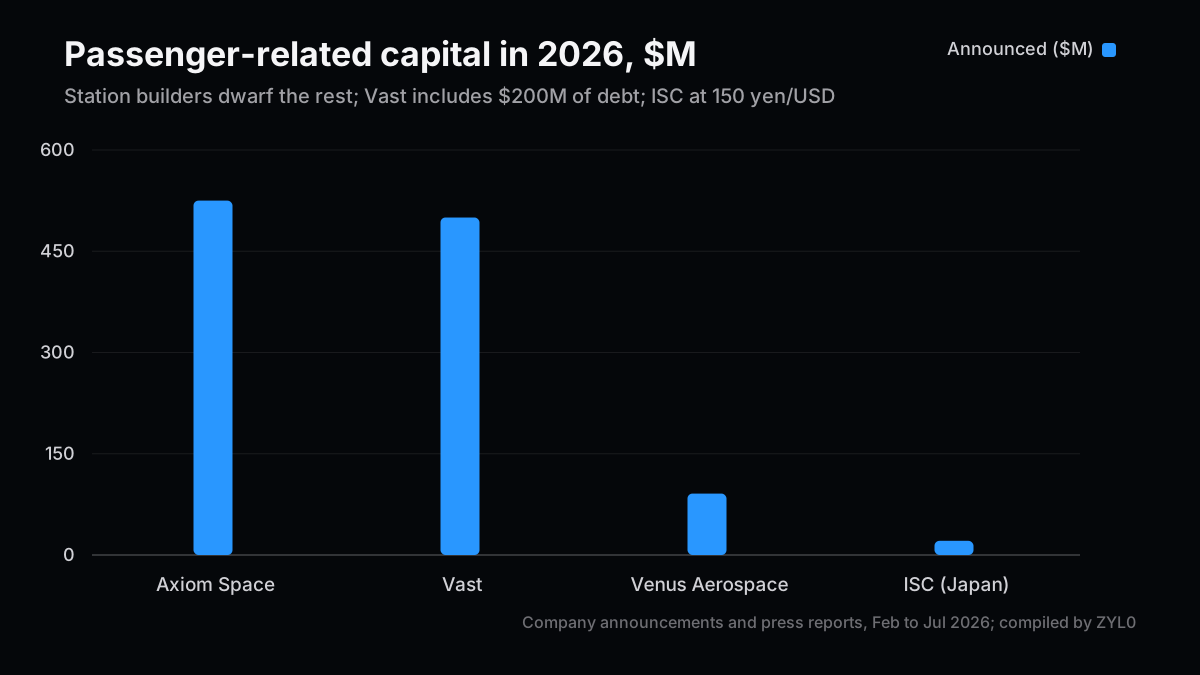
ステーションを作る2社の調達は、合計で約10.3億ドルになる(私の計算)。Virgin Galacticの新しい予約額の約20倍だ。資金は、客を運ぶ側ではなく、客の行き先を作る側に集まっている。
結論から書く。旅客を運ぶ事業は、短期も中期もニュートラルで見る。段階4、つまり月単位の運航が数か月続いたという証拠が出るまで、私は動かない。
ステーションの会社は別の枠で評価する。旅客の事業としてではない。連載①で読んだ「載せる場」として、そして自前の有人機を持たない国の飛行士の受け皿としてだ。こちらは中期ポジティブだが、ほぼすべて非上場である。
3月の8つのメガトレンドの記事で、私は商業ステーションの用途に宇宙観光を並べ、ベースケースに「商業ステーション1基が運用開始」と書いた。半年後のいま、最初の1基は2027年へずれ、用途の列に観光を入れるなら最後に置く。ここは見立てを改める。
上場株で直接触れられるのは、Virgin Galactic(SPCE)にほぼ限られる。2027年2月の初飛行と、その後の頻度に結果が大きく左右される銘柄だ。Vastに出資する三井物産(8031)、三菱UFJフィナンシャル・グループ(8306)、ニコン(7731)は、事業の規模に対して影響がごく小さい。
| シナリオ(2026〜2036年) | 条件 | 確認する証拠 | 投資への含意 |
|---|
| ベース | サブオービタルは1社が月数回で再開し、軌道の客は各国の飛行士が中心のまま | Deltaの月間運航回数、民間ミッションの乗員の内訳 | 旅客は小さな市場にとどまり、ステーションは政府需要で成り立つ |
| メイン | 2030年前後に商業ステーションが常時有人になり、旅客・研究・各国の飛行士を同じ場で受ける | Haven-1の成否、NASAの選定、2028年以降の大型モジュール | 連載①の「載せる場」と旅客が一体で評価される |
| テール(下振れ) | 事故、または2028年の規制の切り替えで運航が長く止まる | 猶予期間の延長の可否、事故やインシデントの報告 | 運航会社の存続が問われ、資金は行き先の側にだけ残る |
| テール(上振れ) | 大型の有人機が実用化し、軌道の席が一桁安くなる | 有人飛行の実績、1席の公表価格 | 観光が初めて量の市場になり、階段の間が埋まる |
この見立てが崩れる条件も書いておく。Deltaが2027年のうちに月8回以上の運航を3か月続け、1回の飛行あたりの損益を開示した場合だ。そのとき私は、サブオービタルを中期ロングへ改める。頻度の証拠が出れば、需要の議論は後からついてくる。
- Virgin GalacticのDeltaが2027年2月に商業飛行を始めるか、その後の月間回数
- VastのHaven-1が2027年第1四半期に上がり、最初の乗員が滞在できるか
- Axiomの5回目のミッションの乗員が、個人か各国の飛行士か
- 米議会が2028年1月1日の期限を前に、猶予期間を延長するか
- 気球の各社のうち、どこが最初に代金を取って客を乗せるか
3回を同じ表に並べる。
| 回 | 層 | いま現金を払っている顧客 | 証拠が最も進んだ例 | 筆者の判断 |
|---|
| ① | 微小重力 | 再突入の環境を試したい政府 | Vardaの再突入6回 | 帰還の層を中期ロング |
| ② | 通信 | 契約者、通信事業者、政府 | Starlinkの1,200万契約 | 部品・地上局・中継を中期ロング |
| ③ | 旅客 | 自前の有人機を持たない国の飛行士 | AxiomのISS訪問4回 | 運航頻度の証拠が出るまでニュートラル |
書き始める前、私は3つの層を別々の市場だと思っていた。並べてみると、共通点のほうが目立つ。どの層でも、いちばん確実な顧客は政府だった。そして資金は、目立つ商品そのものではなく、それを支える接続部分に集まっていた。帰り道、地上局と中継、そして行き先である。
今後10年の宇宙ビジネスを読むなら、私は「何が宇宙でできるか」より先に、「誰が、何回、同じことを繰り返せたか」を数える。派手さはないが、3回書いてみて、これがいちばん外れにくい読み方だと思っている。
次号の記事案
- 案1:宇宙ビジネス3層の資金配分表 — 連載3回の企業を「帰還・通信の部品・行き先」に並べ直し、上場株と非上場の露出をどう組むかを一つの表にまとめる。
- 案2:民間ミッションの乗員は誰が払っているか — ISS訪問の乗員を個人と各国政府に分け、有人機を持たない国の需要が何席分あるかを公開情報から数える。
- 案3:月10回という運航計画を検証する — 機体数、整備の間隔、天候の制約から、サブオービタルの運航頻度の上限を逆算する。
本記事は情報提供を目的としたものであり、特定銘柄の売買や投資助言ではありません。筆者は記事内で触れた企業の有価証券を保有している可能性があります。調査・執筆・翻訳の一部に生成AIを利用しています。座席の価格や調達額には報道ベースの未確定情報を含み、倍率・合計・換算・段階分けは本文に記した方法による筆者の計算と判断です。詳細は免責事項をご確認ください。
Space Business Series ③: When Does Carrying Passengers to Space Become a Business?
Of the three parts, this is the one I hesitated most to write. Microgravity and communications at least had numbers moving forward. Passengers do not. In 2026, suborbital flights carrying customers stopped after a single flight in January.
Note: this piece is an outside-in read based solely on public information — company releases, product pages, papers, and press coverage.
As of October 11, 2026. Flight records, funding and schedules come from company announcements and press reports. Seat prices include figures from press and guide sites, flagged as such. Yen amounts are converted at a rough ¥150 to the dollar; multiples, totals and evidence stages are my own calculations and judgment.
Start with the facts. Both suborbital operators are on the ground at the same time.
On January 30, 2026, Blue Origin said it would pause New Shepard flights for at least two years, to move people and money to its crewed lunar lander. By the company's count, New Shepard has flown 38 times and carried 98 people above 100 kilometers. The last flight was on January 22.
Virgin Galactic flew seven commercial missions on its first vehicle, VSS Unity, between June 2023 and June 2024, then retired it. The next-generation Delta is still in development. In its August 12 update the company moved the first commercial flight from the fourth quarter of 2026 to February 2027 at the earliest.
Right now, no vehicle anywhere is flying suborbital customers.
What about orbit? Axiom Space has run four private missions to the ISS between 2022 and 2025. The fifth is planned for no earlier than January 2027. Roughly one a year is the demonstrated pace so far.
Here is the ladder of evidence I have used through this series, translated to passengers.
| Stage | Evidence you can see | What you still cannot say |
|---|
| 1. Crewed test | People have flown on it | Whether paying customers can |
| 2. First commercial flight | A paying customer has flown | Whether it repeats |
| 3. Repeat | Several commercial flights completed | Whether it can fly every month |
| 4. Scheduled operations | Several flights a month, sustained | Whether each flight makes money |
| 5. Unit economics | Operating profit funds more vehicles | How many years demand lasts |
Blue Origin and Virgin Galactic both reached stage 3 and then returned to the ground. No company has reached stage 4.
Prices and track records, ordered by altitude:
| Type | Experience | Price per seat | Commercial record | Next milestone |
|---|
| Stratospheric balloon | 20 to 30-plus km, several hours, no weightlessness | $50,000 to $195,000 (press and guide sites) | None | Crewed tests targeted for 2027 |
| Suborbital | 80 to 100 km, a few minutes of weightlessness | $750,000 (Virgin Galactic) | Seven on Unity; 98 people on New Shepard | Delta commercial flight (Feb 2027 or later) |
| Orbital (ISS visit) | About 400 km, about two weeks | Estimated near $55 million (reported) | Four by Axiom | Fifth mission (Jan 2027 or later) |
| Commercial station stay | A dedicated habitat module | Not disclosed | None | Haven-1 (Q1 2027) |
From $750,000 for a suborbital seat to about $55 million for an orbital one is a gap of roughly 73 times (my calculation). Nothing is on sale in between. The rungs of this ladder are simply too far apart.
Listing the reasons, I found myself thinking about automotive mass production.
In automotive-grade manufacturing, it was normal to requalify every time a design or a process step changed. In Physical AI Series ③ I wrote that between a working prototype and building the same quality again and again lies a separate branch of engineering. Crewed vehicles are no different. Build a new vehicle and the track record does not carry over. Unity's seven commercial flights are not Delta's record.
The reason Virgin Galactic gave for its delay is telling. There was no single major fault. By its account, hundreds of small installation tasks remained, and some components were a few thousandths of an inch taller or shorter than specified. From my time around structural analysis, the thing to fear is less the individual part than the stack-up of tolerances. The difficulty of assembling the first unit sits somewhere other than the difficulty of designing it.
Here are the choke points I ended up with. There turned out to be six.
| Bottleneck | What it is | What happened in 2026 | Companies involved |
|---|
| Cadence | Fixed costs are only recovered by flying every month | Virgin Galactic set a target of ten flights a month by end of Q2 2027 | Virgin Galactic |
| Rebuilding | A new vehicle restarts testing and qualification | Delta's first commercial flight moved to February 2027 or later | Virgin Galactic |
| Priorities | Passengers get deferred when a bigger contract arrives | Blue Origin prioritized its lunar lander and paused New Shepard | Blue Origin |
| Destinations | In orbit the only destination today is the ISS | Haven-1 moved to Q1 2027; NASA's successor procurement is unsettled | Vast, Axiom Space, Starlab |
| Regulation | US law currently defers occupant-safety rulemaking | The deferral still expires on January 1, 2028 | Everyone |
| Proof of safety | No balloon has yet flown a paying passenger | Crewed test targets moved into 2027 | World View, Zephalto, HALO Space, Iwaya Giken |
The third row is the one I took most seriously. Blue Origin holds a $3.4 billion NASA contract to develop a crewed lunar lander. Virgin Galactic's new $750,000 ticket tranche, on sale since March 2026, sold more than 50 seats for more than $50 million in bookings. The second figure is about 1.5% of the first (my calculation). Ask where the same engineers should go and the answer is obvious. The passenger business did not lose to technology. It lost an internal contest for resources.
The regulatory clock is running too. Since 2004, US law has deferred the regulator's authority to write safety rules for people on commercial spacecraft, on the theory that the industry should be allowed to learn until something goes wrong. The current expiry is January 1, 2028. According to the Congressional Research Service, the Federal Aviation Administration estimated in 2024 that, without an extension, final rules would take effect around April 2028. Whether it is extended is up to Congress.
Ordered by altitude, the money turns out to sit not with those who carry passengers but with those who build somewhere for them to go.
A balloon looks like the gentlest technology of all. No rocket: it rises to the stratosphere over a few hours, shows you a black sky and the curve of the Earth, and comes down. Even so, no company has yet flown a paying customer.
World View, in the US, advertises $50,000 a seat, though guide sites describe its tourism business as dormant. Space Perspective, also American, sold seats at about $125,000, was reported to have been acquired by a Spanish company after running short of money, and has not begun operations. France's Zephalto lists about $195,000 and targets 2027, and Spain's HALO Space places crewed tests in late 2027. These prices and dates come from press and guide sites, not company filings, and may change.
Japan's Iwaya Giken, based in Hokkaido, reached 20,816 meters on a crewed test in July 2024. It originally planned commercial operations for 2023 to 2024 and has not yet started. On flight evidence it is one of the furthest along among the balloon companies.
Why balloons are not moving faster, I honestly cannot say with confidence. I have a hypothesis: it is not the technology but crewed certification, insurance, and enough capital to survive until opening day. A product priced at $50,000 to $200,000 a seat does not attract rocket-scale funding.
Virgin Galactic is a listed company (SPCE) and the only one at this altitude with a published restart schedule. First commercial flight: February 2027 at the earliest. A second ship is planned to enter commercial service in the second quarter of 2027, with a goal of ten flights a month by the end of that quarter. Its record so far is seven flights in about a year. Ten a month would be about 17 times that pace (my calculation).
Axiom Space is the only company to have flown four private missions to the ISS. The change in who rides is the interesting part. On the first mission in 2022, the three seats beside the company's commander went to private individuals. On the third in 2024 and the fourth in 2025, the same three seats were all filled by government astronauts: Italy, Türkiye and Sweden, then India, Poland and Hungary. The "passenger" in orbit has shifted from tourist to the astronaut of a country with no crewed vehicle of its own.
The company announced $350 million in financing in February 2026 and a final close of more than $525 million on June 4, with MUFG Bank joining as a new investor. The money goes to its own station and to spacesuits for NASA.
Vast raised $500 million in March: $300 million of equity led by Balerion Space Ventures and $200 million of debt, with the Qatar Investment Authority, Mitsui, MUFG and Nikon among the participants. Total funding is reported to exceed $1 billion. Its single-module Haven-1 is planned for the first quarter of 2027, to be visited by a crew of four. Vast also won NASA's sixth private astronaut mission to the ISS, the first time a company other than Axiom has taken one of those slots.
Starlab is led by Voyager Technologies (VOYG), with Airbus and Mitsubishi Corporation among its partners. Launch is not expected before 2028.
Compare the investor column with the earlier parts. Part 1 had Lux Capital, Founders Fund and Bessemer; Part 2 had Kleiner Perkins and a16z. Here the names are sovereign funds, banks, trading houses and manufacturers. Carta's Q1 2026 report shows more than 60% of capital raised going to AI companies. It is no surprise that money from funds working to a roughly ten-year horizon does not flow easily to crewed businesses whose payback is distant. What has come in instead, on my hypothesis, is capital that decides on the basis of national space policy or a link to its own business.
Vehicles that take off from runways, and plans to link two points on Earth through space, belong to the 2030s. Radian Aerospace, in the US, is pursuing a single-stage spaceplane; as far as public information shows, it has not yet flown a vehicle. Venus Aerospace flight-tested a rotating detonation rocket engine in May 2025 and raised a $91 million Series B in 2026.
Japan's Innovative Space Carrier (ISC) raised about ¥3.2 billion in March 2026. Its roadmap targets crewed space transport in 2032. It abandoned a planned flight test of its demonstrator in the US after permitting delays and switched to testing in Japan. Here again the pace is set by permission more than technology, the same shape as Varda's first capsule waiting eight months for clearance to land in Part 1.
| Company | Type | 2026 funding or bookings | Operating evidence | Stage (my read) |
|---|
| Virgin Galactic | Suborbital | 50+ seats at $750,000; over $50M in bookings | Seven commercial flights on Unity (retired); Delta unflown | 3 (new vehicle unflown) |
| Blue Origin | Suborbital | Not disclosed | 38 flights, 98 people; pause of two years or more | 3 (paused) |
| Axiom Space | Orbital | Over $525M (final close in June) | Four ISS visits | 3 |
| Vast | Orbital, stays | $500M ($300M equity + $200M debt, March) | Not yet flown; Haven-1 in Q1 2027 | 0–1 |
| Iwaya Giken | Balloon | Not disclosed | Crewed test to 20,816 m (July 2024) | 1 |
| Venus Aerospace | Propulsion | $91M Series B | Engine flight test (May 2025) | 0 |
| Innovative Space Carrier | Point-to-point | About ¥3.2B (March) | Demonstrator in testing | 0 |
The two station builders raised about $1.03 billion between them (my sum), roughly 20 times Virgin Galactic's new bookings. Capital is gathering on the side that builds the destination, not the side that carries the customer.
My conclusion first: I am neutral on passenger carriers in both the short and the medium term. Until there is stage 4 evidence, meaning monthly operations sustained for several months, I will not move.
Station companies I value in a different frame. Not as a passenger business, but as the hosting layer from Part 1, and as the place that receives astronauts from countries without a crewed vehicle. There I am medium-term positive, though almost all of it is private.
In my March post on eight megatrends I listed space tourism among the uses of commercial stations, and wrote "one commercial station begins operations" into my base case. Six months on, the first one has moved to 2027, and if tourism stays in the list of uses, it goes last. I am revising that view.
Direct public-market exposure is close to one name: Virgin Galactic (SPCE), a stock whose outcome depends heavily on the first flight in February 2027 and the cadence after it. For Mitsui (8031), Mitsubishi UFJ Financial Group (8306) and Nikon (7731), which invested in Vast, the effect is tiny relative to their size.
| Scenario (2026–2036) | Condition | Evidence to watch | Implication |
|---|
| Base | One suborbital operator restarts at a few flights a month; orbital riders remain mostly national astronauts | Delta's monthly flight count; crew make-up on private missions | Passengers stay a small market; stations work on government demand |
| Main | Around 2030 a commercial station is permanently crewed, hosting passengers, research and national astronauts | Haven-1's outcome; NASA's selection; larger modules from 2028 | The hosting layer from Part 1 and passengers are valued together |
| Tail (downside) | An accident, or the 2028 regulatory switch, grounds operations for a long time | Whether the deferral is extended; incident reports | Carriers' survival is in question; capital stays only with destinations |
| Tail (upside) | A large crewed vehicle enters service and cuts orbital seat prices by an order of magnitude | Crewed flight record; published seat prices | Tourism becomes a volume market for the first time; the rungs close up |
What would change my mind: if Delta sustains eight or more flights a month for three months during 2027 and the company discloses profit or loss per flight. I would then move suborbital to medium-term long. Once there is evidence of cadence, the argument about demand tends to follow.
- Whether Virgin Galactic's Delta begins commercial flights in February 2027, and the monthly count after that
- Whether Vast's Haven-1 launches in Q1 2027 and its first crew completes a stay
- Whether the crew of Axiom's fifth mission are individuals or national astronauts
- Whether Congress extends the deferral before the January 1, 2028 expiry
- Which balloon company is first to fly a paying customer
All three parts in one table:
| Part | Layer | Who pays cash today | Most advanced evidence | My call |
|---|
| ① | Microgravity | Governments testing re-entry conditions | Varda's six re-entries | Medium-term long the return layer |
| ② | Communications | Subscribers, mobile operators, governments | Starlink's 12 million subscribers | Medium-term long parts, ground and relay |
| ③ | Passengers | Countries without a crewed vehicle of their own | Axiom's four ISS visits | Neutral until there is evidence of cadence |
Before I started, I thought of these three layers as separate markets. Side by side, what stands out is what they share. In every layer the most reliable customer was a government. And capital gathered not on the headline product but on the connective parts that support it: the ride home, ground stations and relay, and the destination.
If I am reading the next ten years of space business, I will count who managed to repeat the same thing, and how many times, before I ask what can be done in space. It is not glamorous. But after writing three parts, I think it is the reading least likely to be wrong.
Next Issue Ideas
- Idea 1: A capital-allocation table for the three space layers — Re-sort the companies from all three parts into return, communications suppliers and destinations, and lay out public and private exposure in one table.
- Idea 2: Who is paying for private-mission crews? — Split ISS-visit crews into individuals and governments, and count from public information how many seats of demand come from countries without a crewed vehicle.
- Idea 3: Testing the plan for ten flights a month — Work backward from vehicle count, turnaround time and weather limits to an upper bound on suborbital flight cadence.
This article is for informational purposes only and is not investment advice or a recommendation to buy or sell any security. The author may hold securities of companies mentioned. Generative AI was used in parts of the research, writing and translation. Some seat prices and round sizes are reported but unconfirmed; multiples, totals, conversions and evidence stages are the author's calculations and judgment using the methods described. See the disclaimer for details.