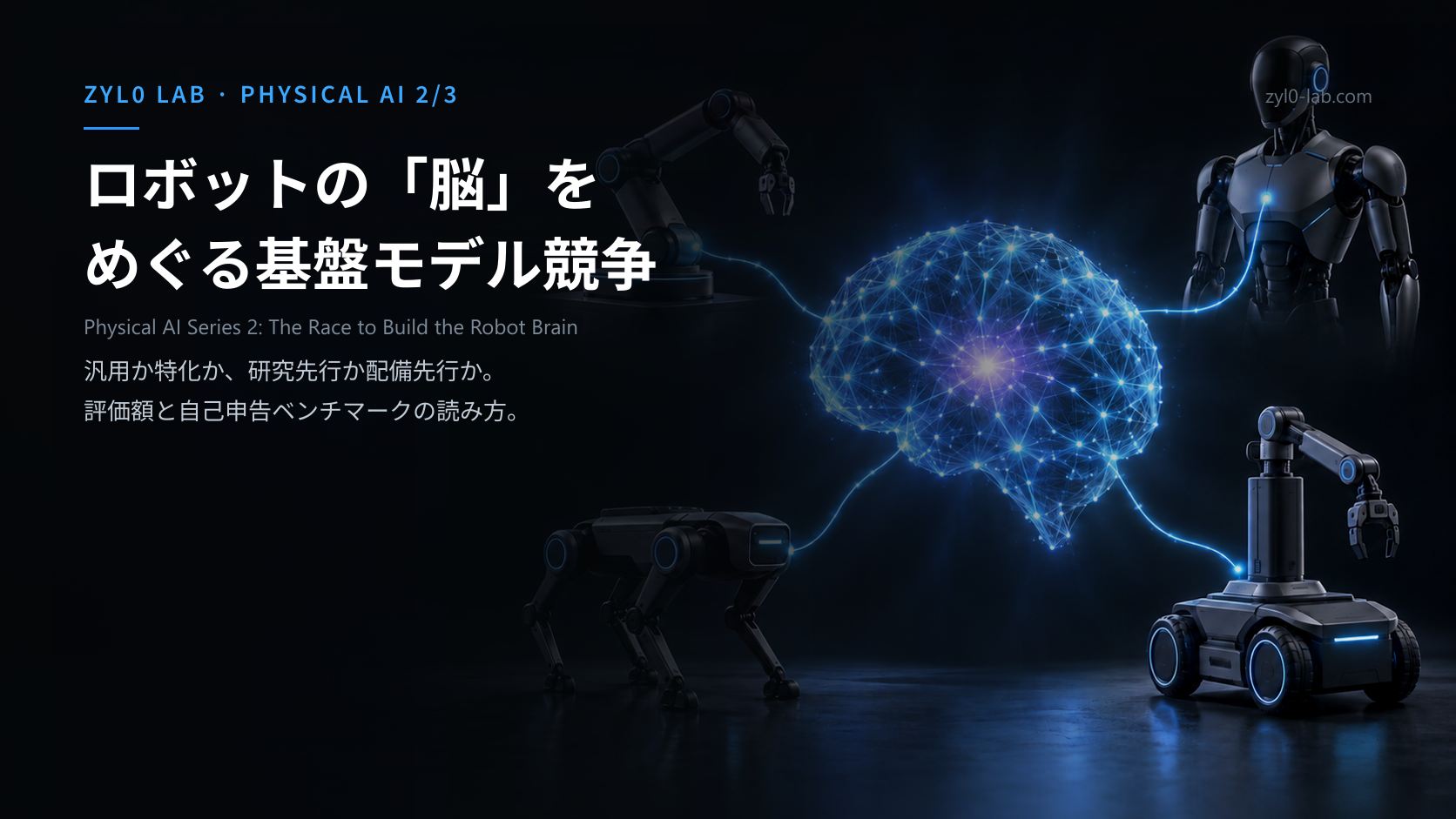
フィジカルAI連載②:ロボットの「脳」をめぐる基盤モデル競争
前回の連載①では、ロボットの学習データを集め、試し、運用する企業を読んだ。今回はそのデータを受け取る側、ロボットの「脳」を作る企業だ。私がこの回を一番書きにくいと感じていたのは、この層の数字のほとんどが会社自身の発表だからである。
確認時点:2026年10月3日。 調達額・評価額は各社発表と報道に基づき、報道ベースの未確定情報はその旨を記した。成功率などの性能値は、断りのない限り各社の自社テストの値である。
最初に私の見立てを書いておく。この層は、技術の進歩も評価額も本物だが、両者の間にまだ距離がある。
Sapphire VenturesのPhysical AIマップで「Intelligence & Models」に並ぶのは13社だ。Covariant、NVIDIA、DYNA、Elorian、FieldAI、Flexion、Generalist、General Trajectory、Genesis AI、Physical Intelligence、RLWRLD、Skild AI、Synphony。このうち主な企業の直近の資金調達を並べる。
| 企業 | 直近ラウンド | 評価額 | 主な投資家 |
|---|
| Skild AI | 14億ドルSeries C(2026年1月) | 140億ドル超 | SoftBank主導、NVentures、Macquarie、Bezos、Lightspeed、Sequoiaほか |
| Physical Intelligence | 約10億ドルSeries C(2026年) | 約117億ドル | Founders Fund、Lightspeed、Thriveほか(報道) |
| Generalist | 4億ドルSeries B(2026年6月) | 20億ドル | Radical Ventures主導、NVentures、Bezos |
| FieldAI | 累計4.05億ドル(2025年8月) | 20億ドル | Bezos、Gates Frontier、NVentures、Khosla |
| Elorian | 5,500万ドルのシード(2026年4月) | 3億ドル | Striker、Menlo、Altimeter、NVIDIA |
| DYNA | 1.2億ドルSeries A(2025年) | 非公表 | CRV、First Round |
| Genesis AI | 1.05億ドルのシード(2025年) | 非公表 | Eclipse、Khosla、Bpifrance |
| Flexion | 5,000万ドルSeries A(2025年11月) | 非公表 | DST Global Partners、NVentures |
| RLWRLD | 2,600万ドルSeed 2(2026年2月) | 非公表 | Headline Asia、Z Venture Capital |
Generalistについては、約30億ドルの評価額で追加調達したとの報道もある。Genesis AIも約30億ドル(プレマネー)での交渉が報じられたが、いずれも本稿執筆時点で確定発表を確認できていない。
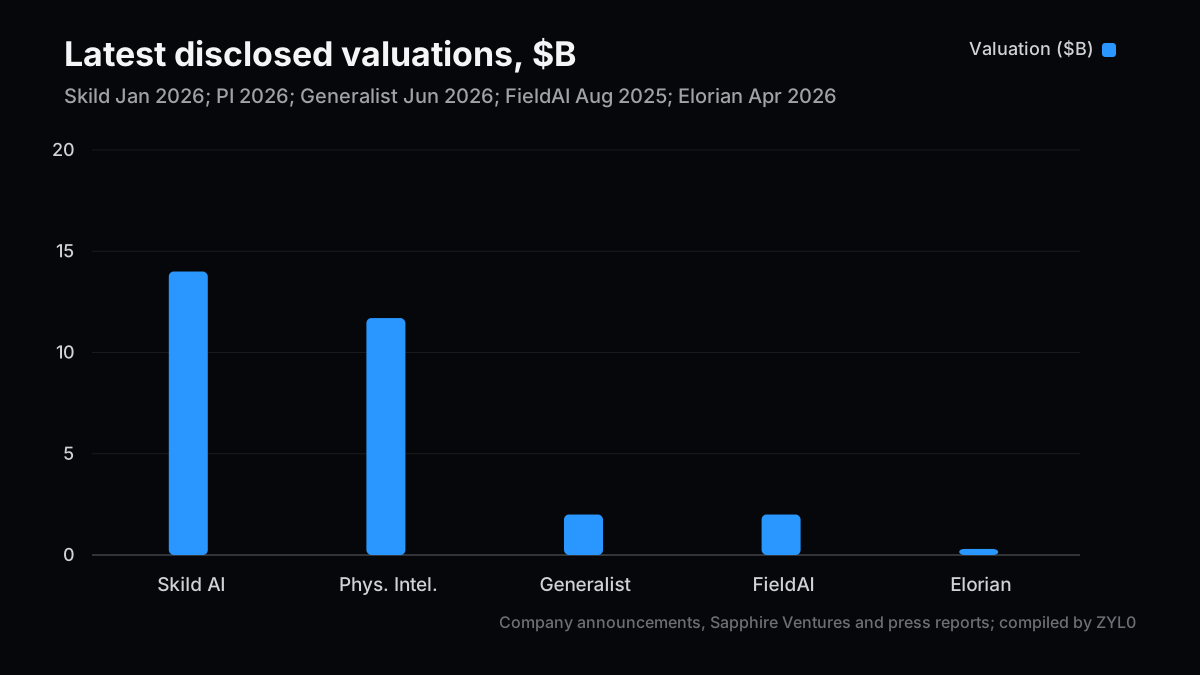
Cartaの2026年第1四半期レポートでは、AI基盤モデル企業のSeries A評価額の中央値は3億ドルだった。Elorianはプロダクトもない段階のシードで、その水準に届いている。
ここで思い出すのは、以前の投資委員会での一件だ。追加出資案件の評価額が高すぎると判断し、データを持って反対し、条件交渉を主導したことがある。そのとき私が使ったのは売上倍率ではなかった。「次の資金調達までに何を証明すれば、この評価額は正当化されるか」という、マイルストーンと評価額の対応表である。
Skild AIは2025年の売上を約3,000万ドルと開示している。140億ドルの評価額は、その約470倍だ(私の計算)。売上倍率で見れば説明はつかない。だから問うべきは、次のマイルストーンが何か、である。
壁を書き出してみて、私は少し考えを改めた。足りないのは賢さより、むしろ「確実さ」と「測り方」だった。
| 壁 | 中身 | なぜ難しいか | 挑み方の例 |
|---|
| 汎化 | 見たことのない部屋や物体で動く | 学習データの分布の外に出る | π0.5・π0.7の汎化、Elorianの視覚推論 |
| 体の違い | 腕・四足・人型で関節構成が違う | 行動の空間が機種ごとに違う | Skild Brain、Gemini Robotics 2 |
| 確実さと長い作業 | 99%台の成功率、10分を超える作業 | 1%の失敗が現場では致命的 | π*0.6の強化学習、PIの長期記憶、GEN-1 |
| 遅延と計算資源 | 連続制御に高頻度の推論が要る | 大きなモデルほど遅い | リアルタイムの行動チャンク化、オンデバイス版 |
| 測り方の不在 | 標準ベンチマークがなく結果は自己申告 | 条件がそろわない | NVIDIA Isaac Lab-Arena(2026年1月) |
| 事業モデル | 研究先行か配備先行か | データの循環と資金繰りが両立しにくい | PIのパートナー戦略、Skildの配備 |
Sapphireはこの層の論点として、「配備先行か研究先行か」の議論と、標準ベンチマークの不在を挙げている。前者は事業の話に見えて、実は技術の話でもある。配備すればデータと売上が入るが、想定外の失敗も表に出る。研究に徹すれば選択肢は残るが、データの循環を失うおそれがある。

測り方の問題は、具体例で見るのが早い。
| 企業・モデル | 指標 | 比較対象 | 条件 |
|---|
| Generalist GEN-1(2026年4月) | 平均成功率99% | 従来モデルで64%だった同じタスク | 自社テスト。タスクあたり約1時間のロボットデータ |
| Generalist GEN-1 | 箱の組み立て12.1秒 | GEN-0とπ0は約34秒 | 同じ箱での自社比較 |
| Generalist GEN-1.5 | ワンショット成功率59% | 数分の追加データで83% | 自社の10タスク平均 |
| DYNA-2(2026年8月) | 1台・18時間で1,590枚のナプキン | — | 自社発表 |
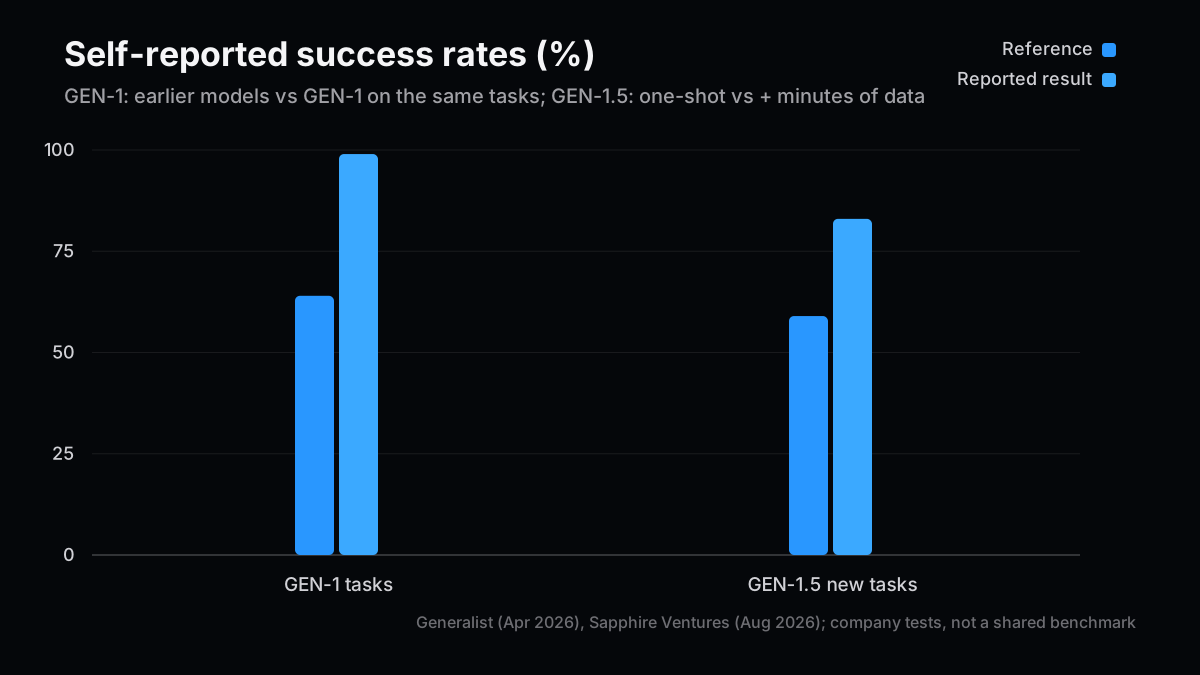
GEN-1の99%は印象的な数字だ。ただし比較対象は「従来モデルで64%だったタスク」で、タスクの選び方は会社が決めている。これは批判ではない。共通の物差しがない以上、各社はこう示すしかない。Big Tech4社のcapex記事で、定義をそろえるまで順位を語らないと書いた。成功率も同じで、条件がそろうまでは会社間の順位にしない。
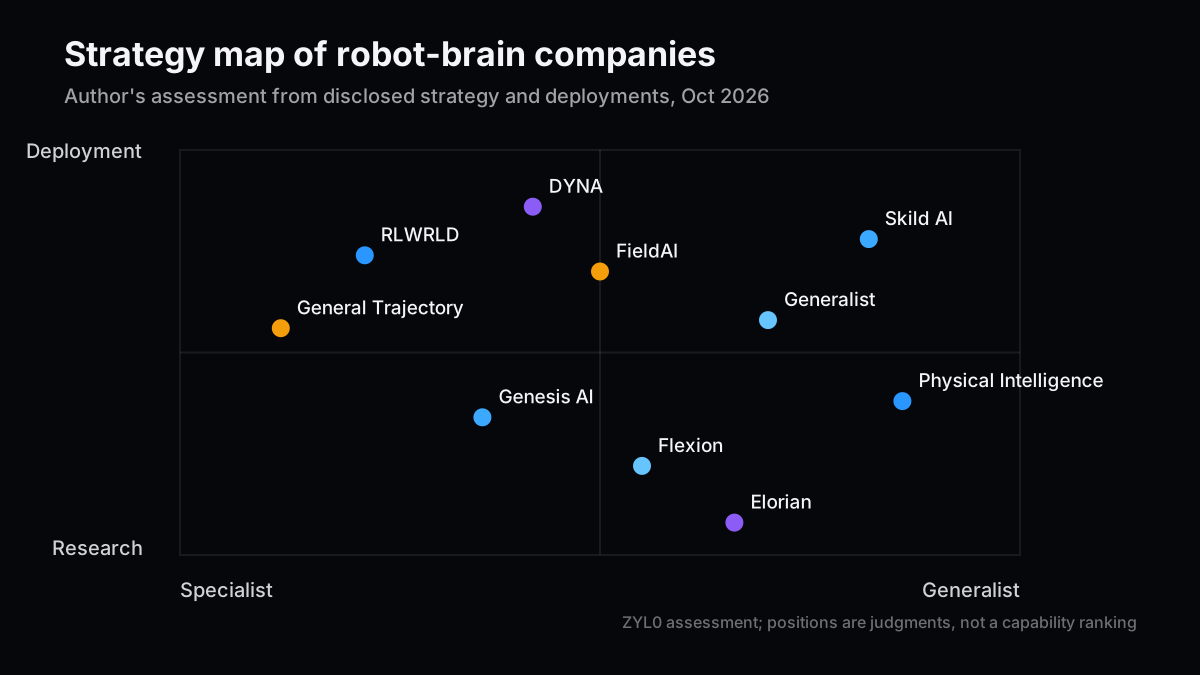
各社を読んでいくと、方針は大きく4つに分かれていた。
Physical Intelligence(PI)は、言語モデルにおけるAPIのような「知能レイヤー」を、ロボットで作ろうとしている。2024年10月に最初の汎用方策π0を出し、2025年2月にはπ0とπ0-FASTの重みを公開した。π0.5で未知の部屋への汎化を示し、2025年11月のπ*0.6では実機の経験から強化学習で成功率と処理速度を上げた。2026年4月のπ0.7は、指示で振る舞いを操れることと汎化の段階的な向上をうたう。
注目したのは、2026年2月の「The Physical Intelligence Layer」という投稿だ。PIはここで、自社でロボットを売るのではなく、配備を専門とする企業(WeaveやUltra)と組んで現場で検証する方針を示した。研究先行だが、データの入口は確保しようとしている。
Skild AIは2026年1月にSoftBank主導で14億ドルを調達した。中核の「Skild Brain」は、四足、人型、卓上アーム、移動マニピュレータなど、体の形を事前に知らなくても制御できるとする。学習データは大規模シミュレーション、インターネット動画、遠隔操作、実配備の4つを組み合わせる。配備先として警備、建設、配送、データセンター、倉庫、工場の組み立てを挙げ、2025年に約3,000万ドルの売上があった。この層で売上を開示している会社は少ない。
Generalistの方針は、ロボットではなく人のデータで事前学習することだ。GEN-1は、低コストの装着型デバイスで集めた50万時間超の物理的なやり取りのデータで事前学習した。タスクごとに必要なロボットデータは約1時間だという。2026年6月にRadical Ventures主導で4億ドルのSeries Bを調達し、評価額は20億ドルになった。
DYNA Roboticsはさらに踏み込んだ。2026年8月に発表したDYNA-2は、100万時間超の人の一人称動画だけで学んだ「世界行動モデル」だという。前世代のDYNA-1は視覚・言語・行動を直接結ぶVLAだった。DYNA-2は過去の映像から未来の映像を予測し、動く前に結果を見積もる。同社はレストランのDin Tai Fungへの導入を発表している。
この「VLAから世界行動モデルへ」という流れは、DYNAだけではない。Sapphireも同じ移行を論点に挙げている。私には、連載①で見た世界モデル企業と、この層の境界が溶け始めているように見える。
FieldAIは屋外や産業現場の、地図もGPSも当てにならない環境に絞る。物理に基づく不確実性の推定を組み込んだ「リスクを意識する」基盤モデルを掲げ、2025年8月までに計4.05億ドルを調達した。Genesis AIはフランスの会社で、人間並みの手とモデルを一体で作る。2026年5月にGENE-26.5を発表した。Flexionはチューリッヒから人型ロボット向けの強化学習基盤を作り、「体ではなく脳を作る」と明言する。
日本の読者に知ってほしいのが韓国のRLWRLDだ。実際の産業現場の中でモデルを学習させる方針で、2026年2月のSeed 2にはLINEヤフー系のZ Venture Capitalが入った。韓国と日本の物流・流通の現場でPoCを進めている。ほかに、視覚推論に特化したElorian(元Google DeepMindのAndrew Dai氏ら)、工場のピッキングに絞ったGeneral Trajectory、イチゴ収穫ロボットを作りながら評価データを基盤モデル企業に売るSynphonyがマップに載る。
| 方針 | 代表企業 | 強み | 弱点 |
|---|
| 汎用の知能レイヤー | Physical Intelligence | 研究の厚み、オープンな公開 | 配備データをパートナーに頼る |
| 体を選ばない配備型 | Skild AI | 売上と配備データ | 評価額が売上の約470倍 |
| 人のデータで規模 | Generalist、DYNA | データの量 | 人と体の差(embodiment gap) |
| 特定の環境・体 | FieldAI、RLWRLD、Genesis AI | 現場の確実さ | 市場が限られる |
独立系の上には、二つの巨人がいる。NVIDIAは2026年1月、人型向けのオープンなVLA「Isaac GR00T N1.6」、世界モデル群「Cosmos」の新版、方策の評価環境「Isaac Lab-Arena」、1,000個購入時1,999ドルのJetson T4000を発表した。モデルを無償で配り、計算資源で稼ぐ構図である。オープンとクローズドのAIモデル比較で見た力学が、ロボットでも繰り返されている。
Google DeepMindは2026年7月末にGemini Robotics 2を発表し、Apptronikの人型Apollo 2の全身制御を示した。推論モデルのER 2はGoogle AI Studioで使えるが、VLA本体は早期アクセスのパートナー向けにとどまる。
最後に、Covariantの教訓を置いておく。2024年3月に倉庫向けのRFM-1を出したが、同年8月にAmazonが非独占ライセンスを結び、創業者3人と社員の約4分の1がAmazonへ移った。研究の質と事業の持続性は別物だという例として、私は今も時々読み返している。
3月の記事で私は「基盤モデルとプラットフォームには今コア配分」と書いた。評価額が半年で倍になった今、その判断を少し修正する。
基盤モデルの独立系は、短期ニュートラル、中期ロングとする。ただし中期で残るのは2〜3社に絞られると見ている。選ぶ基準は、配備から入るデータの循環を持つかどうかだ。売上を開示しているSkildと、外食での導入を示したDYNAは、この点で一歩先にいる。PIは研究の厚みで群を抜くが、パートナー経由の配備がどこまで広がるかを見たい。
上場株では、NVIDIAが最も素直な受け皿だと考える。オープンモデルを配るほど、学習と推論、Jetsonの需要が増える。Alphabetは、Gemini RoboticsとCapitalG経由のPI出資の両方を持つ。SoftBankはSkildを主導したが、同社の規模に比べれば影響は小さい。
| シナリオ | 条件 | 確認する証拠 | 投資への含意 |
|---|
| ベース | 汎用モデルは研究で進むが、収益は特定用途の配備から生まれる | Skild・DYNAの売上、PIのパートナー数 | 配備データを持つ企業が評価額を正当化しやすい |
| メイン | 汎用モデルが「知能レイヤー」としてAPI化し、ロボット企業が採用する | PIやGemini Roboticsの外部採用、ライセンス収入の開示 | 言語モデルと同様に上位数社へ集中 |
| テール | NVIDIAやGoogleのモデルで差が消え、独立系が買収される | GR00Tの性能向上、Covariant型の取引の再来 | 独立系の評価額が急落する |
この見立てが崩れる条件を書いておく。第三者の共通の評価環境で、汎用モデルが追加データなしに特化モデルと同等以上の成功率を示した場合だ。そのとき私は「汎用は研究、収益は特化」という見方を改め、汎用の知能レイヤーに賭ける側へ寄せる。
- Skild AIが2026年の売上を開示するか
- PIのパートナーが何社まで増え、どの業種に広がるか
- Isaac Lab-Arenaのような共通の評価環境で、各社の結果が並ぶ日が来るか
- Generalistの追加調達と、Genesis AIの交渉が確定するか
次回は、どれだけ賢い脳も動かせない最後の律速、ハードウェアを読む。
次号の記事案
- 案1:ロボット基盤モデルの「マイルストーン対応表」を作る — Skild AI・PI・Generalistの評価額を、次の調達までに必要な売上・配備台数・成功率と対応させ、2027年の調達ラウンドを先読みする。
- 案2:共通ベンチマークは誰が作るのか — NVIDIAのIsaac Lab-Arenaと各社の自社テストを比べ、第三者評価が生まれる条件と、それが評価額に与える影響を探る。
- 案3:アジアのロボット基盤モデル — RLWRLDとLINEヤフー系CVC、SoftBankのSkild主導を手がかりに、日本の事業会社が「脳」の層にどう関わるかを整理する。
本記事は情報提供を目的としたものであり、特定銘柄の売買や投資助言ではありません。筆者は記事内で触れた企業の有価証券を保有している可能性があります。調査・執筆・翻訳の一部に生成AIを利用しています。調達額・評価額には報道ベースの未確定情報を含み、性能値は各社の自社テストの値です。倍率は筆者の計算値です。詳細は免責事項をご確認ください。
Physical AI Series ②: The Race to Build the Robot Brain
In Part 1, I looked at the companies that collect, test and operate around robot training data. This time I turn to the receiving end: the companies building the robot brain. I expected this to be the hardest part to write, because nearly every number in this layer comes from the companies themselves.
As of October 3, 2026. Round sizes and valuations come from company announcements and press reports; unconfirmed reports are flagged. Unless stated otherwise, performance figures such as success rates come from each company's own tests.
Let me state my read up front: both the technical progress and the valuations in this layer are real, but there is still distance between them.
Sapphire Ventures' Physical AI map lists 13 companies under "Intelligence & Models": Covariant, NVIDIA, DYNA, Elorian, FieldAI, Flexion, Generalist, General Trajectory, Genesis AI, Physical Intelligence, RLWRLD, Skild AI and Synphony. Here are the latest rounds for the main ones.
| Company | Latest round | Valuation | Key investors |
|---|
| Skild AI | $1.4B Series C (Jan 2026) | $14B+ | Led by SoftBank; NVentures, Macquarie, Bezos, Lightspeed, Sequoia and others |
| Physical Intelligence | ~$1B Series C (2026) | ~$11.7B | Founders Fund, Lightspeed, Thrive and others (reported) |
| Generalist | $400M Series B (Jun 2026) | $2B | Led by Radical Ventures; NVentures, Bezos |
| FieldAI | $405M total (Aug 2025) | $2B | Bezos, Gates Frontier, NVentures, Khosla |
| Elorian | $55M seed (Apr 2026) | $300M | Striker, Menlo, Altimeter, NVIDIA |
| DYNA | $120M Series A (2025) | Undisclosed | CRV, First Round |
| Genesis AI | $105M seed (2025) | Undisclosed | Eclipse, Khosla, Bpifrance |
| Flexion | $50M Series A (Nov 2025) | Undisclosed | DST Global Partners, NVentures |
| RLWRLD | $26M Seed 2 (Feb 2026) | Undisclosed | Headline Asia, Z Venture Capital |
There are also reports that Generalist raised more at around a $3 billion valuation, and that Genesis AI was negotiating at about $3 billion pre-money. I could not confirm a final announcement for either as of writing.
Carta's Q1 2026 report put the median Series A valuation for AI foundation model companies at $300 million. Elorian reached that level at the seed stage, before shipping a product.
It reminds me of an investment committee meeting from a few years back. I concluded that a follow-on round was priced too high, opposed it with data, and led the renegotiation. The tool I used was not a revenue multiple. It was a table matching valuation to milestones: what would the company need to prove before its next raise for this price to make sense?
Skild AI has disclosed roughly $30 million in 2025 revenue. A $14 billion valuation is about 470 times that (my calculation). On a revenue multiple, it does not add up. So the real question is what the next milestone is.
Writing the walls down changed my thinking a little. What is missing is less raw intelligence than reliability — and a way to measure it.
| Wall | What it means | Why it is hard | Examples of attack |
|---|
| Generalization | Working in rooms and with objects never seen before | Leaving the training distribution | π0.5 and π0.7 generalization; Elorian's visual reasoning |
| Different bodies | Arms, quadrupeds and humanoids have different joints | The action space differs by robot | Skild Brain; Gemini Robotics 2 |
| Reliability and long tasks | 99%+ success; tasks longer than ten minutes | A 1% failure rate is fatal on a real line | π*0.6 reinforcement learning; PI's long-term memory; GEN-1 |
| Latency and compute | Continuous control needs high-frequency inference | Bigger models are slower | Real-time action chunking; on-device versions |
| No shared yardstick | No standard benchmark; results are self-reported | Conditions never line up | NVIDIA Isaac Lab-Arena (Jan 2026) |
| Business model | Research-first or deployment-first | Hard to fund research and keep the data flywheel turning | PI's partner strategy; Skild's deployments |
Sapphire flags two debates in this layer: deployment-first versus research-first, and the lack of standard benchmarks. The first looks like a business question but is really technical too. Deploying brings data and revenue, but also exposes edge cases. Staying in research mode preserves options, but risks losing the data flywheel.
The measurement problem is easiest to see in concrete numbers.
| Company / model | Metric | Compared with | Conditions |
|---|
| Generalist GEN-1 (Apr 2026) | 99% average success | Same tasks where earlier models hit 64% | Company tests; ~1 hour of robot data per task |
| Generalist GEN-1 | Box assembly in 12.1 seconds | GEN-0 and π0 took about 34 seconds | Same boxes, company comparison |
| Generalist GEN-1.5 | 59% one-shot success | 83% with a few minutes of extra data | Company average across 10 tasks |
| DYNA-2 (Aug 2026) | 1,590 napkins per robot in an 18-hour shift | — | Company announcement |
GEN-1's 99% is an impressive number. But the comparison is against "tasks where earlier models reached 64%," and the company chose the tasks. That is not a criticism; without a shared yardstick, this is the only way anyone can report progress. In my post on Big Tech capex, I refused to rank companies until their definitions matched. Success rates deserve the same treatment: no cross-company ranking until the conditions line up.
Reading the companies one by one, their strategies sort into four broad camps.
Physical Intelligence (PI) wants to build for robots what APIs became for language models: a ready-made intelligence layer. It released its first generalist policy, π0, in October 2024, and published the weights for π0 and π0-FAST in February 2025. π0.5 showed generalization to unseen homes, and π*0.6 in November 2025 used reinforcement learning from real-world experience to raise success rates and throughput. π0.7, released in April 2026, emphasizes steerability and a step-change in generalization.
The post that caught my eye was "The Physical Intelligence Layer," from February 2026. In it, PI made clear it would not sell robots itself, but would validate its models in the field with deployment specialists such as Weave and Ultra. It is research-first, but it is trying to secure a data on-ramp.
Skild AI raised $1.4 billion led by SoftBank in January 2026. Its core "Skild Brain" claims to control quadrupeds, humanoids, tabletop arms and mobile manipulators without prior knowledge of the body. Its training mixes four data sources: large-scale simulation, internet video, teleoperation and real deployments. It lists deployments across security, construction, delivery, data centers, warehouses and factory assembly, and generated about $30 million of revenue in 2025. Very few companies in this layer disclose revenue at all.
Generalist's bet is to pretrain on human data rather than robot data. GEN-1 was pretrained on more than 500,000 hours of physical-interaction data gathered with low-cost wearable devices, and needs only about an hour of robot data per task. In June 2026 it raised a $400 million Series B led by Radical Ventures at a $2 billion valuation.
DYNA Robotics goes further. DYNA-2, announced in August 2026, is a "world-action model" trained solely on more than a million hours of human first-person video. Its predecessor, DYNA-1, was a VLA that mapped vision and language directly to action. DYNA-2 predicts future video frames from past ones, estimating consequences before it moves. The company has announced a rollout with the restaurant chain Din Tai Fung.
This shift from VLAs to world-action models is not DYNA's alone; Sapphire also calls it out. To me, the boundary between this layer and the world-model companies from Part 1 is starting to dissolve.
FieldAI focuses on outdoor and industrial sites where maps and GPS cannot be trusted. It pitches "risk-aware" foundation models with physics-based uncertainty estimates, and had raised $405 million by August 2025. Genesis AI, a French company, builds a human-scale hand and the model that drives it as one system; it showed GENE-26.5 in May 2026. Flexion builds a reinforcement-learning stack for humanoids out of Zurich, and says plainly that it builds the brain, not the body.
One for readers in Japan: RLWRLD from South Korea trains its models inside live industrial sites, and its February 2026 Seed 2 included Z Venture Capital, the venture arm of LY Corporation. It is running proofs of concept in logistics and retail settings in Korea and Japan. The map also lists Elorian, focused on visual reasoning and founded by former Google DeepMind researcher Andrew Dai and others; General Trajectory, focused on factory picking; and Synphony, which builds strawberry-harvesting robots while selling evaluation data to foundation-model labs.
| Strategy | Representative companies | Strength | Weakness |
|---|
| General intelligence layer | Physical Intelligence | Research depth; open releases | Relies on partners for deployment data |
| Body-agnostic deployment | Skild AI | Revenue and deployment data | Valuation ~470x revenue |
| Scale via human data | Generalist, DYNA | Sheer data volume | The embodiment gap between humans and robots |
| Specific environments or bodies | FieldAI, RLWRLD, Genesis AI | Reliability in the field | Narrower markets |
Above the independents sit two giants. In January 2026, NVIDIA released Isaac GR00T N1.6, an open VLA for humanoids; new versions of its Cosmos world models; Isaac Lab-Arena, an environment for evaluating policies; and the Jetson T4000 module at $1,999 in volume. It gives the models away and earns on compute. The dynamic I described in my post on open versus closed AI models is replaying in robotics.
Google DeepMind announced Gemini Robotics 2 at the end of July 2026, demonstrating whole-body control of Apptronik's Apollo 2 humanoid. The ER 2 reasoning model is available in Google AI Studio, but the VLA itself remains limited to early-access partners.
Finally, the lesson of Covariant. It shipped RFM-1 for warehouses in March 2024, but in August that year Amazon took a non-exclusive license, and the three co-founders plus about a quarter of the staff moved to Amazon. I still go back to it as a reminder that research quality and business durability are different things.
In March I wrote that I wanted core exposure to foundation models and platforms now. With valuations doubling in six months, I am adjusting that call.
For independent foundation model companies, I am short-term neutral and medium-term long — with the expectation that only two or three survive the medium term. My filter is whether a company has a data flywheel fed by deployments. Skild, which discloses revenue, and DYNA, with a restaurant rollout, are a step ahead on that front. PI leads on research depth, and I want to see how far its partner-led deployments spread.
In public markets, NVIDIA looks like the cleanest vehicle. The more open models it hands out, the more demand it creates for training, inference and Jetson. Alphabet owns both Gemini Robotics and, via CapitalG, a stake in PI. SoftBank led Skild's round, but the effect is small relative to SoftBank's size.
| Scenario | Condition | Evidence to watch | Implication |
|---|
| Base | Generalist models advance in research, but revenue comes from task-specific deployments | Skild and DYNA revenue; number of PI partners | Companies with deployment data justify their valuations more easily |
| Main | Generalist models become an API-style intelligence layer that robot makers adopt | External adoption of PI or Gemini Robotics; disclosed licensing revenue | Concentration in a few leaders, as with language models |
| Tail | NVIDIA's and Google's models erase the gap and independents get acquired | GR00T performance gains; another Covariant-style deal | Independent valuations fall sharply |
What would change my mind: if a generalist model matches or beats specialist models on a shared, third-party evaluation environment without extra task data. At that point I would drop my "generalists for research, specialists for revenue" view and lean toward betting on the general intelligence layer.
- Whether Skild AI discloses its 2026 revenue
- How many partners PI signs, and in which industries
- Whether a shared evaluation environment such as Isaac Lab-Arena ever lines up results across companies
- Whether Generalist's follow-on and Genesis AI's talks are confirmed
Next time: the last bottleneck that no brain, however smart, can think its way past — hardware.
Next Issue Ideas
- Idea 1: A milestone table for robot foundation models — Map the valuations of Skild AI, PI and Generalist to the revenue, deployed units and success rates each needs before its next raise, and preview the 2027 rounds.
- Idea 2: Who builds the shared benchmark? — Compare NVIDIA's Isaac Lab-Arena with company-run tests, and explore what it would take for third-party evaluation to emerge — and what that would do to valuations.
- Idea 3: Robot foundation models in Asia — Use RLWRLD's LY Corporation backer and SoftBank's lead in Skild to map how Japanese corporates can engage with the brain layer.
This article is for informational purposes only and is not investment advice or a recommendation to buy or sell any security. The author may hold securities of companies mentioned. Generative AI was used in parts of the research, writing and translation. Some round sizes and valuations are reported but unconfirmed, and performance figures come from the companies' own tests. Multiples are the author's calculations. See the disclaimer for details.