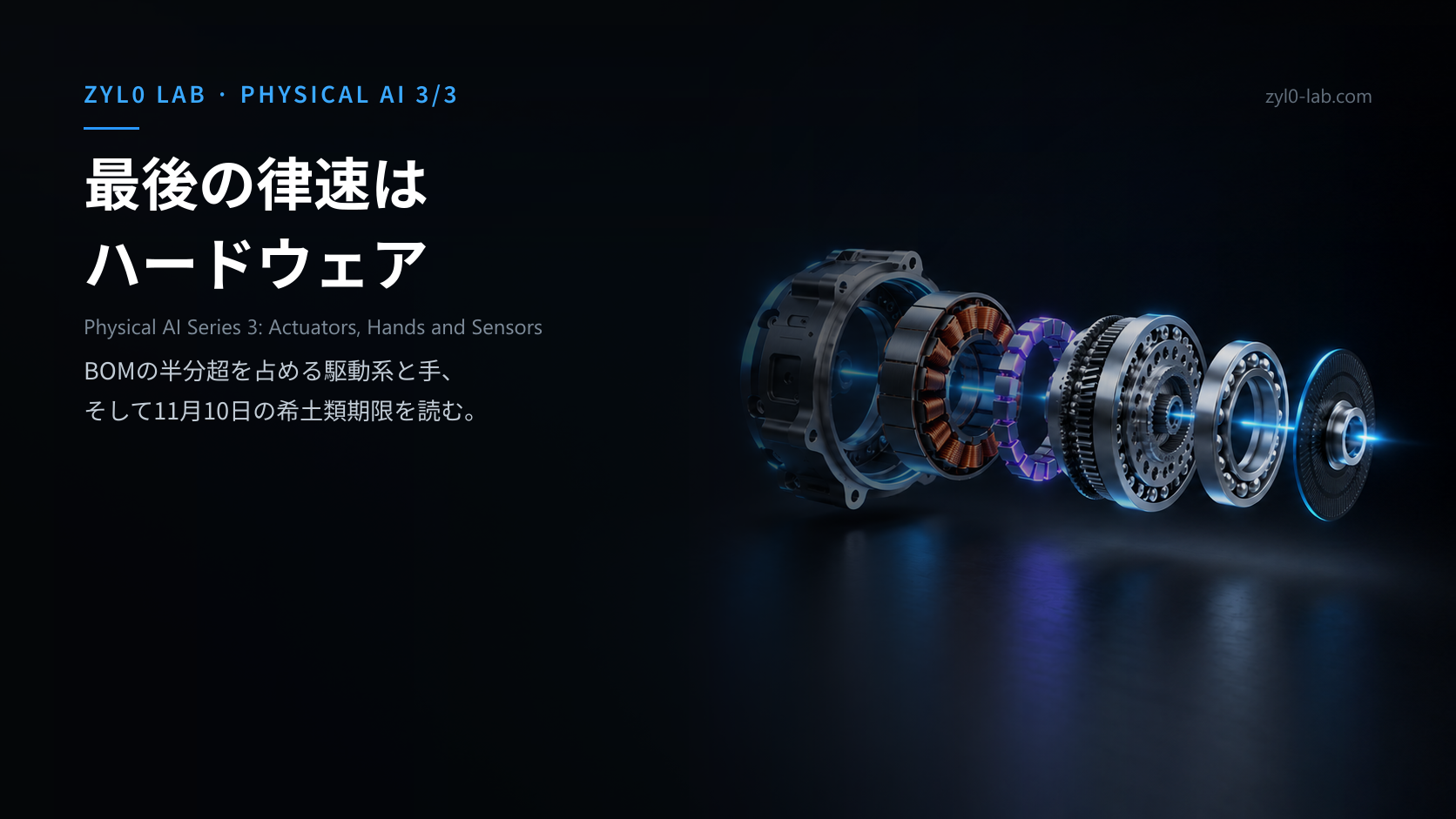
フィジカルAI連載③:最後の律速はハードウェア――アクチュエータ・手・センサー
車載EEPROMの量産に関わっていた頃、試作品が動くことと、同じ品質のものを何百万個も作り続けることの間には、設計とは別の工学があると思い知った。フィジカルAIの連載をデータと運用、ロボットの脳と進めてきて、最後に残るのはその「量産の工学」が支配する層、ハードウェアである。
確認時点:2026年10月3日。 市場予測はBank of America Instituteの2026年3月のレポート、企業の数値は各社の発表に基づく。構成比や伸び率の一部は本稿での計算値である。
最初に結論を置く。ヒューマノイドの値段を決めているのは、脳ではなく筋肉だ。
Sapphire VenturesのPhysical AIマップは、ハードウェアの層にセンサー、アクチュエータ、部品の3つの枠を設けている。並ぶ企業は他の層と様子が違う。Hesai、Ouster、Nabtesco、Moogといった上場企業が多く、スタートアップは少数派だ。Sapphireはアクチュエータ、センサー、計算資源のコストが一桁下がったと書く一方、搭載できる電力の予算がリアルタイムで動かせるモデルの大きさを縛っていること、ハードウェアの開発サイクルが長く資本を食うことも指摘している。
Bank of America Institute(BofA)が2026年3月に出したレポートは、部品別のコストを具体的に示している。2030年時点の構成比はこうだ。
| 部位 | 2030年のBOM構成比 | 役割 |
|---|
| リニアアクチュエータ | 27% | 膝・足首・肘などの伸縮 |
| 回転アクチュエータ | 24% | 肩・股関節・手首の回転 |
| 器用な手 | 19% | 把持と操作 |
| 制御システム | 10% | 計算と運動制御 |
| 視覚・その他のセンサー | 4% | カメラ・触覚など |
| エネルギー系 | 4% | バッテリーと電源 |
| その他 | 12% | 構造材など |
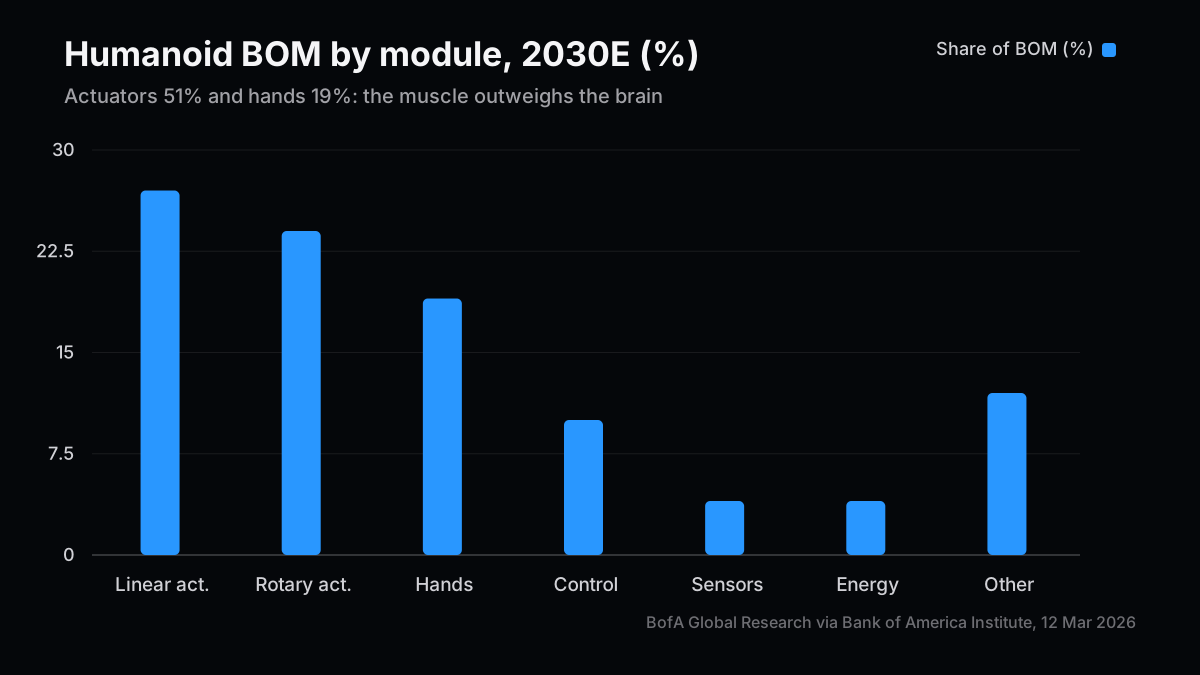
アクチュエータだけで51%。手を足すと70%になる(私の計算)。一方で、連載②で論じた「脳」にあたる制御システムは10%にすぎない。BofAは、中国で作られたヒューマノイドのBOMを2025年に約3万5,000ドルと見積もり、2030年には約1万7,000ドルとほぼ半分になると予想する。試作段階の機体は今も1台9万〜10万ドルかかるという。
数量の見通しも大きい。BofAはヒューマノイドの年間出荷台数が2025年の約2万台から2030年に120万台、2035年に1,000万台へ増えると予想する。2025年から2035年の年平均成長率は86%になる。ヒューマノイド開発への投資額は2018年の7億ドルから2025年に43億ドルへ増えた。
| 年 | BofAの出荷予想(千台) |
|---|
| 2025 | 20 |
| 2026E | 90 |
| 2028E | 500 |
| 2030E | 1,200 |
| 2035E | 10,000 |
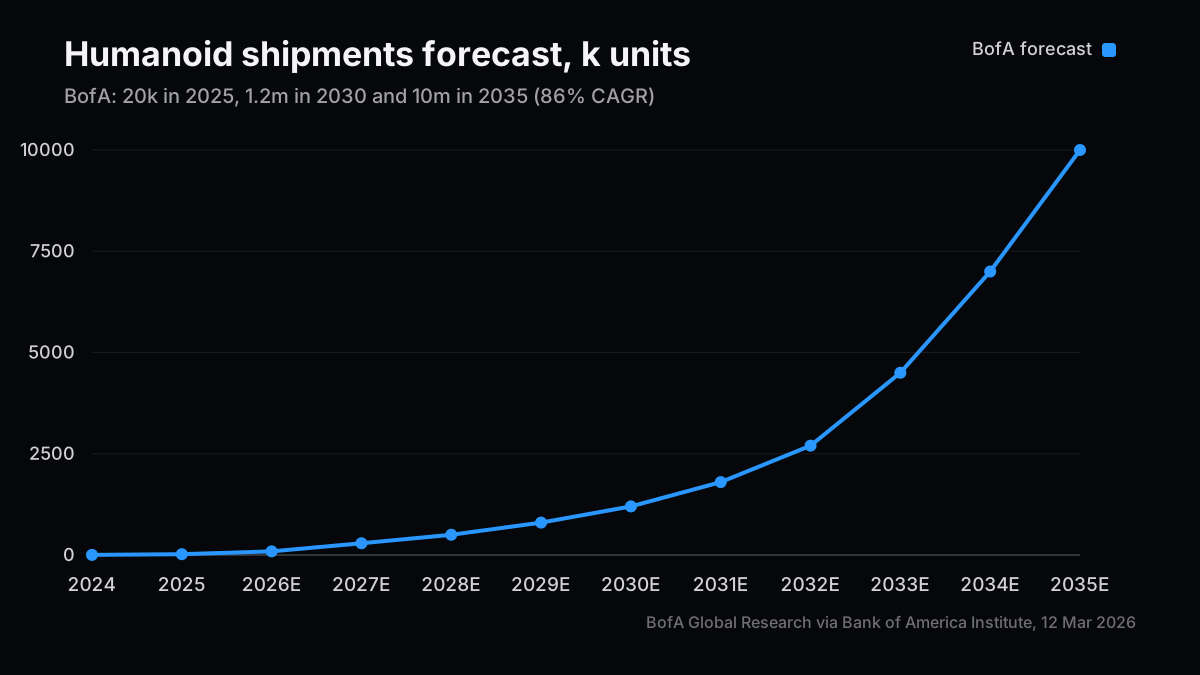
この予想を信じるかどうかは、正直まだ決めきれていない。2026年の9万台は、2025年の4.5倍である。だが、どの値を取っても筋肉の比重が大きいことは変わらない。
課題を書き出すと、私の古い経験がいくつも重なった。
電源管理ICとエナジーハーベスタで新規事業を作ったとき、私は「使える電力の上限」から逆算して機能を削る設計を繰り返した。ロボットも同じだ。Sapphireが指摘するとおり、載せられる電力の予算が、動かせるモデルの大きさを決めてしまう。バッテリーはBOMの4%にすぎないが、その制約は他のすべての部位にかかる。
ANSYSやFusion 360で構造解析をしていた頃は、熱と応力が同時にかかる部位の寿命の見積もりに一番時間を使った。ヒューマノイドの関節は、まさにその部位の集合体である。小さな体積に大きなトルクを詰め込めば、熱が逃げない。
気になった課題を挙げる。数えたら7つあった。
| 課題 | 中身 | 律速の理由 | 挑む企業(マップ掲載) |
|---|
| トルク密度と熱 | 小さな関節に大きな力を詰める | 発熱と寿命のトレードオフ | maxon, Kollmorgen, Moog, Westmag |
| 減速機 | 高トルクと剛性、ガタの少なさ | 精密加工の量産能力 | Nabtesco |
| 器用な手 | 自由度、耐久性、コスト | 部品点数が多く壊れやすい | Clone, Sanctuary AI, Wonik Robotics, Origami Robotics |
| 触覚 | 力と滑りを指先で感じる | 小型化と配線、ノイズ | XELA, ATI Industrial Automation |
| 周辺認識のコスト | LiDAR・深度カメラの価格と信頼性 | 車載並みの量産が必要 | Hesai, Ouster, Aeva, Innoviz, RealSense |
| 電力と熱の予算 | 搭載電力がモデルと稼働時間を縛る | バッテリーのエネルギー密度 | (部品横断) |
| 磁石の供給 | モーターの希土類磁石 | 中国への集中 | Westmag |
器用な手の重さは、BofAの19%という数字に表れている。指を5本にするか、単純なグリッパーで済ませるかという論争もSapphireは取り上げている。私は、多くの工場作業ではグリッパーで足りると見ている。だが家庭や外食まで行くなら、手からは逃げられない。
供給網の課題は、時間軸が具体的だ。CSISによれば、中国は世界の希土類の分離・精製の約90%、磁石製造の約93%を握る。中国は2025年10月9日に、中国産の重希土類を0.1%以上含む磁石にまで輸出許可を求める規制を発表した。だが同年10月30日の米中首脳会談を受け、この規制の実施を2026年11月10日まで1年間停止した。期限まで約5週間である。2025年4月に始まった7種類の希土類への許可制は、この停止の対象ではない。
マップを読んでいて意外だったのは、ハードウェアのスタートアップの多くが「部品」ではなく「部品の作り方」で勝負していることだった。
Westmag(Western Magnetics Company)は2026年6月2日、a16z主導で1,100万ドルのシードを調達してステルスを抜けた。Founders Fund、Lux、Menloも参加している。ドローン用モーターとロボットのアクチュエータを米国内で作る会社で、本社兼工場「Factory 01」をサウスサンフランシスコに置く。設計から巻線、最終検証までを一つの生産基盤で回し、数十万台分の受注を抱えるという。背景には、米FCCが2025年12月に外国製ドローンモーターの新規の機器認証を禁じたことがある。技術ではなく「どこで作るか」を価値にする会社だ。
減速機では日本のNabtescoが存在感を持つ。同社は中・大型の産業用ロボットの根元・肩・肘に使われるRV減速機で、世界シェア約60%と自ら推定している。サイクロイド機構で、剛性と衝撃への強さに優れる。ヒューマノイドで同じ構造がどこまで使われるかは、まだ決まっていない。maxon(スイス)、Kollmorgen、Moogは精密モーターと駆動系の老舗で、マップでは「アクチュエータ」の枠に並ぶ。
Clone Roboticsの方針は最も大胆だ。水圧で縮む人工筋肉「Myofiber」を、206本の骨を模したポリマー骨格に張り、500Wのポンプで動かす。2026年3月の時点で調達累計は約1,700万ドル、5,000万ドルの調達を進めていると同社のCEOが語っている。
Sanctuary AIは、教訓として読むべき会社だ。20自由度を超える油圧駆動の手で知られたが、2024年11月に創業CEOが退任し、2026年には既存の産業用ロボット向けのAIソフトウェア販売へ軸足を移した。手は「開発中の製品」という位置づけになっている。ハードウェアの開発サイクルの長さと資金調達の難しさを、そのまま示している。
韓国のWonik Roboticsは、研究用ロボットハンドの定番「Allegro Hand」を作り、2026年にV5、V6の新版を出した。Origami Roboticsは2026年3月にY Combinatorなどから50万ドルのプレシードを得た新しい会社で、人の手の動きを取り込み、ロボットの手で再生するインフラを作る。手のハードウェアとデータの両方に関わる位置にいる。
XELA Roboticsは日本発の触覚センサーの会社だ。磁気式の「uSkin」で、指先にかかる3軸の力を細かい格子で測る。2026年には感知点の大きさを約4mm角から2.5mm角へ縮め、5本指のハンドへの統合も進めた。4月にはPlug and Playから出資を受けている。力覚では、六軸の力・トルクセンサーで知られるATI Industrial Automation(Novanta傘下)もマップに載る。
周辺認識では、上場企業の数字が一番はっきりしている。Hesaiの2026年第2四半期のLiDAR出荷は62万8,275台で前年同期比78.4%増、うちロボティクス向けは14万2,371台で193.4%増だった。芝刈りロボットなどに使う小型のJTシリーズは累計20万台を超えた。
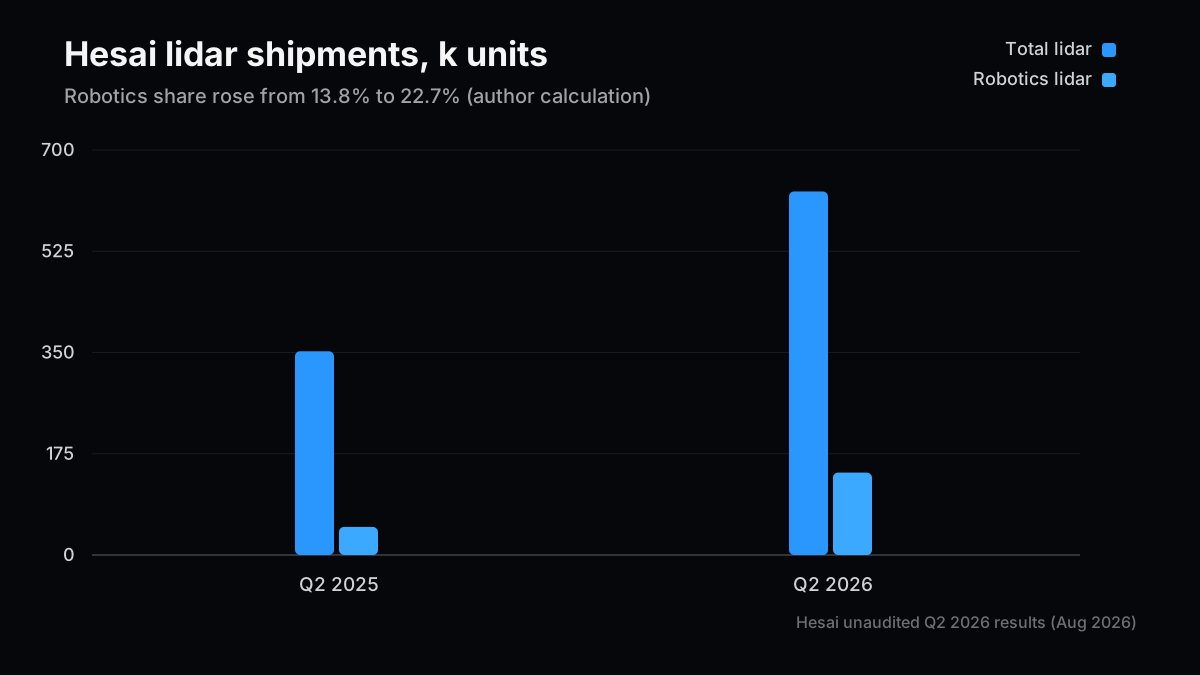
ロボティクス向けの比率を計算すると、2025年第2四半期の13.8%から2026年第2四半期は22.7%に上がった(私の計算)。LiDARは自動車で量産効果を得てから、ロボットへ流れ込んでいる。RealSenseは2025年7月にIntelから独立し、Intel CapitalとMediaTekから5,000万ドルを調達した。同社は世界のAMRの60%、ヒューマノイドの80%に自社の深度カメラが入っていると主張する。ほかにOuster、Aeva、Innovizの上場LiDAR各社が並ぶ。
| 企業 | 区分 | 上場・調達 | プロダクト/技術方針 |
|---|
| Westmag | アクチュエータ | 1,100万ドルのシード(2026年6月、a16z主導) | 米国製のドローンモーターとロボット用アクチュエータ |
| Nabtesco | 減速機 | 東証上場(6268) | RV減速機。中・大型ロボット向けで世界シェア約60%(同社推定) |
| Clone Robotics | 手・人工筋肉 | 累計約1,700万ドル、5,000万ドルを調達中(2026年3月時点) | 水圧の人工筋肉Myofiber |
| Sanctuary AI | 手 | 累計約1.5億ドル | 油圧の手。2026年にソフトウェア販売へ転換 |
| XELA Robotics | 触覚 | Plug and Playが出資(2026年4月) | 磁気式触覚センサーuSkin |
| Hesai | LiDAR | 米国上場(HSAI) | 2026年第2四半期のロボティクス向け出荷14.2万台 |
| RealSense | 深度カメラ | 5,000万ドル(2025年7月) | 深度カメラ。2027年第1四半期に新製品の出荷を予定 |
800Vラックの保護境界の記事で、部品の定格とシステムとしての試験を同じ証拠欄に混ぜないと書いた。アクチュエータも同じだ。カタログのトルクや寿命は部品単体の値で、人型ロボットの中で熱と衝撃を受けたときの寿命は別に確かめる必要がある。関節の駆動回路では、800V化の記事で取り上げたGaNを小型化のために使う議論も出ている。
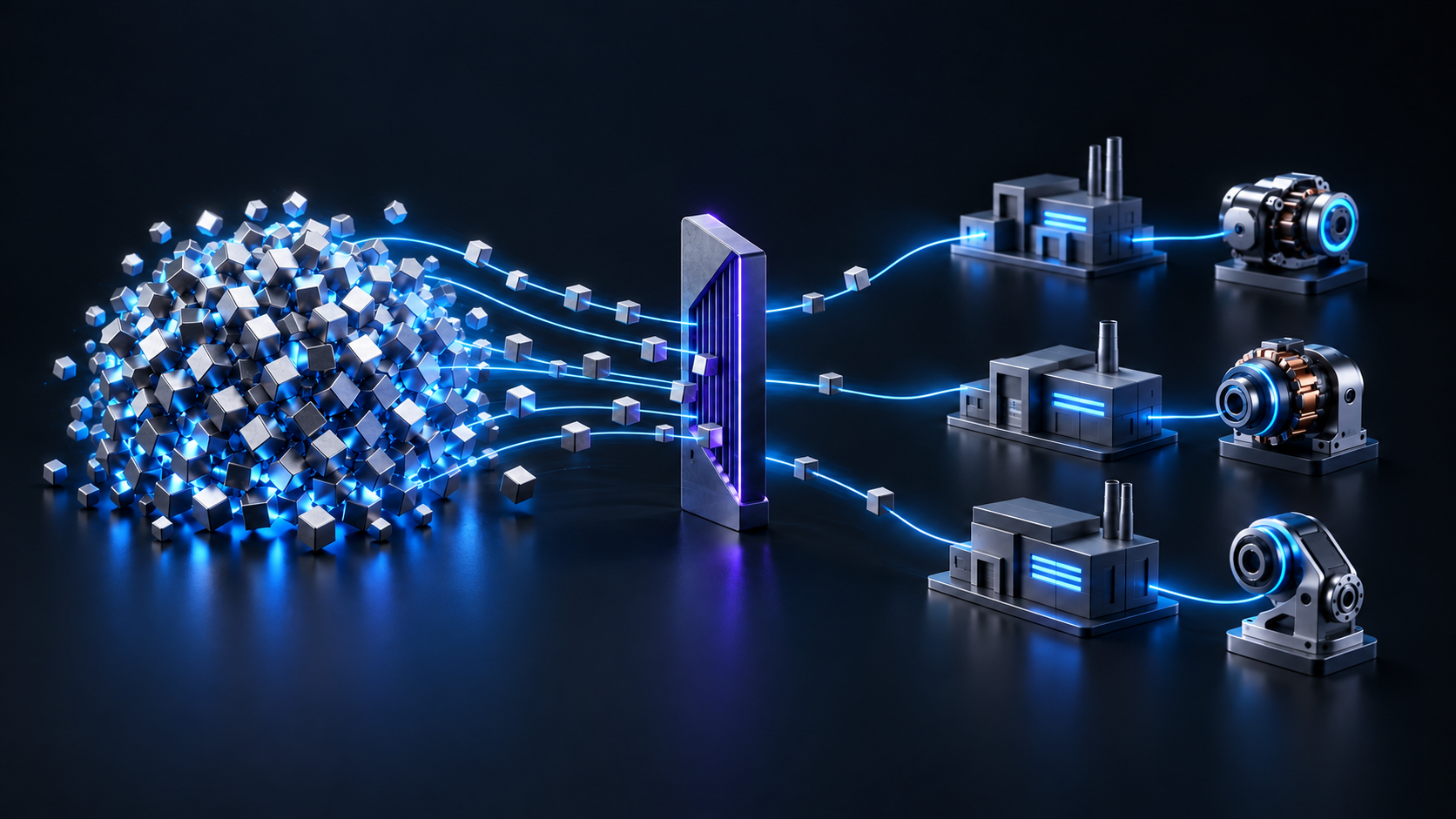
結論から書く。この層は、3つの層の中で最も上場株で触りやすい。
3月の記事で私は「ロボット本体は2027年に押し目で拾う」と書いた。部品については、本体より先に動くと考えを改めている。完成品メーカーの勝者は読みにくいが、どの勝者もアクチュエータ、減速機、センサーを買う。
具体的には、精密部品の上場企業を中期ロングで持つ。減速機のNabtesco、マップには載っていないが同じ領域のハーモニック・ドライブ・システムズ(6324)、ロボティクス向けLiDARが伸びるHesaiがその候補だ。ただし短期はニュートラルにとどめる。BofAが予想するBOMの半減は、部品単価の下落と同じ意味だからだ。量が増えても、単価の下落が速ければ利益は増えない。
スタートアップでは、Westmagのような「どこで作るか」に価値を置く会社が、政策の追い風を受けやすい。手と触覚は技術的に最も面白いが、Sanctuary AIの転換が示すとおり、資金が続くかどうかが最大のリスクになる。
| シナリオ | 条件 | 確認する証拠 | 投資への含意 |
|---|
| ベース | BofAの想定どおりBOMが下がり、量は中国が主導する | 中国メーカーの出荷台数、BOMの実勢 | 精密部品は量で稼ぐが単価は下がる |
| メイン | 中国製が価格を一気に下げ、非中国勢は高付加価値の部品に集中 | 減速機・センサーの単価、非中国勢の受注 | 日本の精密部品は量と価格の板挟み |
| テール | 11月10日以降に中国の磁石規制が再開し、非中国の生産が遅れる | 規制の延長か再開か、モーター各社の調達状況 | 非中国の磁石・モーター製造に追い風、完成品は遅延 |
この見立てが崩れる条件も書いておく。2027年までに非中国製ヒューマノイドのBOMが中国製と同じ水準まで下がった場合、私の「量は中国、利益は精密部品」という見方は外れる。そのときは部品ではなく、完成品メーカーに価値が移っている可能性が高い。
- 2026年11月10日に、中国が希土類の規制停止を延長するか
- Hesaiの出荷に占めるロボティクス向けの比率がどこまで上がるか
- Westmagの量産が受注どおりに立ち上がるか
- Clone Roboticsの5,000万ドルの調達と、Sanctuary AIの手の行方
3回の連載を通して見えたのは、フィジカルAIの価値が「脳」に集まる一方で、現金と量産の制約は「配管」と「筋肉」に残っているという構図だった。次は、この3層を同じ表に並べて、どこに資金を置くかを考えたい。
次号の記事案
- 案1:フィジカルAI3層の資金配分表 — 連載3回の企業を「配管・脳・筋肉」に並べ、上場株と非上場の露出をどう組むかを一つの表にまとめる。
- 案2:11月10日の希土類期限を読む — 規制停止が延長されるか再開されるかで、モーター・磁石・ヒューマノイド各社の2027年の生産計画がどう変わるかを整理する。
- 案3:ハーモニック減速機とRV減速機のヒューマノイド適性 — 関節ごとに求められる性能を分け、日本の精密部品メーカーの受注とバリュエーションを比べる。
本記事は情報提供を目的としたものであり、特定銘柄の売買や投資助言ではありません。筆者は記事内で触れた企業の有価証券を保有している可能性があります。調査・執筆・翻訳の一部に生成AIを利用しています。市場予測は第三者の予想であり、構成比の合計や比率は筆者の計算値です。詳細は免責事項をご確認ください。
Physical AI Series ③: Hardware Is the Last Bottleneck — Actuators, Hands and Sensors
When I worked on automotive EEPROM in mass production, I learned that between "the prototype works" and "we can build millions of identical parts at the same yield" lies a whole branch of engineering that design alone does not cover. This series has moved through data and operations and the robot brain. What is left is the layer governed by that mass-production engineering: hardware.
As of October 3, 2026. Market forecasts come from Bank of America Institute's March 2026 report; company figures come from company disclosures. Some shares and growth rates are my own calculations.
Let me lead with the conclusion: what sets the price of a humanoid is not its brain but its muscle.
Sapphire Ventures' Physical AI map gives hardware three boxes: sensors, actuators and components. The names look different from the other layers. Many are listed companies — Hesai, Ouster, Nabtesco, Moog — and startups are in the minority. Sapphire notes that actuator, sensor and compute costs have fallen by an order of magnitude, but also that onboard power budgets cap the size of model a robot can run in real time, and that hardware development cycles are long and capital-hungry.
Bank of America Institute's March 2026 report puts concrete numbers on the cost structure. Here is its projected 2030 breakdown.
| Part | Share of 2030 BOM | Role |
|---|
| Linear actuators | 27% | Extension in knees, ankles, elbows |
| Rotary actuators | 24% | Rotation in shoulders, hips, wrists |
| Dexterous hands | 19% | Grasping and manipulation |
| Control system | 10% | Compute and motion control |
| Vision and other sensors | 4% | Cameras, touch and more |
| Energy system | 4% | Battery and power |
| Other | 12% | Structure and the rest |
Actuators alone come to 51%. Add the hands and you reach 70% (my calculation). The control system — the "brain" from Part 2 — is just 10%. BofA estimates a China-built humanoid's BOM at about $35,000 in 2025 and expects it to roughly halve to about $17,000 by 2030. Pilot-stage units still cost $90,000 to $100,000 each.
The volume forecast is just as large. BofA expects annual humanoid shipments to grow from about 20,000 units in 2025 to 1.2 million in 2030 and 10 million in 2035 — an 86% compound annual growth rate from 2025 to 2035. Investment in humanoid development rose from $0.7 billion in 2018 to $4.3 billion in 2025.
| Year | BofA shipment forecast (thousand units) |
|---|
| 2025 | 20 |
| 2026E | 90 |
| 2028E | 500 |
| 2030E | 1,200 |
| 2035E | 10,000 |
Honestly, I have not decided whether I believe this forecast. The 2026 figure of 90,000 units is 4.5 times 2025. But whichever number you pick, the weight of the muscle does not change.
Listing the problems brought back several of my own old lessons.
When I built a new business around our power-management ICs and energy harvesters, I kept designing backward from the power ceiling — cutting features to fit the energy available. Robots work the same way. As Sapphire points out, the onboard power budget decides how large a model the robot can run. The battery is only 4% of BOM, but its constraint lands on every other part.
When I did structural analysis in ANSYS and Fusion 360, most of my time went into estimating the life of parts that carry heat and stress at the same time. A humanoid joint is exactly that kind of part, multiplied. Pack big torque into a small volume and the heat has nowhere to go.
Here are the bottlenecks that caught my attention. There turned out to be seven.
| Bottleneck | What it means | Why it binds | Companies on the map |
|---|
| Torque density and heat | Packing large forces into small joints | Trade-off between heat and lifetime | maxon, Kollmorgen, Moog, Westmag |
| Reducers | High torque, stiffness, minimal backlash | Precision machining at volume | Nabtesco |
| Dexterous hands | Degrees of freedom, durability, cost | Many parts, easily broken | Clone, Sanctuary AI, Wonik Robotics, Origami Robotics |
| Touch | Sensing force and slip at the fingertip | Miniaturization, wiring, noise | XELA, ATI Industrial Automation |
| Perception cost | Price and reliability of lidar and depth cameras | Needs automotive-scale volume | Hesai, Ouster, Aeva, Innoviz, RealSense |
| Power and thermal budget | Onboard power limits models and runtime | Battery energy density | (Cuts across parts) |
| Magnet supply | Rare-earth magnets in motors | Concentration in China | Westmag |
BofA's 19% for hands says a lot. Sapphire also covers the debate over five-fingered hands versus simple grippers. My view is that grippers are enough for many factory jobs. But if robots are headed into homes and restaurants, there is no getting around the hand.
The supply-chain problem comes with a concrete date. According to CSIS, China controls about 90% of global rare-earth separation and processing and about 93% of magnet manufacturing. On October 9, 2025, China announced controls requiring export licenses even for magnets containing 0.1% or more of Chinese-origin heavy rare earths. After the US–China summit on October 30, it suspended implementation for one year, until November 10, 2026 — about five weeks from now. The separate licensing regime on seven rare earths that began in April 2025 is not covered by that suspension.
What surprised me reading the map is that many hardware startups compete not on a part, but on how and where the part is made.
Westmag (Western Magnetics Company) came out of stealth on June 2, 2026 with an $11 million seed led by a16z, with Founders Fund, Lux and Menlo participating. It builds drone motors and robot actuators in the US, at a headquarters and plant called "Factory 01" in South San Francisco. It runs design, winding and final validation on a single production platform and says it holds orders for hundreds of thousands of units. The backdrop is the US FCC's December 2025 ban on certifying new foreign-made drone motors. Its value is less a technology than a location.
In reducers, Japan's Nabtesco matters. It estimates its own global share at about 60% for the RV reducers used in the base, shoulder and elbow joints of medium and large industrial robots. Its cycloidal design is prized for stiffness and shock tolerance. How much of that design carries over to humanoids is still open. maxon (Switzerland), Kollmorgen and Moog are long-established makers of precision motors and drives, listed in the map's actuator box.
Clone Robotics has the boldest approach. It stretches water-pressure artificial muscles, called Myofiber, over a polymer skeleton with 206 bone analogues, driven by a 500-watt pump. As of March 2026, its CEO said it had raised about $17 million and was raising a $50 million round.
Sanctuary AI is best read as a lesson. Known for hydraulic hands with more than 20 degrees of freedom, it saw its founding CEO depart in November 2024 and in 2026 shifted toward selling AI software for existing industrial robots. The hands are now described as a product in development. It is a direct illustration of how long hardware cycles and fundraising pressure collide.
South Korea's Wonik Robotics makes the Allegro Hand, a standard research hand, and released new V5 and V6 versions in 2026. Origami Robotics is a young company that raised a $500,000 pre-seed from Y Combinator and others in March 2026. It builds infrastructure to capture human hand motion and replay it on robot hands — a position that straddles hand hardware and data.
XELA Robotics is a Japan-born tactile-sensor company. Its magnetic "uSkin" sensors measure three-axis force at the fingertip across a fine grid. In 2026 it shrank each sensing point from about 4 mm to 2.5 mm square and pushed integration into five-fingered hands; in April it took an investment from Plug and Play. For force sensing, the map also lists ATI Industrial Automation, part of Novanta and known for six-axis force/torque sensors.
In perception, listed companies give the clearest numbers. Hesai shipped 628,275 lidar units in Q2 2026, up 78.4% year on year, of which 142,371 went to robotics, up 193.4%. Its compact JT series, used in robot lawn mowers and similar machines, has passed 200,000 cumulative units.
By my calculation, robotics rose from 13.8% of Hesai's shipments in Q2 2025 to 22.7% in Q2 2026. Lidar earned its scale economies in cars and is now flowing into robots. RealSense spun out of Intel in July 2025 with $50 million from Intel Capital and MediaTek, and claims its depth cameras sit in 60% of the world's AMRs and 80% of humanoids. Listed lidar makers Ouster, Aeva and Innoviz round out the box.
| Company | Category | Listing / funding | Product / approach |
|---|
| Westmag | Actuators | $11M seed (Jun 2026, led by a16z) | US-made drone motors and robot actuators |
| Nabtesco | Reducers | Listed in Tokyo (6268) | RV reducers; ~60% global share in medium/large robots (company estimate) |
| Clone Robotics | Hands / artificial muscle | ~$17M raised; raising $50M (as of Mar 2026) | Water-pressure Myofiber muscles |
| Sanctuary AI | Hands | ~$150M raised in total | Hydraulic hands; pivoted to software in 2026 |
| XELA Robotics | Touch | Investment from Plug and Play (Apr 2026) | Magnetic uSkin tactile sensors |
| Hesai | Lidar | Listed in the US (HSAI) | 142,000 robotics units shipped in Q2 2026 |
| RealSense | Depth cameras | $50M (Jul 2025) | Depth cameras; next product due to ship in Q1 2027 |
In my post on protection boundaries in 800V racks, I argued against putting component ratings and system tests in the same evidence column. Actuators deserve the same care. Catalog torque and lifetime are single-part numbers; the lifetime inside a humanoid, under heat and shock, has to be verified separately. For joint drive circuits, there is also discussion of using the GaN I covered in my 800V data-center post to shrink the electronics.
The conclusion first: of the three layers, this is the easiest to access through listed stocks.
In March I wrote that I would pick up robot makers on a dip in 2027. For components, I now think they move before the finished robots. The winning robot maker is hard to call, but every winner has to buy actuators, reducers and sensors.
Concretely, I would hold listed precision-component makers medium-term long: Nabtesco in reducers; Harmonic Drive Systems (6324), which is not on Sapphire's map but works in the same space; and Hesai, whose robotics lidar is growing fast. But I stay short-term neutral. BofA's forecast of a halving BOM means falling component prices. Volume can grow while profits stall if prices fall fast enough.
Among startups, companies like Westmag that create value from where they manufacture have a policy tailwind. Hands and touch are the most technically interesting, but as Sanctuary AI's pivot shows, the biggest risk is whether the funding lasts.
| Scenario | Condition | Evidence to watch | Implication |
|---|
| Base | BOM falls as BofA expects, with China leading on volume | Chinese makers' shipments; actual BOM prices | Precision parts earn on volume while unit prices fall |
| Main | China-built robots drive prices down fast; non-China players move to high-value parts | Reducer and sensor pricing; non-China order books | Japanese precision suppliers squeezed between volume and price |
| Tail | China's magnet controls resume after November 10, delaying non-China production | Whether the suspension is extended; motor makers' sourcing | Tailwind for non-China magnet and motor makers; finished robots delayed |
What would change my mind: if non-China humanoids reach the same BOM level as Chinese ones by 2027, my "volume in China, profit in precision parts" view is wrong. In that case value has most likely shifted from components to the robot makers.
- Whether China extends its rare-earth suspension on November 10, 2026
- How high robotics climbs as a share of Hesai's shipments
- Whether Westmag's production ramps in line with its orders
- Clone Robotics' $50 million round, and what becomes of Sanctuary AI's hands
Across the three parts, one pattern stood out: value in physical AI is gathering in the brain, while the constraints on cash and mass production remain in the plumbing and the muscle. Next, I want to put all three layers in one table and decide where to place capital.
Next Issue Ideas
- Idea 1: A capital-allocation table for physical AI's three layers — Put every company from this series into "plumbing, brain, muscle" and lay out listed and private exposure in a single table.
- Idea 2: Reading the November 10 rare-earth deadline — How an extension or a resumption would change 2027 production plans for motor, magnet and humanoid makers.
- Idea 3: Harmonic versus RV reducers in humanoids — Split joint-by-joint requirements and compare order books and valuations among Japan's precision-component makers.
This article is for informational purposes only and is not investment advice or a recommendation to buy or sell any security. The author may hold securities of companies mentioned. Generative AI was used in parts of the research, writing and translation. Market forecasts are third-party projections, and summed shares and ratios are the author's calculations. See the disclaimer for details.