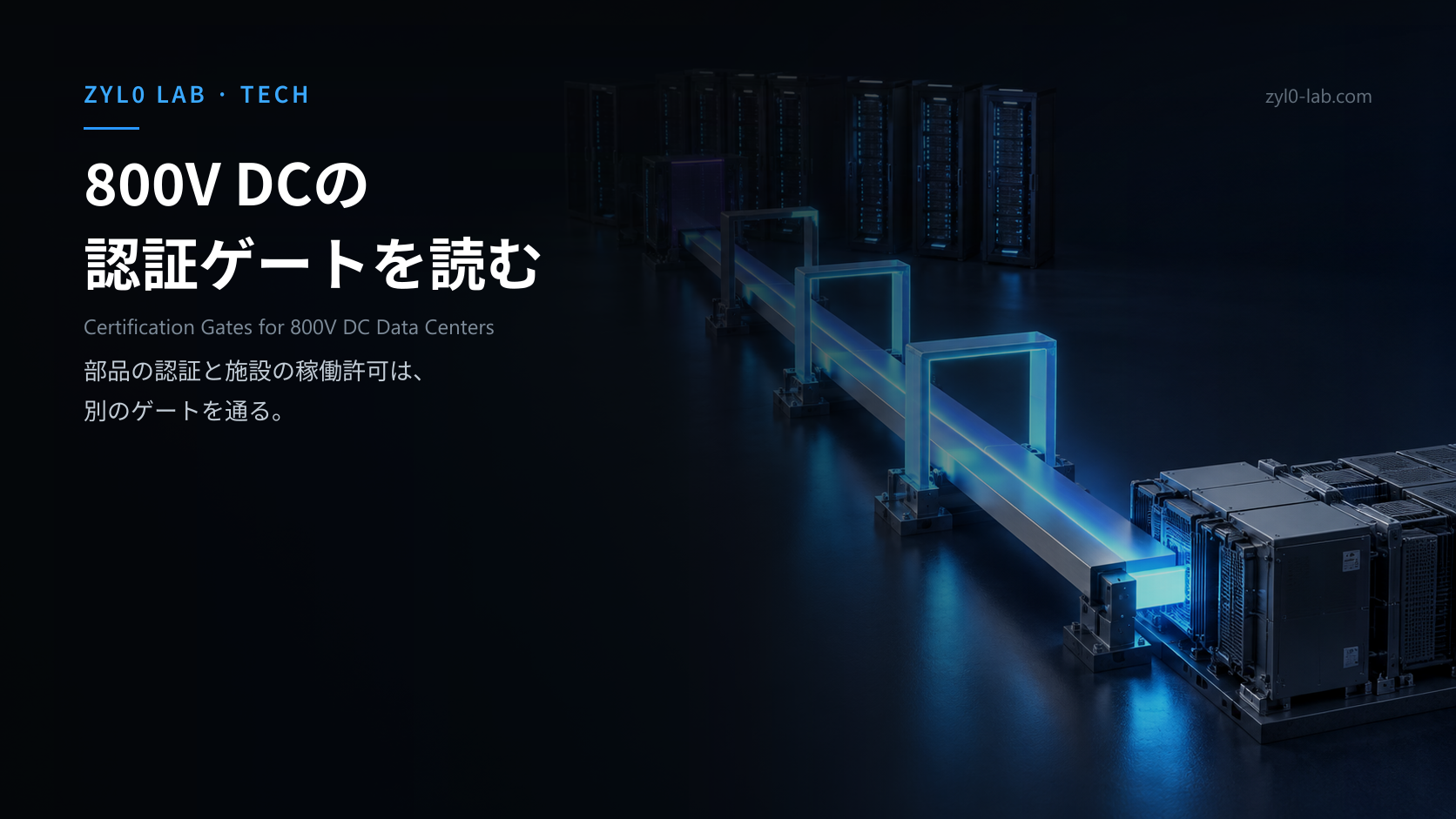
800V DCデータセンターの認証ゲート:部品適合と施設稼働を分ける
本稿は公開情報のみに基づく外部からの読み方であり、各社への取材や非公開資料は使っていない。
10月12〜15日のOCP Global Summitでは、800V DCが主役の一つだった。電源ラック、SST(固体変圧器)、800Vから50Vへの変換シェルフが並び、会期中に電力分野の仕様・白書がいくつも公開された。それでも、OCP自身の10月12日のブログには「ラックまで800VDCを配るバスウェイとレイアウトの設計はまだ完成していない」と書かれている。展示の数と、実際に建屋で通電できる状態の間には、まだ距離がある。
私がこの距離にこだわるのは、車載EEPROMのプロセス開発で量産化に関わった経験があるからだ。部品として認定試験を通しても、搭載先のシステム評価で条件が変わり、日程を決めたのは結局そちらだった。「認定済み」という言葉は、誰が・何を・どの条件で確かめたかを言わないと中身がない。
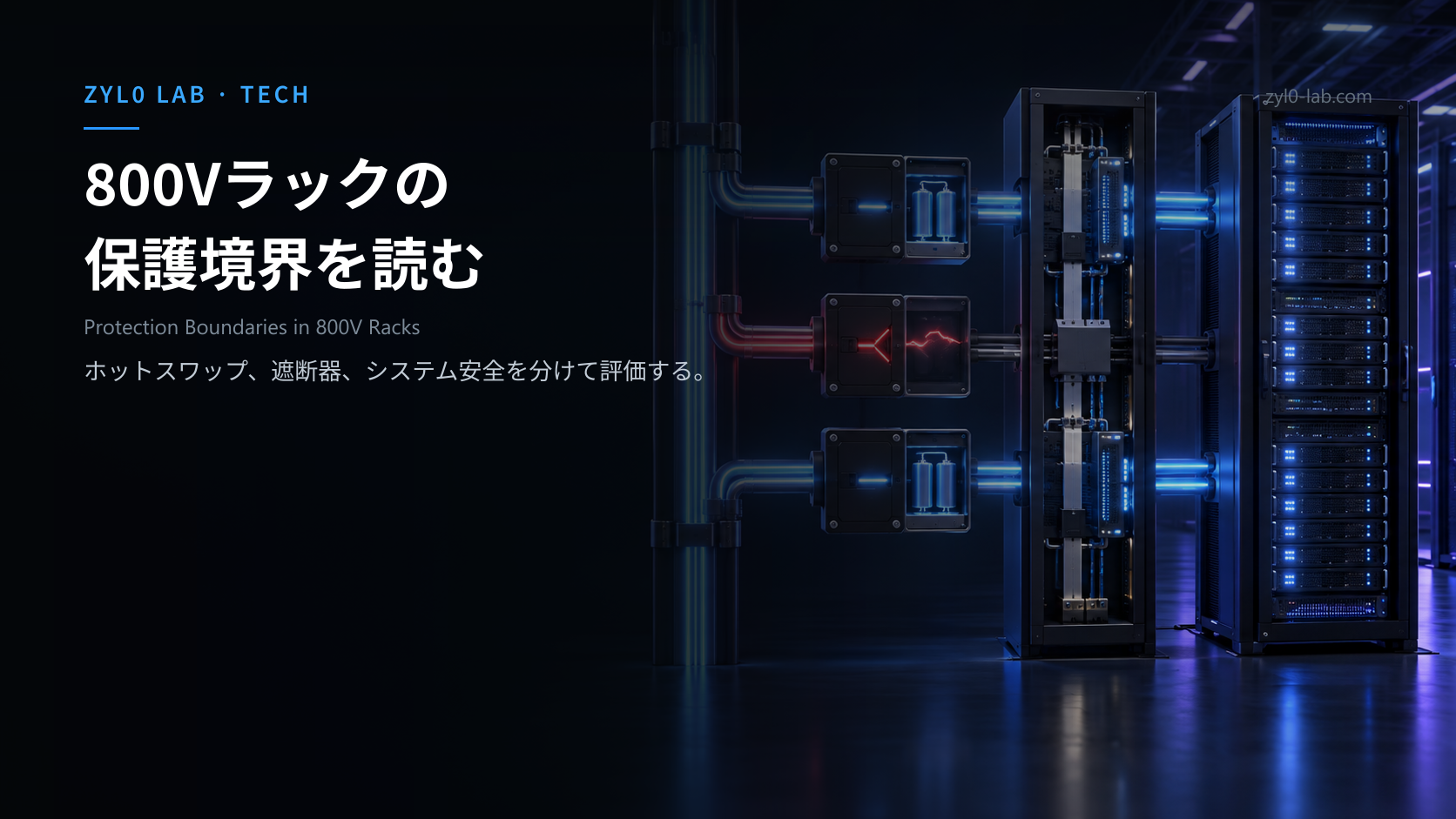
前回の800Vラック保護の記事では、保護をトレイ、配電枝、施設の3層に分けた。今回はその3層を通る「許可」の側を追う。次号案として予告していた「データセンター配電の認証ゲート」だ。
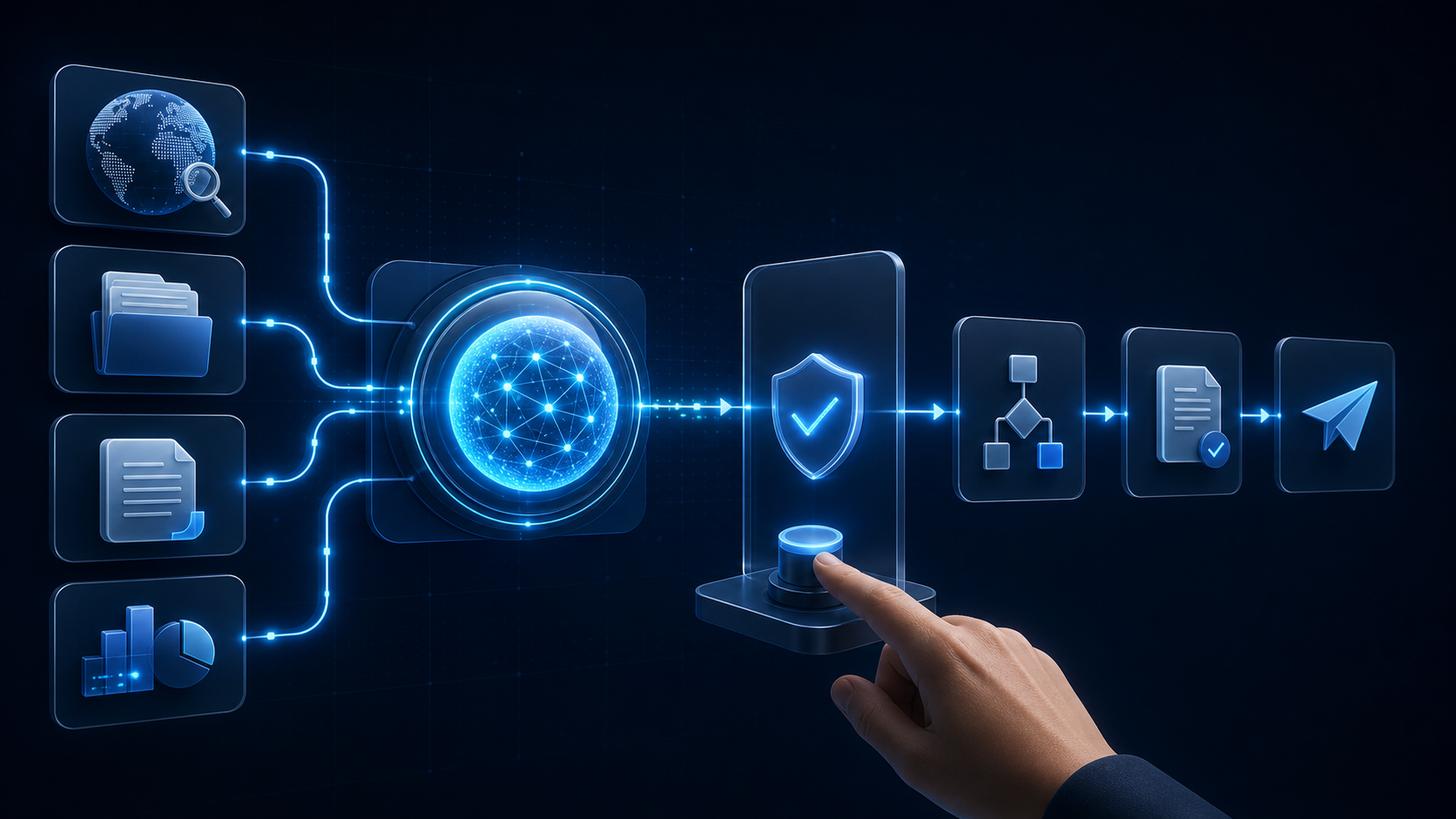
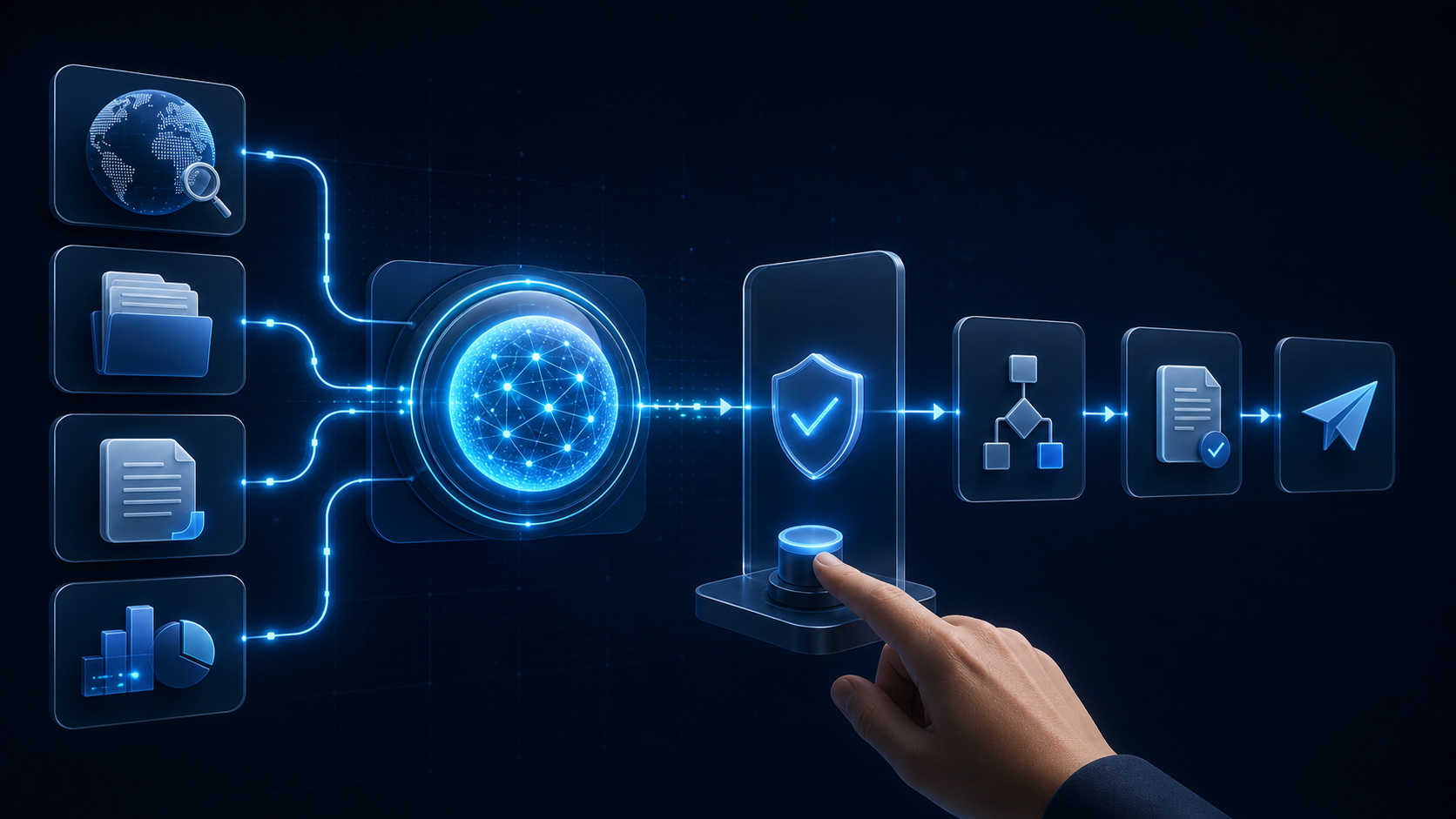
先に私の整理を置く。800V DCの電力経路が稼働するまでには、判定者も証拠の形も違う4つの関門がある。
1つ目は部品の認証で、製品規格に照らしてNRTL(米国の認定試験機関)などが判定する。2つ目は組立品や新しい製品区分で、規格がまだない機器はUL Solutionsの調査概要(OOI、Outline of Investigation)や個別の要求事項決定で評価される。3つ目は設置規程で、米国ならNEC(NFPA 70)、それ以外の多くの国ではIEC 60364が基準になる。4つ目は現地の稼働許可で、管轄当局(AHJ)の検査、現場評価、そしてNFPA 70Eに沿った作業安全の手順がここに入る。
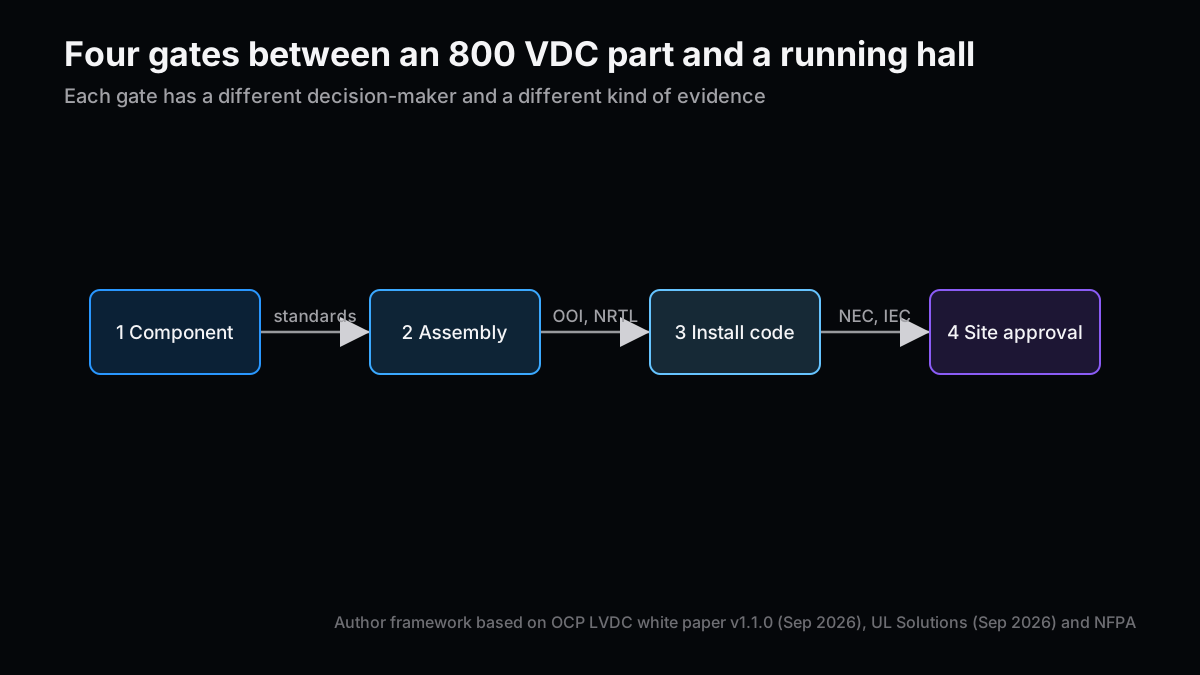
それぞれの関門が2026年10月時点でどこまで進んでいるかを、公開資料から並べると次の表になる。
| 関門 | 判定者 | 根拠となる文書 | 2026年10月時点の公開状況 |
|---|
| 1 部品の認証 | NRTL・認証機関 | UL・IEC・IEEEの製品規格 | OCP白書は70超の製品規格を特定。大半は800VDCをカバーするが、DC用途で試験された製品は少ない |
| 2 組立品・新区分 | 認証機関(OOI・個別決定) | UL 2877、UL 2755、UL 2140など | ULが9月24日、中電圧SST向けにUL 2877に基づく認証プログラムを開始 |
| 3 設置規程 | 規格策定団体・州や自治体 | NEC(NFPA 70)、IEC 60364 | NECにデータセンター固有のDC規定はまだない。次の改訂は2028年第3四半期に完了予定 |
| 4 現地の稼働許可 | AHJ・事業者 | 検査記録、現場評価、NFPA 70E | 州ごとに有効なNECの版は2008年版から2023年版までばらつく |
表の右端の列を読むと、関門が後ろに行くほど「誰かが決めた」証拠が薄くなる。部品は規格がほぼ揃っている。組立品は暫定の評価手段で動き出した。設置規程と現地許可は、まだ改訂サイクルの途中にある。
OCPの低圧DC配電白書v1.1.0(2026年9月2日付)は、この非対称をはっきり書いている。特定した70を超える製品規格の大半はすでに800VDCの要件を含むが、データセンター向けの800V/1500V DC用途で実際に評価・試験された製品はまだ多くない、という。規格の有無と、製品が試験を通った事実は別物だ。
次に、電圧そのものが規格の枠にどれだけ収まっているかを確かめたい。ここが今回いちばん驚いたところだ。
OCP白書は、業界団体Current/OSの電圧帯の定義を引き、U5=840VDCを「設計上の保護電圧の最高値」としている。この840Vを、各規格の上限で割ってみた。計算はすべて筆者によるもので、上限値はOCP白書の記載に基づく。
| 比較する上限 | 上限値 | 840V ÷ 上限 | 余白 |
|---|
| IEC 62368-1(IT機器の安全規格)の対象範囲 | 600V | 140.0% | −240V |
| TC108で検討中の解釈指針(600Vの範囲で850VDCまで) | 850V | 98.8% | 10V |
| 英国BS 7671の線間対地上限(単極800V構成の場合) | 900VDC | 93.3% | 60V |
| 低圧の上限(IEC・NEC 2026の区分) | 1,500VDC | 56.0% | 660V |
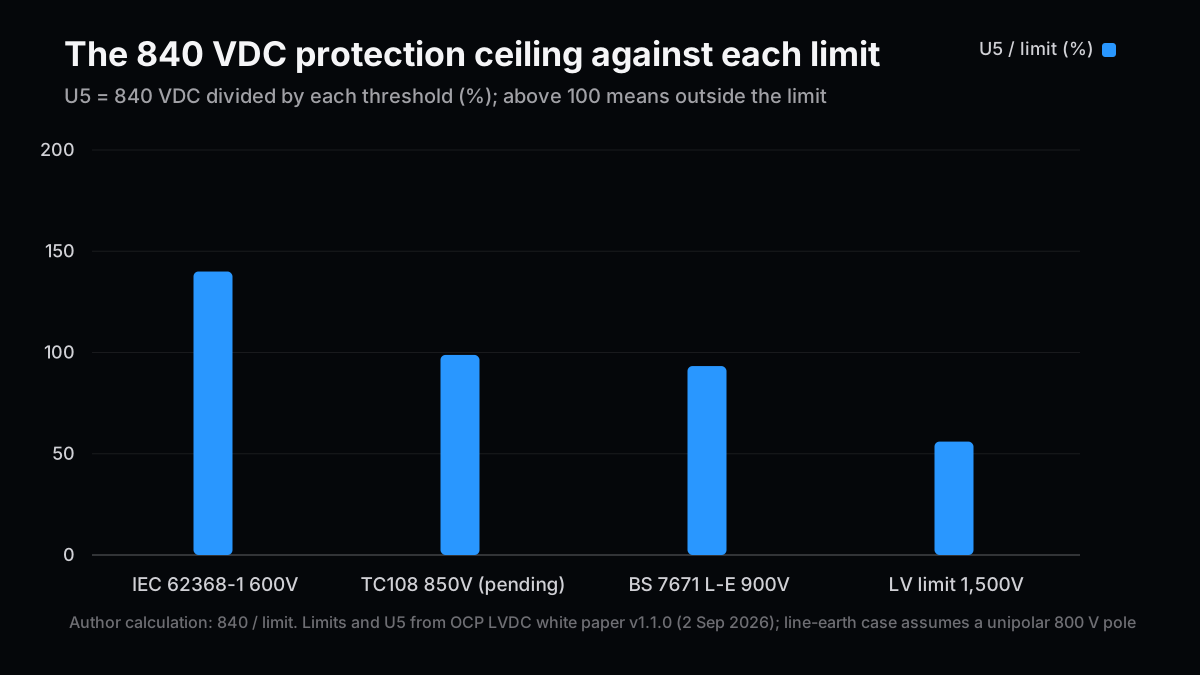
まず、IT機器の安全規格であるIEC 62368-1の対象範囲は、定格600Vまでだ。800Vの公称電圧ですでに133%となり、枠の外にある。だからTC108(IEC 62368-1を所管する技術委員会)では、600Vの範囲を850VDCまで含むと読む解釈指針と、範囲そのものを1000VAC/1500VDCへ広げる提案の両方が動いている。
気になったのは2行目だ。仮に850VDCという解釈指針が出ても、840Vの保護上限との差は10Vしかない。850Vに対して約1.2%だ。電圧帯の議論では、840Vを超える運転を「許容」にするか「要求」にするか、1080Vまでの短時間耐量をどう扱うかがまだ詰められている。1080Vは850Vの解釈には収まらず、単極構成ならBS 7671の900V(線間対地)も20%超える。
逆に、余白が大きいのは1500VDCの低圧上限だ。NEC 2026は、交流1000V・直流1500V未満の系統を第250条、それを超える系統を新設の第270条に分けた。800Vは、設置規程の上では「低圧」の範囲に余裕をもって入る。ただし白書は、800Vの電源を直列に使うと1600Vに達しうる点を挙げ、設定値の制限が必要だとしている。1600Vは1500Vの106.7%だ。
ここから分かるのは、800V DCの規格上の問題が「電圧が高すぎる」ことではない、という点だ。設置規程の低圧区分には収まる。詰まっているのは、IT機器側の製品規格の範囲と、保護・過渡電圧の細部である。接地方式も効く。±400Vの双極構成で中点を接地していれば、通常時の対地電圧は保護上限840Vの半分の420Vで、900Vの46.7%に下がる。ただし、非接地や高抵抗接地の構成では、1線地絡のときに健全側の極が840V近くまで対地電圧を持ちうる。双極にすれば必ず余白が増えるわけではなく、接地方式と地絡時の扱いまで含めて評価される。800VとGaN・SiCの比較記事で見た電圧変換の選択は、そのまま認証の取りやすさにも跳ね返る。
各社の発表を、どの関門にいるかで並べ直す。ここで挙げるのはいずれも公開資料から読める範囲で、採用や売上の見込みを示すものではない。
| 企業・団体 | 2026年の公開内容 | いまいる関門 | 次に見たい証拠 |
|---|
| Google・Microsoft・NVIDIA(OCP) | SST仕様v0.3(6月発効)。13.8kV/34.5kV、5MW〜10MW。短絡耐量の継続時間は「TBD」 | 仕様の策定段階 | v1.0での短絡条件と適合規格の確定 |
| UL Solutions | 9月24日、UL 2877(中電圧電源のOOI)に基づくSST認証プログラムを開始 | 関門2の評価手段を提供 | 最初の認証取得製品の公表 |
| Delta Electronics | 10月15日、660kWのインロー電源ラック、800V→50Vの90kWシェルフ(効率最大98.5%)を展示 | 展示(出荷・認証の記載なし) | 製品の認証取得と出荷開始 |
| Siemens・Reinhausen | 8月14日、最大36kVの系統に接続するSSTを共同開発・量産化すると発表 | 開発段階(出力・時期の記載なし) | 定格、効率、量産時期 |
SST仕様の「TBD」は小さな記載だが、意味は大きい。短絡電流を何秒耐えるかが決まらないと、上流の保護協調も、組立品としての評価条件も確定しない。仕様の版数が0.3であることと合わせて、関門1〜2の手前にある証拠として読んでいる。
Deltaの発表も同じ読み方をした。数値は具体的で、660〜800kWの電源ラックと2.5MWの冷却を一つの絵にまとめた点は印象的だった。ただ、リリースには出荷開始や認証取得の記載がない。展示されたことと、AHJが検査を通したことの間には、少なくとも2つの関門が残る。
上場企業として、関門そのものから収益を得る位置にいるのはUL Solutionsだ。2026年第2四半期の売上高は8.16億ドル(前年同期比+5.2%、オーガニック+6.6%)、調整後EBITDAマージンは26.8%だった。ただし、データセンター向けの認証収入は開示されていない。新しい関門が増えることは追い風だが、全社の売上に占める大きさは外からは測れない。
ここで、投資テーマを決めるときに技術マップを作った経験を思い出す。当時も、技術の成熟度と規格の成熟度を同じ軸に置くと、見立てを誤った。800V DCは技術としては電気自動車や太陽光で実績がある。データセンターという用途での規格の成熟は、別の時計で進んでいる。
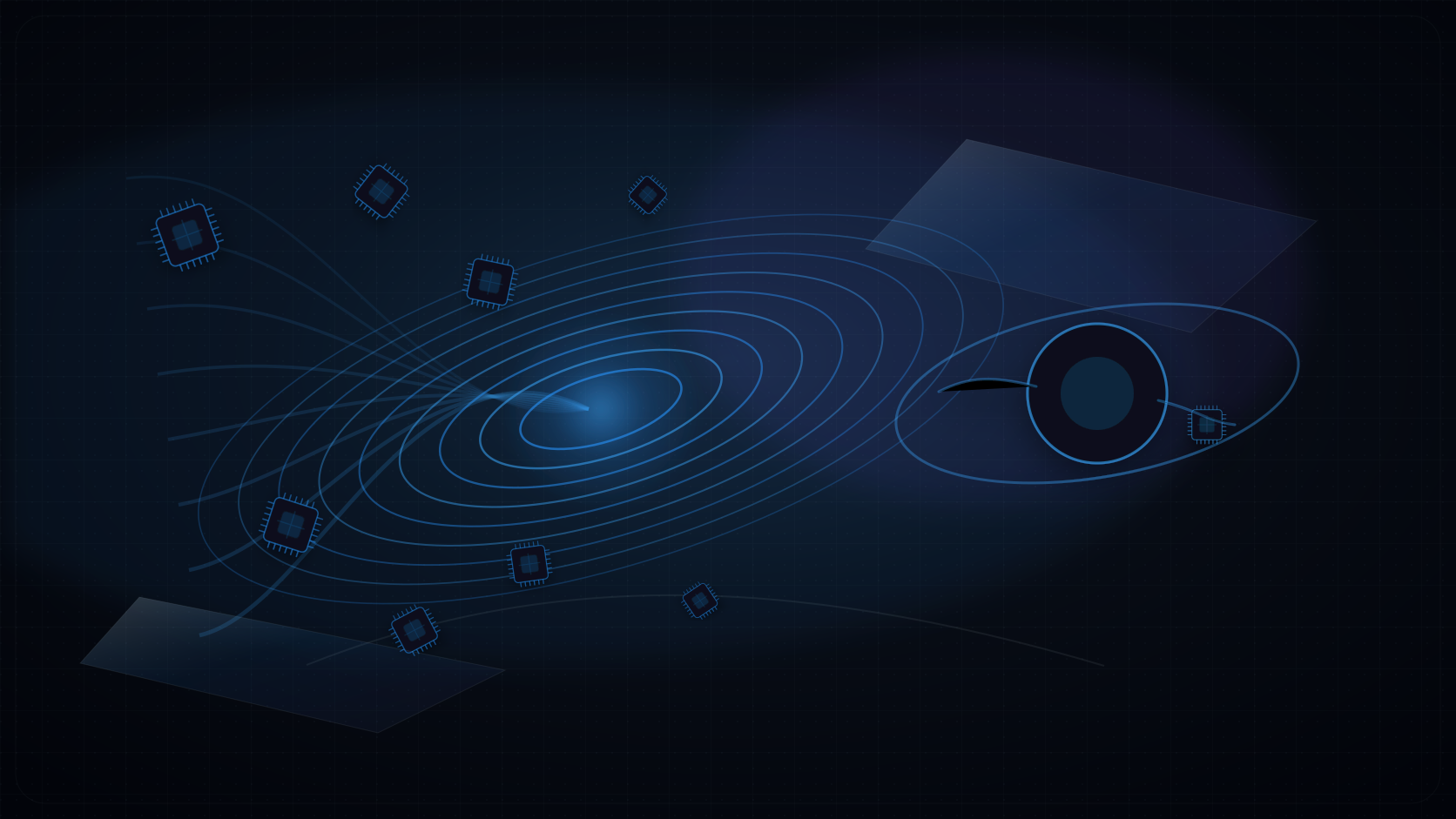
日付が公開されている節目だけを時系列に置くと、次の図になる。NVIDIAが576GPUのKyberラックを「2027年までに」と示している一方、NECの次の版の完成は2028年第3四半期だ。
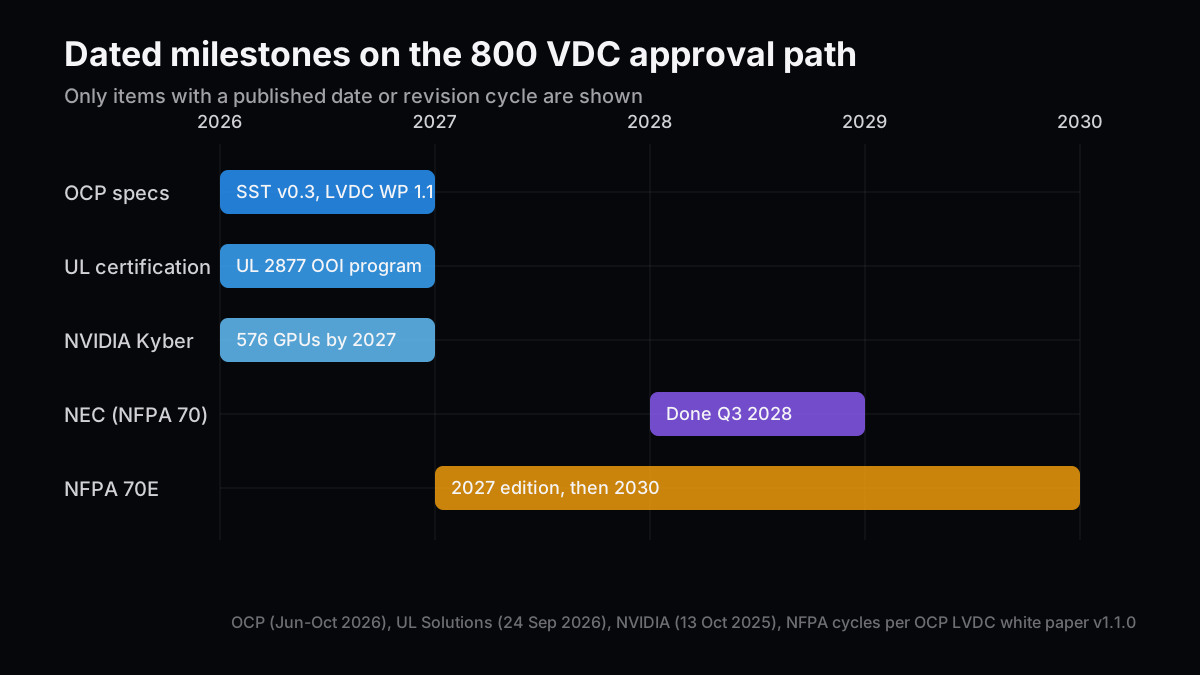
この時間差をどう埋めるかで、シナリオを3つに分けた。いずれも筆者の整理で、確率や売上の予測ではない。
| シナリオ | 想定する経路 | 先に確認できる証拠 | 崩れる要因 |
|---|
| ベースケース:段階導入 | サイドカー型の電源ラックを、OOIやNRTLの個別評価と現場評価で先行導入する | サイドカーの認証取得公表、AHJの承認事例 | 現場評価の長期化、組立品ごとの再評価 |
| メインシナリオ:規格先行 | TC108の850VDC解釈が先に出て、IT機器側の認証が一気に進む | IEC 62368-1の解釈指針の発行、各社の認証取得の連続公表 | 840V上限との余白10V、1080V耐量の扱いが決まらない |
| テールリスク:事故・差し戻し | 初期導入でのアーク事故や検査の差し戻しが、規程改訂を待つ動きを強める | NFPA 70Eの2030年版に向けた議論、AHJの通達 | 規程と作業安全の手順が揃う2029〜2030年まで導入が後ろ倒し |
現時点の私の判断は次の通りだ。
- 認証・試験(UL Solutionsなど):短期は前向き。新しい関門が増えるほど評価の需要は増える。ただし、データセンター向け収入は開示されていないため、効果の大きさは測れない
- SST・サイドカーなどの電源機器:中期はニュートラル。展示と仕様の数は多いが、評価の軸は「認証取得と出荷」の公表に置く
- 保護部品:選別。AI電力のボトルネック整理で見た変換効率の競争に加え、840V付近の保護設計と1080Vの過渡耐量に答えられるかが差になる
この見立てが崩れるのは、NECの改訂を待たずに、800VDCのサイドカーがNRTLの認証とAHJの承認を得て、2027年中に複数の拠点で通電した場合だ。そのときは、関門3が律速ではなかったことになる。逆に、850VDCの解釈指針が2027年を過ぎても出ない場合は、ベースケースよりも遅い経路を考える。
宇宙連載の第3回で「価格より運航頻度を見る」と書いた。ここでも同じで、発表や展示の数ではなく、通過した関門の数を数えていく。
- Open Compute Project, Realizing the OCP Open Data Center Ecosystem Vision (October 12, 2026)
- Open Compute Project, Data Center Facility Low Voltage Direct Current Power Distribution White Paper v1.1.0 (September 2, 2026)
- Open Compute Project, Solid State Transformer Specification Revision 0.3
- UL Solutions, Certification Program for Emerging Power Technology Supporting AI Data Centers (September 24, 2026)
- Delta Electronics, 800 VDC power and cooling solutions at OCP Global Summit 2026 (October 15, 2026)
- IAEI Magazine, Modern Data Centers: Electrical Trends, Risks, and NEC 2026 Implications (January 2026)
次号の記事案
- 案1:TC108の850VDC解釈を待つ間に何が売れるか — IEC 62368-1の範囲外にある機器が、どの認証経路で先に市場へ出るかを、サイドカー・電源シェルフ・PDBごとに追う。
- 案2:SST仕様v0.3からv1.0へ、短絡耐量の「TBD」はどう埋まるか — 13.8kV・34.5kVの2モデルで、上流保護と協調できる短絡条件を公開仕様から読む。
- 案3:認証機関は800V DCでどれだけ稼ぐか — UL Solutions・Intertekなど試験認証各社の開示から、データセンター関連の伸びを外から推し量る。
本稿は投資助言ではありません。記載した企業の有価証券を筆者が保有している可能性があります。作成には生成AIを利用しています。投資判断の前に免責事項をご確認ください。
Certification Gates for 800V DC Data Centers: Separating Component Compliance from Facility Operation
This is an outside-in read based solely on public information. No company interviews or non-public materials were used.
800 VDC was one of the headline themes at the OCP Global Summit on October 12–15. The show floor had power racks, solid-state transformers (SSTs) and shelves that step 800 V down to 50 V, and several power specifications and white papers came out during the week. Yet OCP's own October 12 post says plainly that "the busway and layout designs for 800VDC distribution to the rack are still incomplete." There is still distance between what was on display and what a building can actually energize.
I care about that distance because of my years in automotive EEPROM process development, where I helped take products into volume production. A part could pass its component qualification and still have its schedule decided by the customer's system-level evaluation, where the conditions changed. "Qualified" means little until you say who checked what, and under which conditions.
My previous post on 800 V rack protection split protection into three layers: the tray, the distribution branch and the facility. This one follows the permissions that have to pass through those layers. It is the "certification gates for data-center power" idea I flagged in that post's next-issue list.
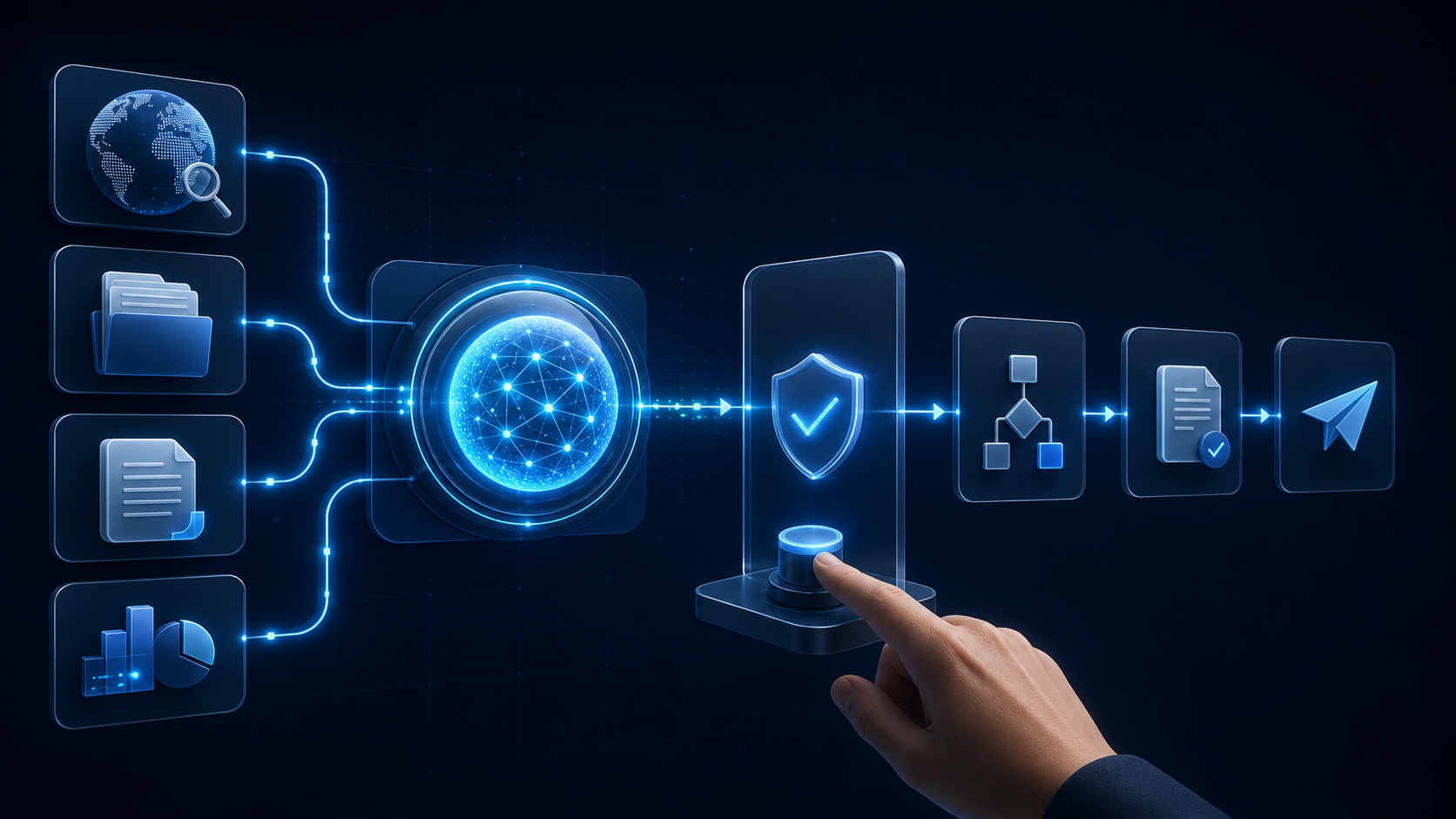
Here is my framework up front. Before an 800 VDC power path can run, it has to clear four gates, each with a different decision-maker and a different kind of evidence.
The first is component certification, judged against product standards by a Nationally Recognized Testing Laboratory (NRTL) or another certification body. The second covers assemblies and new product categories. Equipment with no published standard is evaluated under UL Solutions' Outlines of Investigation (OOIs) or case-by-case certification requirement decisions. The third is the installation code: the NEC (NFPA 70) in the United States, and IEC 60364 in most other countries. The fourth is site approval. That gate holds the inspection by the authority having jurisdiction (AHJ), any field evaluation, and the work practices that NFPA 70E governs.
Lining up the public record as of October 2026 shows how far each gate has moved.
| Gate | Decision-maker | Governing documents | Public status, October 2026 |
|---|
| 1 Component certification | NRTLs and certification bodies | UL, IEC and IEEE product standards | OCP's white paper lists 70+ product standards; most cover 800 VDC, but few products have been tested for DC data-center use |
| 2 Assemblies, new categories | Certifiers (OOIs, decisions) | UL 2877, UL 2755, UL 2140 and others | UL launched an SST certification program based on UL 2877 on September 24 |
| 3 Installation code | Standards bodies, states, localities | NEC (NFPA 70), IEC 60364 | The NEC has no DC rules specific to data centers yet; its next revision completes in Q3 2028 |
| 4 Site approval | AHJs and operators | Inspection records, field evaluations, NFPA 70E | NEC editions in force vary by state, from the 2008 to the 2023 edition |
Read down the right-hand column and the evidence that someone has actually decided gets thinner at each gate. Component standards are mostly in place. Assemblies have just started moving under interim evaluation tools. The installation code and site approvals are still mid-revision.
OCP's Low Voltage DC Power Distribution white paper, version 1.1.0 (dated September 2, 2026), is candid about that asymmetry. Most of the more than 70 product-level standards it identified already address 800 VDC. But it also says most products in those categories have not yet been vetted or tested for 800 V or 1,500 V DC data-center use. Having a standard and having a product that passed it are two separate facts.
Next I wanted to check how well the voltage itself fits inside each standard's limits. This is where the numbers surprised me most.
Citing the industry group Current/OS, the OCP white paper treats U5 = 840 VDC as the highest designed protection voltage. I divided that 840 V by each relevant limit. The arithmetic is mine; the limits come from the white paper.
| Limit compared | Limit | 840 V ÷ limit | Headroom |
|---|
| IEC 62368-1 scope (IT equipment safety) | 600 V | 140.0% | −240 V |
| Interpretation under review at TC108 (600 V scope read as 850 VDC) | 850 V | 98.8% | 10 V |
| UK BS 7671 line-to-earth limit (unipolar 800 V case) | 900 VDC | 93.3% | 60 V |
| Low-voltage ceiling (IEC and NEC 2026 classes) | 1,500 VDC | 56.0% | 660 V |
Start with IEC 62368-1, the safety standard for IT equipment. Its scope stops at a rated 600 V. At 800 V nominal, a rack input is already at 133% of that limit and outside it. That is why TC108, the IEC committee that owns 62368-1, is working on two tracks at once: interpretive guidance that would read the 600 V scope as covering 850 VDC, and a proposal to widen the scope itself to 1,000 VAC / 1,500 VDC.
The second row is the one that stopped me. Even if the 850 VDC interpretation is issued, the gap to the 840 V protection ceiling is just 10 V, or about 1.2% of 850 V. The voltage-band work still has to settle whether operation above 840 V should be allowed or required, and how to treat short-term withstand up to 1,080 V. That 1,080 V figure does not fit inside an 850 V reading. In a unipolar layout, it also exceeds BS 7671's 900 V line-to-earth limit by 20%.
The largest headroom is against the 1,500 VDC low-voltage ceiling. NEC 2026 keeps systems below 1,000 V AC or 1,500 V DC in Article 250 and moves anything above that into the new Article 270. Under the installation codes, 800 V sits comfortably inside low voltage. The white paper does flag one trap: 800 V sources connected in series can reach 1,600 V, so setpoint limits are needed. That would be 106.7% of 1,500 V.
So the standards problem with 800 VDC is not that the voltage is too high. It fits inside the low-voltage class of the installation codes. The friction is in the scope of IT-equipment product standards and in the details of protection and transient voltages. Grounding matters too. In a ±400 V bipolar layout with the midpoint earthed, the normal voltage to earth is half the 840 V ceiling, 420 V, or 46.7% of 900 V. In floating or impedance-grounded layouts, though, the healthy pole can approach 840 V to earth during a first ground fault. Going bipolar does not buy headroom by itself; the grounding method and ground-fault behavior are evaluated with it. The conversion choices covered in the 800 V, GaN and SiC comparison feed straight back into how easy certification will be.
Below I sort the 2026 announcements by the gate each one has reached. Everything comes from public documents. None of it is a forecast of adoption or revenue.
| Company or group | 2026 public record | Gate reached | Next evidence to watch |
|---|
| Google, Microsoft, NVIDIA (via OCP) | SST specification rev 0.3 (effective June): 13.8 kV / 34.5 kV, 5–10 MW; short-circuit duration "TBD" | Specification drafting | Short-circuit terms and compliance list in v1.0 |
| UL Solutions | Launched SST certification based on UL 2877 (an OOI for medium-voltage power supplies), September 24 | Supplies the tool for gate 2 | The first certified product named in public |
| Delta Electronics | Showed a 660 kW in-row power rack and a 90 kW 800 V-to-50 V shelf (up to 98.5% efficiency), October 15 | Display; no shipping or certification stated | Certification and first shipments |
| Siemens and Reinhausen | Announced joint development and industrialization of an SST for grids up to 36 kV, August 14 | Development; no rating or timing stated | Ratings, efficiency, volume timing |
The "TBD" in the SST specification is a small entry with a large consequence. Until the spec says how many seconds the unit must withstand a short-circuit current, neither upstream protection coordination nor the assembly's evaluation conditions can be fixed. Together with the 0.3 revision number, I read it as evidence that this equipment is still short of gates 1 and 2.
I read Delta's release the same way. The numbers are specific, and putting 660–800 kW power racks and 2.5 MW of cooling into one picture was impressive. But the release does not say that anything is shipping or certified. Between being shown at a summit and passing an AHJ inspection, at least two gates remain.
Among listed companies, UL Solutions is the one that earns revenue from the gates themselves. Second-quarter 2026 revenue was $816 million, up 5.2% year on year with 6.6% organic growth, and the adjusted EBITDA margin was 26.8%. Data-center certification revenue is not disclosed, though. More gates are a tailwind, but from the outside there is no way to size it against the whole company.
This reminds me of building technology maps when I set investment themes as a VC. Back then, putting technology maturity and standards maturity on the same axis is exactly what led my reads astray. As a technology, 800 VDC has a track record in electric vehicles and solar. Standards maturity for the data-center use case runs on a separate clock.
Plotting only the milestones with a published date gives the timeline below. NVIDIA has pointed to its 576-GPU Kyber rack "by 2027," while the next NEC edition is due to complete in the third quarter of 2028.
I split the possible outcomes into three scenarios, depending on how that gap gets closed. They are my own framework, not probabilities or revenue forecasts.
| Scenario | Assumed path | Evidence that should appear first | What would break it |
|---|
| Base case: phased rollout | Sidecar power racks go in early under OOIs, case-by-case NRTL evaluations and field evaluations | Sidecar certifications announced; AHJ approvals on record | Long field evaluations; re-evaluation for every assembly |
| Main scenario: standards first | TC108's 850 VDC interpretation arrives first and IT-equipment certifications move quickly | Interpretation issued for IEC 62368-1; a run of certification announcements | The 10 V margin to 840 V; the 1,080 V withstand question stays open |
| Tail risk: incident or rejection | An early arc incident or failed inspections push operators to wait for code revisions | NFPA 70E 2030 debate; AHJ bulletins | Adoption slips to 2029–2030, when codes and work practices line up |
Here is where I stand today.
- Testing and certification (UL Solutions and peers): positive in the short term. Every new gate adds evaluation demand. Data-center revenue is not disclosed, so the size of the effect cannot be measured.
- SSTs, sidecars and other power equipment: neutral over the medium term. There are plenty of displays and specifications; I will judge the group by announcements of certification and shipment.
- Protection components: selective. Beyond the efficiency race covered in the AI power bottleneck overview, the winners will be the designs that can answer protection near 840 V and transient withstand at 1,080 V.
What would change my mind: if 800 VDC sidecars obtain NRTL certification and AHJ approval and are energized at several sites during 2027, without waiting for the NEC revision. That would mean gate 3 was never the bottleneck. In the other direction, if the 850 VDC interpretation still has not appeared after 2027, I will plan for a path slower than the base case.
In the third part of the space series, I argued for watching flight cadence rather than ticket prices. The same rule applies here. I will count gates cleared, not announcements or displays.
- Open Compute Project, Realizing the OCP Open Data Center Ecosystem Vision (October 12, 2026)
- Open Compute Project, Data Center Facility Low Voltage Direct Current Power Distribution White Paper v1.1.0 (September 2, 2026)
- Open Compute Project, Solid State Transformer Specification Revision 0.3
- UL Solutions, Certification Program for Emerging Power Technology Supporting AI Data Centers (September 24, 2026)
- Delta Electronics, 800 VDC power and cooling solutions at OCP Global Summit 2026 (October 15, 2026)
- IAEI Magazine, Modern Data Centers: Electrical Trends, Risks, and NEC 2026 Implications (January 2026)
Next Issue Ideas
- Idea 1: What sells while TC108 decides on 850 VDC — Track which certification routes let sidecars, power shelves and power distribution boards reach the market first, given that they sit outside IEC 62368-1's current scope.
- Idea 2: From SST spec v0.3 to v1.0, filling in the short-circuit "TBD" — Read the public specification for the short-circuit terms that the 13.8 kV and 34.5 kV models need to coordinate with upstream protection.
- Idea 3: How much certifiers earn from 800 VDC — Use the disclosures of UL Solutions, Intertek and other testing firms to estimate, from the outside, how fast data-center work is growing.
This article is not investment advice. The author may hold securities of companies discussed. Generative AI assisted its preparation. Review the disclaimer before making investment decisions.